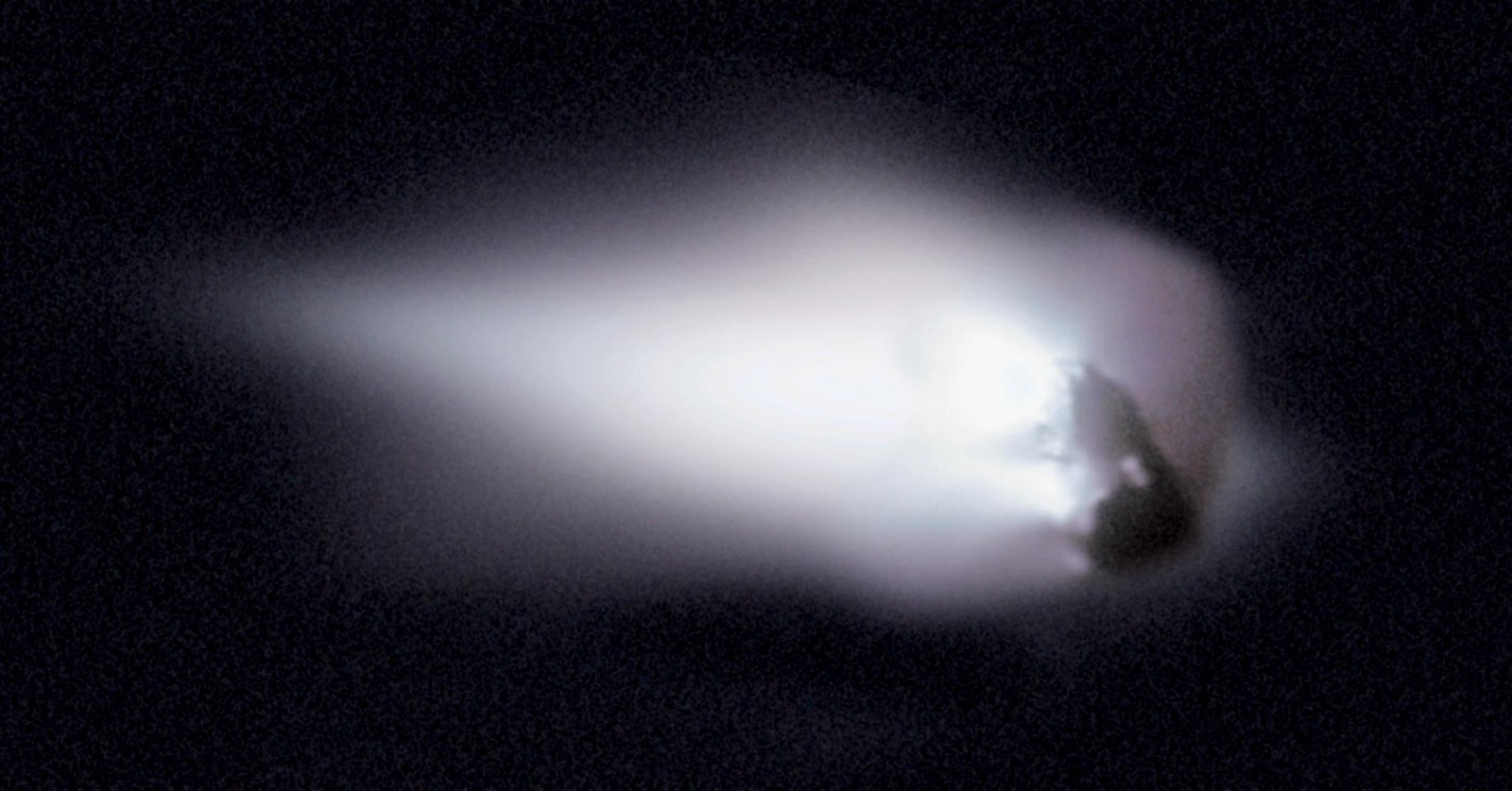
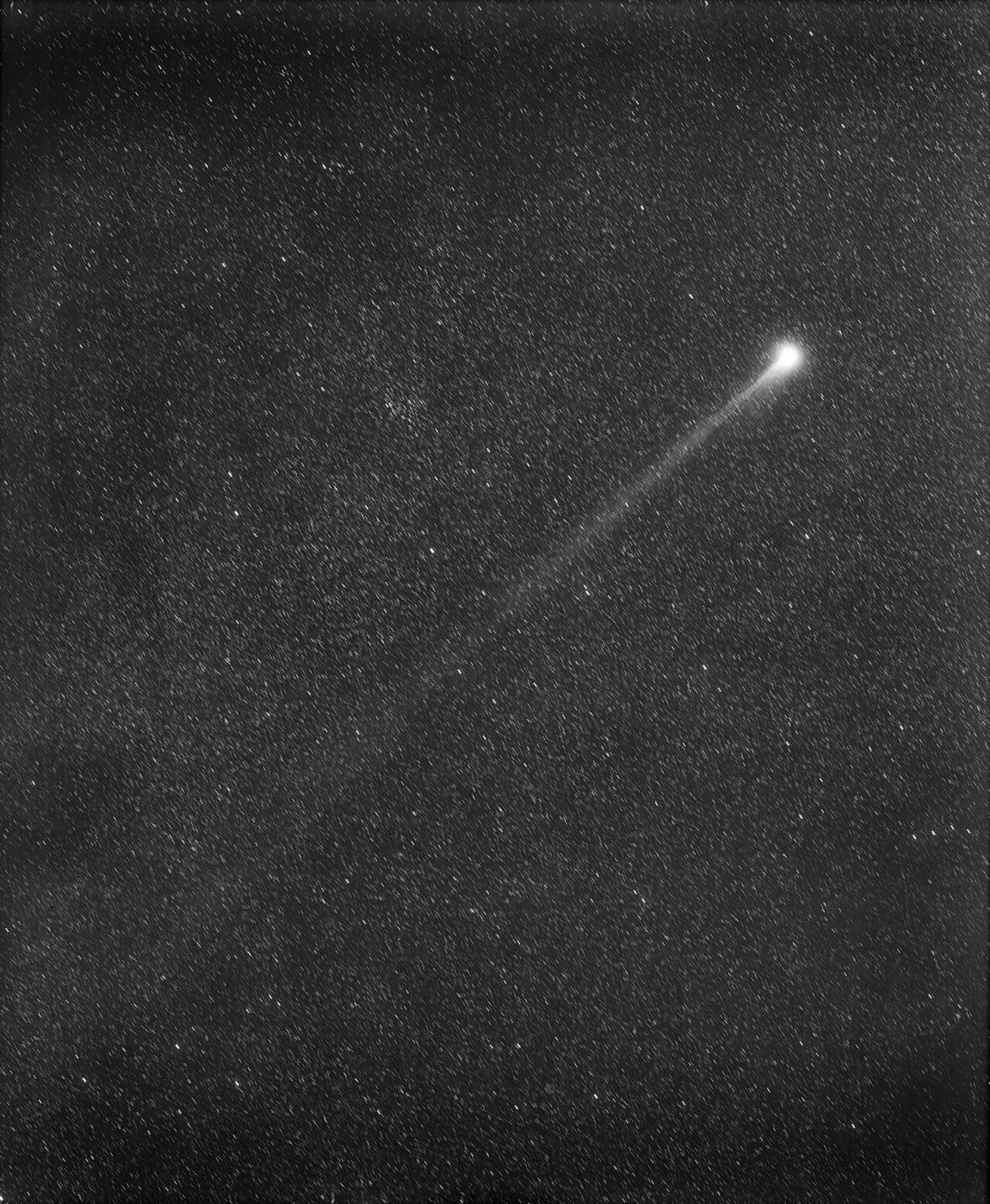
 Photograph · Landessternwarte Heidelberg-Königstuhl · CC0
Comet · Deep guide
Comet Swift–Tuttle (109P)
Also called: 109P/Swift–Tuttle · Comet Swift-Tuttle
A 26-km giant that returns every 133 years and fills August nights with Perseid meteors.
What is it?
Comet Swift–Tuttle was found independently by Lewis Swift and Horace Tuttle in July 1862. Its nucleus is about 26 km across, large for a periodic comet, and it follows a Halley-type orbit lasting roughly 133 years. Dust it has shed over many returns forms the Perseid meteor shower, one of the most reliable showers of the year. It came back in 1992 and is next due in July 2126, when it may be a bright naked-eye comet.
The deep dive
Researched for the Atlas from Wikipedia — Comet Swift–Tuttle (4,760 characters read) · updated Nov 14, 2026
01 Two astronomers, three days apart
The comet carries two names because two astronomers found it independently within the same week. Lewis Swift spotted it first, on 16 July 1862, and Horace Parnell Tuttle followed on 19 July 1862. Neither knew the other had made the same discovery. In that discovery year the comet shone as brightly as Polaris, the North Star — bright enough to be an unmistakable naked-eye object in a dark sky. The formal designation 109P reflects its status as the 109th periodic comet catalogued, with P signalling a confirmed short-period orbit. Its orbital period of 133 years (the 1995 osculating value) places it squarely in the classical Halley-type category, defined as comets with periods between 20 and 200 years. That category is named after the most famous periodic comet, but Swift–Tuttle's nucleus, at 26 km in diameter, is actually considerably larger than Halley's.
02 Ancient sightings hiding in plain sight
Long before Swift and Tuttle trained their telescopes skyward, observers in antiquity had already watched this same comet cross the sky — they just had no way of knowing it. Chinese records indicate that around 188 CE the comet reached an apparent magnitude of 0.1, rivalling the very brightest stars in the sky. A sighting was also recorded in 69 BCE, and the comet was probably visible to the naked eye as far back as 322 BCE. These historical apparitions were not simply curiosities. Amateur astronomer and writer Gary W. Kronk deliberately searched for them after the 1992 rediscovery raised alarm about a possible Earth impact in 2126. He identified the Chinese observations of 69 BCE and 188 CE as most likely Swift–Tuttle; Brian Marsden quickly confirmed both and added them to the official list of perihelion passages at the Minor Planet Center. The added data points extended the arc of known observations by roughly two millennia, dramatically tightening the orbital solution and ultimately proving the comet poses no threat within the next two thousand years.
03 A lost comet and a brilliant recovery
After the 1862 apparition, astronomers predicted the comet would return sometime between 1979 and 1983 — and then watched that window close with no sign of it. The comet appeared to be lost. The breakthrough came in 1902, when it was suggested that Swift–Tuttle was the same object Ignatius Kegler had observed on 3 July 1737. Using that earlier sighting, Brian Marsden recalculated the orbit and correctly predicted a return in 1992. He was proven right when Japanese astronomer Tsuruhiko Kiuchi rediscovered the comet in September 1992. It became visible with binoculars during that return, drawing widespread attention from amateur observers. It was last tracked in April 1995, when it had retreated to 8.6 AU from the Sun — roughly the distance of Saturn's orbit — fading beyond easy reach of small instruments. The next apparition, in 2126, is expected to be spectacular: the comet may brighten to an apparent magnitude of about 0.7, comparable to the brightest stars.
04 Locked in step with Jupiter Deeper
Swift–Tuttle's orbit has an unusual dynamic feature: it is currently trapped in a 1:11 orbital resonance with Jupiter, meaning it completes exactly one orbit for every eleven Jupiter completes. This was the first comet in a retrograde orbit ever found in such a resonance. The resonance sets a theoretically precise long-term average period of 130.48 years, around which the actual period oscillates — a motion called libration. In practice, between the epochs 1737 and 2126 the orbital period varies between 128 and 136 years, a range of eight years on either side of that mean. The resonance is not a permanent condition. It was entered only about 1,000 years ago and is expected to be exited in several thousand years. While the resonance holds, it acts as a stabilising influence, but Swift–Tuttle's long-term trajectory beyond a few thousand years becomes increasingly hard to predict as the resonance eventually releases its grip.
05 An orbit that grazes both Earth and Pluto
The geometry of Swift–Tuttle's path through the solar system is striking in its extremes. At perihelion — its closest point to the Sun — the comet swings just inside Earth's orbit. At aphelion — its farthest point — it reaches just beyond the orbit of Pluto. Very few solar system bodies sweep through such a wide range of distances in a single trip. The Earth-MOID, the minimum possible distance between the comet's orbit and Earth's orbit at their closest geometrical approach, is just 0.0009 AU, equal to about 0.13 million km. For context, the Moon is roughly 0.0026 AU from Earth, so the orbital paths come far closer together than the Earth-Moon distance. This geometry explains why the comet is classified as a near-Earth object and why its threat potential has been studied so carefully, even though actual encounters in the foreseeable future will keep comfortable margins of tens of millions of kilometres.
06 The 2126 alarm that calculation dissolved Deeper
When the comet was rediscovered in September 1992, its perihelion date differed from the 1973 prediction by 17 days — a discrepancy large enough to cause concern. Researchers noticed that if the following perihelion passage, expected in July 2126, were off by another 15 days (specifically landing on 26 July), the comet could strike the Earth or Moon on 14 August 2126. Given that the nucleus is 26 km across, the scenario was alarming. Historical observations uncovered by Gary Kronk and confirmed by Marsden supplied enough additional data points to refine the orbit thoroughly. The result was reassuring: the comet will pass 0.153 AU (22.9 million km) from Earth on 5 August 2126, and 0.147 AU (22.0 million km) from Earth on 24 August 2261. Beyond those dates, a notably closer approach of 0.011 AU is predicted for 3044, and in 4479 a pass of less than 0.05 AU carries an impact probability of 1 in a million. After 4479, orbital evolution becomes harder to model reliably, with per-orbit impact probability estimated at 2×10⁻⁸.
07 What an impact would actually mean
Swift–Tuttle is described as the single most dangerous object known to humanity, and the physics behind that description are sobering. The comet approaches on a retrograde orbit, meaning it travels in the opposite direction to Earth. When two objects move toward each other head-on rather than in the same direction, relative velocity is the sum of both speeds. For Swift–Tuttle, that relative velocity with Earth is 60 km/s — about 216,000 km/h. At that speed, an impact by a 26 km nucleus would release energy estimated at roughly 27 times that of the impactor responsible for the Cretaceous–Paleogene extinction event that wiped out the non-avian dinosaurs. In 1996, the long-term threat from Swift–Tuttle was explicitly compared against that of asteroid 433 Eros and approximately 3,000 other kilometre-sized objects of concern, underscoring that the comparison class for this comet is not typical near-Earth asteroids but civilisation-threatening impactors.
08 The Perseids: a river of comet dust
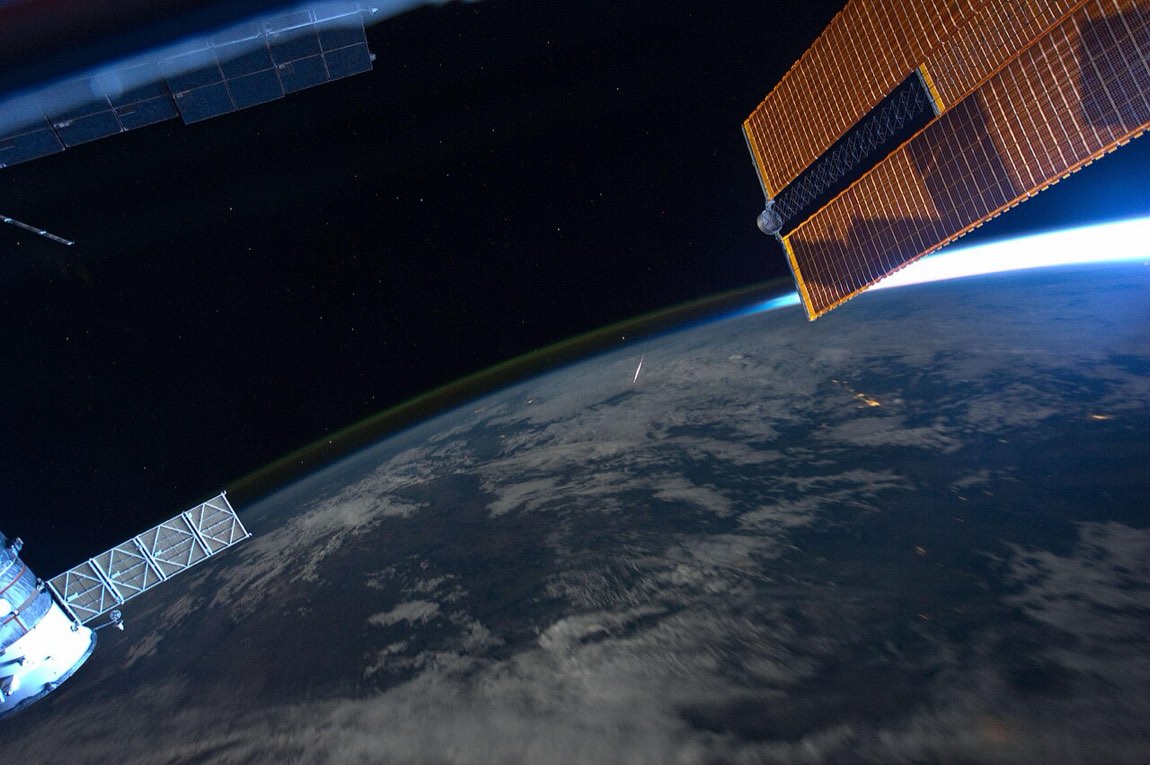
Swift–Tuttle is the parent body of the Perseid meteor shower, described as perhaps the best known shower and among the most reliable in performance. Every year Earth passes through the trail of debris the comet has shed over countless orbits, and particles ranging from sand-grain to marble size slam into the atmosphere at high speed, ablating into the streaks of light observers call shooting stars. The Perseids appear to radiate from the constellation Perseus, hence the name, and they typically peak in mid-August each year — coinciding with the northern hemisphere summer and making them accessible to casual observers who have never heard of the comet that produces them. Because Swift–Tuttle has a nucleus 26 km across, it has an enormous reservoir of ice and dust to supply the stream continuously. The comet's retrograde orbit also means that the particles it sheds strike Earth's atmosphere at a high relative velocity, producing bright, fast meteors.
09 How the orbital period shifts over time Deeper
Although Swift–Tuttle is often quoted with a period of 133 years (the 1995 osculating value), that number is a snapshot rather than a fixed constant. While the comet remains locked in its 1:11 resonance with Jupiter, the proper long-term average period is 130.48 years, and the actual period librates around that value. Between the historically documented epochs of 1737 and 2126, the period ranges from 128 to 136 years — a spread of eight years. This variability is not random drift; it is the expected behaviour of a body in resonance, oscillating back and forth around the equilibrium value the way a pendulum swings around its rest position. Because the resonance is relatively recent in solar system terms — the comet entered it only about 1,000 years ago — and because it will eventually leave, the period will evolve differently once the resonance no longer constrains it. This makes long-baseline predictions increasingly uncertain, which is why orbital calculations beyond the year 4479 are treated with explicit caution.
10 The scale problem: largest of its kind
Among all near-Earth objects — encompassing Apollo asteroids, Aten asteroids, and short-period comets — that cross Earth's orbit and make repeated close approaches, Swift–Tuttle is by far the largest. Its nucleus of 26 km across dwarfs the typical near-Earth asteroid, most of which measure well under a kilometre. To put the size in everyday terms, 26 km is roughly the length of a mid-sized city from one edge to the other. The combination of enormous size, a retrograde orbit that maximises relative velocity, and a path that geometrically intersects Earth's orbital zone is what places it in a category of its own. While hundreds of near-Earth objects are tracked as potentially hazardous, most are small enough that an impact, though devastating locally or regionally, would not approach the global consequences of a 26 km body arriving at 60 km/s. That exceptional scale is why Swift–Tuttle remains a benchmark object in planetary defence discussions even when its near-term orbital solution shows no actual threat.
11 Rediscovery math: Marsden's prediction Deeper
The story of how Swift–Tuttle was recovered in 1992 is as much a triumph of archival research and orbital mechanics as of observational astronomy. The chain began with an 1902 suggestion that Swift–Tuttle was identical to the comet Ignatius Kegler had observed on 3 July 1737. If true, that observation extended the known observation arc by 125 years before the 1862 discovery — an enormous leverage point for orbital calculation. Brian Marsden used this linkage to compute that the comet should return in 1992, a prediction that turned out to be correct. After rediscovery, the perihelion date was found to be off from a 1973 prediction by 17 days, illustrating how sensitive cometary orbits are to non-gravitational forces such as outgassing. Marsden then incorporated the ancient Chinese sightings of 69 BCE and 188 CE, stretching the observational baseline to over two thousand years, which allowed the orbit to be pinned down with enough precision to rule out an Earth impact in 2126 with high confidence.
12 Watching it from Earth: past and future
Swift–Tuttle puts on very different shows depending on which apparition a viewer is lucky enough to witness. At its finest historical apparition, recorded by Chinese observers around 188 CE, it reached magnitude 0.1 — rivalling the very brightest stars. During its discovery apparition in 1862 it matched the brightness of Polaris. The 1992 return was less spectacular but still accessible: binoculars were sufficient to find it, and it was last tracked in April 1995 at a distance of 8.6 AU from the Sun. The next opportunity will come in 2126, and predictions suggest the comet could reach an apparent magnitude of about 0.7, which would make it one of the most conspicuous objects in the night sky — potentially outshone only by a handful of the very brightest stars, the Moon, and planets. That is more than a century away, but every Perseid shower in the meantime is in a sense a preview: each meteor is a tiny piece of Swift–Tuttle announcing its eventual return.
 ⤢