 Photograph · NASA/JPL-Caltech/UMD · Public domain
Comet · Deep guide
Comet Tempel 1 (9P/Tempel)
Also called: 9P/Tempel · Tempel 1
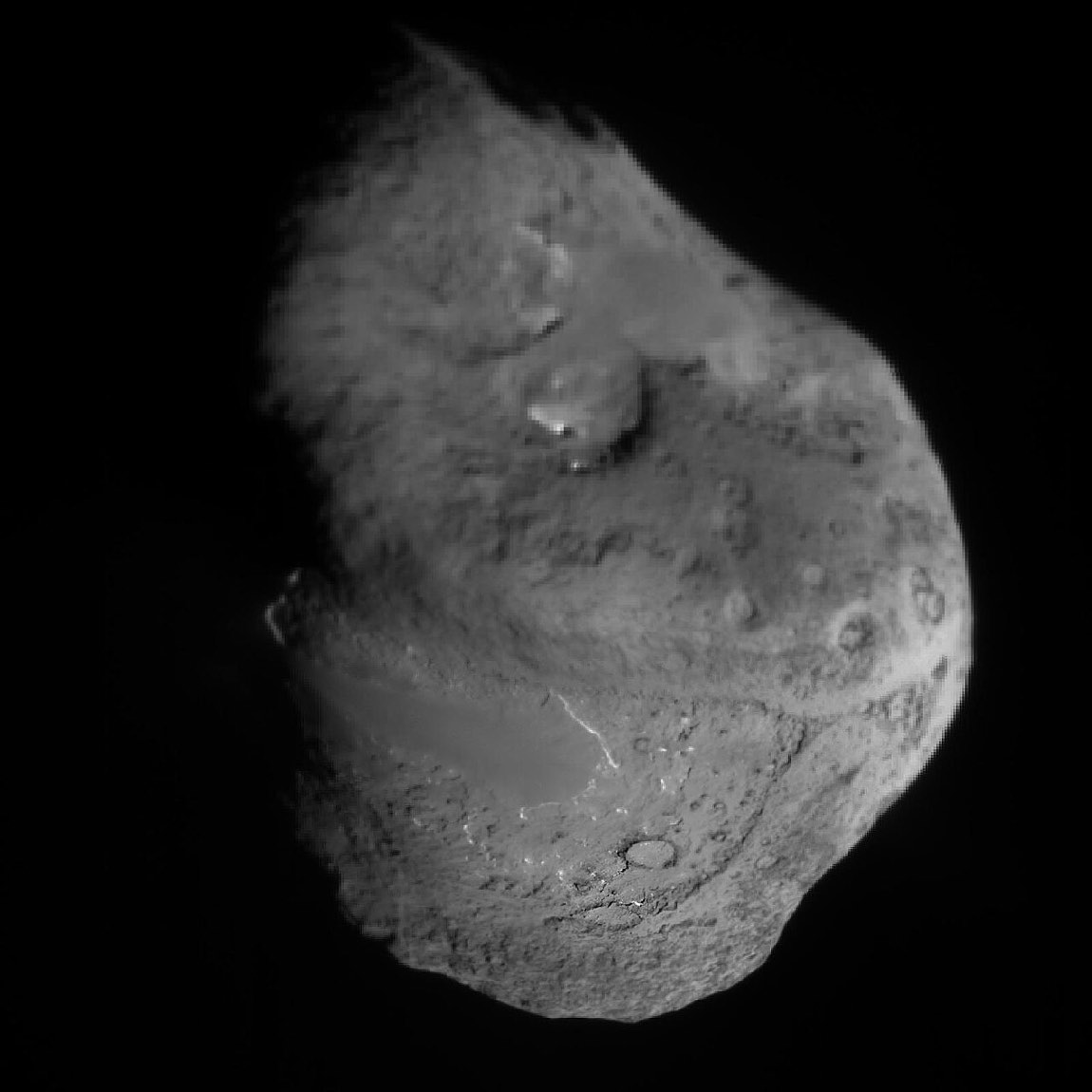
The comet NASA hit on purpose: Deep Impact crashed a probe into it on 4 July 2005.
What is it?
Tempel 1 is a Jupiter-family comet that loops around the Sun about every five and a half years. Wilhelm Tempel found it in 1867. In July 2005 NASA's Deep Impact mission slammed an impactor into its surface and watched the blast of dust and ice to learn what lies beneath a comet's crust. In 2011 the Stardust spacecraft flew past to look at the scar. A 2024 pass near Jupiter nudged its orbit, so it now stays a little farther from the Sun.
The deep dive
Researched for the Atlas from Wikipedia — Tempel 1 (7,376 characters read) · updated Nov 14, 2026
01 Wilhelm Tempel and the 1867 Discovery
Wilhelm Tempel spotted this comet on April 3, 1867, while working at the Marseille Observatory. At discovery, the comet was swinging around the Sun once every 5.68 years, and it was bright enough to be followed at subsequent returns in 1873 and again in 1879. Then it vanished. Photographic searches in 1898 and 1905 turned up nothing, and the astronomy community quietly concluded the comet had fallen apart. The real explanation was far more interesting: Jupiter had reached out gravitationally and shoved the comet into a completely different orbit. A close brush with Jupiter in 1881, at just 0.55 AU separation, stretched the orbital period to 6.5 years and pushed perihelion outward by 50 million km, lifting it to 2.1 AU from the Sun. At that distance the comet became too faint to find, and it stayed lost for decades. Perihelion did not drop back below 2 AU until 1944, after another Jovian encounter in 1941. The comet had not died — it had simply been relocated by the solar system's largest planet.
02 How Brian Marsden Resurrected a Lost Comet Deeper
The recovery of Tempel 1 is a triumph of orbital mathematics. British astronomer Brian G. Marsden painstakingly recalculated the comet's trajectory, carefully folding in Jupiter's gravitational nudges across every close approach. He found that encounters with Jupiter in 1941, at just 0.41 AU, and again in 1953, at 0.77 AU, had progressively shrunk both the perihelion distance and the orbital period to values actually smaller than at original discovery — periods of 5.84 and then 5.55 years respectively. These interactions also locked the comet into a libration around the 1:2 mean-motion resonance with Jupiter, meaning the comet completes roughly two orbits for every one Jupiter makes. Armed with Marsden's prediction, Elizabeth Roemer of the Catalina Observatory photographed the right region of sky during the unfavorable 1967 return. Nothing jumped out immediately, but in late 1968 she examined a June 8, 1967 exposure and found a faint, diffuse 18th-magnitude smudge almost exactly where Marsden had said it would be. Because orbit computation demands at least two positional measurements, the community had to wait for the next return before anything could be confirmed.
03 A Faint, Dark, Slowly Spinning World
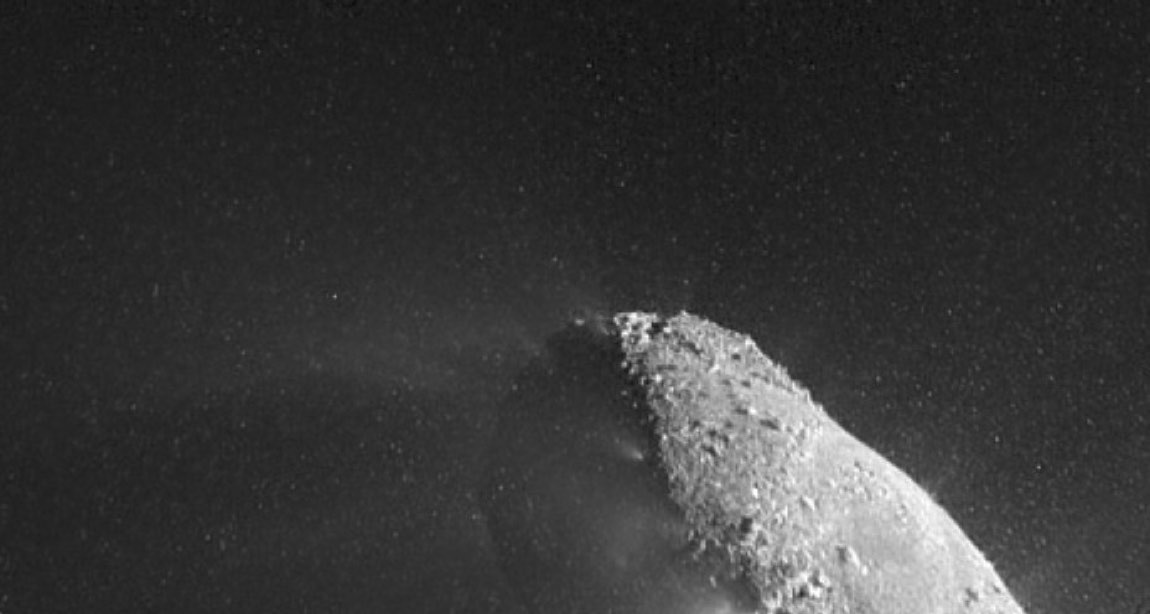
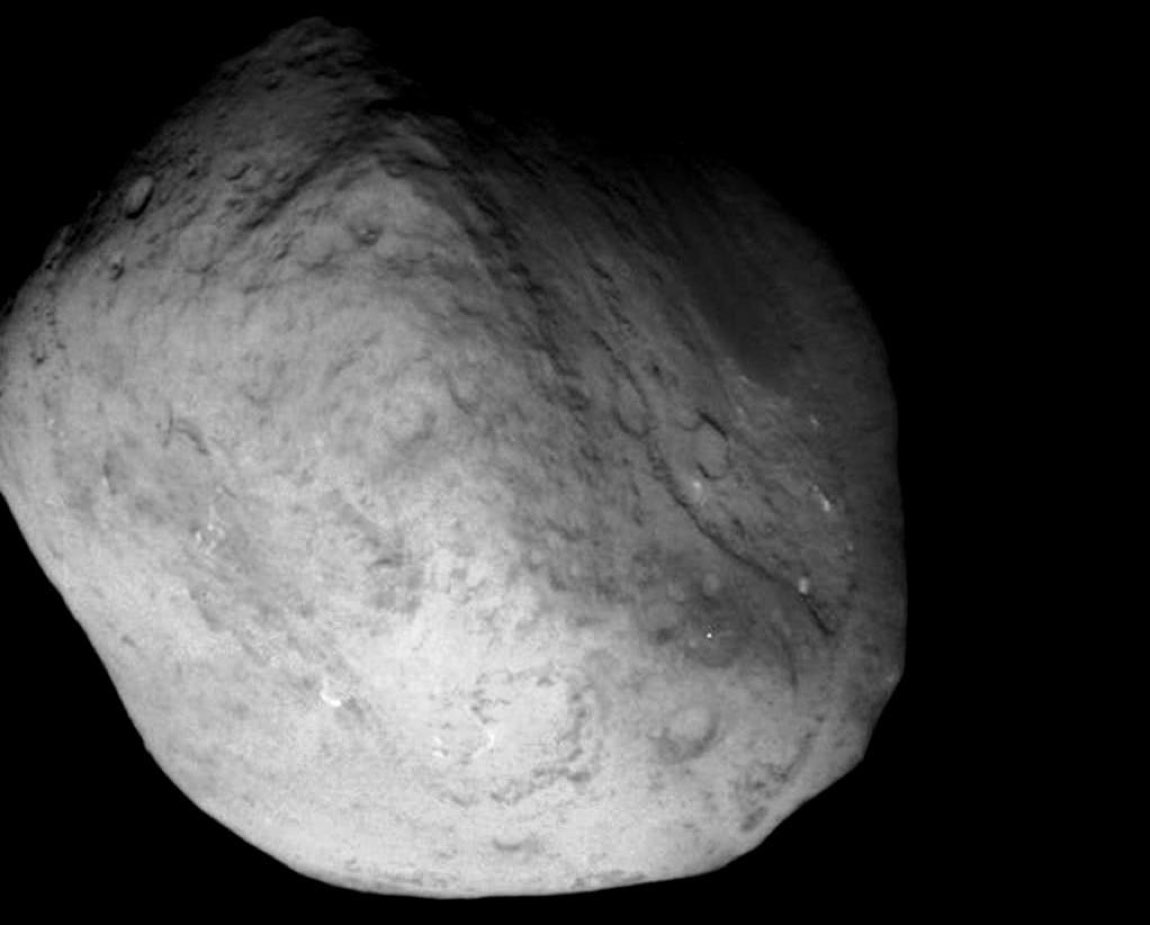
Tempel 1's nucleus is a lumpy potato shape measuring 7.6 km by 4.9 km — roughly the size of a small city district. Despite being an icy body, its surface is remarkably dark. Measurements by the Hubble Space Telescope in visible light and the Spitzer Space Telescope in infrared together pin the albedo at just 4%, meaning the surface reflects only 4 percent of incoming sunlight — darker than charcoal. The brightest the comet has ever appeared since discovery is magnitude 11, which is comfortably invisible to the naked eye; you would need at least a decent pair of binoculars. Its rotation period is roughly two days, a leisurely spin for such a small object. Tempel 1 also does something unexpected for a chunk of ice and rock: it emits X-rays. This happens because highly charged ions streaming outward in the solar wind collide with neutral gas molecules escaping from the nucleus and steal electrons in a process called charge exchange, releasing X-ray photons as a byproduct.
04 Deep Impact: Shooting a Comet on Purpose
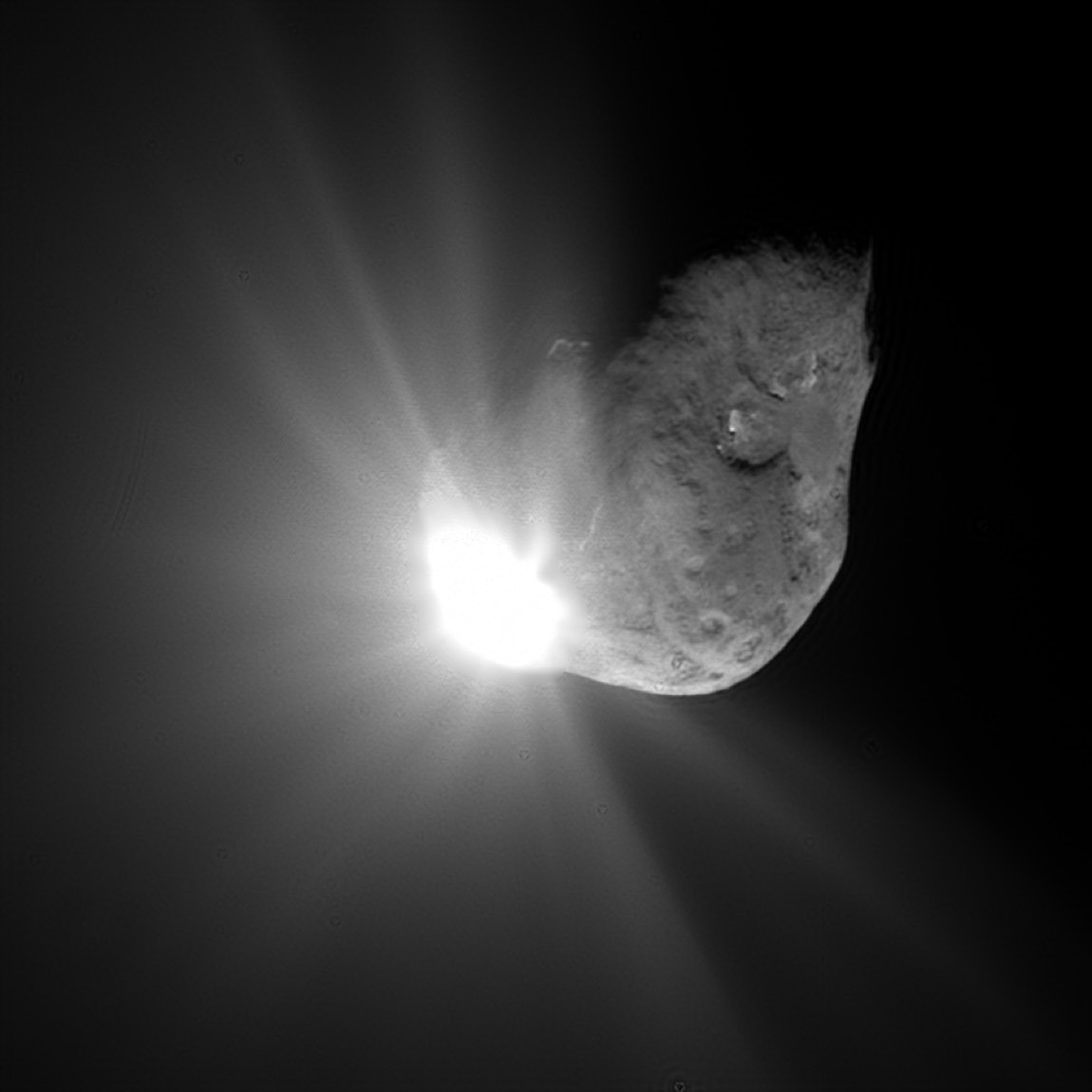
On July 4, 2005, at 05:52 UTC — just one day before the comet reached perihelion — NASA's Deep Impact spacecraft deliberately fired one of its two components into Tempel 1 at a closing speed of approximately 10.2 km per second. The impactor weighed 370 kg, and when combined with that velocity it delivered 19 gigajoules of kinetic energy to the comet's surface — equivalent to detonating about 4.8 tons of TNT. The collision produced a bright spray of ejected material that was recorded by the flyby component of the same spacecraft, and earthbound telescopes watched the comet brighten by several magnitudes. Pre-impact estimates suggested the resulting crater would be roughly 100 meters wide and 28 meters deep. The explosion was not a destructive prank; scientists designed the experiment to excavate deep material and reveal the comet's interior composition for the first time. Unfortunately, the enormous dust cloud thrown up by the impact completely obscured the new crater, leaving the mission's core geological question unanswered — at least temporarily.
 ⤢
05 What the Ejecta Revealed About Cometary Guts Deeper
Even though the crater stayed hidden behind its own dust, the material blasted into space told a detailed story. Spitzer Space Telescope infrared observations of the ejecta cloud identified an extraordinary variety of substances: silicates, carbonates, smectite (a clay mineral associated with water-altered rock on Earth), metal sulfides including pyrite — commonly called fool's gold — amorphous carbon, and polycyclic aromatic hydrocarbons. Dust particles in the cloud were described as finer than a human hair. Crucially, Spitzer also detected water ice in the ejecta, and Deep Impact's own onboard spectrometer independently found surface water ice near the impact site. The ice appears to have originated from about 1 meter below the outer surface layer, a devolatized mantle where previous solar heating had already baked away the most volatile compounds. Finding carbonates and clays alongside ice was significant because those minerals typically form in the presence of liquid water, raising questions about the environments in which the early solar system's building blocks were processed before being incorporated into comets.
06 Stardust Returns: Finding the Hidden Crater
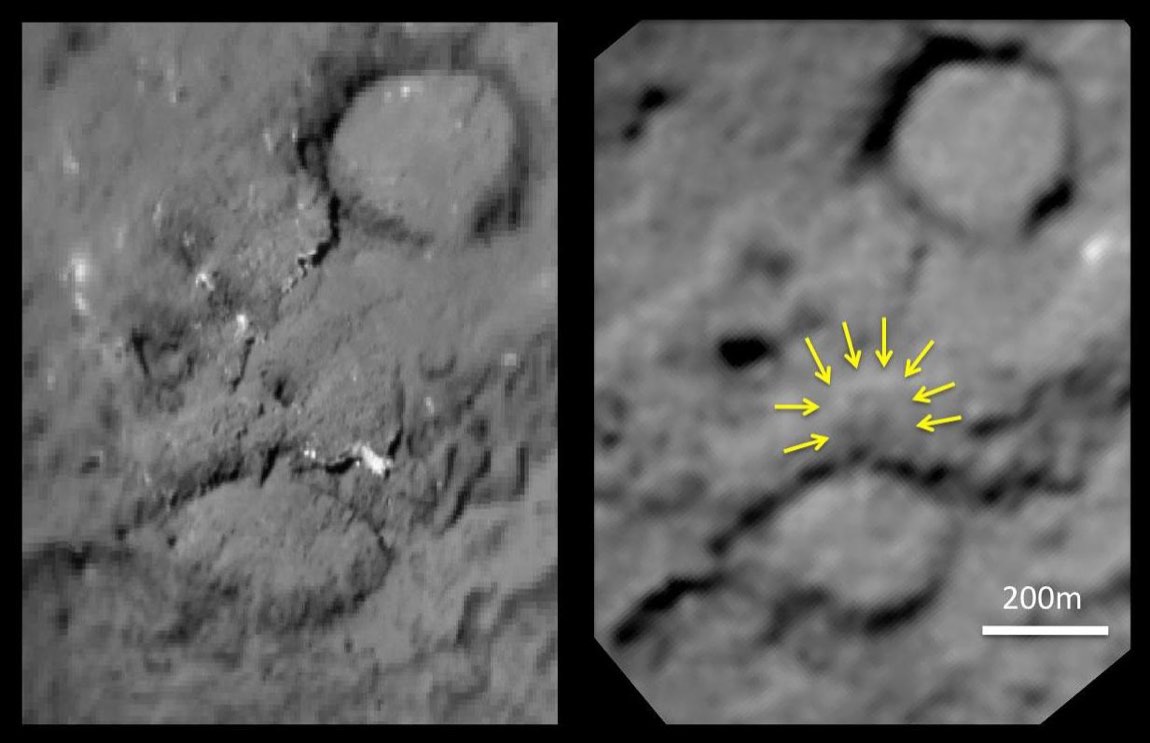
Because Deep Impact's flyby geometry left the crater buried under dust, NASA approved the New Exploration of Tempel 1, or NExT, mission on July 3, 2007. Rather than build a new spacecraft, engineers repurposed the Stardust probe, which had already completed its own mission studying Comet Wild 2 in 2004 and was still operational. Stardust was maneuvered into a new orbit and flew past Tempel 1 on February 15, 2011, at 04:42 UTC, passing at a distance of approximately 181 km. The visit made history as the first time any comet had been visited by two separate spacecraft. Within hours, NASA scientists examining the new images spotted what they had been searching for since 2005: the impact crater. It measured an estimated 150 meters in diameter. At its center sat a bright mound, almost certainly material that had been lofted during the impact and then fallen back down under the comet's feeble gravity. The stereo image pairs captured during the flyby also gave scientists far richer three-dimensional views of the nucleus than the original encounter had provided.
07 Ice That Visibly Retreats Between Visits Deeper
Comparing images from the 2005 Deep Impact flyby with those from Stardust in 2011 gave scientists something rare in planetary science: a direct, side-by-side view of a comet's surface changing over six years. The geometry of the NExT flyby was deliberately chosen to allow stereo reconstruction of the nucleus shape, and the resulting three-dimensional models let investigators pinpoint surface features precisely enough to track evolution. Investigators quickly identified specific locations where elevated, flow-like formations of icy material had visibly receded. The mechanism is sublimation — sunlight turns surface ice directly into gas without passing through a liquid phase, and the escaping gas gradually erodes the landscape. These observations provided concrete, measurable evidence of the process that drives cometary activity and slowly eats away at a comet's nucleus over successive orbits. Each pass near the Sun carves a little more material away, and Stardust's visit documented that erosion happening on a human timescale rather than a geological one.
08 A Smooth Terrain Near the South Pole Deeper
A 2026 study turned attention to an unusually smooth region of the nucleus sitting near Tempel 1's south pole and stretching approximately 2.5 km in length. Smooth terrains on comets are scientifically intriguing because they represent departures from the rougher, more eroded landscape that dominates most cometary surfaces. The authors proposed that this particular feature formed through the gravitational flow of loose surface material — essentially a slow avalanche or slump of regolith — following a period of heightened cometary activity in the comet's recent past. They further suggested the feature is not isolated but connects to other smooth regions elsewhere on the nucleus, implying a broader episode of surface redistribution. The study also quantified how sublimation has been progressively eroding this smooth terrain since it was laid down, whittling away at a feature that may record one of the more energetic chapters in Tempel 1's modern history. This kind of detailed geomorphological analysis was only made possible by having two sets of spacecraft imagery separated by six years.
 ⤢
09 Jupiter's Long Grip on Tempel 1's Future
Tempel 1's orbit is not fixed — it evolves continuously under Jupiter's gravitational influence, and the future holds more dramatic changes. On May 26, 2024, the comet made a relatively modest approach to Jupiter at 0.55 AU (about 82 million km), and even that relatively distant encounter was enough to lift the comet's perihelion distance measurably. As a result, the next perihelion will occur on February 12, 2028, with the comet reaching only 1.77 AU (265 million km) from the Sun — farther than Mars's orbit — making it dimmer and harder to study. Looking further ahead, cumulative Jovian perturbations are expected to push perihelion as high as 1.98 AU by October 2084, nearly as inaccessible as it was during the lost decades of the late 19th century. After that, perihelion will begin dropping again, and by October 17, 2183, the comet is projected to pass just 0.0191 AU — roughly 2.86 million km — from Mars, a genuinely close brush with the red planet.
10 An Unexpected Brush with the Dwarf Planet Ceres
Jupiter is not the only solar system body whose neighborhood Tempel 1 has wandered through. On November 11, 2011, just months after the Stardust flyby, the comet passed within 0.04 AU of Ceres — the largest object in the asteroid belt and the only dwarf planet in the inner solar system. That separation translates to roughly 5.9 million km, or about 15 times the Earth-Moon distance, which is a close encounter in orbital terms even if no spacecraft was present to observe it. The event was not a physical danger to either body but serves as a reminder that Jupiter-family comets like Tempel 1 do not spend all their time near the outer planets. Their orbits sweep across the inner solar system repeatedly, bringing them into the neighborhoods of asteroids, dwarf planets, and terrestrial planets on timescales that are short compared to the age of the solar system.
11 The 1:2 Resonance That Keeps Tempel 1 Corralled Deeper
One of the more subtle but important aspects of Tempel 1's orbital story is the resonance relationship with Jupiter that Brian Marsden identified during his recovery calculations. The comet currently librates — oscillates back and forth — around the 1:2 mean-motion resonance with Jupiter, meaning it completes approximately two orbits for every single orbit Jupiter makes. Resonances like this are not coincidences; they arise because gravitational tugs accumulate coherently when two bodies return to similar configurations repeatedly. Being in or near a resonance can stabilize an orbit for a time, but it can also make the orbit vulnerable to being pumped to larger eccentricities or inclinations if perturbations build up over successive encounters. For Tempel 1, the sequence of Jupiter approaches in 1941 and 1953 is what drove the comet into this resonant state, and it is the same dynamical environment that continues to sculpt the comet's future. The projected perihelion changes expected through 2183 are a direct consequence of this ongoing gravitational conversation between the comet and the solar system's largest planet.
 ⤢