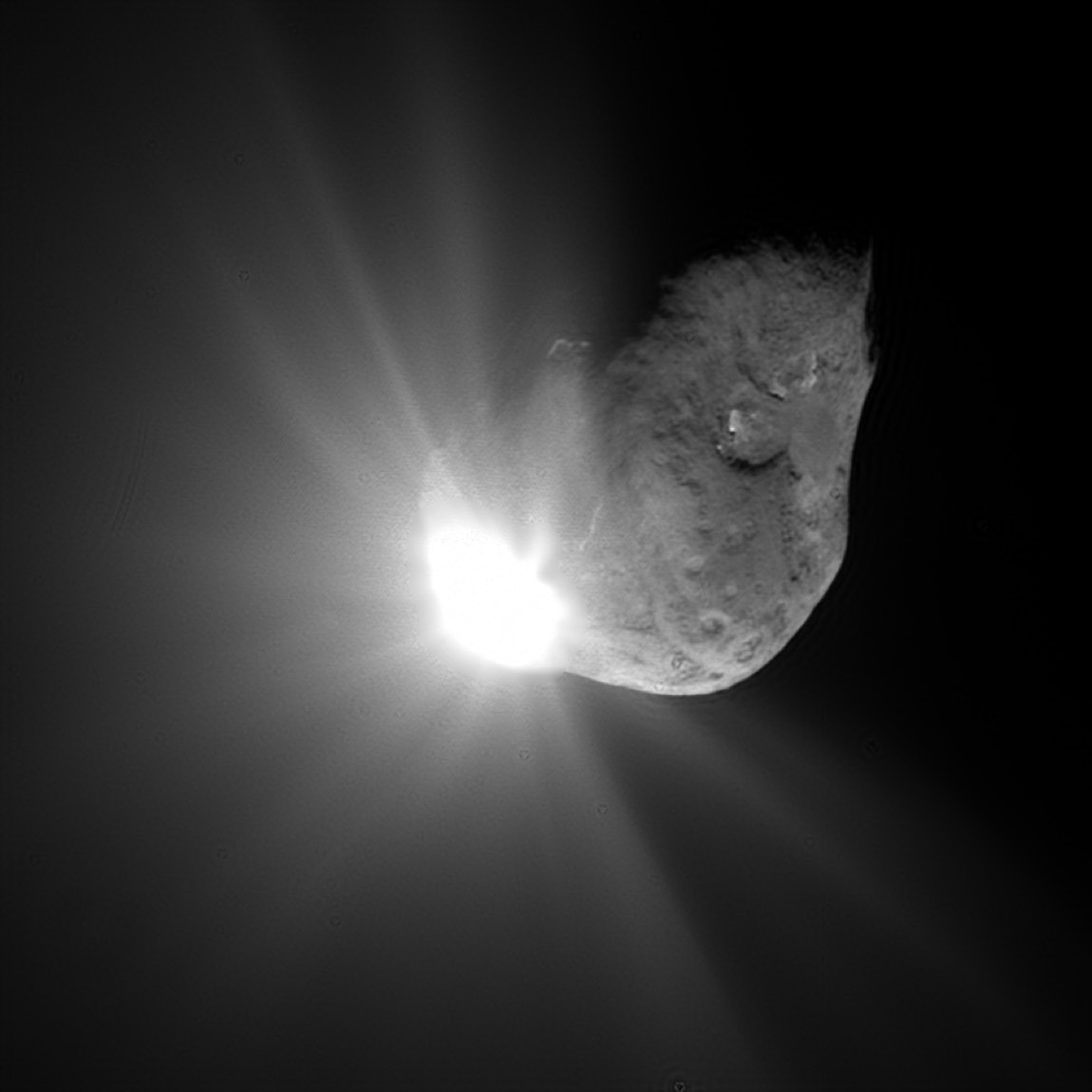
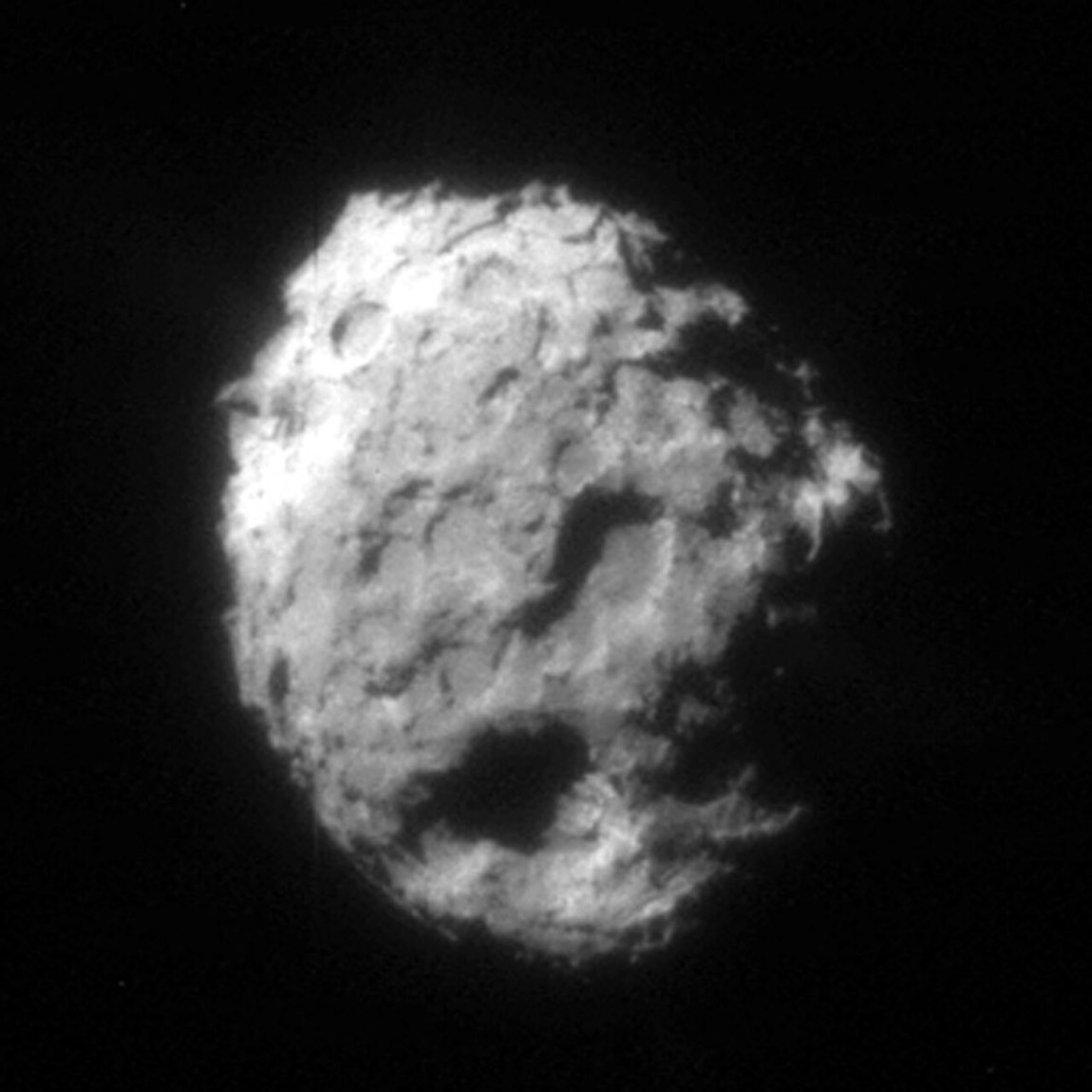
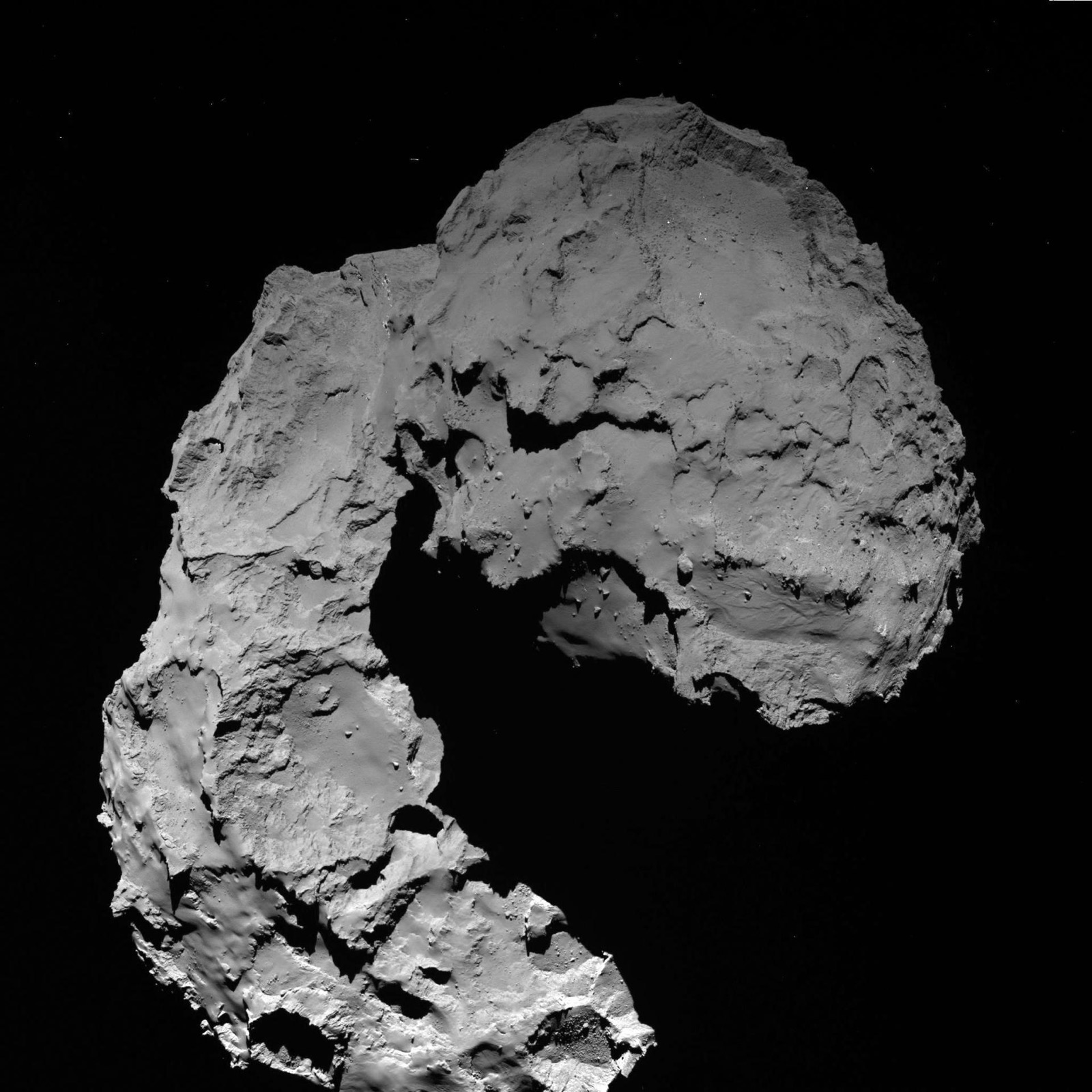
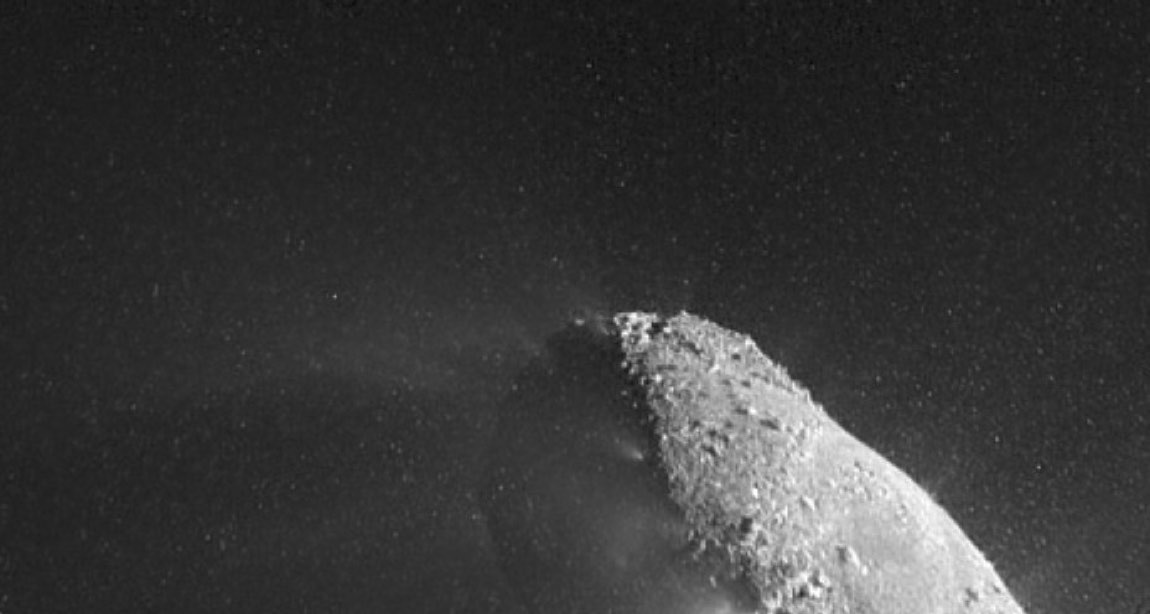
 Photograph · NASA / JPL-Caltech / UMD · Public domain
Comet · Deep guide
Comet Hartley 2 (103P/Hartley)
Also called: 103P/Hartley · Hartley 2
A tiny, lobed comet that sprays ice grains pushed out by carbon dioxide gas.
What is it?
Hartley 2 is a small periodic comet discovered in 1986 by Malcolm Hartley at Siding Spring Observatory in Australia. On 4 November 2010 the reused Deep Impact spacecraft, on its EPOXI extended mission, passed within about 700 km of it. The images showed a lobed nucleus about a kilometre across, which the mission's manager compared to a bowling pin crossed with a pickle. Jets of carbon dioxide were seen dragging chunks of water ice out into space.
The deep dive
Researched for the Atlas from Wikipedia — 103P/Hartley (6,784 characters read) · updated Nov 14, 2026
01 Malcolm Hartley and the 1986 Discovery
Comet Hartley 2 was discovered by Malcolm Hartley in 1986 using the Schmidt Telescope Unit at Siding Spring Observatory in Australia. The comet belongs to the Jupiter-family class, meaning its orbit has been gravitationally shaped by Jupiter into a relatively short loop around the Sun. Its orbital period of 6.46 to 6.48 years means it swings past the inner Solar System roughly every six and a half years, returning to Earth's neighborhood with reliable regularity. Despite being discovered nearly four decades ago, it remained poorly understood for most of that time — a faint, distant smudge that only revealed its true strangeness when a spacecraft finally drew close enough to look it in the face. The comet's perihelion sits at just 1.05 AU from the Sun, nearly the same distance as Earth's orbit, which makes close Earth approaches a recurring feature of its journey and gives amateur astronomers periodic opportunities to spot it without a telescope under dark skies.
02 A Bowling Pin Made of Ancient Ice
When the Deep Impact spacecraft swept past Hartley 2 on 4 November 2010, it revealed a nucleus unlike most people imagined. The project manager of the EPOXI mission described its shape as "a cross between a bowling pin and a pickle." More precisely, the flyby confirmed the comet is 2.25 km (1.40 mi) long and distinctly peanut-shaped, with two rougher, bulging ends connected by a smoother, narrower waist. Radar observations from the Arecibo Observatory had already hinted at this highly elongated shape during the comet's 2010 apparition, and they also revealed that the nucleus rotates over an 18-hour period. The Spitzer Space Telescope, observing in August 2008, had earlier measured the nucleus radius at 0.57 ± 0.08 km (0.354 ± 0.050 mi) and found a very low albedo of 0.028, meaning the surface reflects less than three percent of the sunlight that strikes it — darker than most road asphalt.
03 Tumbling Through Space on Two Axes Deeper
One of the more surprising findings from the EPOXI flyby concerned how Hartley 2 moves through space. The mission revealed that the comet does not rotate cleanly around a single axis the way a well-behaved top would. Instead, it spins around one axis while simultaneously tumbling around a different axis — a complex, wobbling motion technically called non-principal-axis rotation. This kind of tumbling is unusual and suggests the comet's internal mass distribution is uneven, or that some force — perhaps the uneven rocket-like push of its own outgassing jets — has nudged it into this unstable spin state. The smooth, relatively inactive waist connecting the two lobes of the peanut shape is thought to have formed from material re-deposited there: debris ejected from the rough, active ends that moved slowly enough to be captured by the comet's weak gravity and drift back down to the lowest gravitational point, which is the narrow middle section.
04 CO2 Jets: The Comet's Hidden Engine
Before the EPOXI flyby, scientists knew that some comets produced more water vapor than could be explained simply by sunlight warming surface water ice. Hartley 2 helped solve that puzzle in a dramatic way. The flyby showed that jets of frozen carbon dioxide — dry ice — deep inside the comet sublimate as the comet nears the Sun, blasting outward and dragging chunks of water ice with them into the coma. This was the first time comet activity powered by sublimating carbon dioxide had been directly observed. The CO2 ice involved is considered primordial, dating from the formation of the Solar System itself. From the rougher ends of the nucleus, these jets shoot out hundreds of tons of fluffy ice and dust. The largest individual particles range from golf ball to basketball size, and mission scientists noted that the blocky surface objects at the ends — roughly 50 m high and 79 m wide, about as tall as a 16-story building — appear two to three times more reflective than the comet's already-dark average surface.
05 Jets on the Dark Side Deeper
One detail from the EPOXI flyby puzzled researchers immediately: some jets of material were being ejected from the dark side of the comet, the hemisphere facing away from the Sun, rather than from the sunlit face where warming would be expected to drive outgassing. This behavior is difficult to explain with simple surface sublimation driven directly by solar heating. It suggests that heat can penetrate the nucleus and trigger sublimation of buried ices in regions not directly exposed to sunlight, or that the comet's tumbling rotation carries heated material into shadow before it has time to fully release its gases. Mission scientist Don Yeomans summed up the overall impression the comet made on the science team bluntly: "It's hyperactive, small and feisty." Science team leader Michael A'Hearn noted that for the first time it appeared possible to connect specific activity — individual jets — to particular identified features on the nucleus surface.
06 Heavy Water and the Ocean Connection
In 2011 the Herschel Space Observatory detected the spectral signature of vaporized water in Hartley 2's coma. What made this finding scientifically electrifying was the ratio of heavy water to ordinary water. Heavy water contains deuterium, a heavier isotope of hydrogen, and that ratio differs between different reservoirs of water across the Solar System. Hartley 2 was found to contain half as much heavy water as other comets analyzed before it, and crucially, its ratio between heavy water and regular water matched the ratio found in Earth's oceans. This was a striking result because it raised the possibility that Jupiter-family comets like Hartley 2 — rather than, or in addition to, asteroids — could have contributed water to early Earth. The finding was linked to separate evidence that short-period comets like Hartley 2 formed under warmer conditions and closer to the Sun than long-period comets, which is consistent with their lower deuterium enrichment.
07 What CO2 Tells Us About Comet Birthplaces Deeper
The EPOXI flyby of Hartley 2 also prompted a reexamination of the relative abundances of carbon-monoxide ice and carbon-dioxide ice in comets. After this reanalysis, researchers concluded that the balance between these two ices in short-period comets indicates they formed under warmer conditions than long-period comets did. The implication is that short-period comets like Hartley 2 originally formed closer to the Sun in the protoplanetary disk, while long-period comets — with their more distant orbits reaching deep into the Oort Cloud — formed in colder, more remote regions where carbon monoxide ice could accumulate more readily. This finding dovetailed neatly with the heavy water measurements: both lines of evidence point to Hartley 2 having a birthplace in a relatively warmer part of the early Solar System, which also explains why its deuterium-to-hydrogen ratio resembles that of Earth's oceans more closely than other, more distant comets do.
08 The EPOXI Mission: A Spacecraft Repurposed
The spacecraft that visited Hartley 2 had already made history once. Deep Impact had famously fired an impactor into Comet Tempel 1 on 4 July 2005, excavating a crater and revealing subsurface material. After that mission ended, NASA repurposed the surviving spacecraft under the name EPOXI — a combination of its two new objectives — and aimed it at a new target. The original plan was to fly by Comet Boethin, but that comet had not been observed since 1986 and its orbit could not be calculated precisely enough to guarantee a successful encounter. NASA pivoted to Hartley 2 instead. On 4 November 2010, the spacecraft came within 700 km (430 mi) of the nucleus while traveling at 44,300 km/h (27,500 mph). All data gathered during the encounter were transmitted back to Earth through NASA's Deep Space Network. The visit made Hartley 2 the fifth comet ever visited by a spacecraft, and at 1.2–1.6 km in diameter, it became the smallest comet visited as of that date.
09 How Close and How Bright: Observing Hartley 2
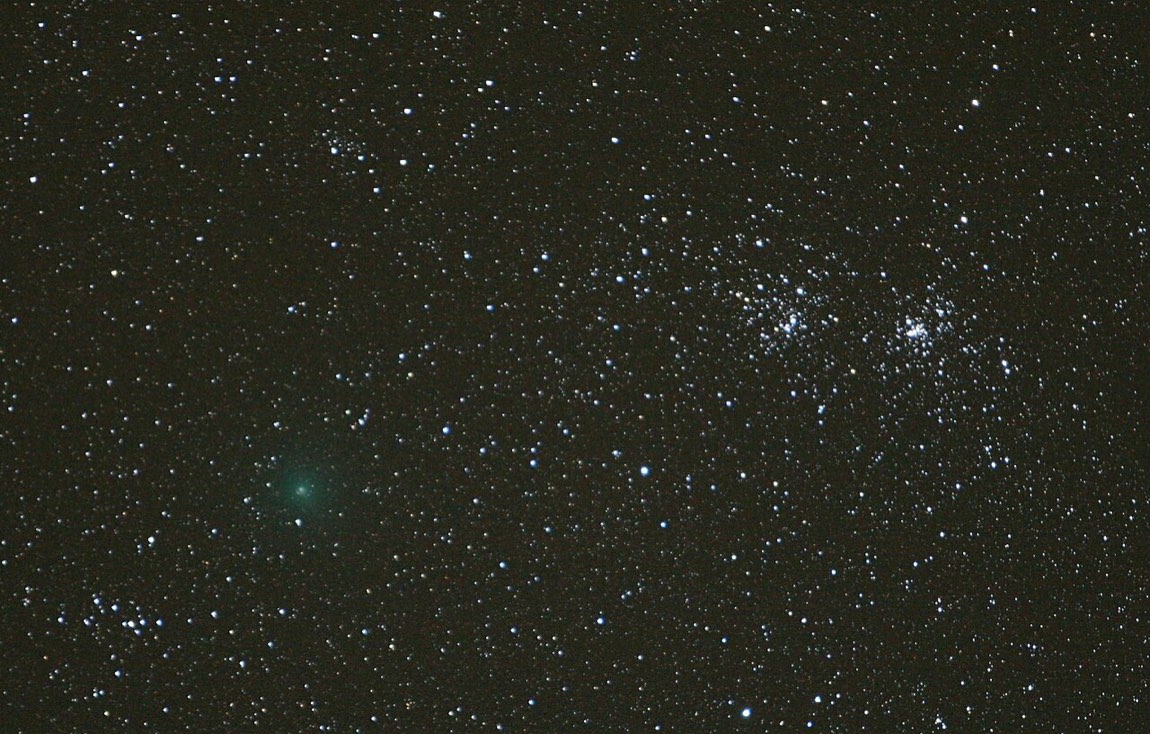
Hartley 2 has treated observers to two notable recent close approaches. During October 2010, it passed within 0.12 AU (18 million km) of Earth — roughly 47 times the distance to the Moon — on 20 October, just eight days before reaching perihelion on 28 October. The comet brightened to an apparent magnitude of about 5, placing it just within naked-eye visibility from dark sites. From northern latitudes in early November 2010, it was well placed around midnight with no Moon to interfere. The 2023 return was somewhat less dramatic: the comet passed 57,268,126 ± 144 km from Earth on 26 September 2023, reached perihelion on 12 October 2023, and brightened only to about magnitude 8 — comfortably within binocular range but not visible to the unaided eye. Its perihelion distance of 1.05 AU keeps it tantalizingly close to Earth's orbital path, ensuring future returns will continue to offer observing windows for patient skywatchers.
10 A Future Meteor Shower in the Making? Deeper
Hartley 2 is not currently recognized as the parent body of any meteor shower, despite its orbit crossing Earth's vicinity repeatedly. However, the picture may change. Dust trails shed during the comet's recent returns weave in and out of Earth's orbital path, and calculations suggest the trail of dust deposited in 1979 is on course to intersect Earth's orbit in both 2062 and 2068. If those encounters produce detectable meteor activity, Hartley 2 could eventually join the roster of comets with associated annual or periodic showers. For now it remains a comet whose meteor potential is acknowledged but unconfirmed — an open question that future observers in the mid-21st century will be positioned to answer. The uncertainty itself is a reminder that the Solar System's dust architecture is dynamic, with trail geometry shifting over decades as planetary gravity tugs on the debris streams comets leave behind.
11 How Long Can This Comet Survive?
Every time Hartley 2 swings close to the Sun, it loses mass — water, carbon dioxide, dust, and icy chunks blast away from its surface in those vigorous jets. The comet's total mass is estimated at about 300 megatonnes (3.0 × 10¹¹ kg), which sounds enormous but is modest for a comet. At its current rate of mass loss, and barring a catastrophic breakup or major splitting event, scientists estimate it should survive up to another 100 apparitions, equivalent to roughly 700 years of continued returns. Cometary breakups are not rare — many comets have been observed splitting into fragments during perihelion passages — so that caveat matters. If Hartley 2 remains structurally intact, observers in the year 2700 or so might still find it in the sky. What they would find is a significantly smaller and probably less active object, its reservoir of primordial CO2 ice gradually depleted after centuries of outbursts, its personality quieter than the feisty little comet EPOXI found in 2010.
 ⤢