 Photograph · NASA · Public domain
Comet · Deep guide
Comet Wild 2 (81P/Wild)
Also called: 81P/Wild · Wild 2
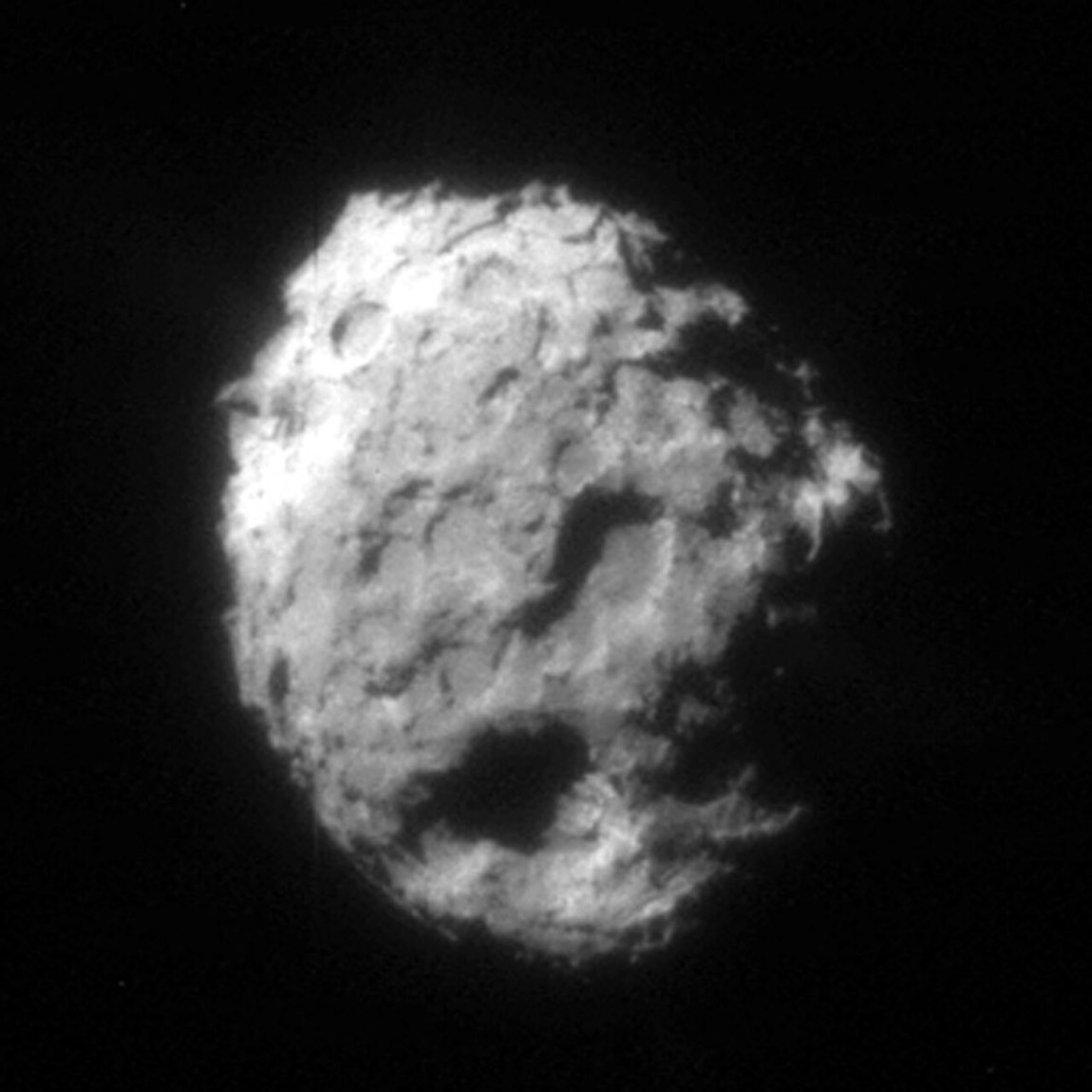
Stardust flew through its dusty halo and brought real comet grains back to Earth in 2006.
What is it?
Wild 2 (said "vilt two") is a Jupiter-family comet discovered in 1978 by Swiss astronomer Paul Wild. On 2 January 2004 NASA's Stardust spacecraft flew past it, photographed its nucleus and caught tiny particles from its coma. The sample capsule parachuted into Utah on 15 January 2006, making Wild 2 the first comet whose dust scientists could study in laboratories on Earth.
The deep dive
Researched for the Atlas from Wikipedia — 81P/Wild (5,669 characters read) · updated Nov 14, 2026
01 A Jupiter Encounter That Changed Everything
Wild 2 was not always the inner Solar System visitor we know today. For roughly 4.5 billion years it followed a wide, nearly circular path with an orbital period of about 43 years, swinging out to an aphelion of around 25 AU — nearly as far as Neptune — and coming no closer to the Sun than just under 5 AU, safely beyond Jupiter's orbit. Then, in September 1974, the comet passed within 1.0 million km of Jupiter. That close approach, less than three times the distance from Earth to the Moon, subjected Wild 2 to a gravitational jolt that dramatically reshaped its trajectory. Jupiter's pull shrank the aphelion from 25 AU down to roughly 5 AU and dragged the perihelion inward to about 1.5 AU, cutting the orbital period from 43 years to just 6.4 years. In a cosmic instant, an ancient outer Solar System body was redirected into the warm inner Solar System, where, only four years later, Paul Wild would spot it for the first time. Without that single planetary encounter, Wild 2 might have remained unknown for millions of years more.
02 Paul Wild and the Discovery Night
The comet bears the name of Swiss astronomer Paul Wild, who first detected it on January 6, 1978 — just over three years after Jupiter had bent its orbit inward. Wild made the discovery using a 40-centimeter Schmidt telescope at Zimmerwald, Switzerland. Schmidt telescopes are specifically designed for wide-field sky surveys, making them well suited for catching faint, diffuse objects like comets that might be missed by instruments optimized for pinpoint stars. The name is pronounced "vilt," following the German-language pronunciation of Wild's Swiss surname, a detail that surprises many English speakers who encounter the comet for the first time. Because Wild 2 had only recently been redirected by Jupiter, it was essentially a fresh comet entering the inner Solar System — its surface had been sheltered from intense solar heating for virtually its entire existence. This made it a scientifically attractive target: a relatively pristine sample of outer Solar System material that had undergone minimal processing compared with comets that have been cycling close to the Sun for millions of years.
03 How the Stardust Spacecraft Collected Its Prize
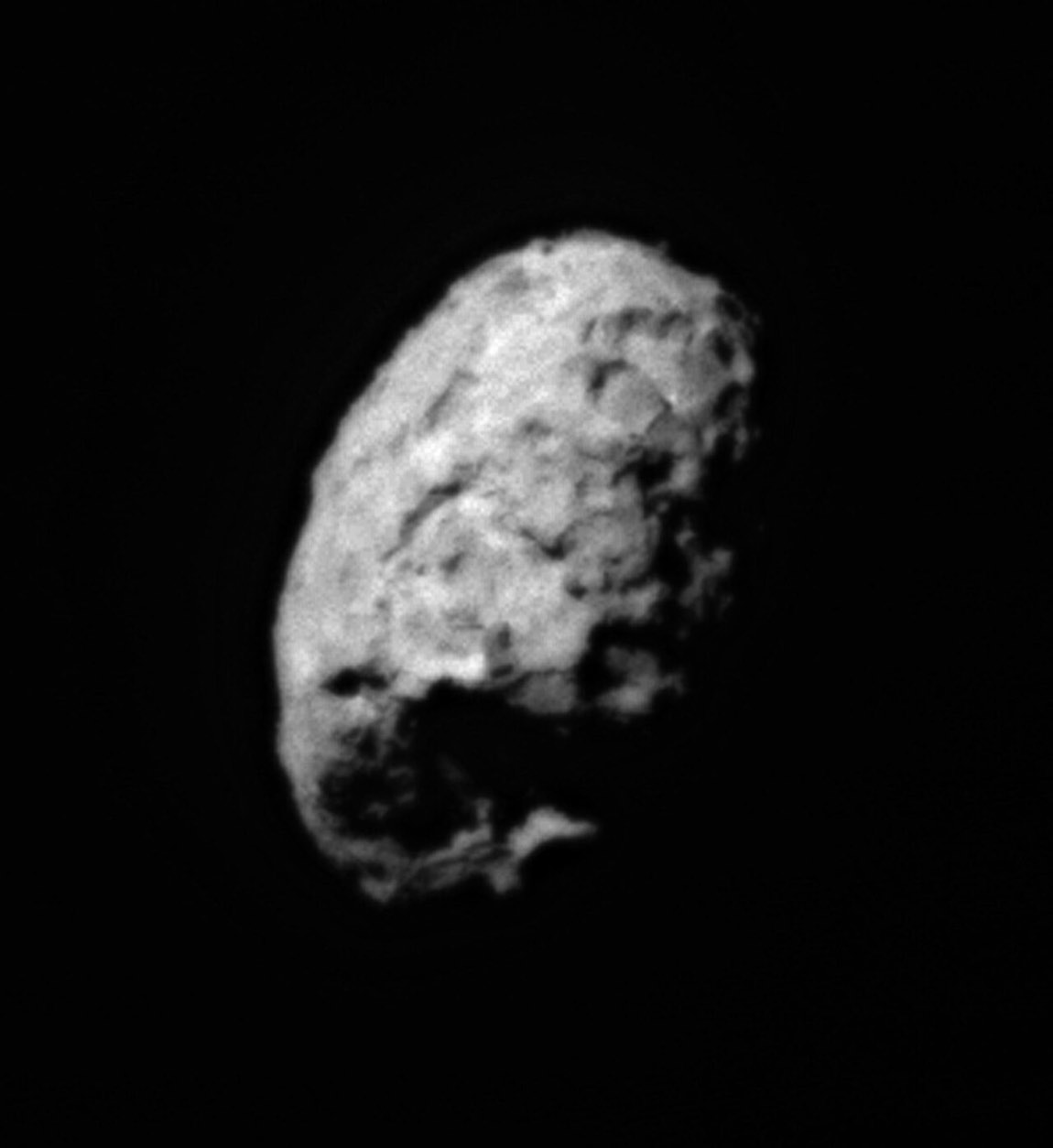
NASA's Stardust spacecraft launched on February 7, 1999, beginning a nearly five-year journey that would take it to Wild 2 and back. On January 2, 2004, Stardust flew past the comet and flew through its coma, the cloud of gas and dust surrounding the nucleus. During that encounter the spacecraft captured particle samples in a special collection medium and also gathered interstellar dust it had swept up during the cruise. Seventy-two close-up images of Wild 2 were returned, giving scientists their first detailed look at the nucleus. On January 15, 2006, the sample return canister parachuted down to Utah, reported to be in excellent condition. Scientists then removed individual grains of comet and interstellar dust from the particle capture cells and distributed them to approximately 150 researchers around the world. NASA also partnered with The Planetary Society on a citizen-science initiative called Stardust@Home, enlisting volunteers to help locate tiny interstellar particles on the Stardust Interstellar Dust Collector. On August 14, 2014, scientists announced the possible identification of genuine interstellar dust particles within the returned collection.
04 A Scarred and Vented Surface
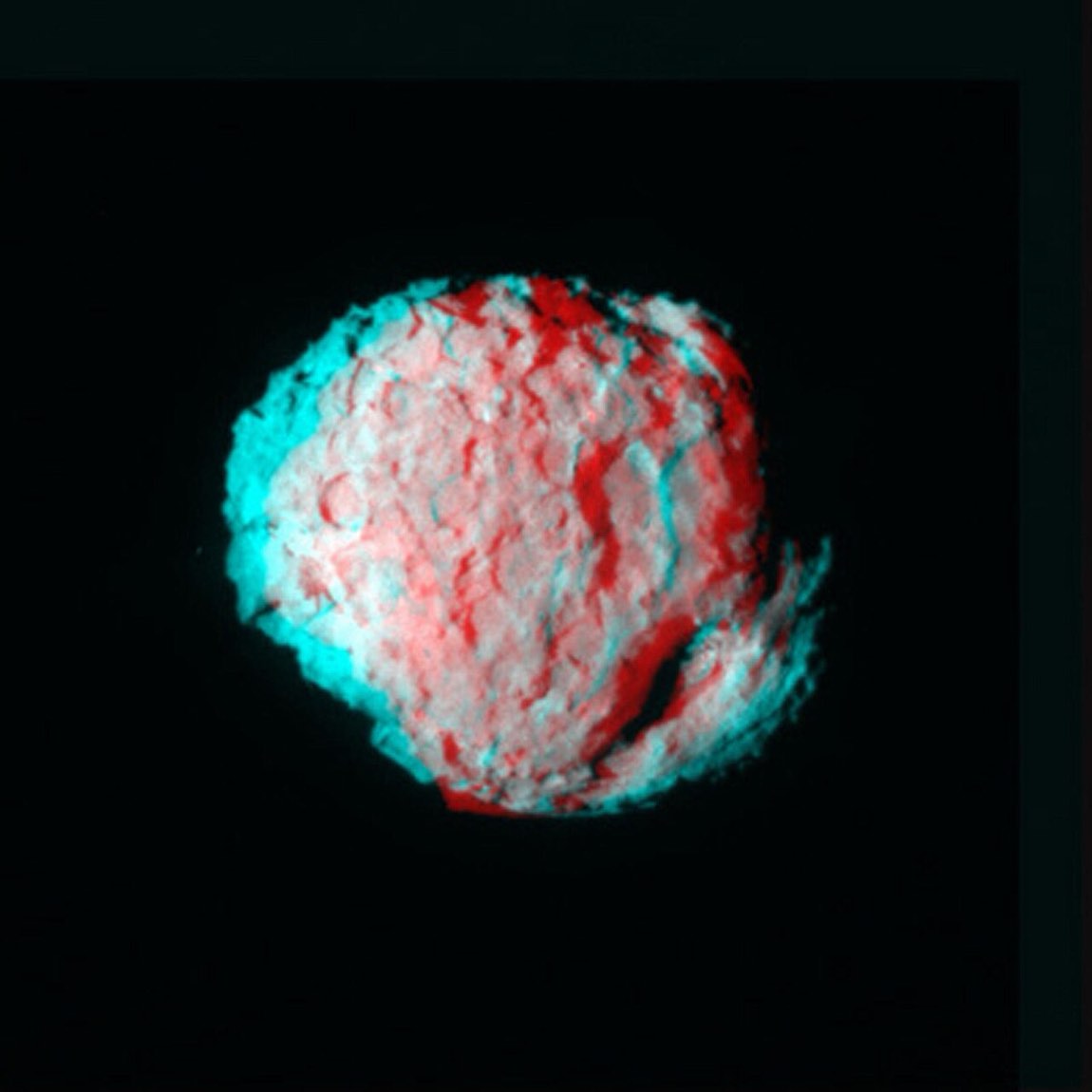
The 72 close-up images Stardust returned revealed a nucleus unlike what many planetary scientists had expected. Rather than a smoothly eroded surface, Wild 2 displayed flat-bottomed depressions with sheer, nearly vertical walls — features ranging in size from very small up to 2 km across. Scientists believe these structures were formed either by impact craters or by gas vents where volatile ices sublimate and burst outward. During the January 2004 flyby, at least 10 gas vents were observed to be actively jetting material into space at that moment. The comet's nucleus itself measures 5 km in diameter — roughly the length of Manhattan from south to midtown — making it a relatively modest but well-defined body. The sheer walls of some depressions are particularly puzzling: on Earth, gravity and erosion would quickly soften such sharp edges, but the comet's low gravity and cold environment apparently preserve them. The combination of impact features and active venting points to a surface that is simultaneously ancient and geologically alive, reshaping itself every time Wild 2 swings close to the Sun.
 ⤢
05 What the Dust Grains Revealed About Chemistry Deeper
Analysis of the returned dust samples, reported as of 2006, uncovered a surprisingly rich chemical inventory. The particles contained a wide range of organic compounds, including two that carry biologically usable nitrogen — a detail that connects cometary material to the broader question of how life's building blocks are distributed through the Solar System. Indigenous aliphatic hydrocarbons were identified with chain lengths longer than those observed in the diffuse interstellar medium, suggesting chemical complexity built up during the comet's formation or evolution. On the inorganic side, the samples held substantial quantities of crystalline silicates including olivine, anorthite, and diopside — minerals that only form at high temperatures, well above the conditions expected in the cold outer Solar System where Wild 2 spent most of its life. Notably absent were hydrous silicates and carbonate minerals, which would have been strong evidence for liquid water altering the dust. This absence implies that Wild 2's dust did not undergo significant aqueous processing. Very few pure carbon CHON particles were found, distinguishing Wild 2's material from what had been expected based on other comet studies.
06 High-Temperature Minerals in a Cold-Born Comet Deeper
The presence of crystalline silicates like olivine and diopside in a comet born in the frigid outer Solar System is one of the most striking puzzles the Stardust mission uncovered. These minerals form at temperatures approaching roughly 1,000 K — far hotter than the environments where comets are thought to originate. An oxygen isotope signature identified in the dust, reported in the September 19, 2008 issue of the journal Science, suggested an unexpected mingling of rocky material between the hot center and the cold edges of the early Solar System. Despite Wild 2 being born beyond Pluto's distance, tiny crystals in its coma appear to have been forged much closer to the Sun. Scientists before the Stardust return had outlined several competing explanations for this phenomenon: crystals could have been transported outward through the protoplanetary disk or in an outward-flowing wind; they could have formed in place through shock heating or lightning; or they could be fragments from larger parent bodies that experienced secondary processing. The Stardust results did not definitively settle the debate but confirmed that large-scale radial mixing of material occurred in the early Solar System, fundamentally challenging simpler models of how the disk evolved.
07 Surprising Signs of Ancient Liquid Water Deeper
In April 2011, scientists from the University of Arizona announced a discovery that cut against a long-standing assumption about comets. Within the Stardust samples they found iron and copper sulfide minerals — compounds that must have formed in the presence of liquid water. This was remarkable because the prevailing view held that comets never get warm enough to melt their icy interiors in a sustained way. The finding placed Wild 2 in direct conflict with that established paradigm. The researchers considered two possible energy sources that might have provided enough heat: collisions with other bodies during the early Solar System's turbulent history, or radiogenic heating — the warmth generated by the decay of short-lived radioactive isotopes trapped inside the comet when it first formed. Neither explanation was definitively confirmed, leaving the question open. If confirmed broadly, the presence of liquid water even briefly inside a comet would have important implications for the chemistry of organic compounds and for discussions about where the ingredients for life might have been processed and distributed across the young Solar System.
08 A Spinning Nucleus That Wobbles Over Time Deeper
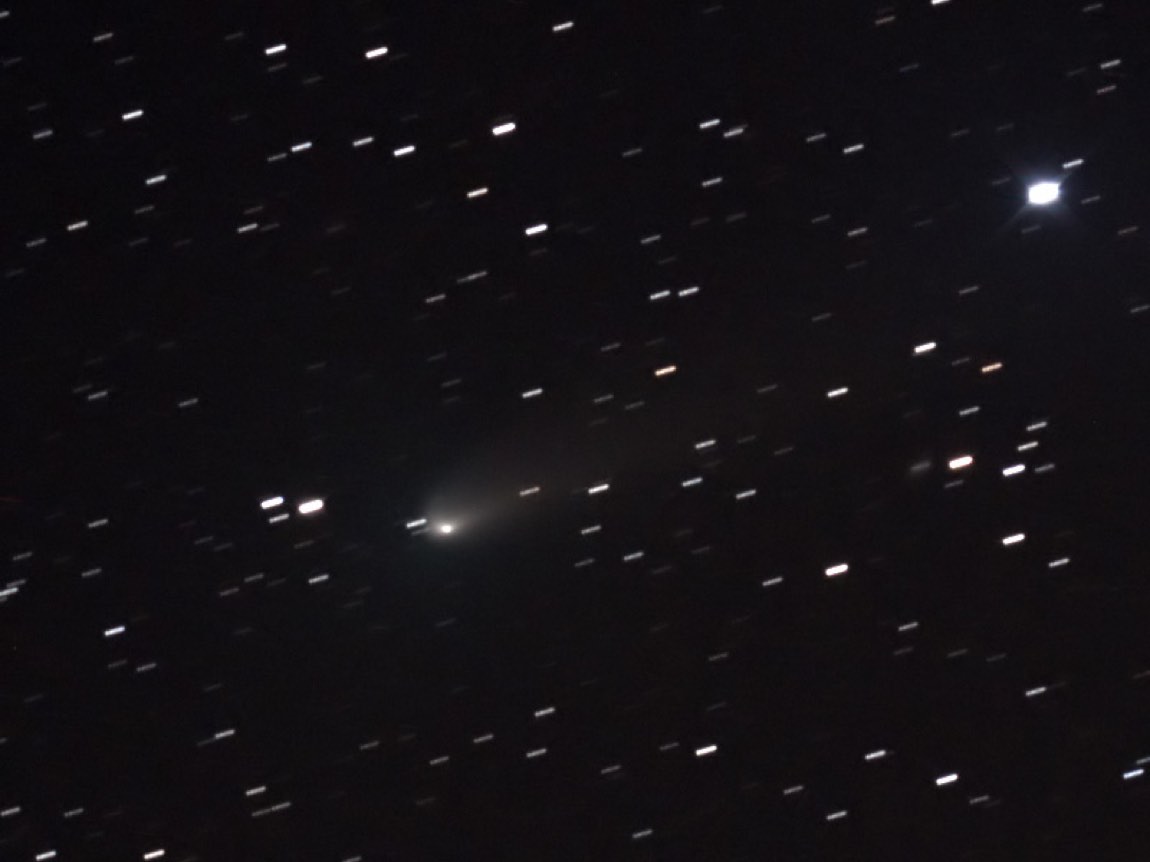
Wild 2 is not a perfectly stable rotator. Observations spanning the comet's apparitions of 2009–10 and 2022–23 indicate that the spin axis orientation of the nucleus changed by at least 1.7 degrees over that period. Such shifts, known as spin axis precession or non-gravitational torquing, are driven by the uneven sublimation of ices as the comet approaches the Sun — essentially, the outgassing jets act like tiny rocket engines, gradually nudging the rotation state. For mission planners and scientists trying to predict exactly where and when to observe specific surface features, this kind of drift introduces real complications. The Zwicky Transient Facility recorded at least two apparent outbursts from Wild 2 in October 2022, sudden brightenings that likely reflect episodes of enhanced activity when fresh volatile-rich material is exposed. These outbursts are consistent with a nucleus whose surface is still being actively sculpted by jets, adding further evidence that Wild 2 remains a dynamically lively body more than 45 years after its Jupiter encounter redirected it into our neighborhood.
 ⤢
09 Wild 2 Seen Through the James Webb Telescope
In March 2023, the James Webb Space Telescope turned its infrared eye on Wild 2 when the comet was approximately 1.85 AU — about 277 million km — from the Sun. JWST's infrared spectroscopy detected molecular emissions from a remarkable list of species in the coma: water (H2O), methane (CH4), ethane (C2H6), methanol (CH3OH), carbon monoxide (CO), carbon dioxide (CO2), the rare isotopologue carbon-13 dioxide (13CO2), carbonyl sulfide (OCS), hydrogen cyanide (HCN), and the cyanide radical (CN). Scientists noted that these detections were consistent with what had been observed during previous apparitions of the comet, suggesting that Wild 2's chemical character is relatively stable from one orbit to the next. The breadth of the molecular inventory detected by JWST underscores how chemically complex a comet's atmosphere can be, and demonstrates the power of modern space-based infrared observatories to characterize these icy travelers in detail that ground-based telescopes cannot match. The 13CO2 detection in particular can help researchers probe isotopic ratios that carry information about where and how the comet's ices originally formed.
10 Citizen Science and the Search for Stardust
Returning cometary samples to Earth was only part of the Stardust mission's challenge. Identifying the tiniest particles within the collector — especially the rare grains of genuine interstellar dust rather than cometary material — required searching through enormous numbers of microscopic images. The sheer scale of the task made it impractical for a small team of scientists to handle alone. NASA's response was to collaborate with The Planetary Society on a project called Stardust@Home, which enlisted volunteers to examine images from the Stardust Interstellar Dust Collector and flag potential particle tracks. This was one of the earlier large-scale distributed astronomy projects, anticipating the citizen-science model that would later become common across many fields. The effort ultimately contributed to the August 14, 2014 announcement that possible interstellar dust particles had been identified in the returned collection. The combination of professional analysis and volunteer effort to process a physical sample returned from deep space remains one of the more unusual collaborations in modern planetary science, blending traditional laboratory work with the distributed attention of the interested public.
11 Open Questions Wild 2 Still Poses Deeper
Despite the unprecedented intimacy of the Stardust encounter and years of subsequent laboratory analysis, Wild 2 continues to present unresolved scientific questions. The origin of its high-temperature crystalline silicates — whether transported outward from the hot inner Solar System, formed in place by shocks or lightning, or derived from collisional debris — remains a matter of active debate, as acknowledged in the peer-reviewed literature before and after sample return. The source of energy that may have produced liquid water inside the nucleus, enabling the formation of iron and copper sulfide minerals, is similarly unsettled: collisions and radiogenic heating are both candidate mechanisms, but neither has been confirmed. The nature of the comet's flat-bottomed depressions — impact craters, collapse pits, or erosion by gas venting — is not definitively resolved either. The gradual drift in spin axis orientation raises further questions about how non-gravitational forces are reshaping the nucleus over successive orbits. And the sporadic outbursts detected by the Zwicky Transient Facility in 2022 point to surface processes that are not yet fully predictable or understood. Wild 2, despite being one of the most studied comets in history, keeps generating new puzzles.
 ⤢