Comet · Deep guide
Comet Shoemaker–Levy 9
Also called: D/1993 F2 · SL9 · Shoemaker-Levy 9
Torn into pieces by Jupiter, it crashed into the giant planet in July 1994.
What is it?
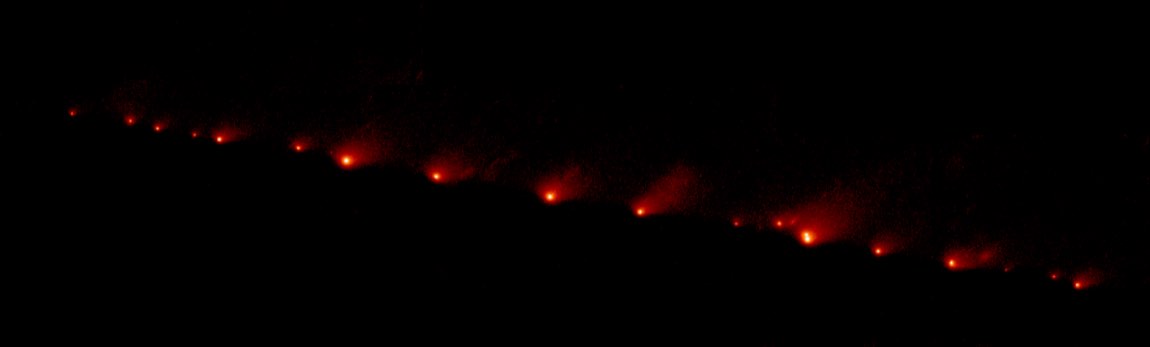
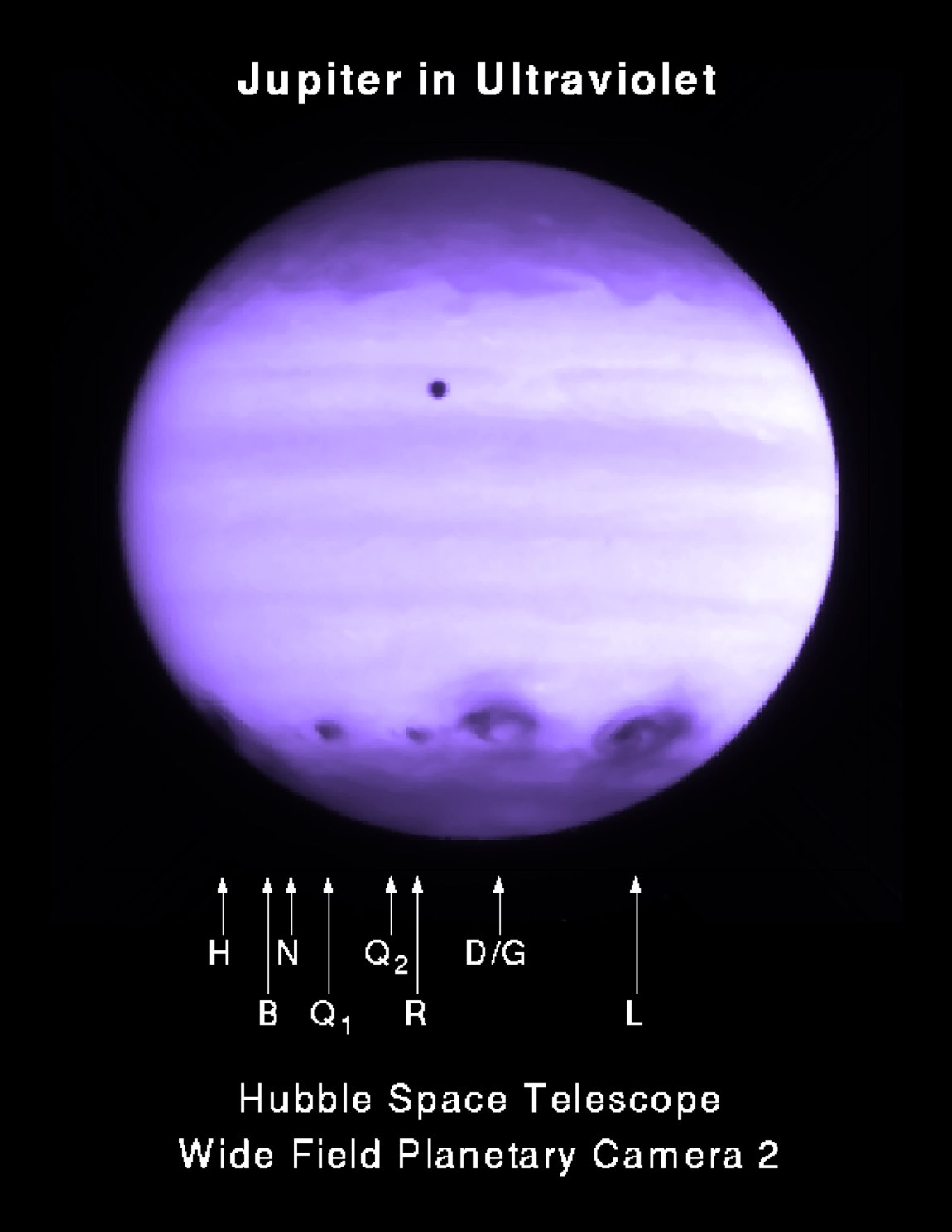
Shoemaker–Levy 9 was a comet that had been captured into orbit around Jupiter. In July 1992 it passed so close to the planet that tidal forces ripped it into a string of fragments. Carolyn and Eugene Shoemaker and David Levy discovered this 'string of pearls' in March 1993. Between 16 and 22 July 1994 the pieces slammed into Jupiter's southern hemisphere at about 60 km/s, leaving dark scars that were easier to see than the Great Red Spot. It was the first collision between Solar System bodies ever observed directly.
The deep dive
Researched for the Atlas from Wikipedia — Comet Shoemaker–Levy 9 (22,131 characters read) · updated Nov 14, 2026
01 A Comet Caught by a Giant Planet
Most comets orbit the Sun, but Shoemaker–Levy 9 was doing something stranger: it was orbiting Jupiter. Its orbit around the planet had a period of about 2 years and an apoapsis — the farthest point from Jupiter — of 0.33 astronomical units, or 49 million kilometres. That orbit was extraordinarily elongated, with an eccentricity of 0.9986, meaning it was nearly a flattened ellipse rather than a proper loop. Astronomers traced its path backward and concluded the comet had most likely been captured from a solar orbit in the early 1970s, though the capture could have happened as early as the mid-1960s. Before capture, it was probably a short-period comet whose farthest point from the Sun sat just inside Jupiter's orbit and whose closest point lay inside the asteroid belt. When the comet drifted near its own aphelion during a Jupiter flyby, its motion relative to the planet was so small that Jupiter's gravity pulled it almost straight inward, producing that extreme eccentricity. It was the first active comet ever observed orbiting a planet rather than the Sun.
02 How Tides Ripped a Comet to Pieces
On July 7, 1992, Shoemaker–Levy 9 passed just over 40,000 km above Jupiter's cloud tops — a distance smaller than Jupiter's own radius of 70,000 km, and well inside the orbit of Metis, the planet's innermost moon. At that altitude the comet was deep inside Jupiter's Roche limit, the zone within which tidal forces overwhelm the self-gravity holding a loosely bound body together. Jupiter's gravity pulled harder on the near side of the nucleus than on the far side, stretching and ultimately shredding it into a chain of separate fragments. Each piece was assigned a letter, running from fragment A through fragment W. Astronomers later estimated the fragments ranged up to 2 km in diameter, while the original intact nucleus was calculated to have been about 1.8 km across — with some pre-impact estimates suggesting it could have been as large as 5 km, somewhat larger than Comet Hyakutake, which dazzled skywatchers in 1996. The average density of the original body was calculated at about 0.5 g/cm³; a significantly less dense comet would not have broken into the neat string of objects that was observed.
03 The Night Three Astronomers Found It
Carolyn and Eugene Shoemaker and David Levy were not hunting for Jupiter's companions on the night of March 24, 1993 — they were searching for near-Earth objects. The discovery of Shoemaker–Levy 9 was entirely serendipitous, made in two photographs taken with the 46 cm Schmidt telescope at Palomar Observatory in California. The discovery image immediately hinted that something was unusual: instead of a single fuzzy dot, the comet appeared as multiple nuclei spread across an elongated region about 50 arcseconds long and 10 arcseconds wide. This was the ninth periodic comet the team had discovered together — periodic meaning an orbital period of 200 years or less — and the eleventh comet they had found overall, counting two earlier non-periodic ones. The formal announcement came in IAU Circular 5725 on March 26, 1993. Brian Marsden of the Central Bureau for Astronomical Telegrams quickly noticed that the object lay only about 4 degrees from Jupiter as seen from Earth, and that its apparent motion suggested a physical association with the planet rather than a mere line-of-sight coincidence.
 ⤢
04 A Fleet of Observatories Watches History
As the July 1994 impact window approached, astronomers directed an extraordinary array of instruments at Jupiter. Ground-based telescopes were joined by the Hubble Space Telescope, the ROSAT X-ray satellite, and the W. M. Keck Observatory. The Galileo spacecraft, still 1.6 AU — about 240 million km — from Jupiter and en route to its 1995 rendezvous with the planet, had a direct view of the impact sites that Earth-bound observers lacked, because the collisions happened on Jupiter's far side. Galileo therefore became the primary real-time witness to the actual moments of impact. The Ulysses solar probe was redirected from its location 2.6 AU away, while Voyager 2 — an astonishing 44 AU from Jupiter, more than six and a half billion kilometres out and already past Neptune — was programmed to listen for radio emissions in the 1 to 390 kHz range and to scan with its ultraviolet spectrometer. Neither Ulysses nor Voyager 2 detected any abnormal signals, with Galileo's data showing the fireballs fell just below Voyager 2's detection threshold. Jupiter's rapid rotation brought impact scars into view for Earth-based observers within minutes of each collision.
05 Fragment G and the Scale of Destruction
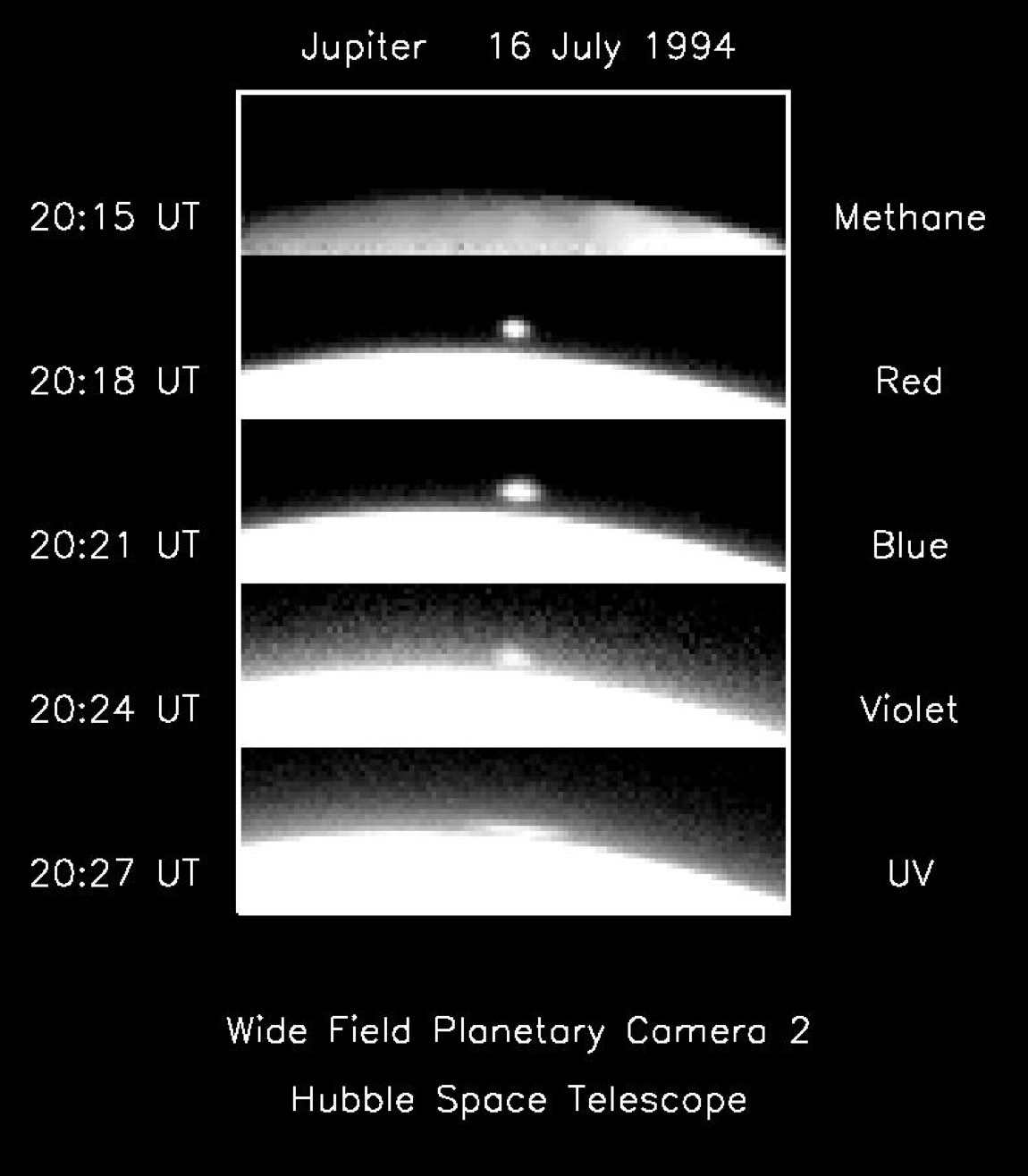
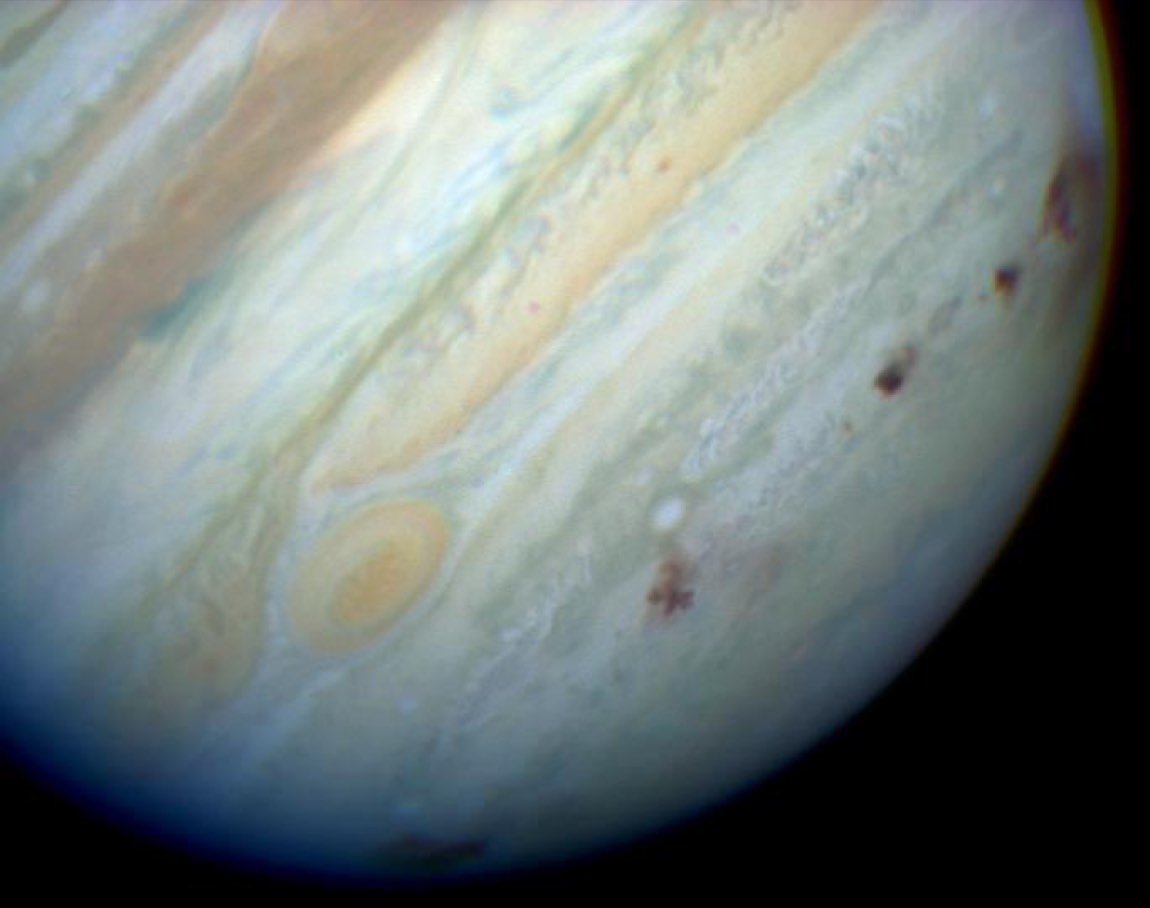
The first fragment, A, struck Jupiter's southern hemisphere at approximately 60 km/s — equal to Jupiter's escape velocity and roughly 216,000 km/h — at 20:13 UTC on July 16, 1994. Galileo measured a fireball that peaked at about 24,000 K, compared to a normal Jovian cloud-top temperature of about 130 K, before cooling rapidly to around 1,500 K. The resulting plume climbed over 3,000 km high and was captured by the Hubble Space Telescope. Over the following six days, 21 distinct impacts were recorded in total. The most powerful came on July 18 at 07:33 UTC, when fragment G struck the planet and carved a dark spot over 12,000 km across — nearly one Earth diameter. That single impact was estimated to have released energy equivalent to 6 million megatons of TNT, or about 600 times the combined yield of every nuclear weapon in the world's arsenals. The impact scars, described by observers as more easily visible than the Great Red Spot, persisted for many months and were probably the most prominent transient features ever recorded on Jupiter.
06 Chemistry Dredged Up from the Deep Deeper
Scientists hoped the impacts would act as a natural probe, punching through Jupiter's cloud deck and exposing material from below. Spectroscopic observations delivered striking results. Diatomic sulfur (S2) and carbon disulfide (CS2) were detected in Jupiter's spectrum — the first detection of either molecule in Jupiter, and only the second detection of S2 in any astronomical object at all. Ammonia (NH3) and hydrogen sulfide (H2S) were also identified. The quantities of sulfur implied by these compounds were far greater than a small cometary nucleus could supply, confirming that deep Jovian material was being excavated. Emission from heavy atoms — iron, magnesium, and silicon — was detected with abundances consistent with a cometary nucleus rather than Jupiter itself. Water was found spectroscopically but in smaller quantities than models predicted, suggesting either that the water layer beneath Jupiter's clouds was thinner than expected, or that the fragments never penetrated deeply enough to reach it. Post-impact analysis concluded that even the largest fragments were probably destroyed when atmospheric pressure reached about 250 kPa — well above where the water layer was thought to reside.
 ⤢
07 Waves, Auroras, and Magnetosphere Shocks Deeper
The largest impacts generated enormous atmospheric waves that swept across Jupiter at 450 m/s and remained observable for over two hours. Scientists debated whether these waves propagated within a stable layer in the troposphere, possibly at the level of a hypothetical water cloud, or within the stratosphere — the chemical evidence pointed in conflicting directions. Radio observations revealed a sharp increase in continuum emission at a wavelength of 21 cm, peaking at 120 percent of Jupiter's normal emission, interpreted as synchrotron radiation produced by relativistic electrons injected into the Jovian magnetosphere by the impacts. About an hour after fragment K entered Jupiter, auroral emission appeared both near the impact site and at its antipode relative to Jupiter's magnetic field. One explanation proposed that upward-accelerating shock waves energised charged particles enough to trigger auroras, a process more usually associated with solar wind particles near a magnetic pole. The Io plasma torus — a ring of high-energy particles linking Jupiter and its volcanic moon Io — was also monitored, but variations in ion density, rotational velocity, and temperature stayed within normal limits.
08 Long Shadows: Decades of Lingering Chemistry Deeper
The impacts did not simply leave visible dark spots that faded with time — they deposited new chemical species into Jupiter's stratosphere that persisted for years and even decades. Long-lasting compounds included water (H2O), carbon monoxide (CO), carbon monosulfide (CS), and hydrogen cyanide (HCN). Ammonia and CS2 were still detectable at least fourteen months after the collisions, with an unusual amount of ammonia sitting in the stratosphere rather than its normal home in the troposphere. Carbon monosulfide was detected a remarkable 19 years after the impact using the Atacama Submillimeter Telescope Experiment, though its total atmospheric mass had declined by 90 percent. Water emission was monitored between 2002 and 2019 by the Odin Space Telescope, which showed a steady linear decline over that period. ALMA detected CO and HCN in the atmosphere. James Webb Space Telescope observations from December 2022 found elevated H2O in Jupiter's south polar region alongside a depletion of CO2, interpreted as an exchange of oxygen between the two molecules driven by chemistry in the southern auroral zone. HCN was also depleted toward the south polar region, possibly because auroral processes bond it onto large aerosol particles.
09 Rings Disturbed and a Possible New One Deeper
Jupiter possesses a faint ring system, and Shoemaker–Levy 9 left its mark there too. The Galileo spacecraft, which arrived at Jupiter in 1995, detected ripples in the ring structure that were traced back to the 1994 impacts. Thirteen years later, the New Horizons spacecraft — passing through the Jovian system on its way to Pluto — also observed ripples in the rings, hinting that subsequent impact events may have further disturbed them. Researchers additionally predicted that the comet's material could have seeded an entirely new ring around Jupiter, though confirming such a structure remains difficult. The impact-generated ring disturbances are scientifically valuable because they carry information about the ring's physical properties and the energy deposited by the collision. This episode joined a longer chain of evidence that Jupiter's ring and moon system bears the marks of past cometary encounters: the Voyager missions had already identified 13 crater chains on Callisto and 3 on Ganymede, whose origin was unclear until SL9 demonstrated that trains of tidally disrupted cometary fragments striking a surface would naturally produce exactly such aligned crater sequences.
 ⤢
10 How Often Does Jupiter Get Hit?
Shoemaker–Levy 9 was dramatic but not entirely unprecedented in kind. Five other comets are known to have been temporarily captured by Jupiter, including 82P/Gehrels, 147P/Kushida–Muramatsu, and 111P/Helin–Roman–Crockett. Such captured orbits are inherently unstable because the Sun's gravity strongly perturbs a comet at the far point of its elongated Jovian orbit. Impacts of the scale of SL9 are genuinely rare. One post-impact study estimated that comets 0.3 km in diameter strike Jupiter roughly once every 500 years, while those around 1.6 km in diameter do so only once every 6,000 years. For comparison, SL9's parent body was calculated at about 1.8 km across. Despite that rarity, the impact of July 19, 2009 — exactly 15 years after the SL9 events — showed that Jupiter does get struck by other objects. A new black spot roughly the size of the Pacific Ocean appeared in the southern hemisphere; thermal infrared data showed the site was warm, and spectroscopy detected excess hot ammonia and silica-rich dust. Scientists concluded the impactor was probably a small, compact, previously undiscovered asteroid rather than a comet.
11 Jupiter as the Solar System's Shield
SL9 brought renewed scientific attention to Jupiter's role as what astronomers informally call a "cosmic vacuum cleaner." The rate of cometary impacts on Jupiter is estimated to be between 2,000 and 8,000 times higher than the rate on Earth — a stark illustration of how effectively the planet's gravity intercepts debris that might otherwise threaten the inner Solar System. The extinction of non-avian dinosaurs at the end of the Cretaceous period is widely attributed to the Chicxulub impact event, demonstrating that such collisions are genuinely catastrophic for life. Some astronomers have argued that without Jupiter's gravitational influence, extinction events on Earth could have been far more frequent, and complex life might never have had the stability to evolve. This reasoning forms part of the Rare Earth hypothesis. However, the picture grew more complicated in 2009, when modelling showed that a smaller planet in Jupiter's orbital position might actually increase the rate of cometary impacts on Earth, and that while a Jupiter-mass planet does seem to offer some protection against asteroids specifically, its total effect on all orbital bodies in the Solar System remains an open and actively debated question.
12 What the Discovery Images Revealed
Even before orbital calculations confirmed the comet's fate, the photographic plates taken on March 24, 1993, betrayed its extraordinary nature. The object did not look like a normal comet; instead of a single condensed nucleus, it showed multiple nuclei spread across an elongated region about 50 arcseconds long and 10 arcseconds wide — a shape compared at the time to a string of pearls. Precovery searches turned up earlier images: Kin Endate photographed the comet on March 15, Satoru Otomo on March 17, and a team led by Eleanor Helin captured images on March 19. A Schmidt photographic plate from March 19 was identified by M. Lindgren on March 21 during a project specifically searching for comets near Jupiter — yet because the team expected inactive or weakly comatose objects rather than something so morphologically unusual, the true nature of what Lindgren had found was not recognised until the official announcement five days later. No precovery images predating March 1993 have ever been located, limiting how far back orbital reconstruction can be pushed with observational anchors.
 ⤢