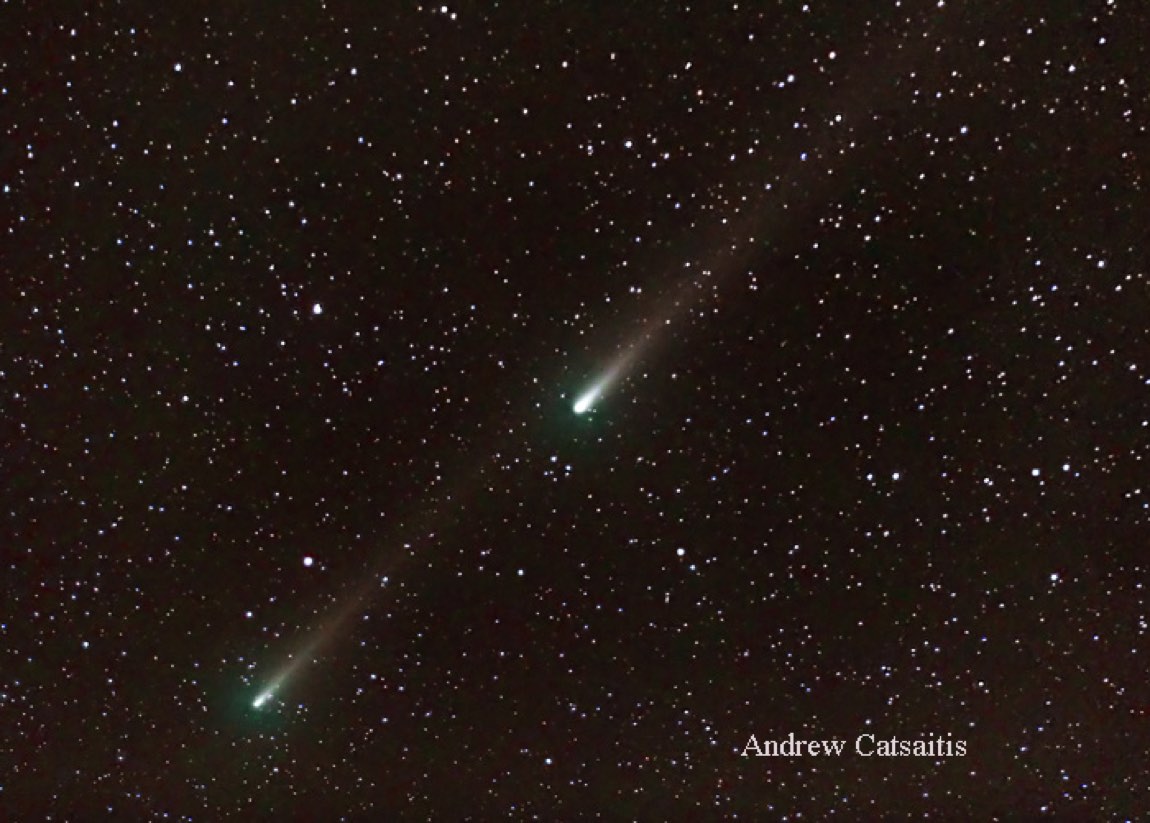
 Photograph · Andrew Catsaitis · Public domain
Comet · Deep guide
Comet Schwassmann–Wachmann 3 (73P)
Also called: 73P/Schwassmann–Wachmann · Schwassmann–Wachmann 3 · SW3
A comet caught in the act of falling apart, shedding fragments since 1995.
What is it?
73P/Schwassmann–Wachmann was discovered at Hamburg in May 1930 and orbits the Sun every five and a half years. In September 1995 it began to disintegrate as it warmed up near the Sun, and it has kept breaking into pieces on later returns, with new fragments still being spotted in 2022. The original nucleus was about 2.2 km across; the main surviving piece, fragment C, is about 1 km.
The deep dive
Researched for the Atlas from Wikipedia — 73P/Schwassmann–Wachmann (5,324 characters read) · updated Nov 14, 2026
01 Two Astronomers Looking for Asteroids
The discovery of Schwassmann–Wachmann 3 was entirely accidental. Arnold Schwassmann and Arno Arthur Wachmann were working at the Hamburg Observatory in Bergedorf, Germany, exposing photographic plates in a systematic search for new asteroids as part of a minor planet survey. On 2 May 1930, an unexpected smudge on one of those plates turned out to be a comet — not an asteroid at all. Just four weeks later, on 31 May 1930, the newly found comet swept past Earth at a distance of only about 0.062 AU, which works out to roughly 9.3 million kilometres — close enough in astronomical terms that it produced a meteor shower on June 9 of that year, with observers counting as many as 100 meteors per hour. The comet then essentially vanished from records. The 1935 apparition had poor viewing geometry, and so the object was lost until it was finally recovered in 1979, nearly half a century after its discovery. Its 1990 return brought it to apparent magnitude 9, the best apparition recorded since the discovery year of 1930.
02 A Comet Coming Apart at the Seams
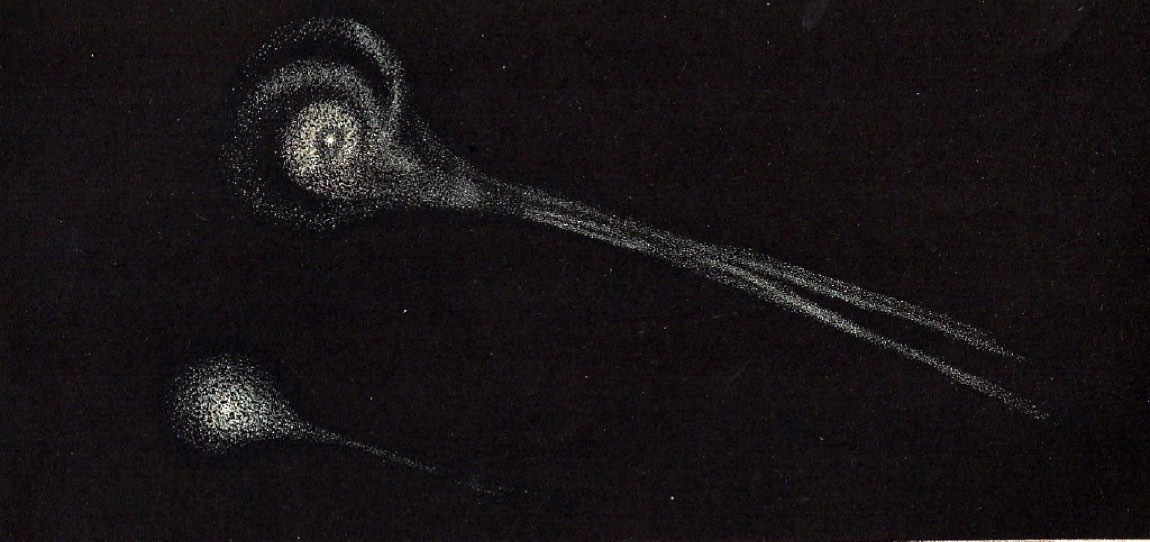
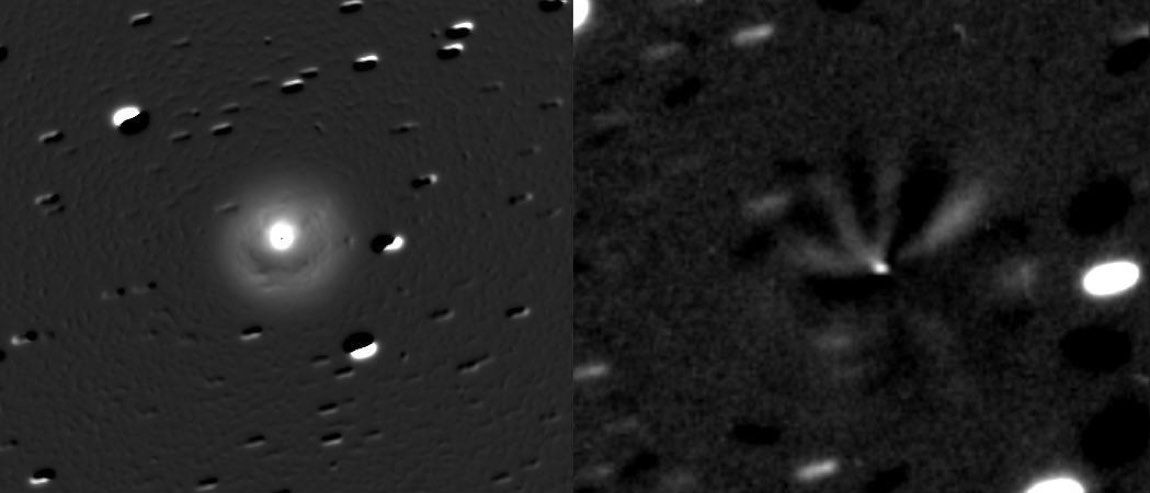
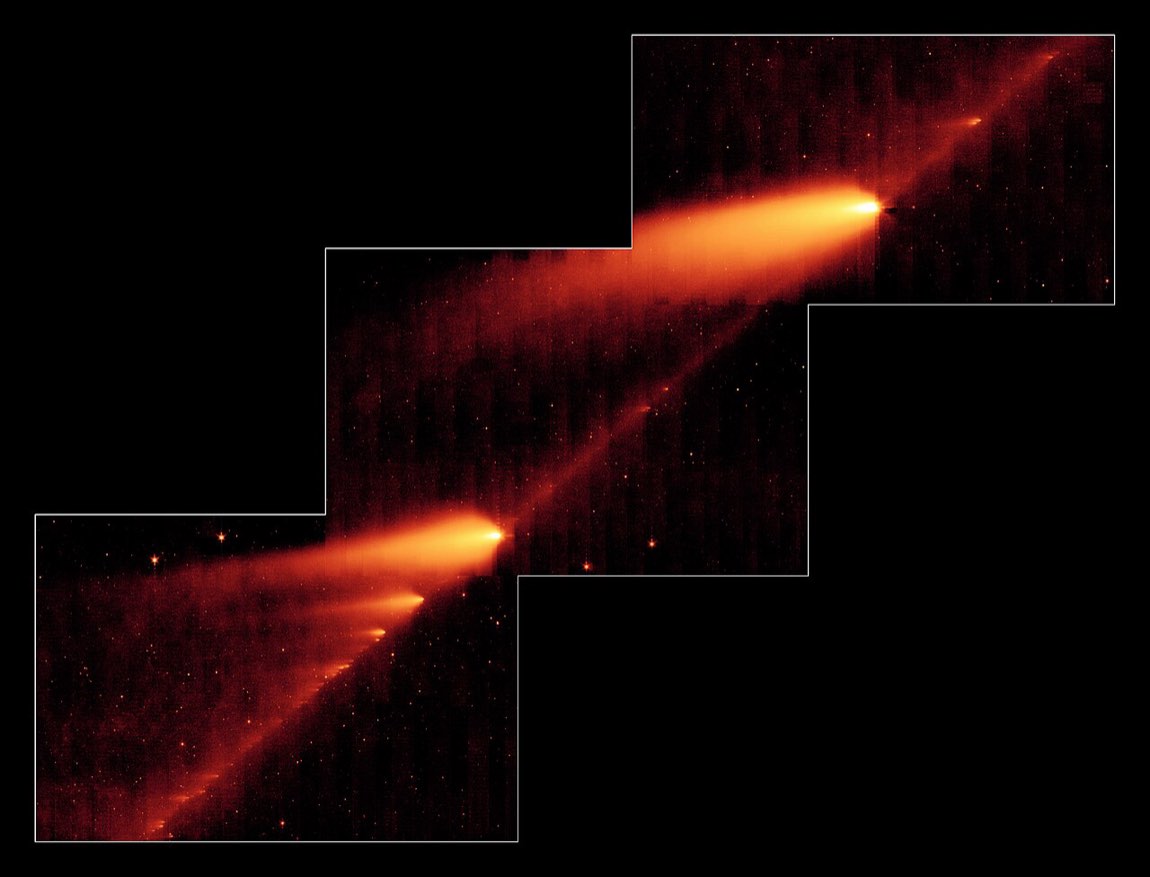
The defining moment in this comet's modern story came in September 1995, when it began visibly disintegrating as it re-entered the inner Solar System. The trigger was straightforward: the Sun's heat acting on icy material that had been preserved in the cold outer Solar System, causing volatile ices to explosively sublimate and physically tear the nucleus apart. The comet was initially seen to break into four large pieces, labeled 73P-A, B, C, and D. By March 2006, at least eight fragments — B, C, G, H, J, L, M, and N — were confirmed. Then, on 18 April 2006, the Hubble Space Telescope captured images revealing dozens of smaller pieces shed by fragments B and G alone. By May 2006, the total count had climbed to at least 66 separate objects. Astronomers drew a pointed historical comparison: the 19th-century comet 3D/Biela disintegrated in almost exactly the same way and eventually disappeared entirely. If SW3 follows the same fate, its designation would formally change from 73P to 73D, marking it as a comet that no longer exists.
03 Fragment C: The Principal Survivor Deeper
Among all the pieces scattered by the 1995 breakup, fragment C emerged as the dominant remnant. In April 2006, it was identified as the largest surviving piece and was treated as the presumed principal remnant of the original nucleus. For context, the pre-breakup nucleus had been estimated at approximately 2.2 km in diameter — roughly the length of 22 football fields end to end. By 2005, fragment C alone had shrunk to an estimated diameter of about 1.0 km, suggesting that roughly half the original nucleus's width had already been lost to the disintegration process. During the 2011 perihelion passage, fragment C was recovered on 28 November 2010 at an apparent magnitude of about 21.3 — extremely faint, requiring large telescopes to detect — and went on to reach perihelion on 16 October 2011. The main comet then reached perihelion again on 25 August 2022, at that time only 0.97 AU from the Sun and exactly 1 AU from Earth, placing it at roughly the same distance as Earth is from the Sun.
 ⤢
04 How the Fragments Drift Apart Over Time Deeper
The dozens of fragments produced by SW3's breakup do not travel as a single formation. Because each piece separated at a slightly different speed, they now follow orbits with slightly different periods, and over many decades they will spread progressively further along the comet's orbital path. The range is already measurable: known fragments span orbital periods from 4.7 years for fragment 73P-AJ to 6.1 years for fragment 73P-Y. That nearly one-and-a-half-year gap in period means those two fragments arrive at the same point in their orbits at very different times, and the gap will keep widening. Fragment 73P-Y's best-fit orbital solution placed it near the orbit of Jupiter — roughly 6.0 ± 0.5 AU from Earth — at a time when the main fragment was just 1 AU away. By the 2022 perihelion season, fresh fragmentation was still occurring: fragments 73P-BU and 73P-BV were detected on 23 July 2022, reached perihelion on 24 August 2022, and were joined by three more fragments — BW, BX, and BY — announced on 2 September 2022, all discovered in mid-August of that year.
05 The Close Approaches of 2006
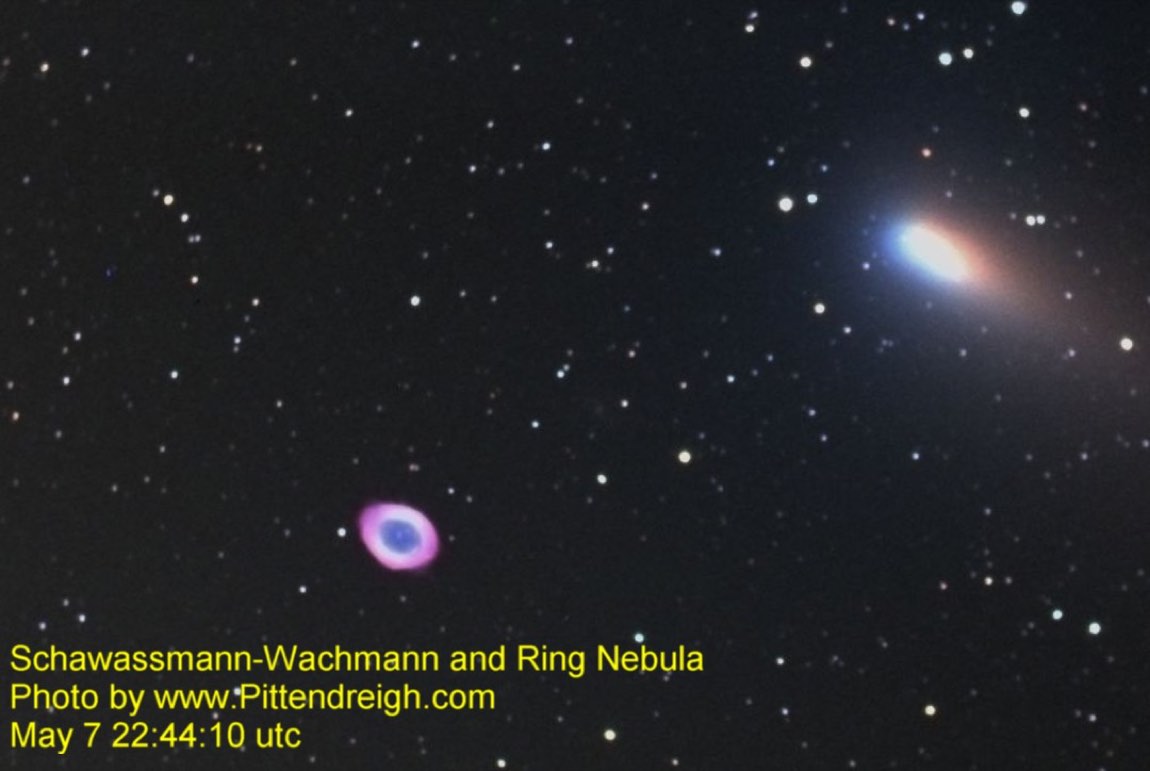
May 2006 was an unusually eventful month for observers watching SW3's parade of fragments. The comet came to its nearest point on 12 May 2006, closing to just 0.078 AU from Earth — about 11.7 million kilometres — which is close enough in astronomical terms to generate real excitement, though scientists were clear that there was no significant threat of debris colliding with Earth. A secondary fragment, 73P-T, was tracked over a 34-day observation arc and was calculated to have passed even closer, at roughly 0.059 AU (about 8.8 million kilometres), on 16 May 2006. The echoes of 1930 were on researchers' minds, since the 1930 flyby at a comparable distance had produced a genuine meteor outburst. Analysis by P. A. Wiegert and colleagues examined whether a similar spectacle might repeat in 2006 and concluded that a recurrence of the 1930-style shower with rates as high as 100 meteors per hour was unlikely, dampening expectations — though the passage still attracted enormous observational attention from both professional and amateur astronomers.
06 Tau Herculids: A Meteor Shower Born from Breakup
SW3 is the parent body of the meteor shower known as the Tau Herculids. This is not uncommon for periodic comets — as they shed material, streams of debris gradually fill the orbit, and Earth periodically sweeps through those streams, producing meteor showers. What makes SW3's case distinctive is that the dramatic 1995 breakup injected a fresh pulse of material into the debris stream, and that specific pulse produced a detectable meteor shower around 31 May 2022, peaking between approximately 4:00 and 5:00 UT. The event lasted only a few hours, described as a modest shower rather than a dramatic outburst. Nevertheless, it demonstrated that large-scale fragmentation events leave measurable astronomical fingerprints that persist for decades, with Earth occasionally cutting through the new material laid down by an episode of cometary self-destruction. The shower's character and density give researchers indirect evidence about how much material was dispersed during the 1995 breakup and how that debris is evolving through space.
 ⤢
07 An Orbit Shaped by Jupiter's Gravity Deeper
SW3's orbital architecture is deeply connected to Jupiter. The comet reaches aphelion — its farthest point from the Sun — in a region where Jupiter's gravitational influence is strong, and it has made close approaches to the giant planet at key moments in its history, including 1965 and a future encounter predicted for 2167. More recently, on 3 April 2025, SW3 made a modest approach of 0.3 AU to Jupiter. These repeated encounters are almost certainly responsible for sculpting the comet's current 5.4-year period and may have originally delivered the comet into its present orbit from a more distant trajectory. The comet also has an Earth Minimum Orbital Intersection Distance of 0.014 AU — roughly 2.1 million kilometres — meaning its orbital path comes quite close to Earth's own path, which is precisely why close approaches like those of 1930 and 2006 occur and why its debris stream can intersect Earth's orbit to produce meteor showers. The 2027 perihelion, by contrast, will occur with the comet on the far side of the Sun, 1.9 AU from Earth — a much less favourable geometry.
08 The Mission That Never Arrived
SW3 was once slated for a close-up spacecraft visit. NASA's CONTOUR mission — the Comet Nucleus Tour — was designed to fly past multiple comets and study their nuclei directly, and SW3 was on its itinerary for a planned encounter on 18 June 2006. It would have arrived right in the middle of the comet's spectacular 2006 fragmentation episode, potentially giving scientists an unprecedented close-range view of an actively disintegrating cometary nucleus. That encounter never happened. On 15 August 2002, ground controllers lost all contact with CONTOUR when it fired its Star 30BP solid rocket motor, the burn intended to inject the spacecraft into its solar orbit trajectory. The probe was never recovered, and SW3 passed through the inner Solar System in 2006 with no dedicated spacecraft to meet it. The lost opportunity remains one of the more frustrating near-misses in solar system exploration history, given that 2006 turned out to be an extraordinarily active period for the comet.
09 Fading Visibility: A Comet Hard to Catch
SW3's observational record is a story of repeated disappearances and recoveries. After its discovery on 2 May 1930, the comet was lost almost immediately: the 1935 apparition had such poor viewing geometry that it went undetected, and it was not recovered until 1979 — a gap of roughly 44 years. The 1985 perihelion was missed entirely because the comet was on the far side of the Sun, 1.9 AU from Earth. The 1990 return was the most favourable since 1930, reaching apparent magnitude 9. The 2022 perihelion was similarly hampered: the comet remained less than 80 degrees from the Sun from 25 May 2022 all the way until August 2023, making sustained observation difficult. The upcoming 2027 perihelion on 23 December will again place the comet on the far side of the Sun at 1.9 AU from Earth — repeating almost exactly the same geometry that caused the 1985 apparition to be missed. For observers, SW3 is a comet that frequently hides in the Sun's glare precisely when it is closest to it.
 ⤢
10 Will It Completely Disappear?
The open question hanging over every study of SW3 is simple: will it survive? The historical parallel astronomers return to is 3D/Biela, a 19th-century periodic comet that broke apart and was never seen again after its fragmentation, eventually receiving the designation change that marks a comet as defunct — from P (periodic) to D (disappeared). If SW3 follows the same trajectory, its current designation of 73P would formally become 73D. The evidence is not reassuring. The comet split into four pieces in 1995, produced at least 66 fragments by May 2006, and was still generating new fragments as recently as 2022, with five new pieces identified during that perihelion season alone. Each breakup episode leaves the surviving fragments smaller, more structurally weakened, and more susceptible to further fragmentation on subsequent passes near the Sun. Whether any single fragment is large and coherent enough to survive many more perihelion passages remains genuinely uncertain — and that uncertainty is itself scientifically valuable, offering a rare chance to watch cometary death in real time.