 Photograph · E. Weiß · Public domain
Comet · Deep guide
Biela's Comet (3D/Biela)
Also called: 3D/Biela · Comet Biela
A comet seen to split in two, then vanish, leaving only a meteor shower behind.
What is it?
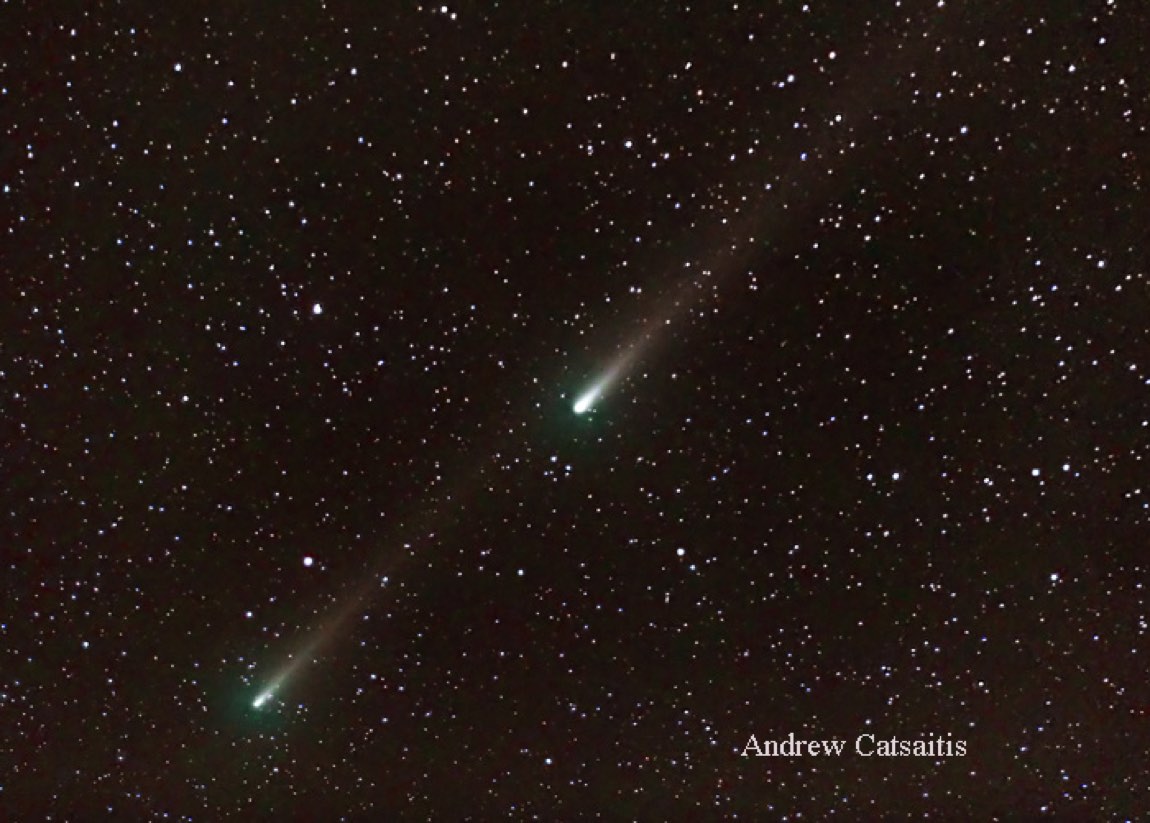
Biela's Comet was first recorded in 1772 and identified as periodic in 1826 by Wilhelm von Biela, with an orbit of about six and a half years. Astronomers later watched it split into two separate comets. Both pieces came back in 1852, but the comet has never been seen since and is considered destroyed. Its remains survive as the Andromedid meteor shower.
The deep dive
Researched for the Atlas from Wikipedia — Biela's Comet (10,516 characters read) · updated Nov 14, 2026
01 Three Discoverers and a Naming Dispute
The comet carries only one name today, but three different people independently laid claim to it. Jacques Leibax Montaigne spotted it first on 8 March 1772, and Charles Messier independently found it during the same apparition. Jean-Louis Pons recorded it again in 1805 without realising it was the same object. Then in 1826, Wilhelm von Biela — an army officer posted to the fortress town of Josefstadt — calculated that the comet was periodic and returned every 6.6 years. His name stuck, but not without controversy. Jean-Félix Adolphe Gambart made a later yet independent discovery in the same year and, crucially, provided the first rigorous mathematical proof linking the 1826 and 1805 apparitions. Letters from both Biela and Gambart appeared in the same issue of the Astronomische Nachrichten, creating an awkward tie. A third independent claim came from Thomas Clausen. Despite the contested priority, the comet was named after Biela — perhaps because he observed it first in 1826, and perhaps simply because astronomy's naming conventions favoured whoever computed the orbit.
02 The Third Periodic Comet Ever Known
When Biela confirmed the comet's periodicity in 1826, only two other comets in the entire history of astronomy had been proven to return on a schedule: 1P/Halley and 2P/Encke. Biela's was the third. That elite status made every return a public event, watched not just by professional astronomers but by a broader educated public increasingly aware that the solar system contained recurring visitors. The comet's orbital period of 6.6 years meant it could be observed multiple times within a single human lifetime, which helped astronomers track subtle changes in its path caused by planetary gravity. It was classified as a Jupiter-family comet, meaning Jupiter's immense gravitational influence had captured it into a relatively short orbit. That same influence, over decades, would subtly warp its trajectory — and may ultimately have played a role in stressing the fragile icy nucleus that eventually tore itself apart.
03 Public Panic Over a Comet That Missed
The 1832 return of Biela's Comet triggered one of the earliest mass-media astronomy panics on record. Orbital calculations by Heinrich Wilhelm Matthias Olbers, later refined by Marie-Charles Damoiseau to include planetary gravitational effects, showed that the comet's coma would likely pass through the Earth's orbit around October 29. Newspapers of the time transformed this technical result into predictions of catastrophic collision. What the coverage ignored — as the French scientist François Arago patiently explained in a public article — was that the Earth itself would not reach that same point in its orbit until November 30, a full month later, putting the two objects about 0.55 AU (roughly 82 million km) apart at closest approach. Arago calculated the actual probability of collision at 1 in 281 million, though he acknowledged that comet tail gases might theoretically cause harm. The episode stands as an early case study in the gap between scientific nuance and popular reporting on astronomical risk.
04 An Orbit That Intersected Earth's Path Deeper
What made Biela's Comet uniquely unsettling throughout the nineteenth century was not rumour but geometry. It was the only comet known at the time whose orbit actually crossed the Earth's orbital path. By 1832, the Earth-MOID — the Minimum Orbit Intersection Distance, the closest the two orbits could theoretically bring the bodies together — was just 0.0005 AU, or roughly 75,000 km. For scale, the Moon orbits at about 384,000 km from Earth, so the two orbits passed within a fifth of that lunar distance of each other. Even Olbers, writing in 1828, predicted that in roughly 2,500 years a collision with Earth was probable — a prediction dramatic enough to become the framing premise of the Russian science-fiction work The Year 4338: Petersburg Letters. The comet's close orbital relationship with Earth also meant that when it eventually disintegrated, its debris was deposited along a path that Earth would cross annually, seeding the meteor shower that remains its most visible legacy.
05 Watching a Comet Split in Real Time
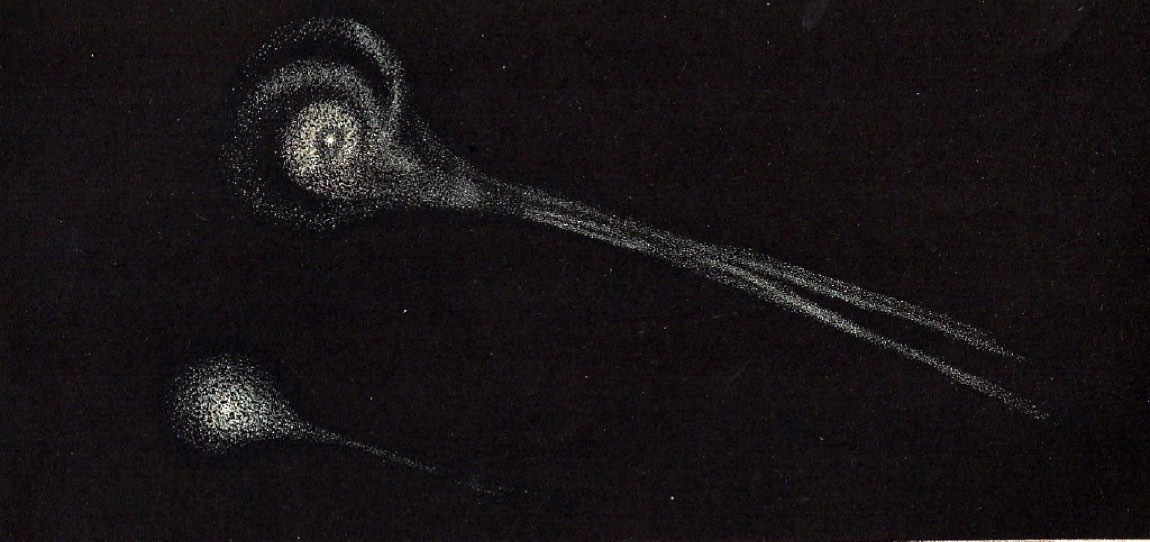
Francesco de Vico rediscovered the comet on 26 November 1845, and at first it looked ordinary, showing small faint nebulosities. Then, on 14 January 1846, Matthew Fontaine Maury noticed something strange: an apparent companion sitting just 1 arc minute north of the main nucleus. As more observers turned their telescopes to the sky, the picture clarified into something remarkable. The comet had split into two distinct pieces, now labelled Comet A and Comet B. The two halves developed parallel tails and alternated unpredictably in brightness as they approached perihelion. Some observers reported an archway of cometary matter bridging the two nuclei, hinting that the breakup may have produced many more fragments than just two, with smaller pieces simply too faint to resolve individually. Subsequent calculations suggested the nuclei had probably separated around 500 days before the 1845 apparition, with more recent analysis pointing to a split near aphelion in late 1842 — meaning the comet was quietly coming apart years before anyone noticed.
06 The Final Farewell: 1852 and Gone
The comet returned as predicted in 1852, and astronomers were ready. Angelo Secchi rediscovered Comet A on August 26. Comet B was relocated on September 16, and once again the two nuclei traded the role of brighter fragment back and forth. The final confirmed observations of either piece were made by Otto Wilhelm Struve: Comet A was last detected on September 26 and Comet B on September 29, 1852. No one knew at the time that these would be the last reliable sightings. When the predicted 1859 return came — admittedly an unfavourable viewing geometry — neither fragment appeared. The 1865 return also yielded nothing definitive, despite tantalising reports from Charles Talmage and James Buckingham who thought they glimpsed nebulous objects near the predicted positions. John Russell Hind, who had supplied the prediction ephemerides, concluded those sightings were unlikely to be Biela's Comet. By 1872 it was clear the comet was gone, though astronomers were about to learn exactly where it had gone.
07 3,000 Meteors an Hour: The Comet's Ghost
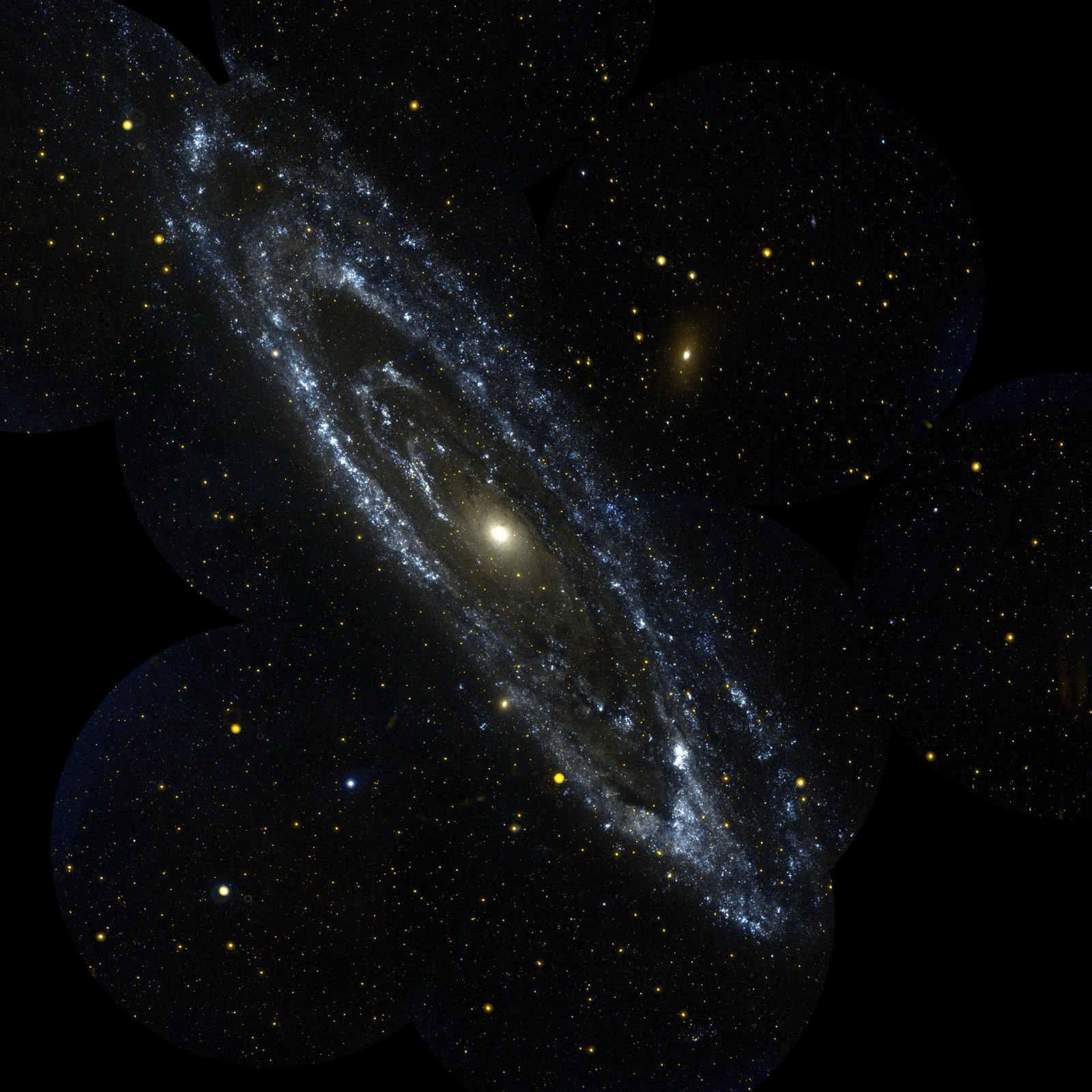
On the night of 27 November 1872, observers across the world watched a brilliant meteor shower erupt from the constellation Andromeda at a rate of 3,000 meteors per hour. The timing was not coincidental: that was precisely the date when Earth intersected the region of space where the comet had been predicted to cross in September 1872. Earth was sweeping through the debris streams laid down during the 1839 and 1846 passages of the comet. The meteors became known as the Andromedids, or sometimes the Bielids in honour of the comet that spawned them. They reappeared on subsequent nights throughout the remainder of the nineteenth century. Eventually, however, gravitational perturbations from the planets shifted the stream's orbital node outside Earth's path, and the great Andromedid displays faded away. In late 2023, the 1649 meteoroid stream associated with Biela was expected to generate only a modest increase in Andromedid activity — a faint echo of those spectacular Victorian storms.
08 Could Any Fragment Still Be Out There? Deeper
The destruction of Biela's Comet raises an intriguing open question: did all of it actually go? Calculations of the total mass of debris in the Andromedid meteor stream show it falls well short of the original comet's estimated total mass. If the main mass loss occurred near aphelion before the 1845 apparition — as the most recent orbital work suggests — then it is possible that fragment A, at least, still exists somewhere as a dormant comet, its volatile surface depleted but its bulk intact and simply inactive. Astronomers Brian G. Marsden and Zdeněk Sekanina attempted to compute a probable orbit for any surviving remnants. A search guided by Marsden's calculations led Luboš Kohoutek to a different discovery entirely: comet C/1973 E1, the famous Comet Kohoutek of 1973. The comet 207P/NEAT, found in 2001 by the Near-Earth Asteroid Tracking survey, was initially flagged as potentially related to Biela due to its similar orbit, though no firm link was established. The lost main mass of Biela's Comet remains unaccounted for.
09 The Chicago Fire Theory: Compelling but Disputed
Several of the most destructive fires in American history occurred on the same October night in 1871: the Great Chicago Fire, the Great Michigan Fire, and the Peshtigo Fire. A fringe theory, first proposed by Ignatius L. Donnelly in 1883 and revived in a 1985 book and an unpublished 2004 scientific paper, argues that fragments of Biela's Comet struck Earth and ignited all of them simultaneously. The idea is vivid and superficially tempting, but mainstream scientists reject it. The core problem is physical: meteorites are actually cold to the touch when they reach the ground, because their surface heating during atmospheric entry is brief and the interior never warms appreciably. No credible report exists of any fire being started by a meteorite anywhere. Furthermore, cometary nuclei have very low tensile strength, meaning that if an icy fragment survived to reach the lower atmosphere, it would most likely detonate as an air burst rather than strike the surface intact.
10 The Mazapil Meteorite and a Comet Connection Deeper
On 27 November 1885 — exactly thirteen years to the day after the great 1872 Andromedid storm — an iron meteorite fell in northern Mexico near Mazapil, coinciding with a spectacular Andromedid outburst of 15,000 meteors per hour. The timing seemed too neat to ignore, and the Mazapil meteorite was for some decades attributed to the disintegrating comet. However, the idea fell out of favour after the 1950s once scientists developed a clearer understanding of how iron meteorites form. Iron meteorites require a process called differentiation: a planetary body must be large enough to melt internally, allowing heavy iron to sink to its core and then be excavated by a later collision. Comets, as small icy bodies, simply cannot undergo differentiation. An iron meteorite could not have originated from Biela's Comet regardless of the coincidental timing. The Mazapil fall remains an impressive historical curiosity, but its connection to Biela is considered essentially ruled out by modern planetary science.
11 Biela's Role in the Ether Debate Deeper
Before the twentieth century dismantled the concept entirely, physicists and astronomers believed that all space was filled with an invisible medium called the luminiferous aether, through which light and gravity propagated. Biela's Comet, alongside Comet Encke, contributed observational data to that now-discredited debate. Astronomers noticed that the orbit of Biela's Comet was gradually shrinking in size from one apparition to the next. The explanation favoured at the time was that the comet was experiencing drag as it moved through the aether, losing energy and spiralling inward just as a satellite loses altitude due to atmospheric drag. The idea gave the aether theory a concrete, measurable prediction grounded in real celestial mechanics. We now understand that such orbital changes in comets have far more mundane explanations — including outgassing forces from the nucleus itself — and the aether was conclusively abandoned in the early twentieth century. Biela's shrinking orbit was a footnote in a long scientific wrong turn.
12 A Comet That Entered Literature and Folklore
Few comets have embedded themselves so deeply in popular culture as Biela's. The public panic of 1832 was so vivid that it inspired creative works almost immediately. Edgar Allan Poe's 1839 short story The Conversation of Eiros and Charmion, which describes the destruction of Earth by a comet altering its atmosphere, may have drawn on both Biela's Comet and Lexell's Comet for its scenario. The collision prediction by Olbers — that in 2,500 years Earth faced probable impact — became the narrative engine of The Year 4338: Petersburg Letters, a Russian science-fiction text that imagined life on Earth in that far future year. Even the false 1899 prediction by Rudolf Falb, claiming the comet's remnants would destroy Earth on 13 November 1899, reportedly caused genuine public anxiety, particularly, as one contemporary source noted, among the poorer classes of Continental peasantry. Biela's Comet thus occupies a rare dual role: a genuine scientific landmark and a recurring character in the cultural history of cosmic dread.