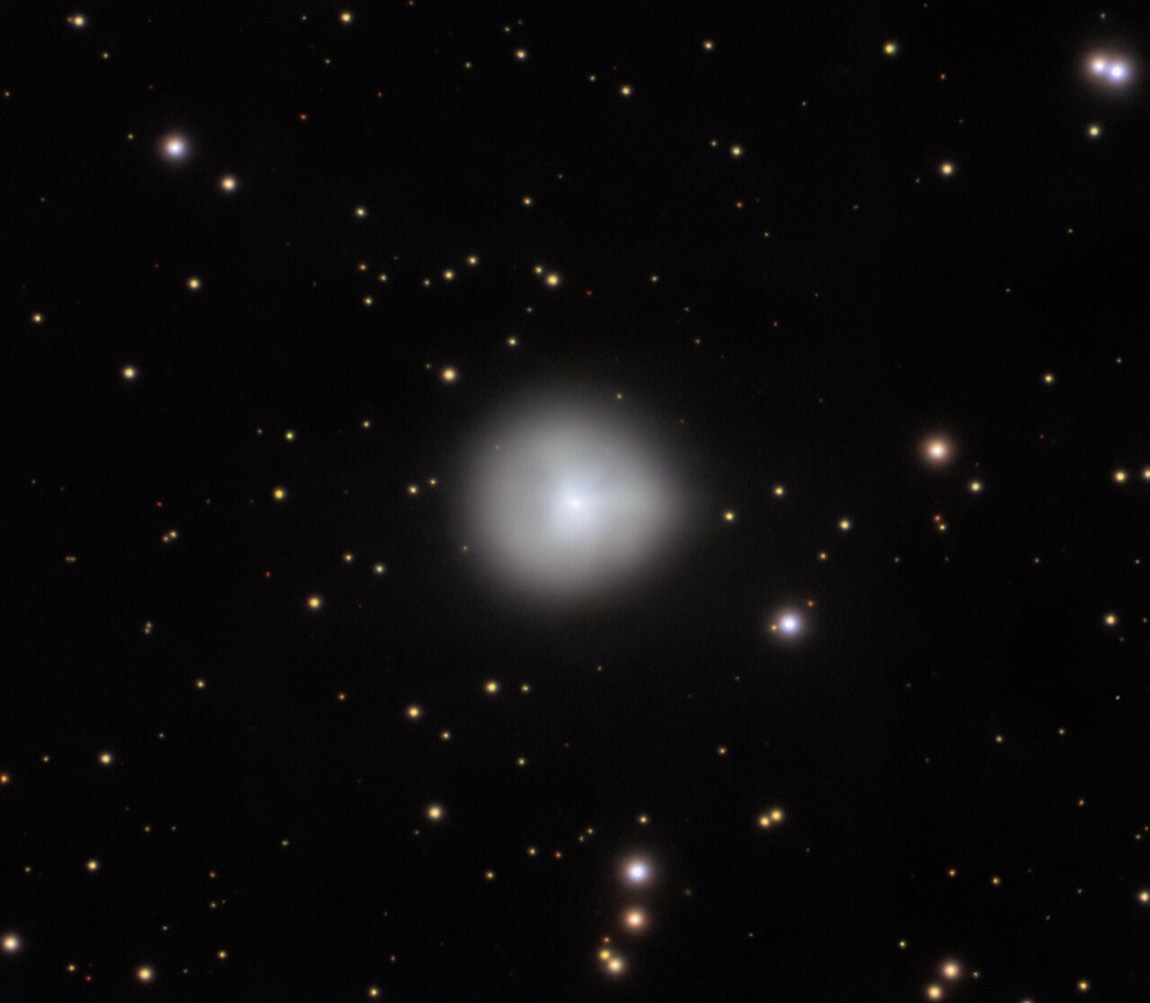
 Photograph · Juan lacruz · CC BY-SA 4.0
Comet · Deep guide
Comet Schwassmann–Wachmann 1 (29P)
Also called: 29P/Schwassmann–Wachmann · Schwassmann–Wachmann 1 · SW1
A 60-km comet on a near-circular orbit that erupts in outbursts several times a year.
What is it?
29P/Schwassmann–Wachmann was discovered at Hamburg Observatory in November 1927. Unlike most comets, it follows an almost circular orbit far from the Sun, never coming closer than about 5.8 AU. Its nucleus is about 60 km across, and it is famous for frequent outbursts that brighten it by two to three magnitudes, which makes it a favourite of amateur observers. Outbursts were recorded in April, May and November 2026.
The deep dive
Researched for the Atlas from Wikipedia — 29P/Schwassmann–Wachmann (3,326 characters read) · updated Nov 14, 2026
01 A Comet That Never Really Sleeps
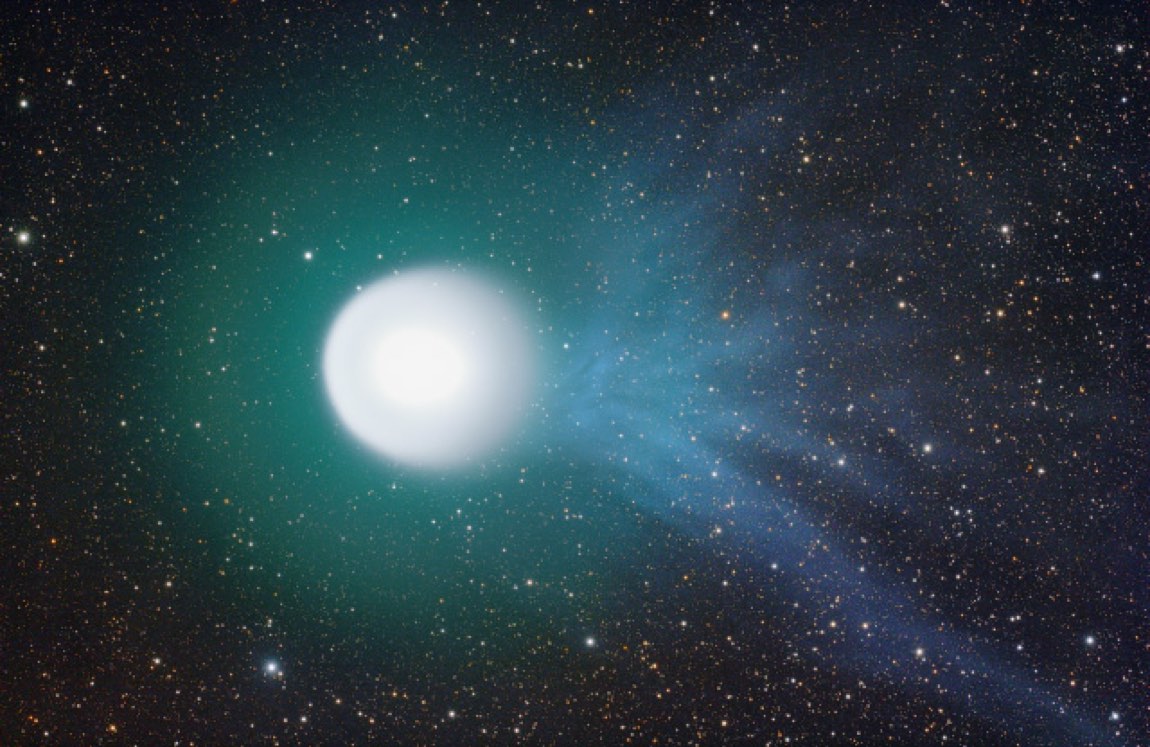
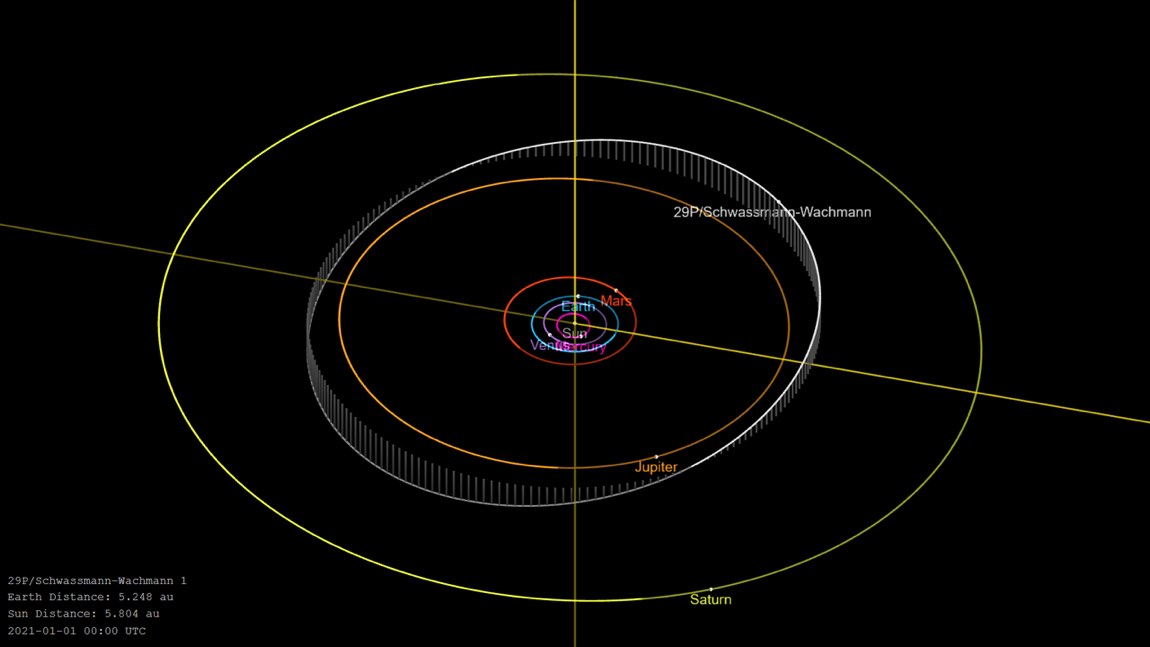
Most comets are active only when they swing close to the Sun, their ices briefly warming before they retreat into frozen darkness. Comet 29P is different. It spends its entire orbit at 5.8 to 6.3 AU from the Sun — just beyond Jupiter — and yet it maintains a persistent coma the whole time. The reason lies in its proximity to the snow line, the boundary in the solar system where water ice can survive in stable form. Near that threshold, even feeble sunlight is enough to keep volatile ices slowly sublimating. The result is a comet that never fully switches off, making it one of the most consistently observable comets known. At 16th magnitude during quiet periods, it sits at the limit of modest amateur telescopes, but its habit of sudden, dramatic brightening means that any observation session might catch it mid-outburst and looking dramatically different from the night before.
02 Photographed Before It Was Found
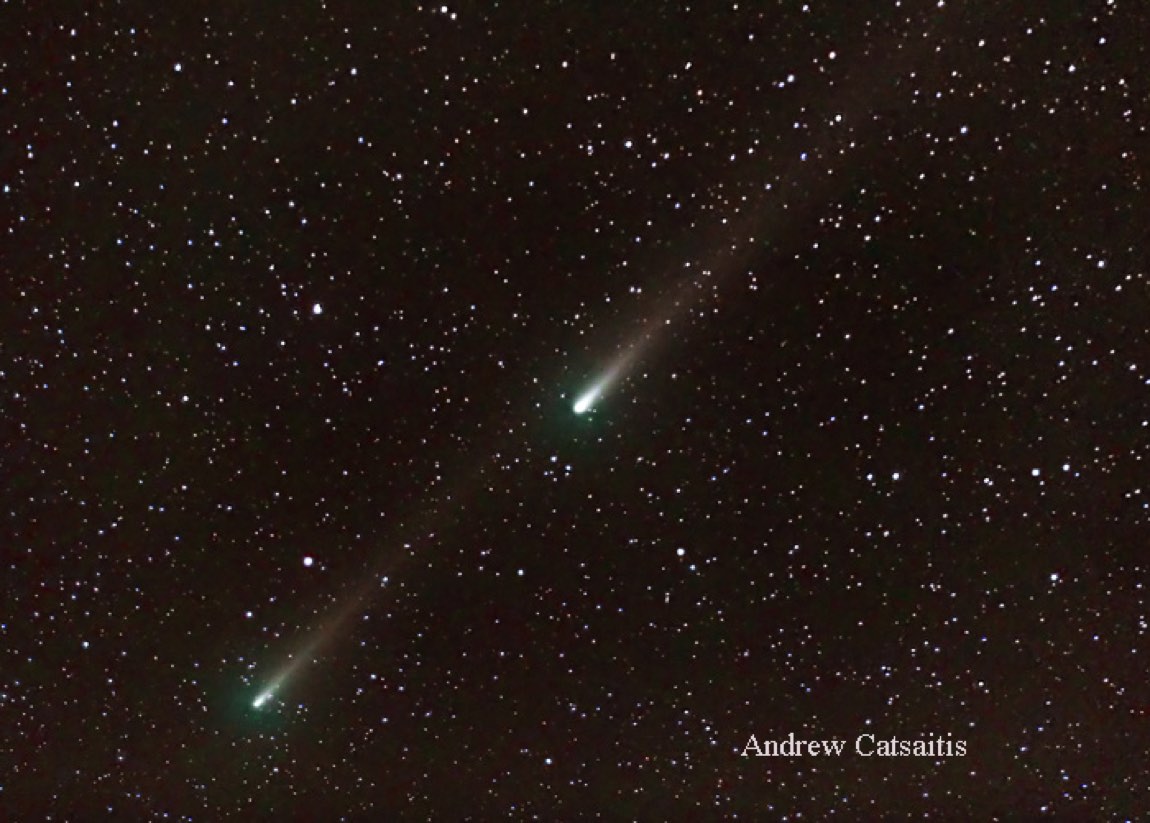
Arnold Schwassmann and Arno Arthur Wachmann discovered 29P on November 15, 1927, at the Hamburg Observatory in Bergedorf, Germany, by spotting it on photographic plates while the comet happened to be in outburst, shining at around 13th magnitude. Had it been in its quiet state near 16th magnitude, the discovery might have been missed entirely. The story of its true history stretches further back, however. In 1931, researchers digging through archival plates found precovery images taken as far back as March 4, 1902 — twenty-five years before the official discovery — showing the comet glowing at 12th magnitude. Precovery images like these are invaluable: they extend the baseline of observations, allowing astronomers to refine orbital calculations and understand how the comet has behaved over decades. The 1902 plates suggest that 29P's remarkable outburst behavior is not a recent development but a long-standing characteristic of this restless world.
03 An Outburst Over in Hours, Remembered for Weeks
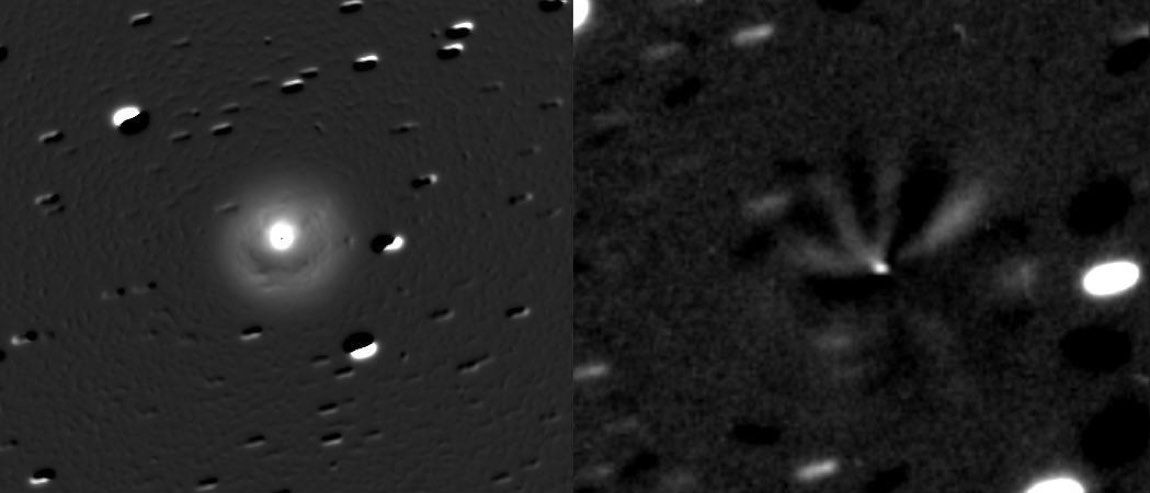
The outbursts of 29P are startling in their speed. From the moment one begins, the comet rises to peak brightness in roughly two hours — faster than a typical thunderstorm develops on Earth. The subsequent fade is far more leisurely, taking a week or two. The sheer pace of the brightening is a critical clue: it strongly points to cryovolcanism as the driver. In a cryovolcanic event, pressurized pockets of volatile material — gases like carbon monoxide or carbon dioxide locked beneath the surface — rupture suddenly, spraying enormous quantities of material into space in a geological instant. Between 2014 and 2026, observers recorded 120 such outbursts, averaging about 10 per year. The long-term average is 7.3 outbursts per year, and in its most extreme events the comet swings from 18th magnitude all the way to 10th — a more than thousand-fold increase in brightness. The December 2025 outburst, for instance, reached about magnitude 13, bright enough to be tracked by modest backyard equipment.
04 Twin Outbursts and a 58-Day Drumbeat Deeper
One of the most intriguing patterns in 29P's behavior is its tendency to produce pairs of outbursts in close succession. During 2025, eight notable outbursts arrived as four twin events: January 2 and 6, February 1 and 2, May 13 and 25, and December 4 and 11. This pairing hints at something structural — perhaps two active source regions rotating into sunlight in sequence, or a single region that fires twice as internal pressure rebuilds. Underlying these twins is a broader 58-day periodicity in outburst timing that astronomers believe reflects the rotation period of the nucleus itself. With a rotation period of about 58 days, 29P qualifies as an extraordinarily slow rotator; for comparison, Earth completes a full rotation in one day and even large asteroids typically spin in hours to days. If the same face of the nucleus is repeatedly exposed to whatever triggers eruptions, that slow spin could pace the outbursts like a geological clock, making 29P one of the few comets whose internal rotation can be inferred from its eruptive rhythm rather than direct imaging.
05 A Refugee from the Kuiper Belt
29P belongs to the centaurs, a class of more than 1,000 known small icy bodies orbiting between Jupiter and Neptune. The centaurs are not a permanent fixture of their current locations; they are refugees. Gravitational nudges have recently — in astronomical terms — scattered them inward from the Kuiper belt, a broad disk of trans-Neptunian objects stretching from Neptune's orbit out to roughly 50 AU from the Sun. 29P currently orbits within that unstable centaur zone, and Jupiter is not done with it. Frequent gravitational perturbations by the giant planet will gradually accumulate, and by around the year 4000 the comet is expected to migrate either inward toward the inner solar system or outward toward the distant reaches. This transient nature makes every observation of 29P historically precious: we are catching a Kuiper belt émigré in a temporary, dynamic phase of its long journey through the solar system.
06 A Family of Centaurs Around It Deeper
29P may not be entirely alone in its orbital neighborhood in a meaningful sense. A number of other centaurs appear to be both dynamically and perhaps even physically related to it, suggesting they share a common origin or have been sculpted by similar gravitational forces. What makes this especially striking is that some of these related objects are thought to actually pass through 29P's coma during its outburst phases. A coma can extend hundreds of thousands of kilometers from the nucleus, and during a major outburst it becomes a temporary, tenuous nebula drifting through space. The idea that a sibling centaur might physically travel through that expanding cloud of gas and dust is extraordinary — one small world briefly enveloped by the outgassing of another. These dynamical families are still being mapped and debated; whether the physical relationship between 29P and its neighbors is real or coincidental remains an open question that future surveys of the outer solar system may help resolve.
 ⤢
07 How Its Vast Nucleus Was Measured Deeper
With a nucleus estimated at 60.4 ± 7.4 kilometers in diameter, 29P is among the largest known cometary nuclei. That size makes it roughly the width of the state of West Virginia compressed into a single icy body. Measuring a comet nucleus is genuinely difficult: the coma of gas and dust surrounding it scatters light and masks the solid surface from direct optical imaging at typical distances. Astronomers must use thermal observations and careful modeling to separate the faint signal of the nucleus from the much brighter surrounding haze, which is why the measurement carries an uncertainty of 7.4 km. The sheer scale of the nucleus matters for understanding outbursts: a larger body retains more material and can sustain a higher outburst frequency over a longer active lifetime. It may also explain why 29P produces outbursts so persistently — there is simply a vast reservoir of volatiles waiting beneath the surface to drive eruptions for millennia to come.
08 Citizen Scientists on the Front Lines
Because 29P is observable throughout its entire orbit and prone to sudden, unpredictable outbursts, professional astronomers cannot monitor it continuously with limited telescope time. This has made it a favorite target of citizen scientists — amateur observers around the world who submit brightness estimates and images through coordinating networks. Their collective effort is what makes statistics like "120 outbursts between 2014 and 2026" possible; no single professional program could achieve that density of coverage. The comet's large size and relatively bright outburst peaks — sometimes reaching 10th magnitude — mean that even modest telescopes equipped with CCD cameras or sensitive digital sensors can contribute scientifically useful data. For citizen astronomers, 29P offers the rare thrill of catching an event in real time: an alert goes out, observers worldwide turn their telescopes to a patch of sky, and within hours a brightening comet confirms that another cryovolcanic eruption has just reshaped its surface.
09 Tracking 29P Across the Sky Right Now
29P crossed the celestial equator in late 2025 and is drifting progressively southward. By April 2029, it will reach a declination of −31°, placing it firmly in southern skies and gradually disadvantaging observers in the northern hemisphere while opening excellent windows for those in Australia, South Africa, and South America. The comet reached aphelion — its farthest point from the Sun — on September 30, 2026, and came to solar conjunction just four days earlier on September 26, 2026, when it was lost behind the Sun. It will next reach opposition on April 5, 2027, when it rises opposite the Sun in the sky and is best placed for nighttime observation. Because its orbit keeps it near 6 AU at all times, its distance from Earth varies relatively little compared with comets that swing through the inner solar system, meaning observers get a consistently placed target rather than a brief window of visibility.
10 What Keeps Its Outbursts Going: Cryovolcanism Deeper
The two-hour rise time of 29P's outbursts is a fingerprint that cryovolcanism theorists find compelling. On Earth, a volcano erupts when pressure beneath the surface overcomes the mechanical strength of overlying rock. On 29P, the analogous process involves volatile ices — most likely carbon monoxide or carbon dioxide, which remain liquid or gaseous at the frigid temperatures of 5–6 AU — building pressure in subsurface cavities until a weak point in the crust gives way. The sudden decompression launches a jet of gas and entrained dust into the coma, temporarily enormously increasing the comet's cross-section of reflective material and therefore its apparent brightness. What makes 29P exceptional is that this process repeats at an average rate of 7.3 times per year with no sign of exhaustion over the decades it has been observed. Whether the same vents reactivate repeatedly or new ones open with each eruption is still not established, but the 58-day rotation-linked periodicity in outburst timing suggests that specific active regions on the surface are rotating in and out of favorable conditions.
11 Open Questions That Still Haunt Researchers Deeper
Despite nearly a century of observations, 29P leaves fundamental questions unanswered. The precise composition of the volatiles driving outbursts has not been definitively pinned down from the article record. The relationship between the 58-day rotation period and the pairing of outburst events remains suggestive but not fully explained — it is unclear whether paired eruptions reflect two distinct active regions or a single region with a recharge mechanism. The physical reality of the proposed family of related centaurs, and whether any of them have genuinely passed through 29P's coma, awaits confirmation. Perhaps the deepest uncertainty is the comet's long-term fate: while gravitational modeling points to a significant orbital change by around the year 4000, whether 29P will plunge inward to become a spectacular inner-solar-system comet or be flung outward to rejoin the distant population is not known. Each outburst observed today adds a small piece to that larger puzzle, making ongoing monitoring scientifically essential.
 ⤢