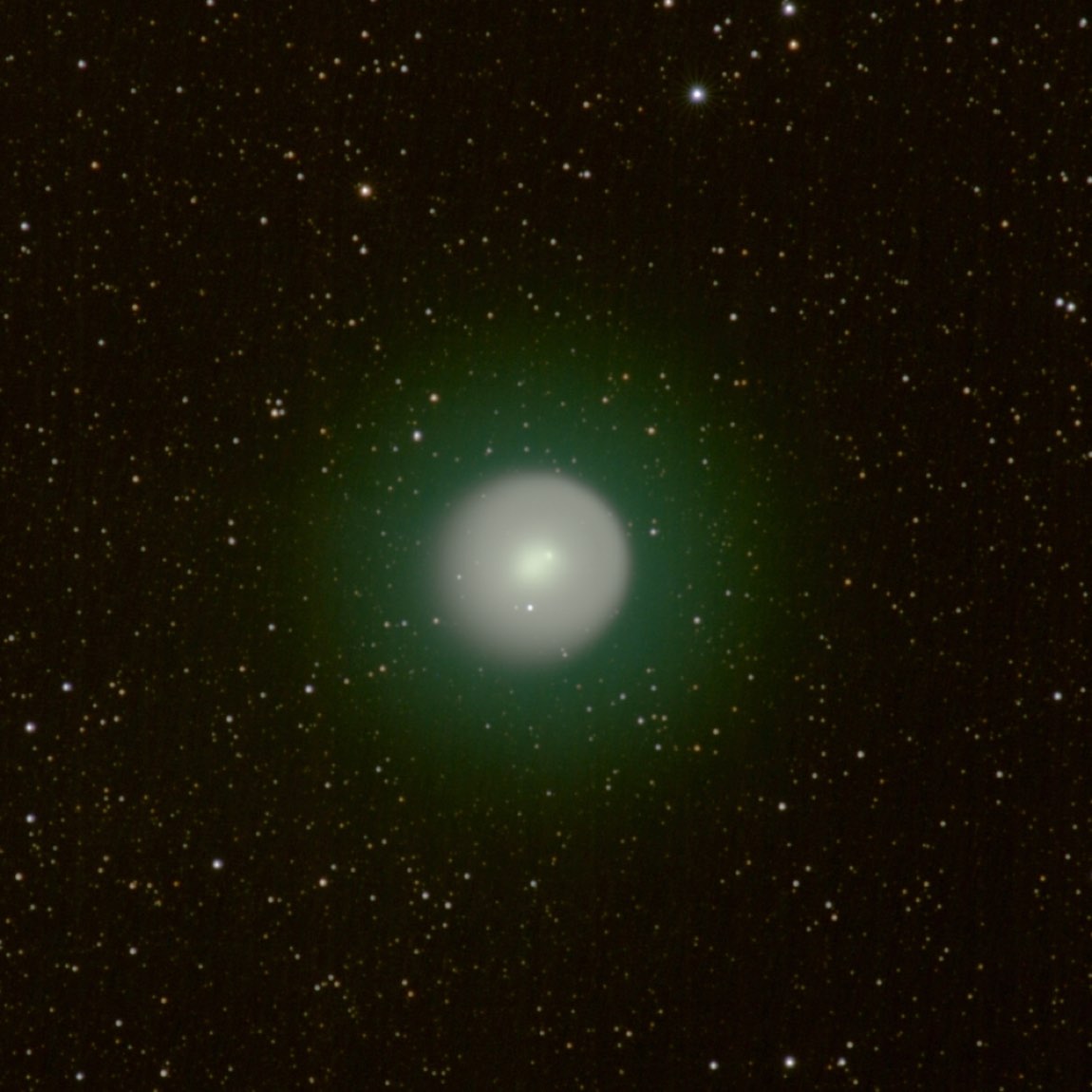
 Photograph · Iván Éder · CC BY-SA 3.0
Comet · Deep guide
Comet Holmes (17P/Holmes)
Also called: 17P/Holmes
In 2007 it brightened a millionfold in two days, the biggest comet outburst ever seen.
What is it?
Comet Holmes was discovered by British amateur Edwin Holmes in November 1892 during an outburst. Normally it is a faint telescopic object, but in October 2007 it suddenly jumped from about magnitude 17 to 2.8 in only 42 hours, becoming visible to the naked eye. Its expanding dust cloud briefly grew wider than the Sun, making it for a while the largest object in the Solar System by size, although its mass stayed tiny.
The deep dive
Researched for the Atlas from Wikipedia — Comet Holmes (5,504 characters read) · updated Nov 14, 2026
01 An Amateur Astronomer Stumbles onto a Comet
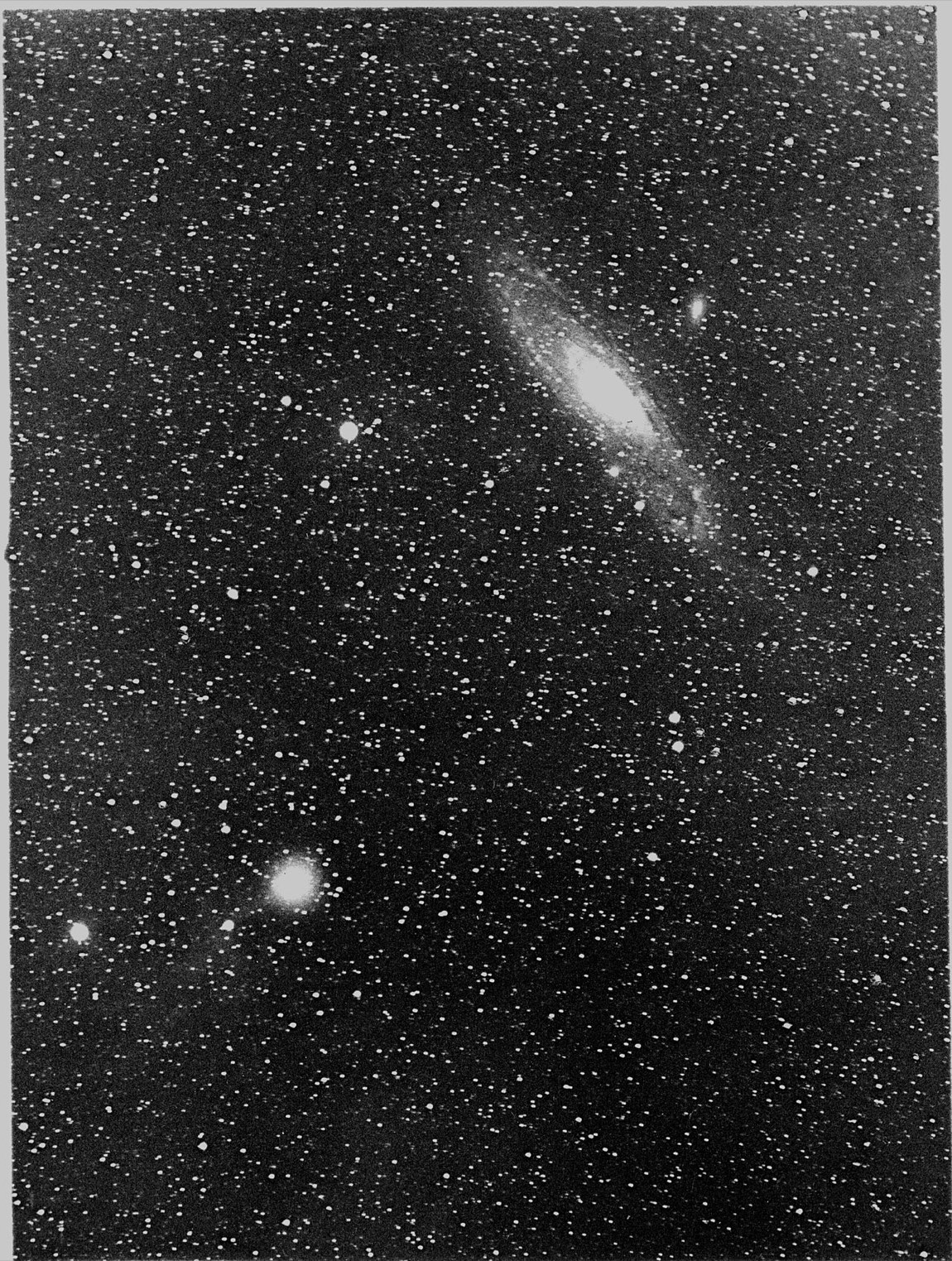
Edwin Holmes was not hunting comets on the night of November 6, 1892 — he was conducting routine observations of the Andromeda Galaxy (M31) when an unexpected brightening caught his eye. What he found turned out to be a periodic comet, now officially designated 17P/Holmes, and it remains the only comet he ever discovered. The find was quickly confirmed by Edward Walter Maunder at the Royal Observatory in Greenwich, William Henry Maw in Kensington, and B. Kidd in Bramley, Surrey. Independent discoveries followed within days: Thomas David Anderson in Edinburgh spotted it on November 8, and Mike Brown in Wilkes, USA, and John Ewen Davidson in Mackay, Queensland, Australia each found it independently on November 9. That five observers across three continents noticed the comet within just three days is itself telling — the comet had brightened dramatically enough to betray itself even to observers who weren't looking for it, reaching an approximate magnitude of 4 or 5 before fading over several weeks. The 1892 outburst and the famous 2007 event are therefore eerily parallel chapters in the same comet's story.
02 Pinning Down the Orbit — and What It Ruled Out Deeper
Once the comet was confirmed, the pressing task was to calculate where it had come from and where it was going. Heinrich Kreutz and George Mary Searle independently worked out the first elliptical orbit for 17P/Holmes, and their combined efforts eventually fixed a perihelion date of June 13 and an orbital period of 6.9 years. One of the most consequential outcomes of that calculation was what it disproved: some observers had wondered whether Holmes might be a surviving fragment of Biela's Comet, the famous periodic comet that had split apart and effectively disintegrated in the mid-nineteenth century. The orbital solution put that speculation to rest — 17P/Holmes was an entirely different object on its own trajectory. Between the years 1857 and 2106, the comet's perihelion distance is projected to remain in the range of 2.05 to 2.36 AU from the Sun, keeping it in the outer part of the inner solar system, well beyond Mars, for every pass it makes.
03 Lost for Nearly Sixty Years, Then Found Again
After its initial discovery apparition, Comet Holmes was successfully observed during its 1899 and 1906 returns. Then it vanished. For nearly six decades — from 1906 until July 16, 1964 — no one could locate it. The comet was considered 'lost,' meaning astronomers knew it should be returning but could not find it against the crowded backdrop of the sky. Its recovery was the work of Elizabeth Roemer at the US Naval Observatory Flagstaff Station in Arizona. The recovery was not simply a matter of pointing a telescope in roughly the right direction; it depended on precise orbital predictions computed by Brian G. Marsden. Marsden's computer-aided calculations gave Roemer a tight enough search window to actually find the faint object. The collaboration between predictive computation and skilled observational work set a template: aided by Marsden's ongoing predictions, 17P/Holmes has been successfully observed on every subsequent return since 1964, transforming it from a lost comet into a reliably tracked one.
04 From Magnitude 17 to Naked Eye in 42 Hours
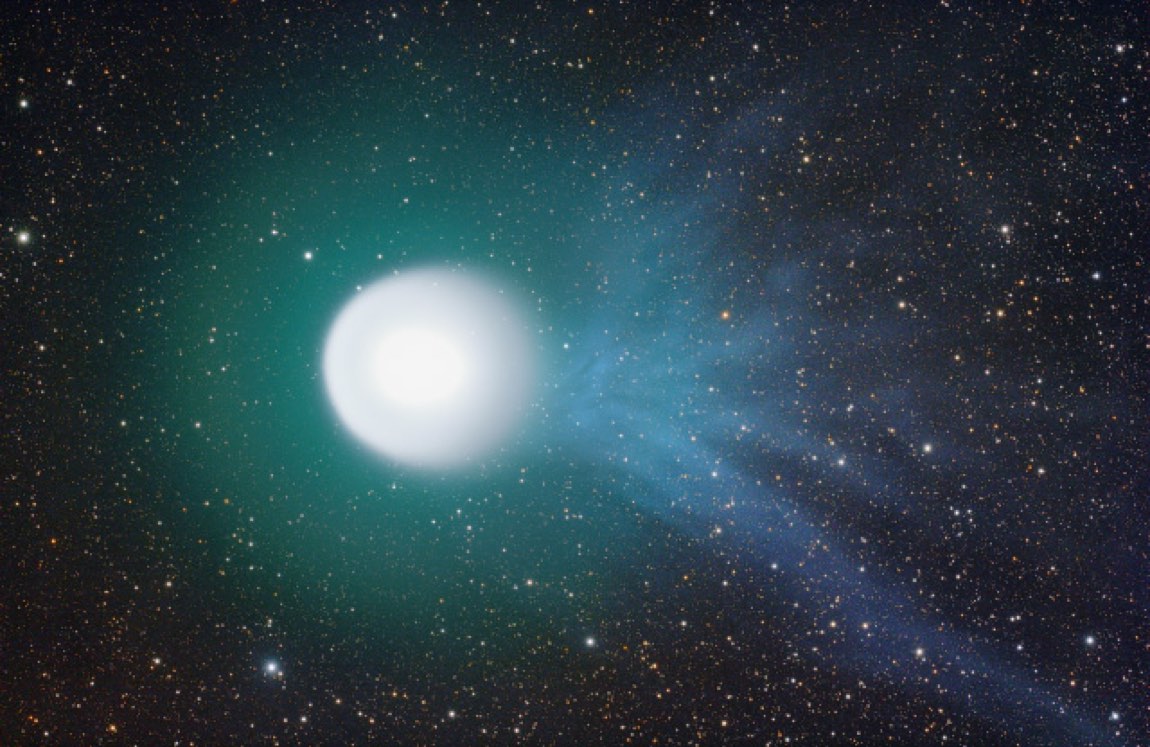
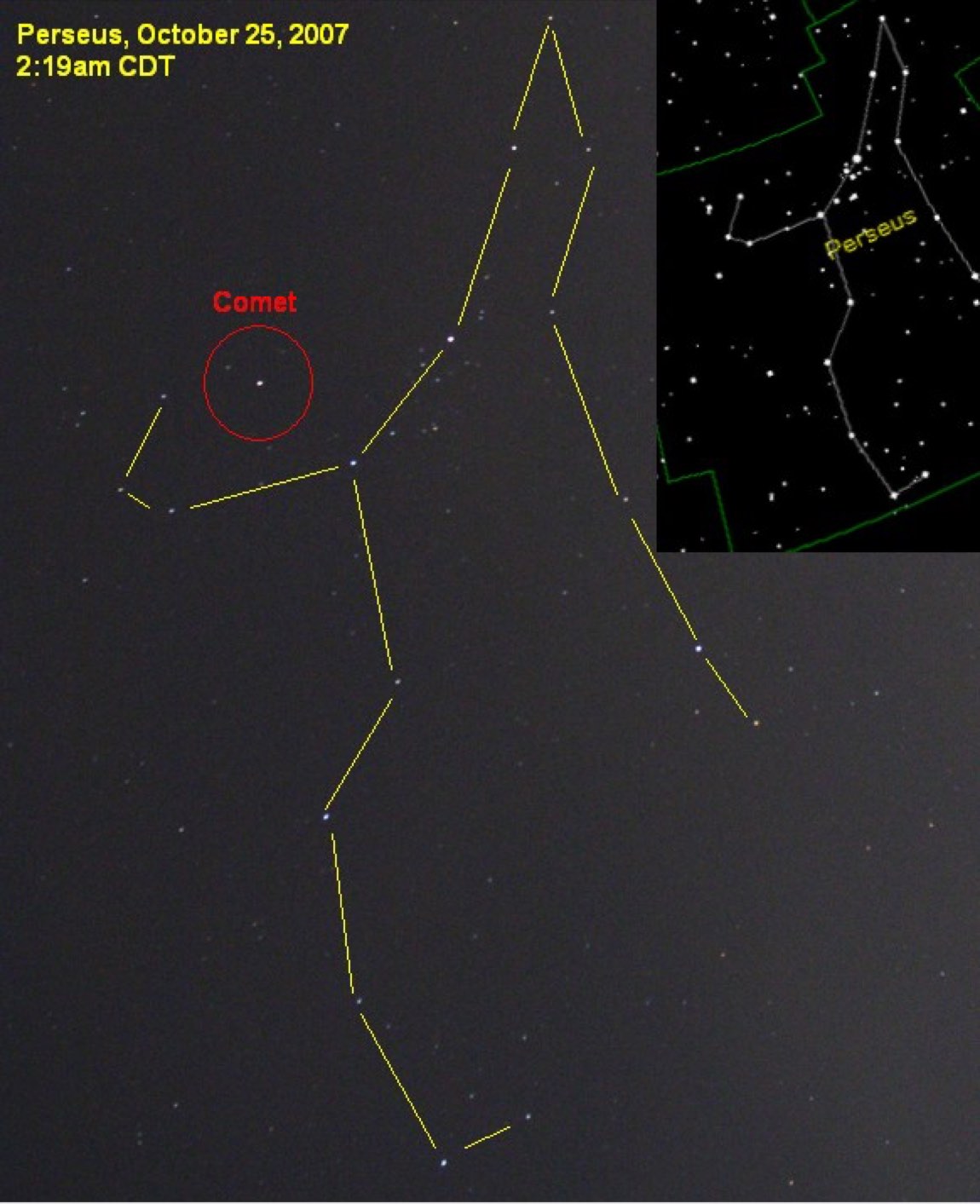
The 2007 outburst was staggering in its speed. Between October 23 and 24, 2007, Comet Holmes rocketed from a magnitude of about 17 — far too faint to see without a large telescope — to about magnitude 2.8, well within naked-eye range, in just 42 hours. That is a brightness increase by a factor of one million, which the article identifies as the largest known outburst by a comet. The first person reportedly to notice the change was J. A. Henríquez Santana on Tenerife in the Canary Islands; minutes later, Ramón Naves in Barcelona clocked the comet at magnitude 7.3. Within a day, 17P/Holmes appeared as a bright yellow 'star' in the constellation Perseus, and by October 25 it had become the third-brightest 'star' in that constellation. For observers using only their eyes, the comet initially looked star-like rather than fuzzy, partly because Earth's viewing geometry placed it near opposition, meaning observers were looking almost directly down the length of the comet's tail, compressing it into an apparently compact, star-like point.
 ⤢
05 A Coma That Swallowed the Sun's Volume
As the outburst progressed, the comet's coma — the cloud of gas and dust surrounding the solid nucleus — grew to extraordinary proportions. In late October 2007 its apparent diameter ballooned from 3.3 arcminutes to over 13 arcminutes, reaching about half the Moon's apparent diameter in the sky. Because the comet sat roughly 2 AU from Earth at the time, that angular size translated to a true diameter exceeding 1 million km, or about 70 percent of the Sun's diameter. For comparison, the Moon orbits Earth at a distance of 380,000 km, meaning the coma was a sphere wider than the entire span of the Moon's orbit. By November 2007 the coma had dispersed further, swelling to a volume larger than the Sun itself — briefly granting Comet Holmes the largest extended atmosphere of any object in the Solar System. Its mass, however, remained minuscule; the comet was enormous only in the sense of a nearly weightless fog filling a vast space.
06 Three Competing Explanations for the Blast Deeper
What actually triggered the outburst? The honest answer is that it is not definitively known. Two broad mechanisms have been proposed. The first is an external impact: a collision with a meteoroid could have suddenly excavated fresh volatile material from beneath the surface. The second, considered more probable, is an internal pressure buildup — gas accumulating inside the nucleus until it finally punched through the surface in a sudden explosive release. A third, more detailed explanation came from researchers at the Max Planck Institute, who published their analysis in the journal Astronomy and Astrophysics. They proposed that a thick, airtight dust cover acted as a heat trap, storing energy from solar insolation in the dust layer and in the nucleus over the months preceding the outburst. When water ice (H2O) began sublimating, the comet's porous internal structure provided up to one order of magnitude more surface area for that process than a simple smooth surface would, dramatically amplifying the gas release. The competing hypotheses are not mutually exclusive, and the 2007 event has not settled the debate.
07 A Pattern of Eruptions Every Few Decades Deeper
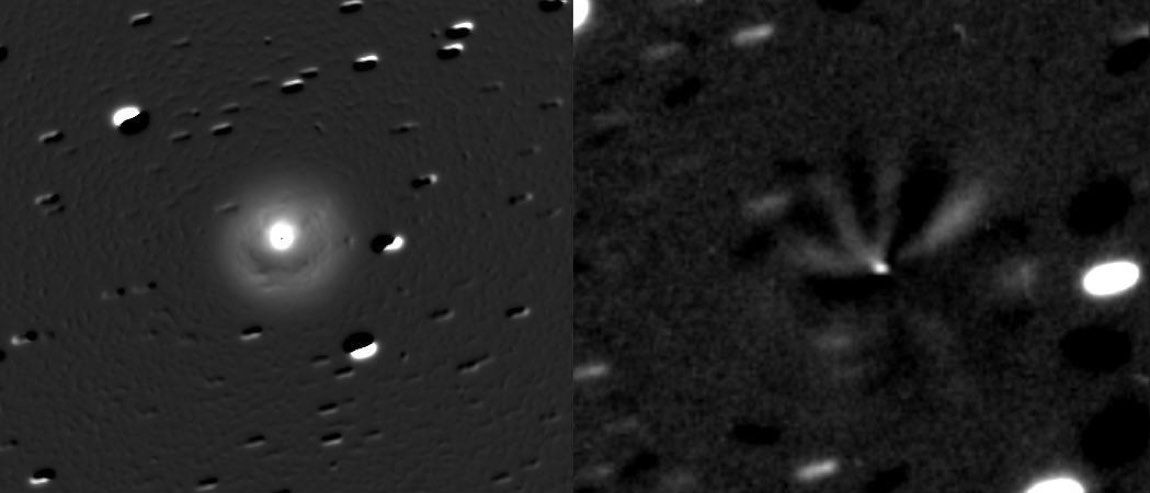
The 2007 explosion was extreme, but it was not entirely out of character for 17P/Holmes. The comet's very discovery in 1892 was possible only because of a comparable brightening to roughly magnitude 4 or 5 — an outburst strikingly similar in scale to the 2007 event. That symmetry is not just a coincidence of history. A 2012 modeling study revealed that Comet Holmes undergoes a recurring outburst pattern on two timescales: a smaller eruption roughly every 30 years, and a larger near-perihelion outburst on a cycle of approximately every 100 years. That framework places both the 1892 and 2007 events within the same long-period cycle. Supporting the ongoing activity of the nucleus, a separate outburst of 3 to 4 magnitudes was recorded in January 2015 — still substantial enough to be notable, though it required a large telescope to observe and did not approach naked-eye visibility. The dust trail from the 2007 outburst also shows an unusual behavior: it repeatedly converges back at the original outburst site.
08 How the Comet Looked as It Faded Away
The spectacle of late October 2007 gradually gave way to a different kind of observing challenge. By February 2008, Comet Holmes was still technically visible, but it had faded to around magnitude +5 — right at the edge of naked-eye detectability under good skies — and remained in the constellation Perseus. The reason it became difficult to see was not so much its faintness in total light output but the way that light was spread out. The coma had expanded to cover more than 2 degrees of arc as seen from Earth — four times the apparent width of the full Moon — diluting its surface brightness to a very low level. A large, dim smear is far harder to notice than a small, concentrated point of equal total brightness. This is a reminder that cometary visibility depends on both magnitude and angular size simultaneously, and that an expanding coma can paradoxically make a comet harder to observe even as it grows physically larger.
 ⤢
09 The Tiny Nucleus Behind the Giant Show
All of the drama of 2007 — the million-fold brightening, the coma wider than the Moon's orbit, the volume surpassing the Sun — originated from a nucleus estimated at just 1.71 km in radius, roughly the size of a small town. That object is so small relative to the cloud it produced that the disproportion is almost absurd: the coma at peak expansion was roughly 300,000 times wider than the nucleus itself. The nucleus is classified as a periodic comet in a roughly 6.9-year orbit, never swinging closer than about 2.05 AU to the Sun even at its nearest approach. It is a cold, dark, porous body that spends most of its life far from significant solar heating. The outburst behavior suggests a nucleus with internal structure capable of trapping heat and volatile gases over long timescales, releasing them in sudden episodic bursts rather than through steady, gentle sublimation — a behavior that makes 17P/Holmes a scientifically valuable case study in comet interior dynamics.
10 Finding Holmes in the Sky: A Practical Guide
During a quiescent apparition, Comet Holmes hovers around magnitude 17, requiring a substantial telescope and precise ephemeris data — the kind of object that professional and advanced amateur astronomers track rather than casual stargazers. The constellation to watch is Perseus: during both the 1892 discovery and the famous 2007 outburst, Holmes appeared there as an anomalous bright point. Because the comet's perihelion distance stays between roughly 2.05 and 2.36 AU throughout its known orbital history, it never comes especially close to Earth, which limits how bright it typically appears even in outburst. The 2007 event was exceptional precisely because the outburst coincided with the comet being near opposition — the geometry where Earth lies between the comet and the Sun — meaning the comet was both intrinsically active and optimally placed for viewing. Outside of such coincidences, the best practical tool for locating Holmes on any given return is a current set of computer-generated orbital predictions, the same kind of calculation that enabled Elizabeth Roemer's recovery of the comet in 1964.
11 Why 17P/Holmes Matters to Comet Science Deeper
Comet Holmes occupies an unusual place in the scientific literature because it offers two well-documented mega-outbursts separated by 115 years, plus at least one additional smaller event in 2015, all from the same identified nucleus. That record is rare. Most comets are either discovered during a bright outburst and never identified as periodic, or observed steadily without dramatic activity. Holmes provides a natural laboratory for testing models of cometary interior structure, heat storage, and volatile release. The Max Planck Institute study used the 2007 event to argue for a specific physical mechanism involving a dust insulating layer, H2O sublimation, and enhanced porosity — claims that can in principle be tested against future apparitions. The 2012 modeling work projecting a ~30-year minor outburst cycle and a ~100-year major cycle gives forecasters a framework to watch for. If those models hold, the next large near-perihelion outburst on the scale of 1892 or 2007 would be expected around the late 2000s or early 2100s, making ongoing monitoring of 17P/Holmes a scientifically worthwhile long-term project.
 ⤢