 Photograph · Herbert Couper Wilson · Public domain
Comet · Deep guide
Comet Pons–Brooks (12P)
Also called: 12P/Pons–Brooks · Comet Pons-Brooks
A 71-year Halley-type comet known for dramatic outbursts on its 2023–24 return.
What is it?
Comet Pons–Brooks was discovered by Jean-Louis Pons in 1812 and again by William Robert Brooks on its next return in 1883, and older records show it was seen even before that. It is a Halley-type comet that takes about 71 years to orbit the Sun and is one of the brightest periodic comets known. On its latest visit it reached perihelion on 21 April 2024 and grew to about magnitude 3.8.
The deep dive
Researched for the Atlas from Wikipedia — 12P/Pons–Brooks (10,558 characters read) · updated Nov 14, 2026
01 A Comet Witnessed Across Six Centuries
Long before Jean-Louis Pons pointed his telescope at the sky in 1812, observers half a world away were already recording this comet. Chinese astronomers noted a bright apparition in 1385, writing it into the Ming Shilu chronicle, and Paolo dal Pozzo Toscanelli — the same Florentine scholar famous for his maps — logged an appearance in January 1457 that Chinese sources also mention. In both of those pre-discovery visits the comet shone at magnitude 3 or brighter, rivaling the brightest stars in Orion. Researchers have even proposed that an entry in Chinese records from September 245 CE refers to the same body, though that link remains unconfirmed. The 71-year orbital clock means only a handful of human generations ever witness back-to-back returns, which makes the multi-century paper trail of observations all the more remarkable — and the job of matching ancient records to calculated orbits all the more painstaking.
02 The Discovery That Took Three Astronomers
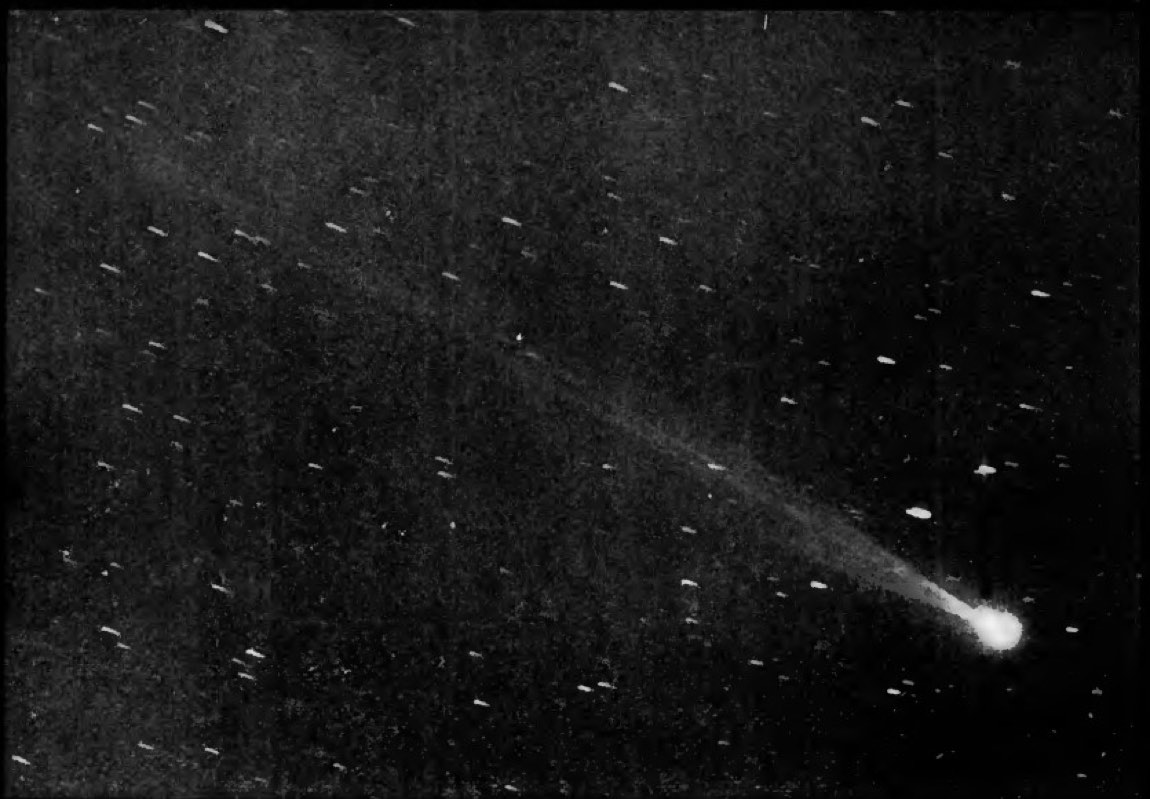
On 12 July 1812, Jean-Louis Pons swept the comet up from Marseilles Observatory, earning the first credit. Within three weeks, Vincent Wisniewski independently found it on 1 August and Alexis Bouvard on 2 August — a reminder of how quickly word traveled, or rather didn't, across early-19th-century Europe. By 13 August the comet was bright enough to see with the naked eye, and before the end of the month observers reported a tail stretching two full degrees across the sky, roughly four times the width of the full Moon. Johann Franz Encke then worked out a definitive orbit with a period of 70.68 years, precise enough that his ephemeris successfully guided astronomers to the comet's return more than seven decades later. When William Robert Brooks accidentally stumbled across a faint smudge on 2 September 1883 and it was matched to the 1812 object, Encke's mathematics were vindicated across a 71-year gap.
03 Outbursts: A Comet That Can't Stop Erupting
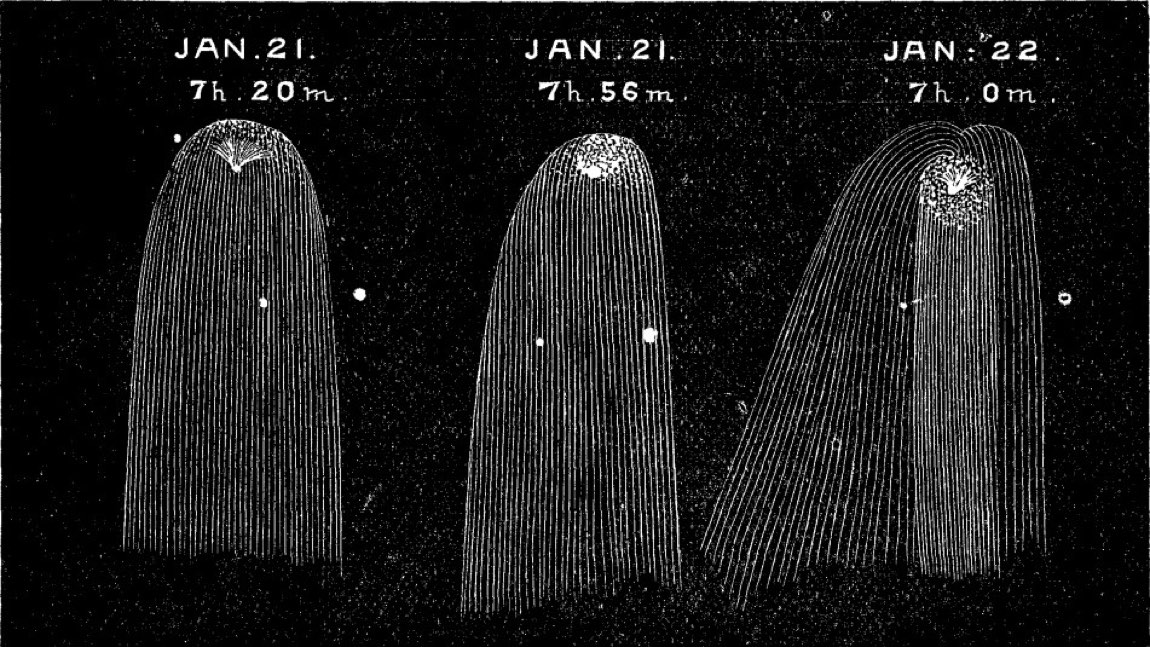
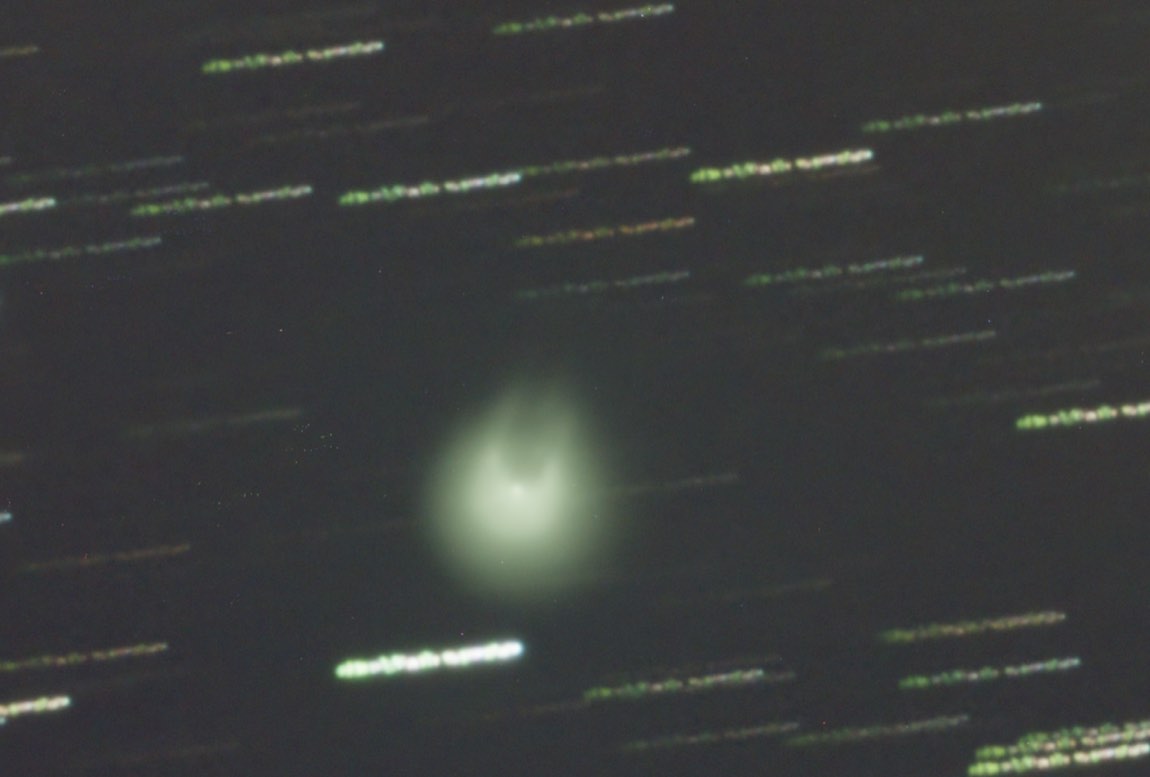
Pons–Brooks is unusually prone to sudden, dramatic brightenings. During the 1883–84 apparition it flared from magnitude 10–11 down to 8–8.5 in just two or three days, its appearance switching from a diffuse glow to something almost star-like. The 1954 return brought at least four outbursts, one of which leaped from magnitude 18 to 13 on a single day — a jump of roughly 100-fold in brightness. The 2024 apparition surpassed all prior records for documented activity: 14 well-observed outbursts struck between 13 June 2023 and April 2024 alone, at distances ranging from 4.26 AU all the way in to 0.85 AU from the Sun. The 5 October 2023 event alone brightened the comet by approximately 40 times. Even after perihelion, two more outbursts erupted during summer 2024. This relentless volatility is what earned the comet its popular nickname, the "devil comet," during its 2024 return.
04 Inside the Nucleus: Ranges, Not Certainties Deeper
Pinning down the true size of Pons–Brooks is genuinely difficult because the comet is already shedding material — and therefore glowing — before any telescope gets a clean look at the bare nucleus beneath. When Quanzhi Ye analyzed the 2020 recovery data, he estimated a radius of 17.0 ± 6.0 km, assuming a geometric albedo of 0.04 and an absolute magnitude of 13.4; that figure would make it roughly half the diameter of Hale–Bopp, estimated at 30 km radius. But because the comet was already active, that number is an upper limit. David C. Jewitt later applied a different approach, using the energy output of outbursts — around 4.3 × 10¹⁰ watts, equivalent to the solar energy falling on a 200 km² hemisphere — to revise the radius down to 5.6 km. At the lower bound, water-production data point to a minimum active surface of 70 km², implying a nuclear radius of just 2.2 km. Combining all estimates, the comet's mass likely falls between roughly 2 × 10¹³ and 10¹⁶ kg, assuming a density of 500 kg/m³.
 ⤢
05 The Coma That Grew Bigger Than the Sun
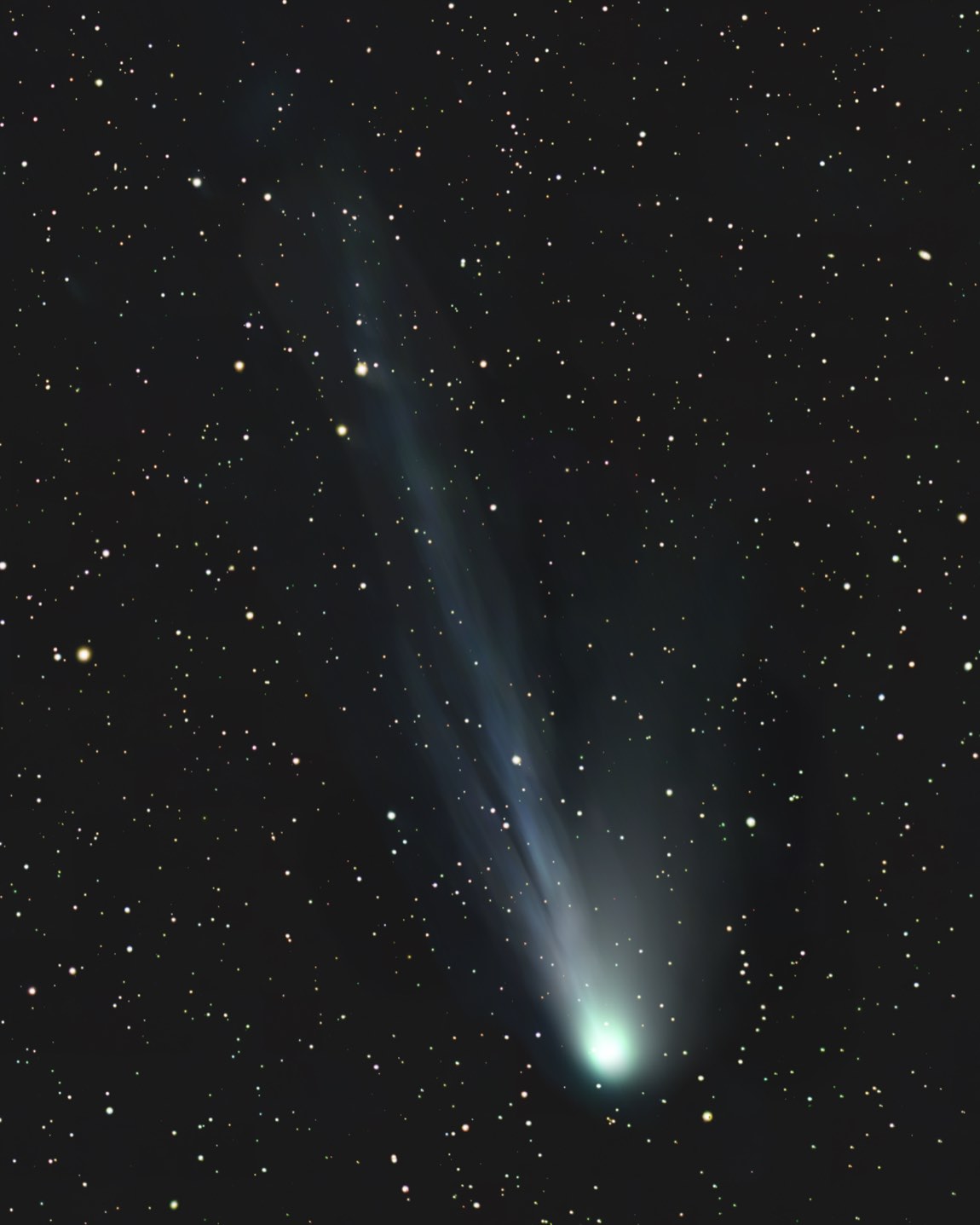
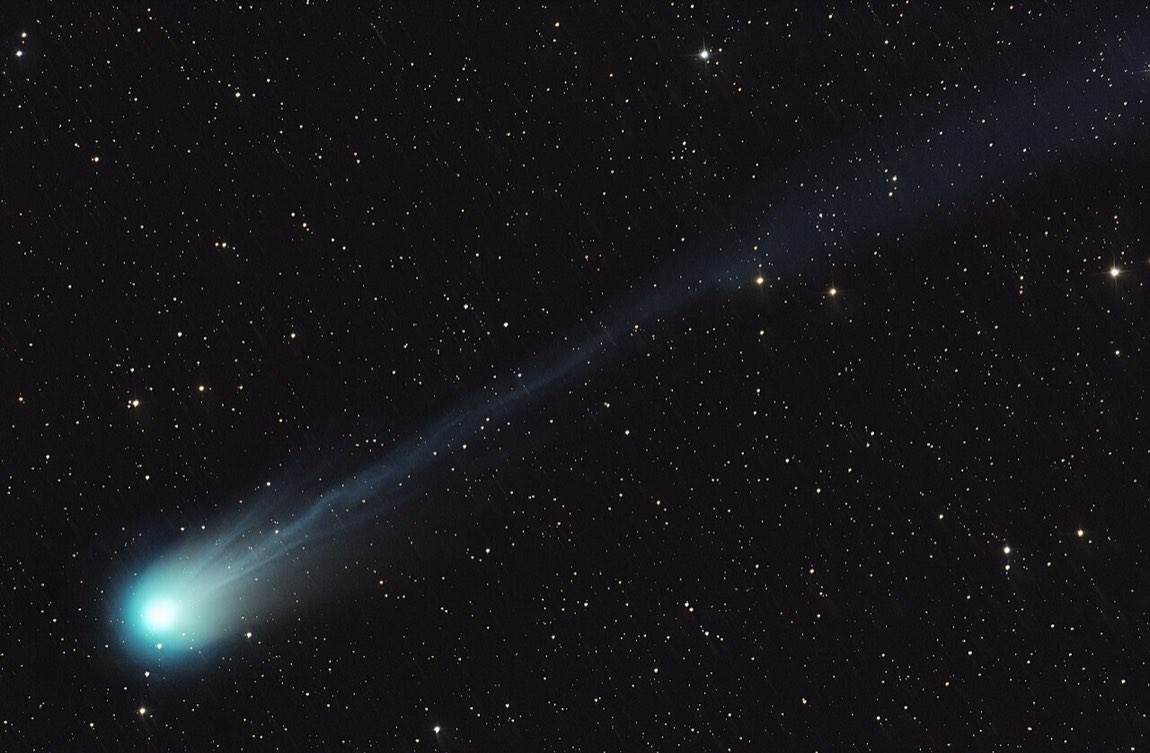
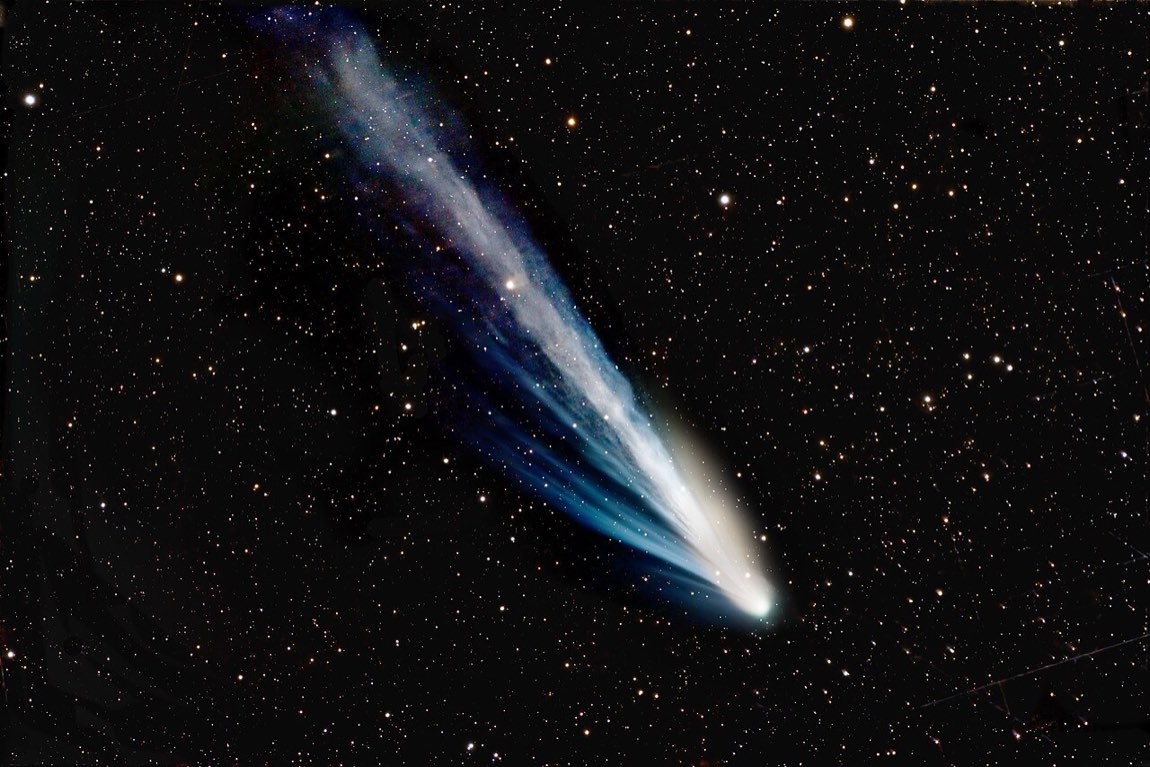
A comet's coma is the temporary atmosphere that blooms from the nucleus as solar heat vaporizes ices. During the 2024 return, Pons–Brooks put on a spectacular display: by 5 August the coma had expanded to a diameter of 600,000 km — wider than the Sun itself, which measures about 1,392,000 km across, so the coma spanned roughly 43 percent of the Sun's diameter. The gas was streaming outward at an expansion rate of 220 m/s. Initially the cloud was spherical, but radiation pressure from sunlight gradually pushed the dust into an asymmetric shape. By mid-February the comet had also grown a prominent ion tail about two degrees long, laced with jets and filaments. In early June 2024, as Earth crossed the comet's orbital plane, an anti-tail appeared — a spike of dust pointing seemingly toward the Sun, an optical geometry trick caused by our viewing angle through the comet's trail.
06 Measuring Water: Radio Telescopes and SOHO Deeper
Understanding how much water a comet releases is central to understanding its activity, and two different observational tools tackled this question for Pons–Brooks in 2024. The Thai National Radio Telescope detected OH maser emissions at 1665 and 1667 MHz by late March 2024. Because water molecules breaking apart produce hydroxyl (OH), these radio signals act as a proxy for the comet's water output — and the fluctuations in the signal traced how production rate shifted as the comet closed in on the Sun. Meanwhile, the SWAN instrument aboard the SOHO spacecraft provided a broader view, monitoring ultraviolet emissions from the whole hydrogen coma. SWAN data showed the water production rate peaked at 1.7 × 10³⁰ molecules per second on 14 April 2024, just one week before perihelion. That figure is enormous: a mole of water molecules is about 6 × 10²³, so the comet was releasing roughly three billion moles of water every second near its closest approach to the Sun.
07 An Orbit Shaped by Jupiter and Neptune Deeper
Pons–Brooks does not simply loop around the Sun on a tidy ellipse — it moves within a gravitational web dominated by two giants. Its orbit is locked in a 1:6 resonance with Jupiter, meaning the comet completes one orbit for every six that Jupiter makes. The Tisserand invariant with respect to Jupiter is 0.60, a value that flags it as a Halley-type comet rather than a Jupiter-family comet. Its steep orbital inclination of 74.2° keeps it well away from the ecliptic plane where most planetary traffic travels, so close encounters are rare. Aphelion sits just beyond Neptune at 33.6 AU — about 5.03 billion km from the Sun. Daniel Kirkwood noticed in 1884 that the orbit closely resembles that of comet 122P/de Vico and suggested de Vico may have calved off Pons–Brooks some centuries earlier, with both objects sharing their capture into elliptical orbits — or their parent body's capture — near Neptune around 991 CE. The orbit appears stable from 1740 to 2167 with no strong planetary perturbations.
08 Long-Term Fate: Mostly Stable, With Caveats Deeper
On human timescales and even on geological ones, Pons–Brooks looks reassuringly predictable. Models show its orbital evolution will remain stable for the next 100,000 years. The closest documented approach to any planet between 1900 and 2200 was a pass within 1.6 AU of Saturn on 29 July 1957 — close enough to notice on a chart, but with negligible actual effect on the orbit. The next perihelion after 2024 is currently calculated for 15 August 2095, refined from an earlier Kinoshita estimate of 10 August 2095 once 2020–2023 observations were incorporated. Yet probabilistic modeling introduces a small but genuine uncertainty: there is a 0.5 percent chance that non-gravitational perturbations — forces from outgassing jets pushing subtly on the nucleus — could nudge the comet into a retrograde orbit or even make it a sungrazing comet within those same 100,000 years. It is a reminder that even a "stable" small body carries a tail of improbable but real outcomes.
 ⤢
09 A Comet With Its Own Spin
Like a slowly tumbling boulder in space, the nucleus of Pons–Brooks rotates — but pinning down exactly how fast proved surprisingly contentious during the 2024 apparition. Observations made at Lowell Observatory between January and February 2024 tracked the evolving shape of the coma to infer a rotation period of 57 ± 1.0 hours, or about two and a third Earth days. A completely independent analysis using CN jet morphology from the TRAPPIST telescope network yielded a different answer: either 29.45 hours or 58.90 hours, the ambiguity arising because a half-period can mimic a full period in certain observing geometries. The two results are not definitively reconciled. What the spin rate matters for is understanding how outbursts are driven: if active patches rotate in and out of sunlight, the rotation period should modulate the timing and intensity of eruptions, so nailing down the true value is scientifically important rather than merely a point of bookkeeping.
10 Meteor Showers Traced Back to Pons–Brooks
Every time Pons–Brooks rounds the Sun it sheds dust and gravel along its orbital path, and Earth occasionally sweeps through those debris trails to produce meteor showers. The most confidently linked shower is the December κ Draconids (shower catalogue number 336), active from roughly 29 November to 13 December each year — though it is a feeble display, generating fewer than 2 meteors per hour at its peak. A second shower, the northern June Aquilids, has been tentatively connected to the comet, though researchers consider that link unlikely. More exotically, Pons–Brooks may help seed meteor showers on Venus, sharing that role with comets 122P/de Vico and 27P/Crommelin. It is also worth noting that in December 1954, Earth passed within 0.12 AU — about 18 million km — of the comet's own meteor stream, sending particles plunging into our atmosphere at a relative velocity of 45 km/s.
11 The 2024 Return: A Timeline of Brightness
The 2024 apparition gave astronomers an unusually complete record of one comet's journey from deep cold to perihelion heat. Recovery happened on 10 June 2020 when the Lowell Discovery Telescope caught it at apparent magnitude 23 — roughly 400 million times fainter than what the naked eye can see — with the comet still 11.9 AU from the Sun, beyond Saturn's orbit. By mid-February 2024 it had climbed to magnitude 7.5. By 7 March it reached magnitude 5.5 and lay about 10 degrees from the Andromeda Galaxy, within reach of binoculars. A major outburst on 3 April pushed brightness to about magnitude 3.8, making it visible without any optical aid. On 8 April, during the solar eclipse crossing North America, the comet sat 25 degrees from the Sun. Perihelion came on 21 April at 0.781 AU from the Sun, with the comet traveling at 47.1 km/s relative to the Sun. Earth's closest approach followed 42 days later, on 2 June 2024, at 1.55 AU — about 232 million km.
12 How Pons–Brooks Fits Among Periodic Comets
Comets are classified partly by how long they take to orbit the Sun. Those with orbital periods between 20 and 200 years are called Halley-type comets, and Pons–Brooks, at 71 years, sits squarely in that family. It is also regarded as one of the brightest-known periodic comets, reaching an absolute visual magnitude of about 5 near perihelion; during the 2024 return it peaked at magnitude 3.8. For comparison, its orbital siblings include 13P/Olbers, 23P/Brorsen–Metcalf, and the most famous periodic comet of all, 1P/Halley. What sets Pons–Brooks apart even within that company is its extraordinary outburst frequency — documented across 1812, 1883–84, 1954, and again 2023–24 — suggesting a nucleus with unusually volatile or structurally fragile icy reservoirs. The comet was first recovered for the 2024 return at an unprecedented heliocentric distance of 11.9 AU, with the uncertainty in that measurement being only roughly ± 10,000 km, showcasing how dramatically telescope technology has improved since Brooks squinted at a faint smudge in 1883.
 ⤢