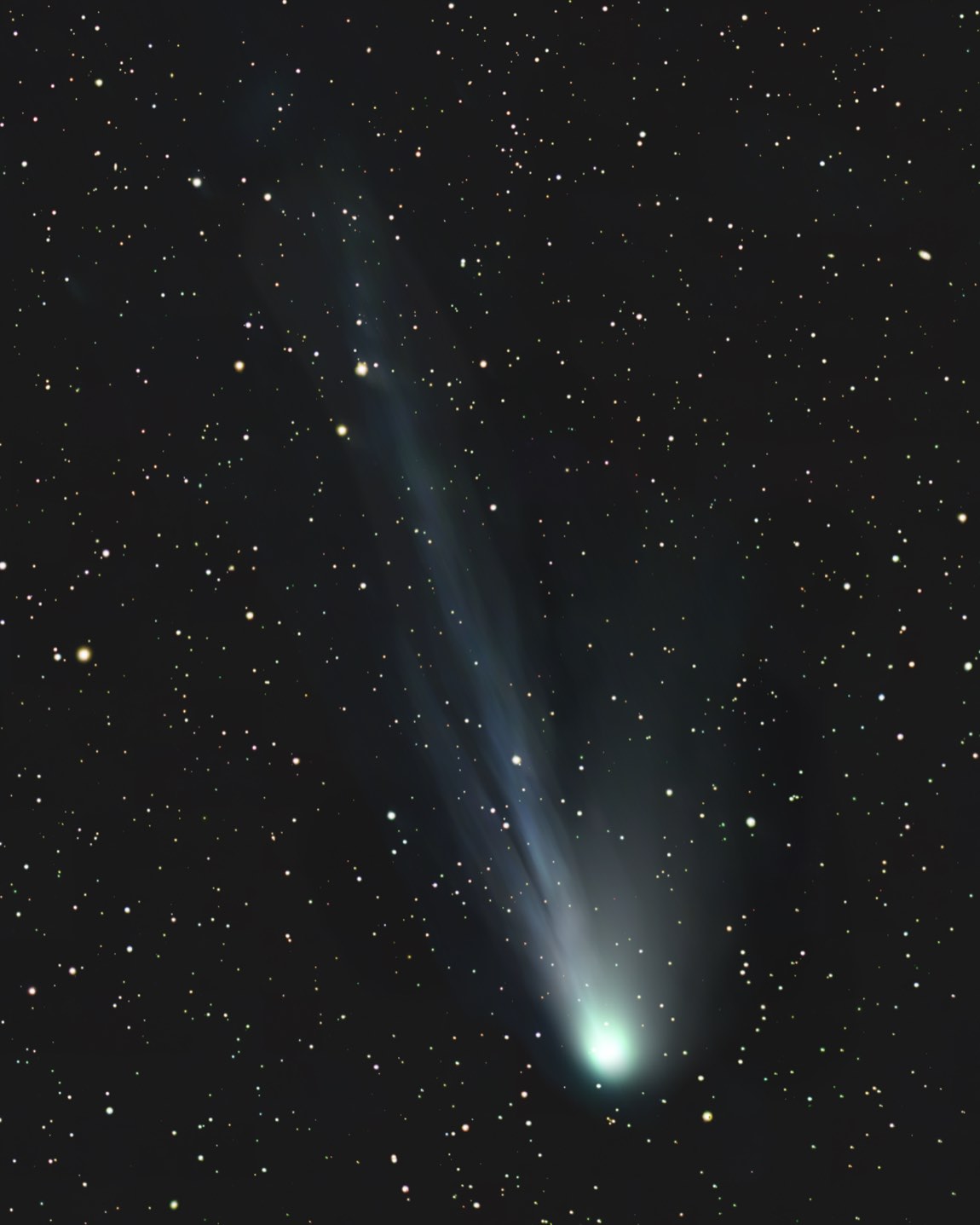
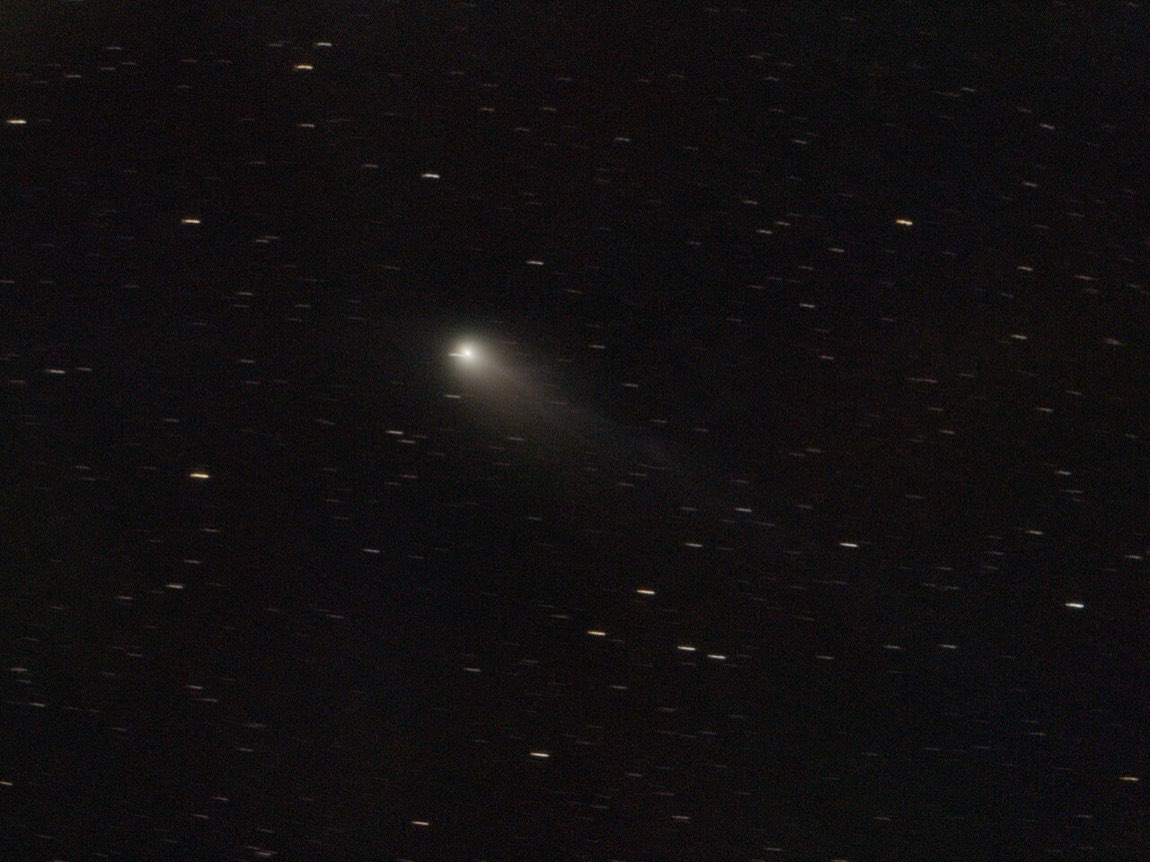
 Photograph · Don Heffernan · CC BY 2.0
Comet · Deep guide
Comet Olbers (13P)
Also called: 13P/Olbers · Comet Olbers
Found by Heinrich Olbers in 1815, this comet returns about every 69 years.
What is it?
13P/Olbers was discovered on 6 March 1815 by German astronomer Heinrich Olbers, and Friedrich Bessel soon worked out that it was periodic. It is a Halley-type comet with an orbit of about 69 years. It returned in 1887 and 1956, and on its most recent visit, in June 2024, it reached about magnitude 6, near the limit of naked-eye visibility. It will be back in 2094.
The deep dive
Researched for the Atlas from Wikipedia — 13P/Olbers (4,812 characters read) · updated Nov 14, 2026
01 Heinrich Olbers and His Third Great Find
Heinrich Wilhelm Matthias Olbers discovered this comet on 6 March 1815, describing it simply as small. It was the third comet he found, a remarkable tally for any observer in any era. Almost immediately, two of the greatest mathematical minds in history turned their attention to it. Carl Friedrich Gauss computed its orbit on 31 March 1815, initially treating the path as parabolic — the standard first approximation when an orbital period is unknown. Friedrich Bessel then went further, using observations gathered through June to calculate a closed, elliptical orbit with a period of 73.9 years. Other astronomers of the period ran their own calculations and landed anywhere between 72 and 77 years, a spread that reflects just how sensitive period estimates are to the arc of observations available. Modern solutions, with the benefit of multiple returns and far more precise data, settle the 1815 epoch period at 74.9 years — remarkably close to what Bessel deduced with a few months of naked-eye and small-telescope measurements.
02 A Naked-Eye Comet in the Age of Napoleon
When 13P/Olbers reached perihelion on 26 April 1815 — just weeks after Napoleon's return from Elba — it brightened to an apparent magnitude of about 5, placing it at the very threshold of naked-eye visibility under dark skies. For context, most stars visible to the unaided eye range from magnitude 1 to 6, so a comet at magnitude 5 would have been a subtle but real smudge of light for attentive observers scanning the spring sky. The discovery had come only six weeks before perihelion, meaning Olbers caught it on approach rather than retreat. This short warning window was typical of 19th-century comet hunting, which depended entirely on the patience and eye of individual observers sweeping the sky with modest telescopes, without the benefit of photographic plates or digital sky surveys that would arrive decades later.
03 An Accidental Rediscovery After a Failed Search
The 1887 return of the comet was a small drama in itself. Astronomers knew the comet was due and searched for it throughout the year without success — until William Robert Brooks stumbled across it accidentally on 25 August 1887. Brooks described it as an easy object through a 9-inch reflector, with a brightish nucleus and a faint tail, suggesting it was already well-developed when found. What made the geometry of this return especially interesting is that just weeks earlier, on 28 July 1887, the comet had swept within 0.081 AU — roughly 12.1 million km — of Mars, a close planetary encounter in comet terms. The comet then passed perihelion on 8 October 1887 and brightened to about magnitude 9, comfortably within binocular range but not naked-eye. The failed systematic searches before Brooks's accidental find highlight how unpredictable comet recovery was before modern ephemeris-based prediction methods.
04 From Photographic Plates to Modern Recovery Deeper
The 1956 return introduced a new tool to comet recovery: archival photographic plates. Antonín Mrkos formally recovered the comet on 4 January 1956, finding it in the constellation Eridanus at a faint magnitude of 16 — far beyond what any eye or earlier instrument could detect. But he then traced it back to plates already sitting in the McDonald Observatory archive, obtained on 12 November 1955, pushing the confirmed timeline of the return back further. The comet eventually reached magnitude 6.5 at its 19 June 1956 perihelion, and observers reported a tail stretching roughly one degree across the sky — equivalent to twice the apparent width of the full Moon. The 2024 return followed an even more dramatic arc of pre-recovery detective work: Alan Hale recovered it on 24 August 2023 using the Las Cumbres Observatory network at Siding Spring, at a faint magnitude of about 22, and earlier images from 13 August 2023 were subsequently identified, extending the observational baseline still further.
05 How the 2024 Apparition Unfolded Week by Week
The 2024 appearance of 13P/Olbers offered a rare chance to track a Halley-type comet from extreme faintness to naked-eye brightness. When recovered in August 2023, it shone at about magnitude 22 — roughly 40 million times fainter than anything the unaided eye can detect. By 14 January 2024 it had climbed to magnitude 15.3, already sporting a strongly condensed coma 0.9 arcminutes across and a faint tail one arcminute long. By 10 March 2024 the coma had swelled to 4 arcminutes, and the comet had brightened four full magnitude steps to 11.4. An April 12 visual observation put it at magnitude 9.2 — a full magnitude brighter than predictions. At perihelion on 30 June 2024, the comet stood 1.18 AU (177 million km) from the Sun and 1.94 AU (290 million km) from Earth. Pre-perihelion forecasts suggested it would peak at magnitude 7 to 8, but the comet outperformed them, peaking at 6 to 7 and briefly reaching naked-eye detectability for observers under good conditions.
06 Water Ice Outgassing and an Irregular Eruption Pattern Deeper
The SWAN instrument aboard the SOHO spacecraft, designed to track hydrogen emission from water molecules being broken apart by solar ultraviolet light, measured 13P/Olbers reaching a peak water production rate of 1.1×10²⁹ molecules per second on 3 June 2024 — roughly a month before perihelion. That is an enormous number: a hundred thousand billion billion billion water molecules escaping the nucleus every second. What caught scientists' attention was the character of this outgassing: irregular and scattered compared to the outbursting comet 12P/Pons–Brooks, which was active at the same time, yet still showing a general upward trend as the comet neared the Sun. This kind of irregular production hints at an uneven surface, with active regions rotating in and out of sunlight and producing variable jets rather than a smooth, uniform sublimation front across the nucleus.
07 A Chemical Fingerprint Rich in Volatile Ices Deeper
Infrared spectroscopy at the NASA Infrared Telescope Facility (IRTF) during the 2024 return produced a detailed chemical inventory of gases streaming off the nucleus. Confirmed molecules included water (H₂O), carbonyl sulfide (OCS), ethane (C₂H₆), methanol (CH₃OH), and formaldehyde (H₂CO) — a roster broadly consistent with other comets of its class. What set 13P/Olbers apart were significantly enriched abundances of carbon monoxide (CO) and methane (CH₄). Both of these molecules are extremely volatile, sublimating at temperatures far lower than water ice. Their elevated presence suggests that the comet either formed in an unusually cold region of the early solar system, preserving a larger-than-typical reservoir of these supervolatile ices, or that some other process has concentrated them. This chemical fingerprint makes it a scientifically valuable object for understanding the conditions and chemistry of the outer protoplanetary disk where comets are thought to originate.
08 What Unusual CO Levels Tell Us About the Nucleus Deeper
The enriched carbon monoxide signature carries a direct implication for the physical size of the nucleus, though the reasoning involves a chain of assumptions worth understanding. If researchers use the observed CO/H₂O ratio and assume a correlation between that ratio and nucleus size — as has been proposed for other comets — the data point to an upper size limit of roughly 20 to 30 km (12 to 19 mi) in radius. For comparison, that would make it larger than Halley's Comet, whose nucleus is roughly 8 km across its longest dimension. However, the article is careful to flag the uncertainty: comets like 1P/Halley and 23P/Brorsen–Metcalf, both described as more active periodic comets, are substantially smaller, suggesting the relationship between CO enrichment and nucleus size is not straightforward. Because the water production rate of 13P at 1.36 AU (203 million km) from the Sun falls between those two comets, scientists believe the actual nucleus radius is probably smaller than 20 to 30 km — likely ranging from several kilometers to about 10 km (6.2 mi). The true size remains unconfirmed.
09 A Meteor Shower on Mars, Not Earth
One of the more unusual footnotes in 13P/Olbers's story is a speculative connection not to any meteor shower on Earth, but to one on Mars. Because the comet's orbit and Mars's orbit come within 0.0266 AU (about 3.98 million km) of each other at their closest intersection — well below the 0.1 AU threshold researchers treat as a meaningful indicator — there is genuine reason to think that debris shed by the comet over many orbits could strike the Martian atmosphere. The predicted impact speed of 27 km/s is fast enough that incoming particles would ablate, glowing briefly as meteors. This matters because a meteor shower on another planet requires a streak of comet dust to have spread along an orbit that intersects that planet's path, which is precisely what the orbital geometry of 13P seems to allow. The radiant — the point in the sky from which the meteors would appear to diverge — lies in the direction of the star Beta Canis Majoris as seen from Mars. No spacecraft has yet confirmed this shower observationally.
10 Pinning Down the Next Return in 2094
Planning for the comet's next appearance in 2094 has already begun in a modest way. Before any observations were made in 2023, astronomer Kinoshita had calculated a predicted perihelion date of 22 March 2094, working only from the 1956 observational record — a gap of nearly seven decades. Once the 2023 and 2024 observations came in and refined the orbital solution, the nominal perihelion date shifted slightly to 20 March 2094. The difference of two days is a measure of how well Kinoshita's earlier prediction held up and also of how much additional precision the new data added. For anyone alive in 2094, the comet will return as a Halley-type object in a 69-year orbital period — meaning anyone who saw it in 2024 would need to be in their late eighties or beyond to witness both returns, much as Halley's Comet defines a rough human-lifetime cadence.
11 Its Place Among Halley-Type Comets
13P/Olbers belongs to the family of Halley-type comets, a classification that requires an orbital period between 20 and 200 years. With a current orbital period of 69 years, it sits comfortably within that range, though closer to the short end than Halley itself, which returns every 75 to 76 years. Halley-type comets are thought to originate from the Oort Cloud or the scattered disk — distant reservoirs of icy bodies — and to have been nudged inward by gravitational interactions over geological timescales. What makes 13P/Olbers notable within this group is its combination of chemical enrichment in supervolatile ices and a brightness that has exceeded predictions during the 2024 return. Its water production rate puts it in the same league as 1P/Halley and 23P/Brorsen–Metcalf, making it one of the more productive comets in this periodic class and a useful point of comparison for understanding how Halley-type nuclei evolve.
 ⤢