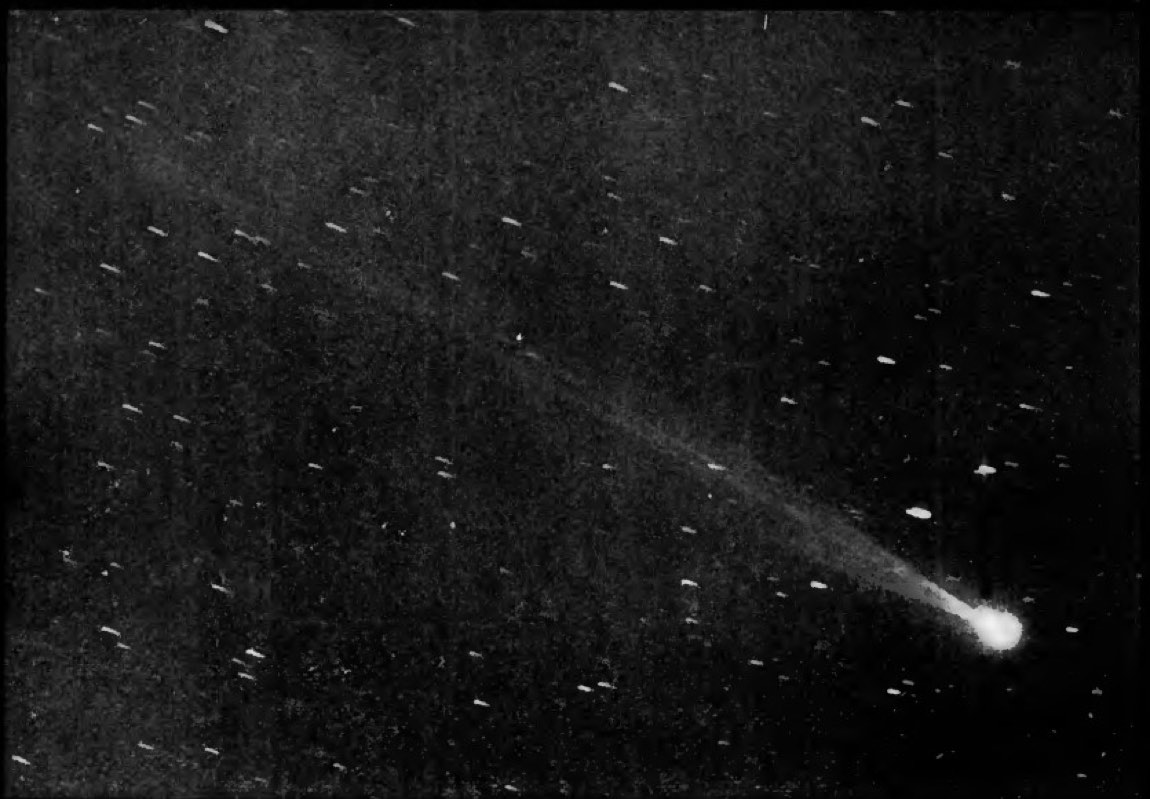
 Photograph · Edward Emerson Barnard · Public domain
Comet · Deep guide
Comet Brorsen–Metcalf (23P)
Also called: 23P/Brorsen–Metcalf · Comet Brorsen-Metcalf
A Halley-type comet that returns about every 70 years, last seen in 1989.
What is it?
Comet Brorsen–Metcalf was discovered by Theodor Brorsen at Altona Observatory in July 1847 and rediscovered by Joel Metcalf in 1919. It is a Halley-type comet with an orbit of about 70 years that brings it to within about half an astronomical unit of the Sun. It was observed again in 1989 and is next expected in 2059.
The deep dive
Researched for the Atlas from Wikipedia — 23P/Brorsen–Metcalf (2,374 characters read) · updated Nov 14, 2026
01 A Comet Discovered Twice in One Summer
The story of 23P/Brorsen–Metcalf begins with a near-simultaneous pair of discoveries separated by just three weeks. Theodor Brorsen, working at the Altona Observatory, spotted the comet on 20 July 1847. Then, on 11 August 1847, Kaspar Schweizer in Moscow independently found the same object without knowing Brorsen had already seen it. Such duplicate discoveries were common in the pre-telegraph era, when news of a new comet traveled slowly across Europe. The comet carries both men's names as a result — a convention that honors independent effort rather than sole priority. After that initial apparition, astronomers calculated that the comet should return sometime between 1919 and 1922, a prediction window of three years that reflects the inherent uncertainty in comet orbit determination from limited 19th-century observations. That prediction would eventually be vindicated with remarkable precision, though it took the sharp eye of a third observer, working from a camp in Vermont more than seven decades later, to close the loop.
02 Joel Metcalf and the 1919 Recovery
On 21 August 1919, Joel Hastings Metcalf recovered the comet from Camp Idlewild in Vermont, United States, measuring it at 8th magnitude — faint enough to require a telescope but already a recognizable fuzzy smudge against the star field. Within days, the sighting triggered a cascade of independent confirmations. Edward Barnard, one of the most celebrated visual observers of his era, spotted it from Yerkes Observatory in Wisconsin on 22 August. Michel Giacobini observed it from Paris, while Ostrovlev in Theodosia, Crimea, and Selavanov in Saint Petersburg added further reports. By the end of September 1919, astronomers had accumulated enough positional data to confirm beyond doubt that this was the same object Brorsen had first seen in 1847. Metcalf's name was consequently added to the comet's official designation, giving 23P/Brorsen–Metcalf the hyphenated identity it carries today. His recovery from Vermont — an amateur-style field camp rather than a grand observatory — is a reminder that great comet finds have never been exclusively the domain of large institutions.
03 When the Comet Put On a Naked-Eye Show in 1919
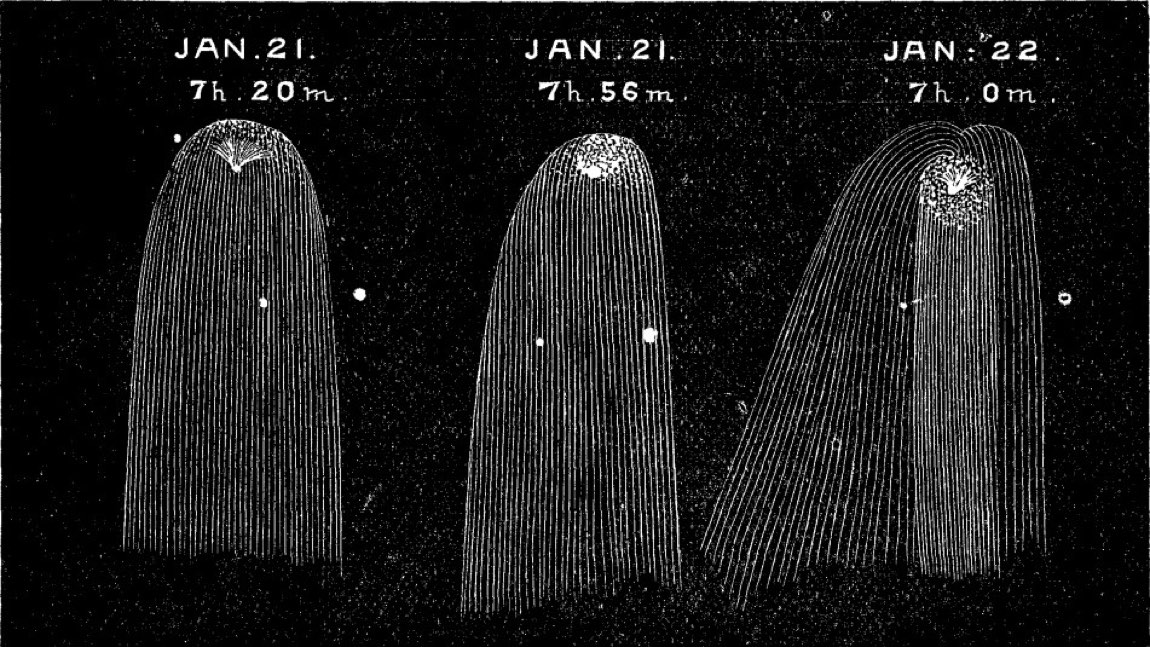
The 1919 apparition delivered a genuinely impressive spectacle to anyone who knew where to look. By early October the comet had brightened to magnitude 4.5 — well within unaided-eye visibility — appearing as a small hazy spot of light against the autumn sky. Its tail stretched a slender 8.5 degrees across the sky, equivalent to roughly seventeen full Moon widths laid end to end, which is a substantial sweep of light for any comet. Then, on photographs taken on 22 October 1919, something dramatic became apparent: a disconnection event in the tail was visible, with the break thought to have started around 20 October. Tail disconnection events occur when a comet's ion tail physically separates from the coma, usually triggered by a rapid change in the solar wind or the comet crossing a sector boundary in the interplanetary magnetic field. The 1919 photographs captured this process in progress, providing an early documented example of a phenomenon that would not be fully understood for many decades. The images stand as some of the most scientifically interesting records from that apparition.
04 The Comet's Halley-Type Classification Deeper
23P/Brorsen–Metcalf is formally classified as a Halley-type comet, a designation with a specific dynamical meaning. The classification applies to periodic comets with orbital periods between roughly 20 and 200 years. With a period of 70 years, 23P sits comfortably within this range — far longer than the short-period Jupiter-family comets that complete laps in under 20 years, but shorter than the multi-century or near-parabolic long-period comets that fall in from the outer solar system. Halley-type comets are thought to originate in the scattered disc or inner Oort Cloud and are dynamically distinct from shorter-period comets, which tend to have orbits confined near the ecliptic plane due to repeated gravitational nudges from Jupiter. The 70-year period of 23P means it has returned to the inner solar system only a handful of times since its discovery, limiting the observational record and making each apparition scientifically precious. It also means that a person who watches the comet in one apparition is very unlikely to live to see the next — a quality it shares with its more famous Halley-type cousin, Comet Halley itself.
05 The 1989 Return: From Faint Speck to Naked-Eye Object
The 1989 apparition showed how dramatically a comet can transform over just a few weeks. The Palomar Observatory recovered the returning comet on 4 July 1989 at an estimated magnitude of 15 — so faint that it required one of the world's premier telescopes to detect. Within days, Alan Hale observed it visually and estimated magnitude 11.5 on 7 July, already a significant brightening. By the end of July the comet had surged to an apparent magnitude of 7–7.5, developing a short tail in the process. It reached perigee — its closest approach to Earth — on 6 August at a distance of 0.62 AU, equivalent to about 93 million kilometres, roughly the same as the distance from Earth to Venus near inferior conjunction. Between perigee on 6 August and perihelion on 11 September, the comet hovered between magnitude 5 and 6, remaining visible to the naked eye throughout that window. By September the tail had grown to roughly 7 degrees in visual length, mirroring the impressive display the comet had given seventy years earlier in 1919.
06 A Historic Detection in Submillimeter Light Deeper
The 1989 apparition carried a distinction that no comet had ever earned before: 23P/Brorsen–Metcalf became the first comet to be definitively detected at submillimeter wavelengths. Submillimeter radiation — sitting between infrared and microwave on the electromagnetic spectrum — traces cold dust and certain molecular emissions that are invisible at optical wavelengths. This detection opened a new observational window onto cometary science, one that has since become a standard tool for studying the composition and thermal properties of cometary material. The achievement illustrates how each return of an otherwise unremarkable periodic comet can produce a landmark result when the right technology is available and pointed at the right object at the right time. The 1989 apparition happened to coincide with the maturation of submillimeter astronomy as a practical observational discipline, and 23P was bright enough and well-positioned enough to serve as the ideal first target. This first detection essentially validated the technique for cometary research and encouraged astronomers to pursue submillimeter observations of subsequent bright comets.
07 Measuring the Nucleus: An Upper Limit, Not a Certainty Deeper
One of the most practically important measurements made during the 1989 apparition was an attempt to constrain the size of the comet's solid nucleus. Spectroscopic and infrared photometric observations were conducted between 28 August and 6 September 1989 using the NASA Infrared Telescope Facility at Mauna Kea Observatory in Hawaii. The result was an upper limit — not a direct measurement — placing the radius of the nucleus at no greater than 5.0 km (3.1 miles). An upper limit is scientifically honest: it tells us the nucleus cannot be larger than that figure, but it could be considerably smaller. Direct imaging of cometary nuclei is notoriously difficult because the bright coma of gas and dust surrounding the solid core floods detectors, making the nucleus itself hard to isolate. Infrared techniques help because they can probe thermal emission from the nucleus more cleanly than optical imaging, but uncertainties remain. For 23P, the value of 5.0 km places it broadly in the same size class as many well-studied short-period comets, though without a tighter constraint it is impossible to say exactly where in that class it falls.
08 Multiple Observers and a Web of Confirmations
The recovery of 23P in 1919 unfolded almost like a relay race across the Northern Hemisphere. Within 24 hours of Metcalf's Vermont sighting, Edward Barnard at Yerkes Observatory in Wisconsin — a man famous for his extraordinary eyesight and his cataloguing of dark nebulae — had independently confirmed the object. Then reports arrived from Michel Giacobini in Paris, from Ostrovlev in Theodosia on the Crimean Peninsula, and from Selavanov in Saint Petersburg. The sheer geographic spread of confirmations, from North America to Russia, reflects how the global astronomical community rallied around a predicted return. It also reflects the communication infrastructure of the time: telegram networks allowed news to hop across continents in hours, enabling observers in different countries to converge on the same object almost simultaneously. The convergence of independent observations from at least five separate sites, spread across two continents, gave 19th- and early-20th-century astronomers the confidence they needed to declare a successful recovery and begin the orbital refinement that proved this was indeed Brorsen's 1847 comet.
09 Orbital Timing and the Gap Between Returns Deeper
With a period of 70 years, the gaps between documented apparitions of 23P stretch across human generations. The comet was discovered in 1847, recovered in 1919 — a gap of 72 years, slightly longer than the nominal period, suggesting gravitational perturbations from the giant planets had nudged its timing. The next documented apparition came in 1989, 70 years after 1919, neatly matching the nominal period. These long gaps mean that each apparition benefits from substantially more advanced technology than the last: 1847 relied on visual telescopic observation; 1919 added photography; 1989 brought digital detectors, infrared telescopes, and submillimeter arrays. Each technological leap translated directly into new kinds of data. The flip side is that the comet's behavior is poorly characterized by any single set of observers — a problem that short-period comets, returning every few years, do not share to the same degree. Astronomers watching the 1989 return were essentially working from a baseline set 70 years earlier, with no modern precursor observations to guide their predictions about brightness or activity level.
10 How Bright Does It Get, and Can You See It?
Based on its two modern apparitions, 23P/Brorsen–Metcalf appears capable of reaching naked-eye brightness near its best. In 1919 it peaked at magnitude 4.5, and in 1989 it hovered between magnitude 5 and 6 for several weeks. Both values fall within the range detectable by the unaided eye under reasonably dark skies, though the 1989 comet was closer to the threshold and would have been missed entirely by observers in light-polluted cities. The tail, reaching around 7 to 8.5 degrees in both apparitions, added to the visual impression — length that experienced observers describe as a prominent sweep against the background stars. However, comets are notoriously unpredictable. The brightness figures from 1919 and 1989 represent what 23P actually did on those occasions, not guaranteed future performance. Outgassing rates can change as a cometary nucleus ages and its volatile-rich surface layers are progressively depleted by successive passes near the Sun. Future apparitions may be brighter, dimmer, or similar — and the only way to know is to wait for the comet to return and observe it directly.
11 The Role of Palomar and NASA in the Modern Record
The 1989 apparition demonstrated how professional observatories with large-aperture instruments shaped the modern scientific record of 23P. Palomar Observatory, home to the famous 200-inch Hale Telescope in California, made the initial recovery on 4 July 1989 when the comet was still a faint magnitude-15 object — roughly 10,000 times too dim to see without a telescope. That early recovery gave the community months of warning time to plan follow-up observations. The NASA Infrared Telescope Facility on Mauna Kea then contributed the spectroscopic and infrared photometric observations between 28 August and 6 September that yielded the nucleus size upper limit. Mauna Kea's high altitude of about 4,205 metres above sea level reduces the infrared-absorbing water vapor in the overlying atmosphere, making it one of the best sites on Earth for thermal infrared work. The combination of early recovery at Palomar and detailed characterization from Mauna Kea illustrates a pattern common in modern cometary astronomy: wide-field survey telescopes find or recover the object, then dedicated facility instruments extract the physical parameters.