 Photograph · Islandia Geomatics · CC BY-SA 3.0
Comet · Deep guide
Comet McNaught (Great Comet of 2007)
Also called: C/2006 P1 · Great Comet of 2007
The brightest comet in decades, seen in daylight and crowned with a huge fan-shaped tail.
What is it?
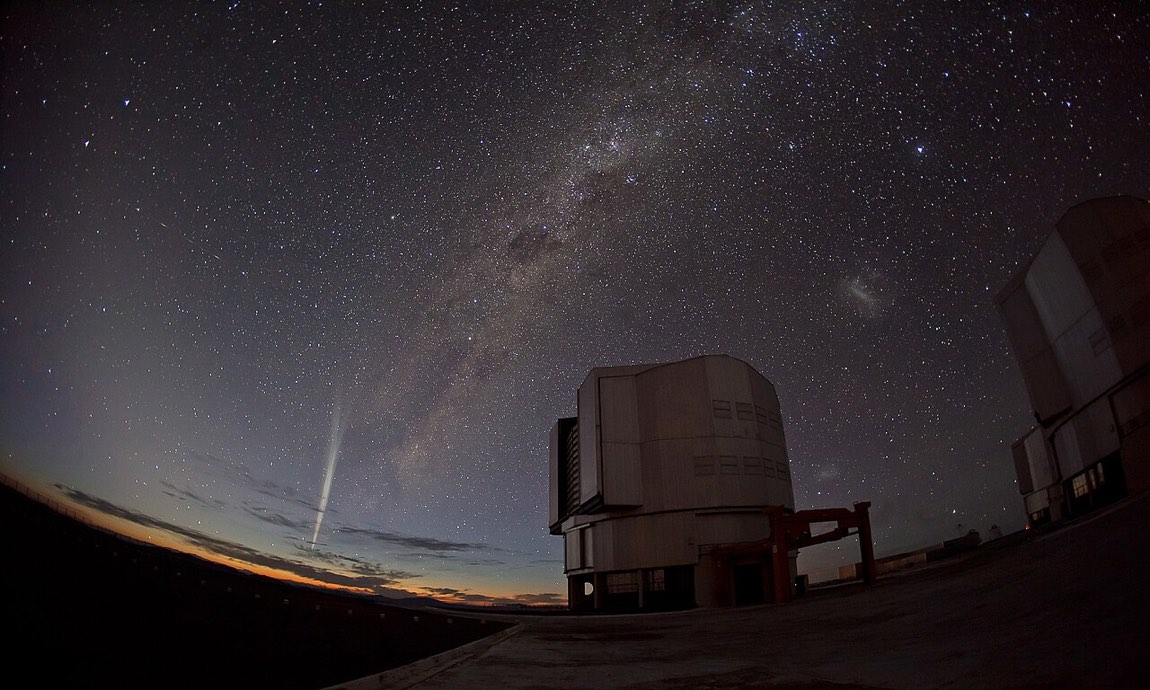
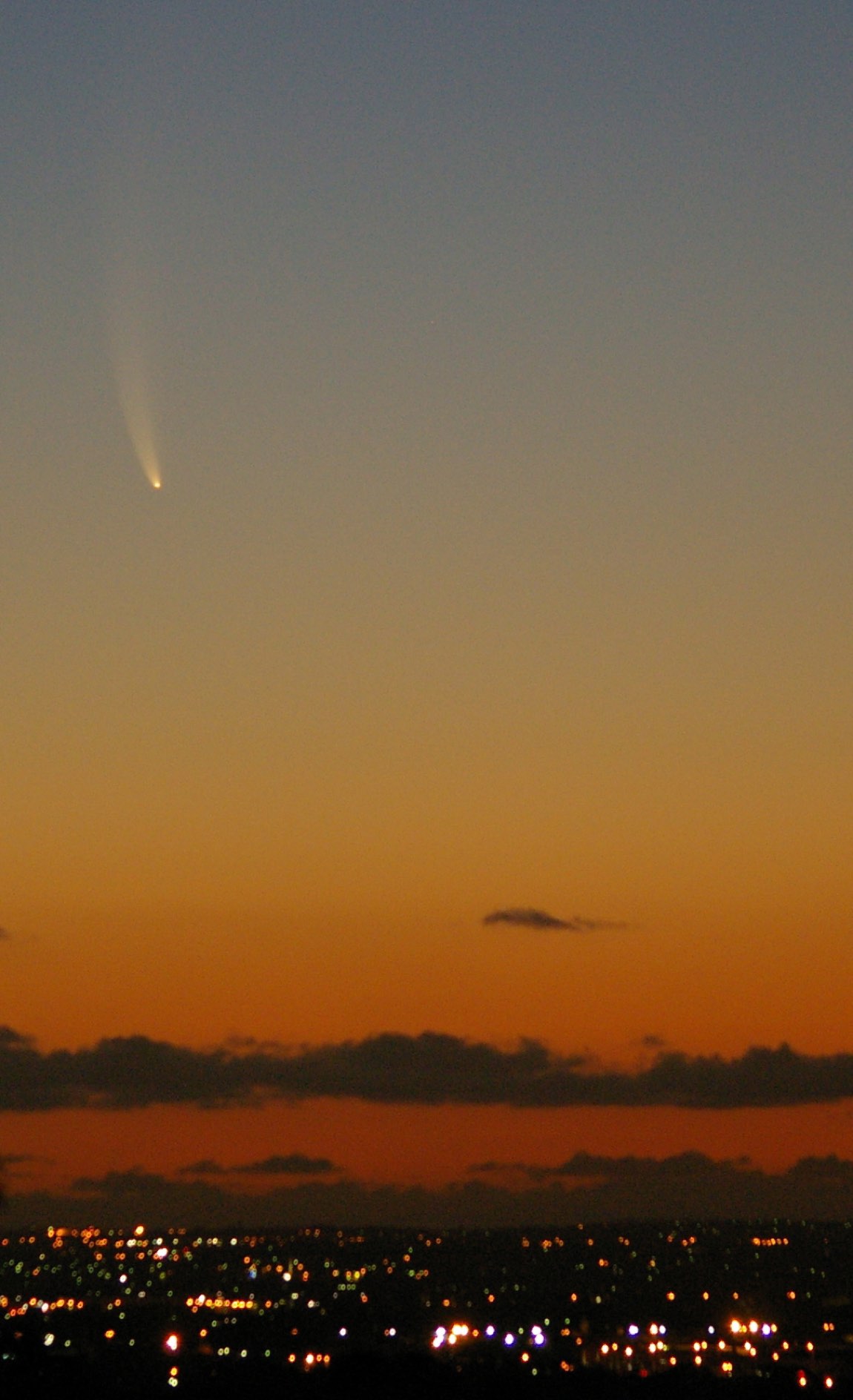
Comet McNaught was discovered in August 2006 by Robert McNaught with the Uppsala Southern Schmidt Telescope at Siding Spring Observatory, Australia. Around its perihelion on 12 January 2007 it reached about magnitude −5.5 and could be seen in broad daylight. Sunlight scattering forward through its dust boosted its glow. Southern Hemisphere observers then saw a huge tail spanning some 35 degrees of sky.
The deep dive
Researched for the Atlas from Wikipedia — Comet McNaught (6,556 characters read) · updated Nov 14, 2026
01 Discovered in the Dark: How McNaught Was Found
Robert H. McNaught was not hunting for something spectacular when he stumbled upon C/2006 P1. He was conducting routine observations for the Siding Spring Survey, a systematic program designed to find Near-Earth Objects that might pose a collision threat to Earth. On 7 August 2006, a CCD image taken through the Uppsala Southern Schmidt Telescope in Ophiuchus revealed a faint smudge glowing at approximately magnitude +17 — roughly 25,000 times too dim for the unaided human eye to detect. For context, the faintest stars visible on a clear dark night sit around magnitude +6. McNaught's find was methodical rather than serendipitous, the product of a survey purpose-built to catch exactly these kinds of slowly brightening interlopers. From August through November 2006, astronomers tracked the comet as it drifted through Ophiuchus and Scorpius, brightening to around magnitude +9. It then vanished into the Sun's glare for most of December. When observers recovered it, it was brightening far faster than anyone had anticipated, hinting at the extraordinary show still to come.
02 Daylight Comet: The Perihelion Performance
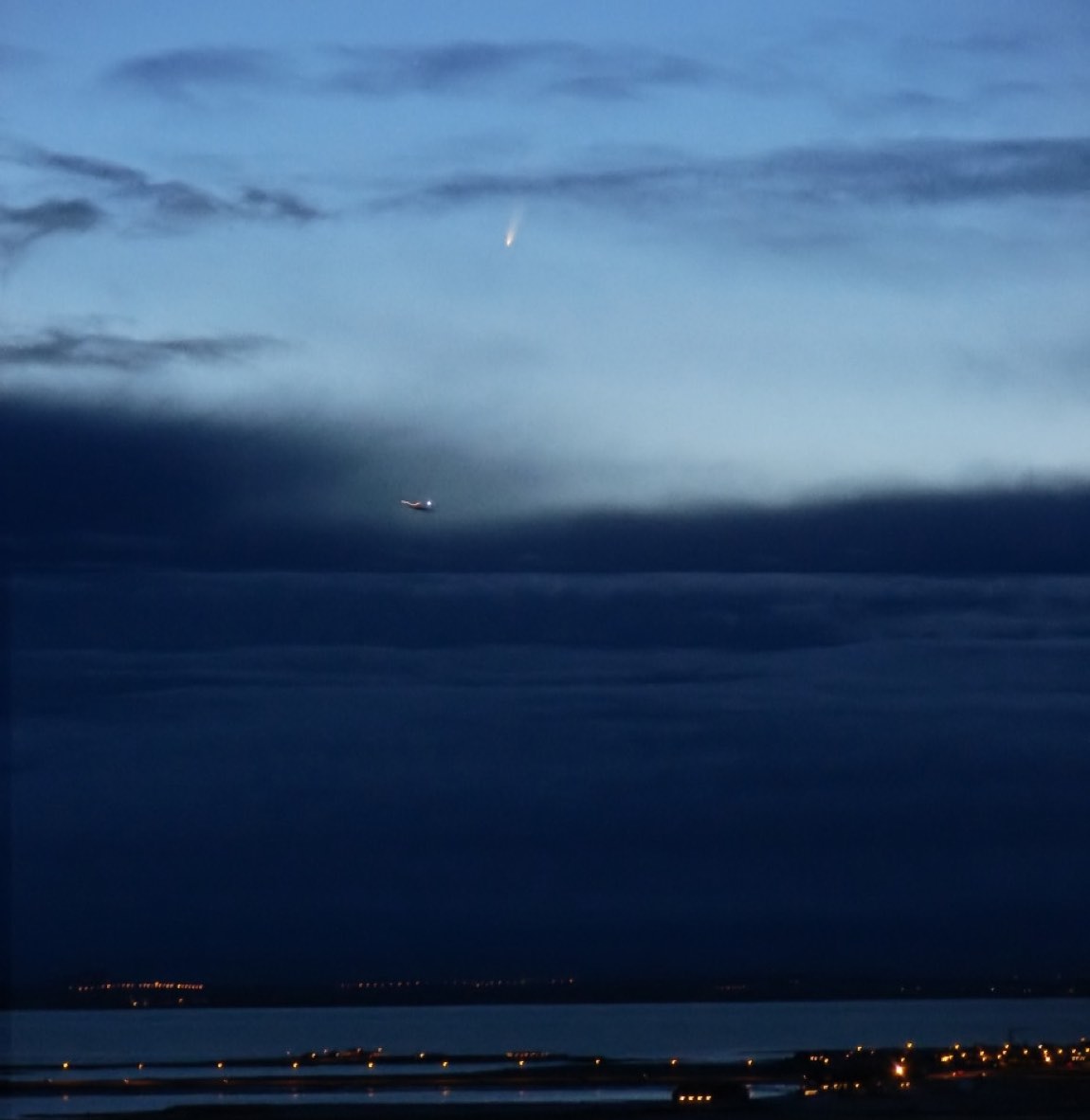
Comets near the Sun are common; comets bright enough to watch in full afternoon daylight are not. As C/2006 P1 swung through perihelion on 12 January 2007, passing within 0.17 AU — roughly 25 million kilometres — of the Sun, it blazed to an estimated peak apparent magnitude of −5.5 on 13 and 14 January. That made it the brightest comet since Comet Ikeya–Seki in 1965, and the second-brightest since 1935. Observers who knew exactly where to look could spot it roughly 5° to 10° southeast of the Sun in broad daylight. That window was narrow: northern hemisphere ground-based viewers were restricted to bright twilight glimpses, and the comet cleared view only until about 13 January before moving into geometry more favourable for the Southern Hemisphere. The Space.com website coined the now-standard nickname, the Great Comet of 2007, capturing the public excitement that accompanied those brief daylight sightings. The closest approach to Earth followed shortly after, on 15 January, at 0.82 AU — a comfortable distance, but close enough to put on a stunning display.
03 Why It Shone So Fiercely: Forward Scattering Deeper
Raw size and icy abundance are the usual suspects when explaining a bright comet, but C/2006 P1 had an additional optical advantage. Near perihelion, the geometry between the Sun, the comet, and Earth placed observers almost directly behind the Sun relative to the comet's coma and dust. In this configuration, sunlight passes through the cloud of microscopic dust particles and scatters strongly toward the observer — a phenomenon called forward scattering. It is the same principle that makes the beam of a car's headlights look spectacular when you face directly into it on a foggy night. This forward-scattering enhancement artificially inflated the comet's apparent brightness well beyond what its physical properties alone would have produced. The effect peaked around perihelion, coinciding almost perfectly with the comet's closest approach to the Sun, and helps explain why the brightness spike was so dramatic and so short-lived. Once the viewing geometry changed and the comet moved into the Southern Hemisphere sky after mid-January, the forward-scattering boost faded, and the comet settled into the more typical brightness profile driven by outgassing.
04 SOHO's Front-Row Seat at Perihelion
Ground-based observers lost McNaught in the solar glare, but a space observatory orbiting far from Earth's atmospheric interference had a perfect view. The Solar and Heliospheric Observatory, known as SOHO, picked up the comet in its LASCO C3 wide-field camera on 12 January 2007 — the same day as perihelion — and kept watch until 16 January. Because SOHO streams its images to the web in near real-time, anyone with an internet connection could watch the comet glide across the camera's field of view, the Sun's disk blotted out by the coronagraph's occulting disk at the frame's centre. This kind of citizen access to live space-observatory data was still relatively novel in 2007, and the McNaught images attracted enormous online attention. SOHO had previously caught many sungrazing comets — small fragments that dissolve near the Sun — but McNaught was a robust, large nucleus that survived perihelion intact, making its transit through the LASCO field a dramatic four-day event rather than the brief flicker typical of the Kreutz sungrazers that SOHO routinely records.
 ⤢
05 An Unexpected Encounter: Ulysses Flies the Tail Deeper
On 3 February 2007, the veteran Ulysses spacecraft — originally launched to study the Sun's polar regions — made an unplanned crossing of McNaught's ion tail at the remarkable distance of 260 million kilometres, or 1.7 AU, from the comet's nucleus. That is farther from the comet than Earth is from the Sun, illustrating just how vastly elongated the ion tail had grown. The encounter was unexpected rather than planned, and the results were published in The Astrophysical Journal on 1 October 2007. Instrument readings showed what scientists described as "complex chemistry" in the tail. Most strikingly, the Solar Wind Ion Composition Spectrometer (SWICS) detected O3+ oxygen ions — oxygen atoms stripped of three electrons — near a comet for the first time. The leading explanation is that solar wind ions, already electron-deficient, captured some electrons while passing through the comet's extended atmosphere, producing these unusual charge states. The detection offered a rare direct chemical sample of material that condensed when the Solar System formed, approximately 4.5 billion years ago.
06 How a Small Comet Slowed the Solar Wind Deeper
Perhaps the most physically surprising result from Ulysses's tail crossing involved not chemistry but dynamics. At 260 million kilometres from McNaught's nucleus — well past the orbit of Mars — the Solar Wind Ion Composition Spectrometer measured the local solar wind speed and found it had dropped to less than 401 km per second. At that distance from the Sun, the solar wind is normally expected to blow at approximately 700 km per second. The comet's ion tail had effectively braked the solar wind to under 60 percent of its usual speed across a region enormously larger than the comet itself. Principal investigator Professor George Gloeckler of the SWICS team called the finding deeply surprising, noting that it was "way past the orbit of Mars" where the disturbance was still felt. The result poses a serious modelling challenge: understanding exactly how a small, cold, icy nucleus can inject enough neutral material into the surrounding plasma to disrupt the supersonic solar wind flow across hundreds of millions of kilometres. Theoreticians and computer modellers are still working on the physics.
07 A Hyperbolic Path Through the Inner System Deeper
C/2006 P1 arrived from the Oort cloud after a journey spanning millions of years. During its swing through the inner Solar System, it followed a hyperbolic trajectory, meaning its osculating eccentricity exceeded 1 and it appeared mathematically unbound. However, that apparent escape is an artifact of planetary gravitational perturbations. Once the comet leaves the planets' influence, its eccentricity is expected to drop below 1 again, and it will remain gravitationally bound to the Solar System as an Oort cloud comet — an extremely long-period visitor rather than a true interstellar traveller. Because objects at such high eccentricity are sensitive to the reference frame used, astronomers prefer barycentric coordinates over heliocentric ones for stability. Using the barycenter of the Solar System as the reference point and an epoch of 2050, JPL Horizons calculations yield a semi-major axis of 2050 AU and an orbital period of approximately 92,700 years. That means the comet will not return to the inner Solar System for nearly 93 millennia.
08 Striae in the Tail and What They Reveal Deeper
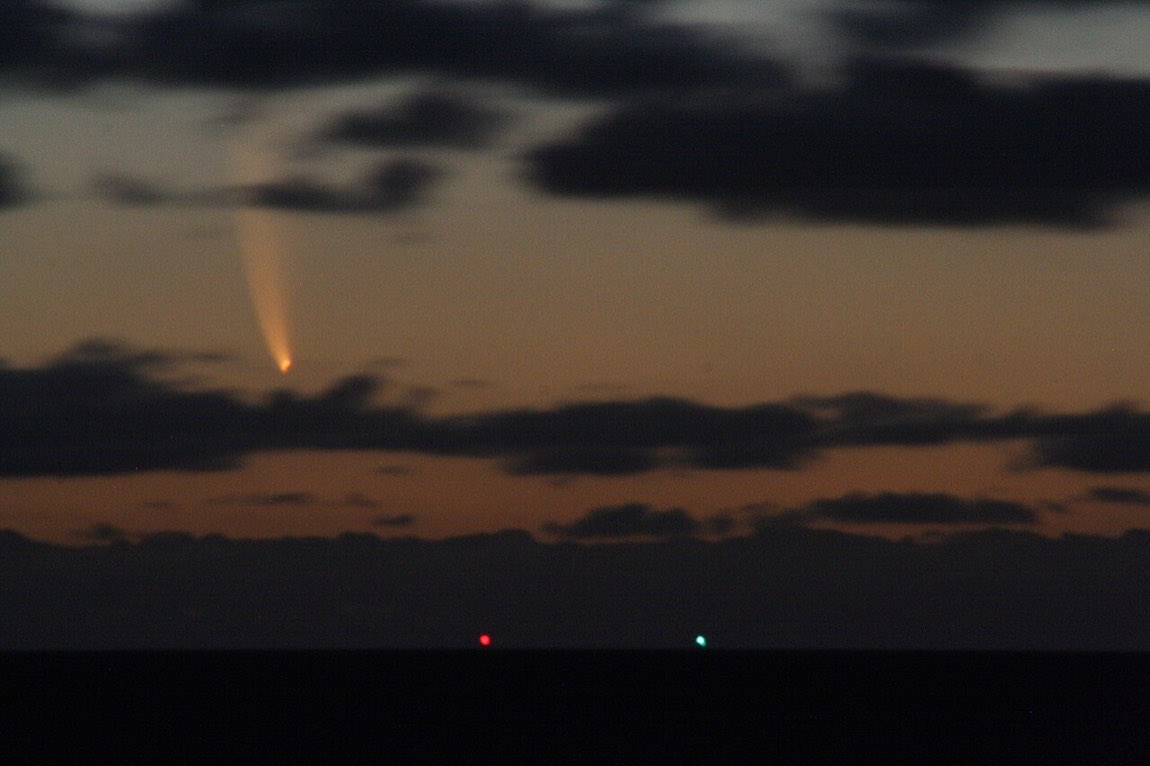
Among the most visually striking features of McNaught's tail were its striae — the fine, ray-like structures fanning outward from the nucleus and visible in photographs taken during January 2007. Studies published in 2010 linked these striae to activity on the nucleus itself. Researchers concluded that three distinct local active domains on the rotating nucleus were responsible, each producing an increased outflow of material as it swung into sunlight. The initial rotation period calculated from this morphological analysis was 21 hours. However, narrowband imaging obtained from the La Silla Observatory in Chile provided a more refined picture, revealing a faster rotational period of 11.8 hours. This kind of morphological analysis — essentially reading the comet's tail structure like a clock face — is a powerful indirect technique for probing nucleus properties that spacecraft cannot easily measure remotely. The striae pattern preserved information about which parts of the surface were active and how quickly the nucleus was spinning, offering a window into the physical state of a body too small and distant to image directly.
 ⤢
09 The Southern Hemisphere's Great Comet
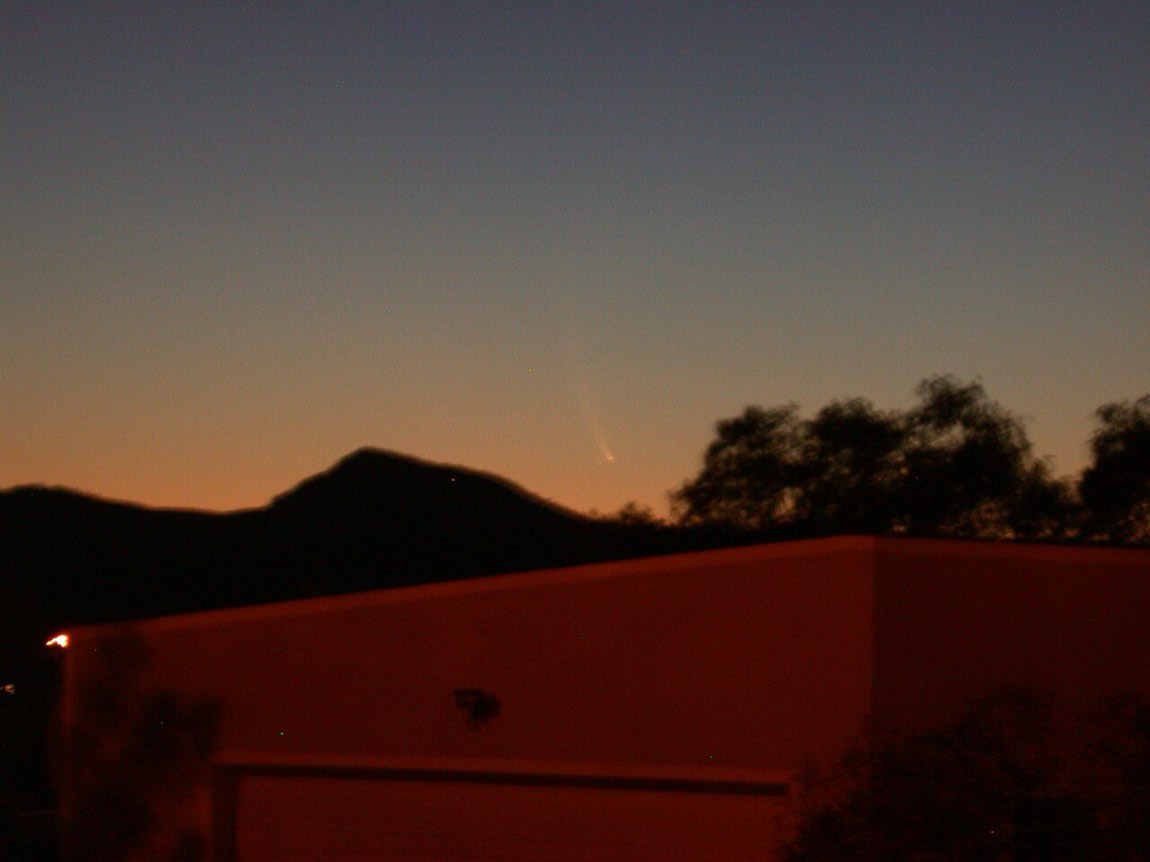
While northern observers scrambled for brief twilight glimpses, the Southern Hemisphere received the full spectacle. After McNaught swept past the Sun and moved southward, Australian skywatchers in particular were treated to a comet visible to the naked eye through January and into February 2007. Siding Spring Observatory at Coonabarabran — the institution where the comet had been discovered — calculated that the comet would reach its theoretical peak brightness on Sunday, 14 January, just after sunset, remaining visible for approximately 23 minutes that evening. At Perth Observatory on 15 January, observers recorded an estimated apparent magnitude of −4.0, still brilliant enough to cast shadows and to be unmistakable even to casual observers who had never knowingly seen a comet before. The tail, estimated at 74.935 million km in length — equivalent to 0.501 AU, or roughly half the distance from Earth to the Sun — stretched across 35 degrees of sky at its peak, a span equivalent to seventy full Moon widths laid side by side.
10 Naming the Comet and Its Discoverer
Comets discovered by an individual observer traditionally carry that person's name, and C/2006 P1 is no exception — it bears the name of Robert H. McNaught, described as a British-Australian astronomer. McNaught was working as part of the Siding Spring Survey when he identified the comet in a CCD image. The formal designation, C/2006 P1, encodes its history: "C" indicates a non-periodic comet, "2006" is the year of discovery, "P" identifies the half-month of August in which it was found (the first half of August being labeled O, the second P in the standard system), and "1" marks it as the first comet found in that interval. The informal name "Great Comet of 2007" was popularised by Space.com and reflects the tradition of bestowing the "Great Comet" label on those rare naked-eye objects brilliant enough to capture widespread public attention. McNaught's discovery was particularly notable because it came not from dedicated comet hunting but from a systematic near-Earth object survey — a reminder that sky-safety programs can deliver spectacular scientific bonuses.
11 What the Ancient Ice Tells Scientists
The excitement surrounding C/2006 P1 extended well beyond its visual drama. Professor George Gloeckler, principal investigator for the SWICS instrument aboard Ulysses, emphasised that the chemical composition of comets preserves a direct record of conditions in the early Solar System approximately 4.5 billion years ago — before the planets had fully formed and while the raw material of the Sun's family was still condensing and mixing. McNaught's tail, sampled unexpectedly by Ulysses, provided what Gloeckler called "a direct sample of this ancient material," offering some of the best compositional information on cometary chemistry obtained to that point. The detection of previously unseen ion species, the evidence for electron-capture processes in the coma, and the surprisingly large-scale disturbance of the solar wind all contributed pieces to a broader puzzle: understanding how comets lose mass as they interact with the Sun and how a sudden injection of cold, neutral material behaves when it meets the hot solar plasma. Those questions, as Gloeckler noted publicly, have parallels throughout the universe wherever cold gas clouds meet hot plasma environments.
 ⤢