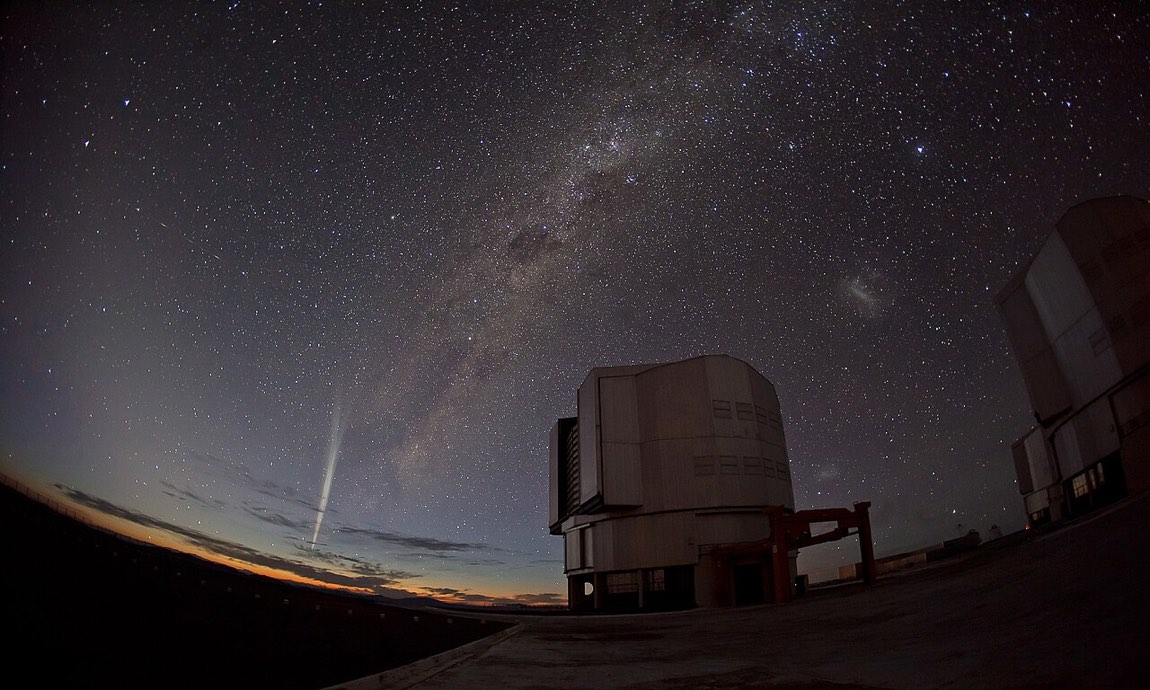
 Photograph · ESO/ Guillaume Blanchard · CC BY 4.0
Comet · Deep guide
Comet Lovejoy (C/2011 W3)
Also called: C/2011 W3 · Great Christmas Comet of 2011 · Great Comet of 2011
A sungrazer that plunged through the Sun's corona at Christmas 2011, and came out the other side.
What is it?
Comet Lovejoy, C/2011 W3, was found by Australian amateur astronomer Terry Lovejoy in November 2011. It belongs to the Kreutz sungrazers, a family of comets on orbits that skim the Sun. On 16 December 2011 it passed through the Sun's corona and, to many astronomers' surprise, emerged with a long tail, though heavily damaged. Visible from the Southern Hemisphere over the holidays, it was nicknamed the Great Christmas Comet.
The deep dive
Researched for the Atlas from Wikipedia — C/2011 W3 (Lovejoy) (7,547 characters read) · updated Nov 14, 2026
01 The Man Who Found It with Off-the-Shelf Gear
Terry Lovejoy, an amateur astronomer from Thornlands, Queensland, discovered the comet on 27 November 2011 using a 20 cm Schmidt–Cassegrain telescope paired with a QHY9 CCD camera — the kind of equipment a dedicated hobbyist might own. When he first spotted it, he described the object simply as "a rapidly moving fuzzy object" of 13th magnitude, far too dim to see without optical aid. This was his third comet discovery, a remarkable achievement for a non-professional. Official confirmation didn't arrive until 1 December, when Alan Gilmore and Pamela Kilmartin observed it at Mount John University Observatory in New Zealand using the facility's 100 cm McLellan Telescope. From there the report went to the Central Bureau for Astronomical Telegrams, and the Minor Planet Center formally announced the comet's existence on 2 December. Perhaps most notably, it was the first Kreutz-group comet discovered from the ground in 40 years — a reminder that amateur observers can still make headline finds in the modern era.
02 A Fleet of Six Spacecraft Watched It Dive
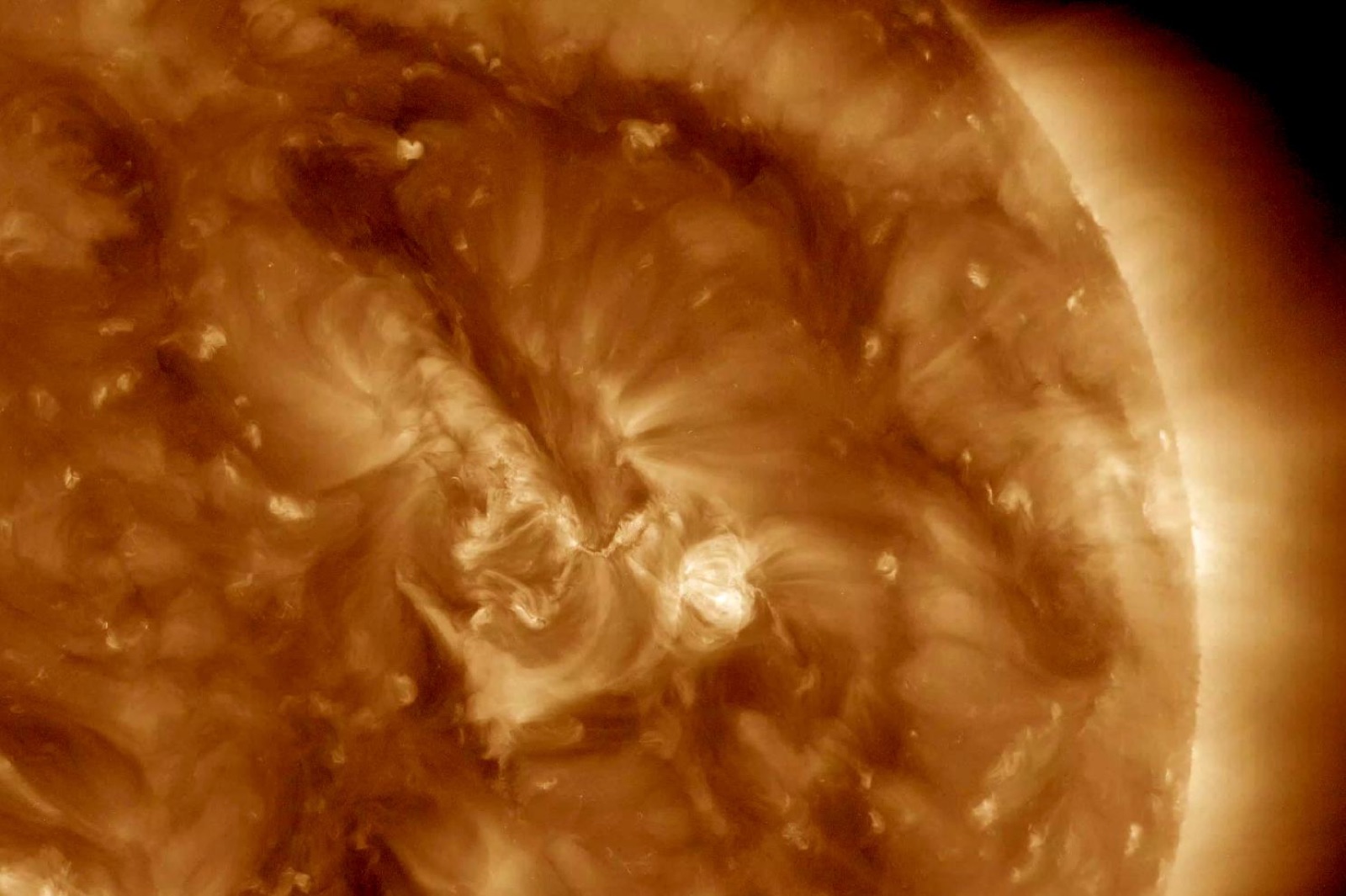
As Comet Lovejoy plunged toward the Sun, it became one of the most observed comets in history from space. Eighteen instruments spread across six separate spacecraft tracked its journey: STEREO-A and STEREO-B, SOHO, the Solar Dynamics Observatory, Hinode, and PROBA2. STEREO-A caught the first glimpse on 3 December, while SOHO didn't pick it up until 14 December, just two days before perihelion. That same day, citizen scientist Zhijian Xu spotted a small companion comet in SOHO imagery, later confirmed by the STEREO twins and designated SOHO-2203. Scientists believe SOHO-2203 is a fragment of Lovejoy that broke away several decades earlier. Finding a smaller companion alongside a Kreutz-group sungrazer was not unexpected — such pairings are a known feature of this family of comets. The sheer number of instruments watching meant that Lovejoy's corona passage was recorded in multiple wavelengths simultaneously, giving scientists an unprecedented dataset of a sungrazer at the moment of its greatest peril.
03 Plunging Through a Million-Kelvin Furnace Deeper
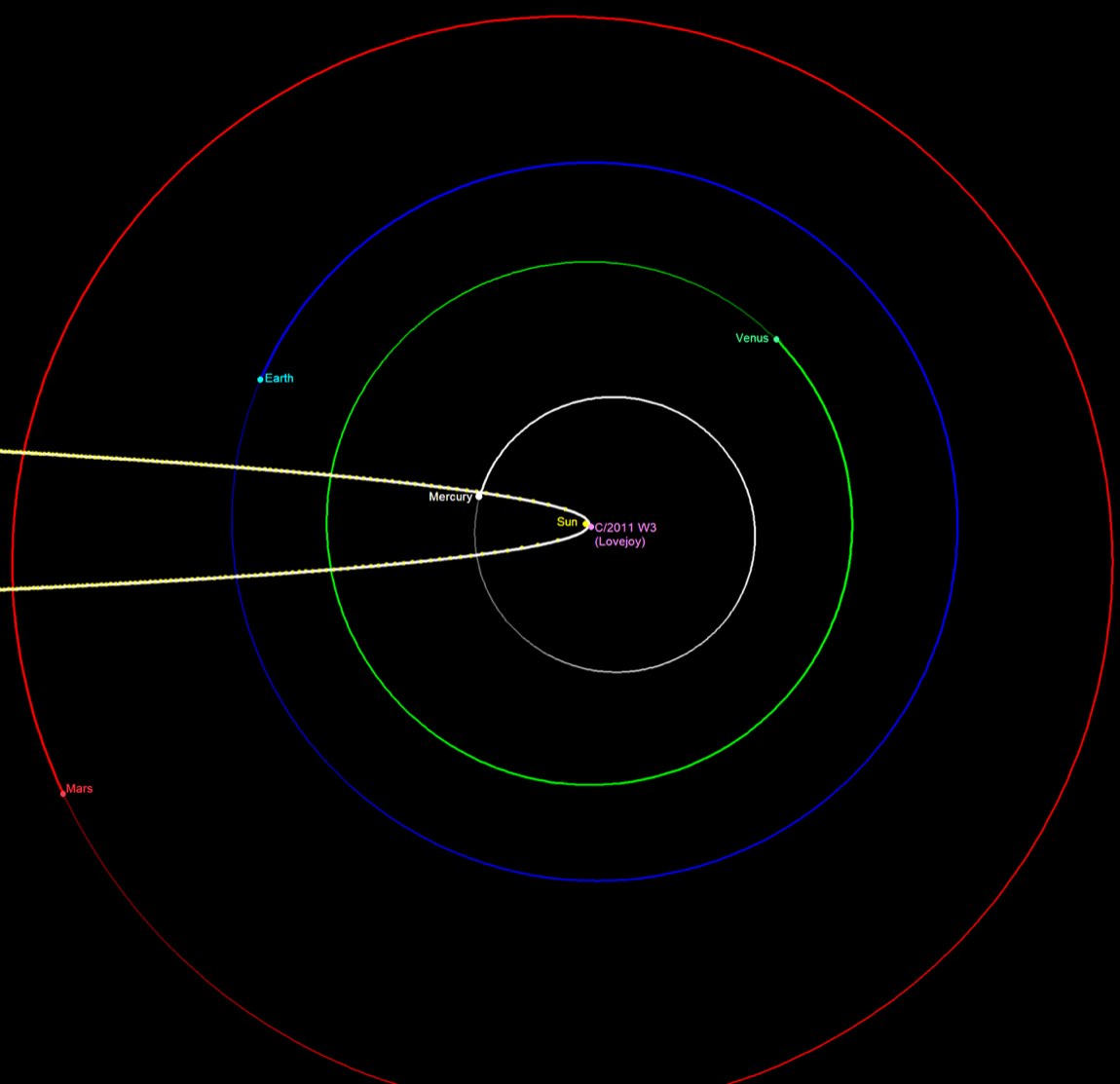
At 00:17 UTC on 16 December 2011, Comet Lovejoy reached perihelion approximately 140,000 kilometres above the Sun's surface — a distance smaller than Earth's diameter by a factor of roughly eleven. It was moving at 536 km/s, equivalent to 1.93 million km/h or about 0.18% the speed of light. The coronal environment it passed through reaches temperatures exceeding one million kelvins, and the comet spent nearly an hour inside this extreme zone. Before the encounter, the nucleus had been estimated at between 100 and 200 metres in diameter. Most models predicted complete destruction: no known comet had survived such conditions. When the Solar Dynamics Observatory watched the comet emerge on the far side, still intact as a coherent object, it shocked the scientific community. The survival implied the nucleus must have been larger than the pre-perihelion estimate — perhaps as much as 500 metres across — because a significant fraction of its mass had evaporated during the passage, yet enough remained to hold together, at least temporarily.
 ⤢
04 Survived Perihelion, Then Fell Apart Anyway Deeper
The comet's survival of perihelion was dramatic, but its story did not end there. The first ground-based sighting after perihelion came on 16 December at 19:55 UTC, when Rick Baldridge and Brian Day of the Foothill Observatory estimated it at magnitude −1. Terry Lovejoy himself observed it the following day, recording magnitudes of −1.2 and −0.8. By 20 December, however, something had changed. Czech astronomer Jakub Černý, using the robotic FRAM telescope at Pierre Auger Observatory, captured images showing the nucleus had apparently become bar-shaped and was accompanied by a bright tail ray. Researchers Zdeněk Sekanina and Paul Chodas analyzed the Pierre Auger data and concluded that while the nucleus did survive perihelion for several days, a significant dust outburst on 19 December preceded a "cataclysmic fragmentation" event on 20 December, after which the nucleus completely disappeared. The comet's visible tail and coma persisted, which is why the ongoing brightness masked the absence of a solid core and observers could not locate a distinct nucleus amid the display.
05 Naked-Eye Glory from the Southern Sky
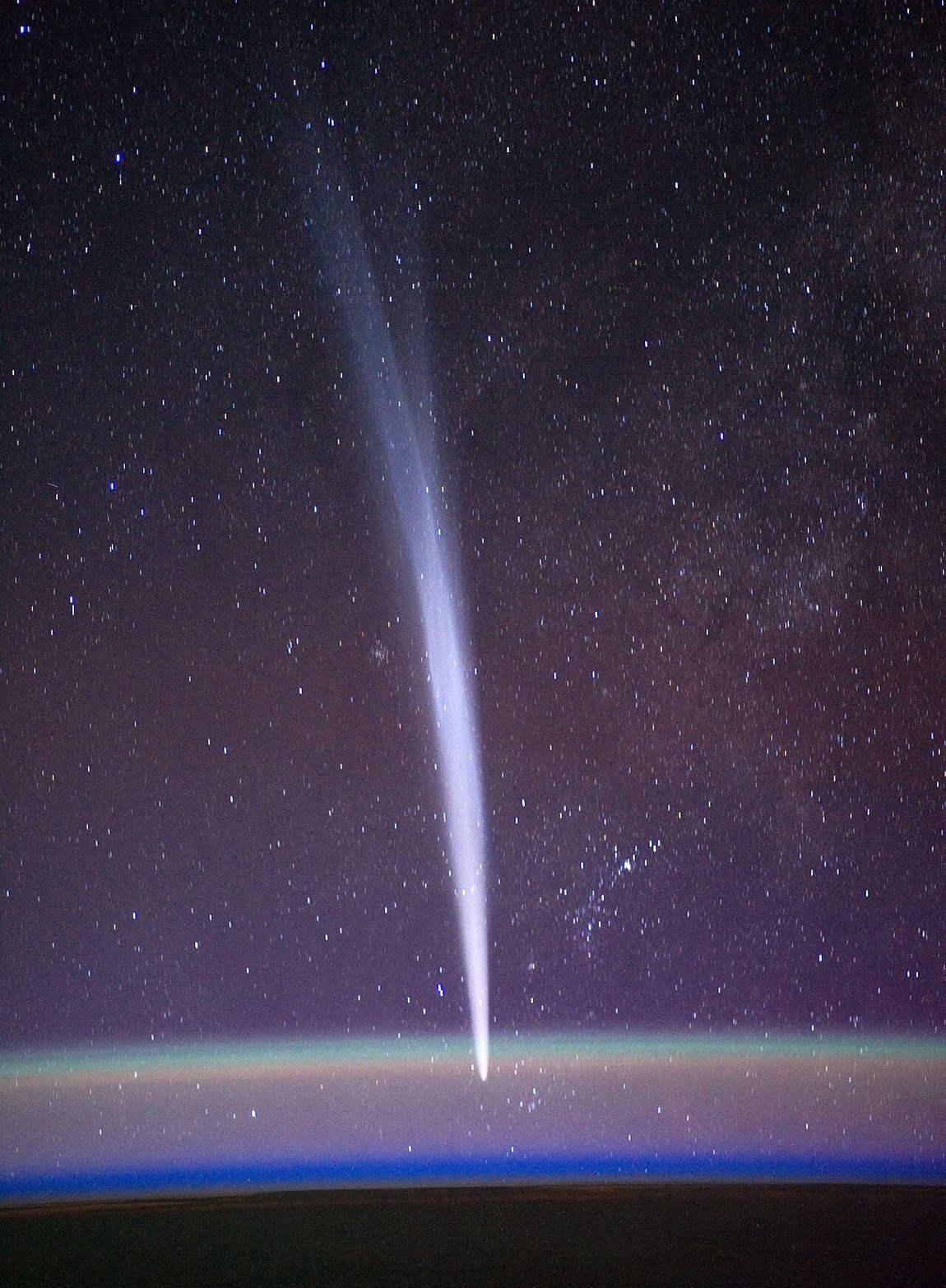
Despite the violence happening in its nucleus, Comet Lovejoy delivered a genuine spectacle for Southern Hemisphere observers. Around 21–22 December, it re-emerged as a naked-eye object, and astronaut Dan Burbank photographed it from the International Space Station, producing some of the most striking images of the event. Ground-based photographers continued capturing the comet as it faded toward 4th magnitude — still comfortably visible without optical aid under good skies. At its absolute peak, near the Sun, it had reached an apparent magnitude of between −3 and −4, roughly equivalent to the brightness of Venus. That made it the brightest sungrazing comet SOHO had ever observed and the brightest comet since Comet McNaught of 2007, which had reached magnitude −5.5. Because Lovejoy's peak coincided with its proximity to the Sun, most of that extreme brightness was inaccessible to naked-eye viewers. Southern observers who looked in late December were catching the comet during its gentler, outbound fade rather than its fiery maximum.
06 An Orbital Future Built on a Big Assumption Deeper
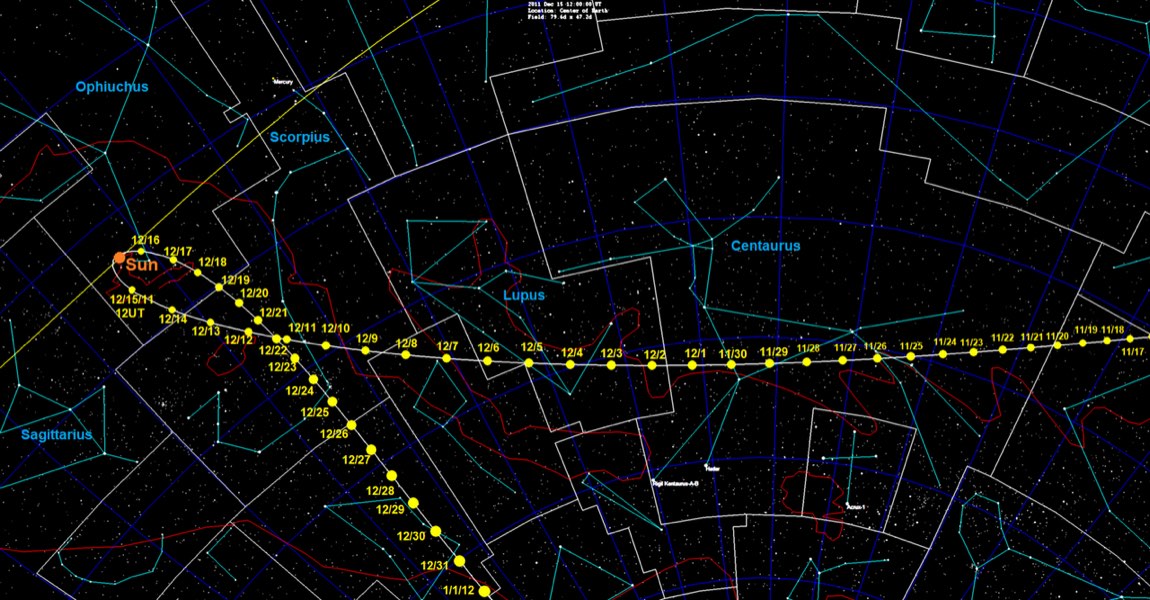
Whether Comet Lovejoy's orbit can be meaningfully calculated depends entirely on whether any portion of the nucleus survived the fragmentation event of 20 December. If some remnant persists, its trajectory offers an unusually stable future: Lovejoy's eccentricity and orbital inclination are arranged such that planetary perturbations are minimal. Using an epoch 2050 solution, the comet is estimated to follow roughly a 622-year orbit, suggesting a return to perihelion around the year 2633. That date carries significant uncertainty, since the fragmentation event and mass loss during the corona passage both affect the precise trajectory. The comet's orbital calculation was refined progressively after discovery: the first estimate on 2 December assumed a parabolic trajectory and placed perihelion at 0.0059 AU; successive refinements tightened this to 0.0056 AU on 5 December and then to 0.0055 AU on 11 December, when the first elliptical orbit was finally published. Each refinement moved perihelion by small but meaningful fractions of an astronomical unit, illustrating how quickly comet orbits sharpen with additional observation.
 ⤢
07 A Family Tree Stretching Back to 467 CE Deeper
In 2012, Zdeněk Sekanina and Paul Chodas published a detailed fragmentation history suggesting that Comet Lovejoy is a distant descendant of a sungrazer that may have passed the Sun as far back as 467 CE. According to their model, that ancient parent comet split near perihelion due to tidal forces. One fragment — or a portion that fragmented non-tidally — returned as the Great Comet of 1106, a historically recorded event of exceptional brightness. A secondary fragment received a longer orbital period and reached perihelion around 1329, an event that went unrecorded. That 1329 body also split, with its principal fragment expected to return around 2200, likely arriving as a cluster of further pieces. A secondary fragment of the 1329 event was set on a shorter period that theoretically should have brought it into the inner solar system in the early 21st century. At some point after its perihelion, non-tidal forces fractured this fragment, and one of the resulting pieces became Comet Lovejoy. Other sibling fragments, the authors suggest, may still be traveling sunward and could appear as future Kreutz sungrazers.
08 The Comet That Owned Two Nicknames
Comet Lovejoy accumulated an unusual pair of informal names, each tied to a calendrical coincidence. The formal announcement of its existence came on 2 December 2011, the 16th anniversary of the launch of the SOHO spacecraft, earning it the nickname "The Great Birthday Comet of 2011" among solar observers who appreciated the symmetry. The second name stuck more broadly: because the comet was visible from Earth during the Christmas holiday period, it was widely called "The Great Christmas Comet of 2011." After the fact, it was also retroactively recognized as the Great Comet of 2011, the standard informal title given to the most spectacular comet of a given year. The formal designation, C/2011 W3, encodes its discovery year and the two-week interval within that year in which it was found. The name Lovejoy, attached by convention to its discoverer, thus sits alongside two seasonal monikers and one official retroactive honor — a richer naming legacy than most comets receive.
09 How the Nucleus Size Estimate Had to Change Deeper
Before perihelion, scientists working from available brightness and dust measurements estimated Comet Lovejoy's nucleus at somewhere between 100 and 200 metres in diameter — roughly the length of one to two American football fields. That range placed it squarely among the smaller known sungrazers, and it fed predictions of certain destruction in the corona. When the comet emerged intact, those predictions were falsified and the size estimate had to be revised upward. The reasoning was straightforward: a body spending nearly an hour in a corona exceeding one million kelvins, moving at 536 km/s, would have required substantially more material to survive even briefly. The revised upper estimate placed the nucleus at perhaps 500 metres. Even at that size, a significant fraction of its mass was thought to have evaporated during the coronal passage. The uncertainty in both estimates illustrates a persistent challenge in comet science: ground-based photometry measures the coma, not the nucleus directly, making pre-perihelion size assessments inherently indirect and prone to revision when a comet's behavior contradicts the model.
 ⤢
10 Open Questions the Data Left Behind Deeper
Despite the extraordinary number of instruments trained on Comet Lovejoy, the encounter left several questions unresolved. The most fundamental is whether any fragment of the nucleus genuinely survived beyond 20 December. Sekanina and Chodas concluded it did not, based on Pierre Auger Observatory data, but the comet's continued visibility as a bright tail made independent verification of the nucleus's absence difficult in real time. The nature of the companion fragment SOHO-2203 is also not fully settled: while it is believed to have broken away from Lovejoy's progenitor several decades ago, the precise separation event has not been identified. The mechanism by which a sungrazer survives coronal passage at all remains a subject of active research — Lovejoy's unexpected emergence provided a rare natural experiment, but interpreting the data from eighteen instruments in six spacecraft is an ongoing task. Finally, the predicted return of sibling fragments from the same fragmentation lineage, possibly in the near future, offers a testable prediction that could either confirm or complicate the Sekanina–Chodas family tree model.