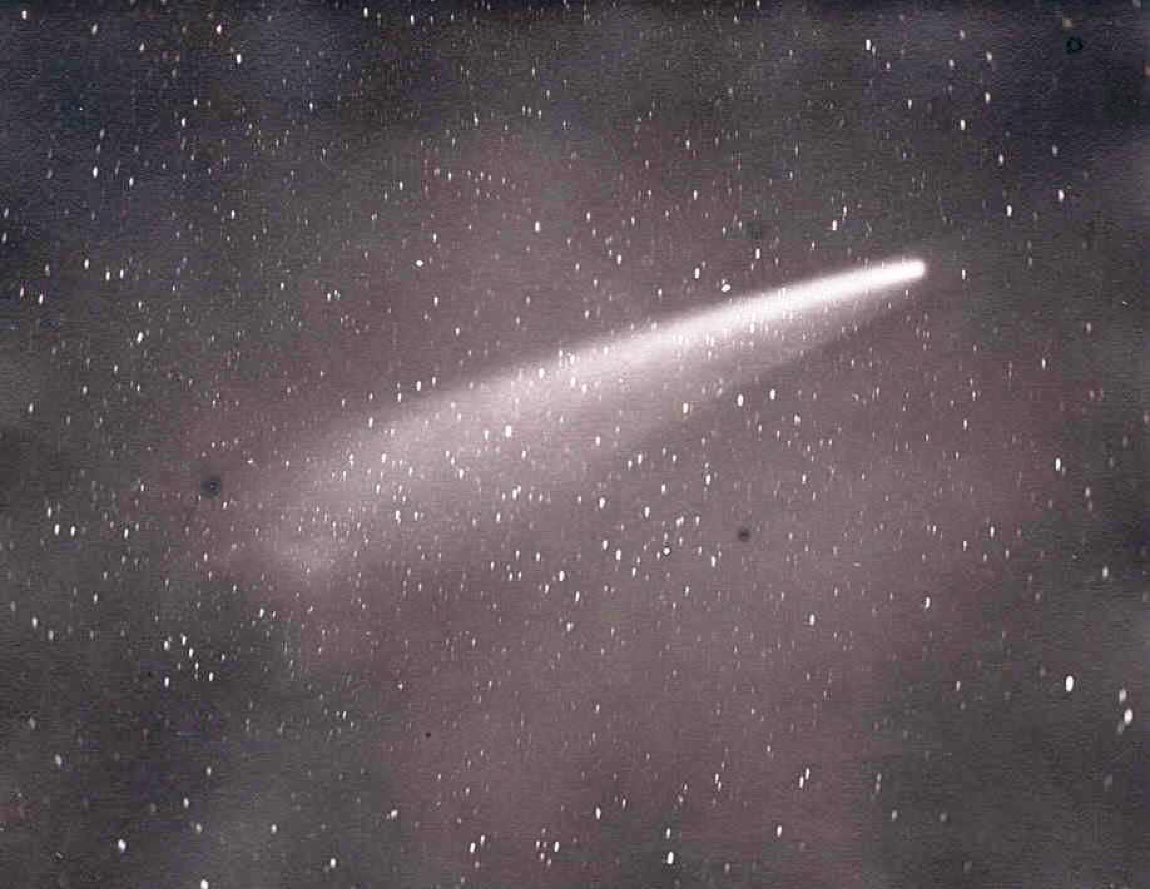
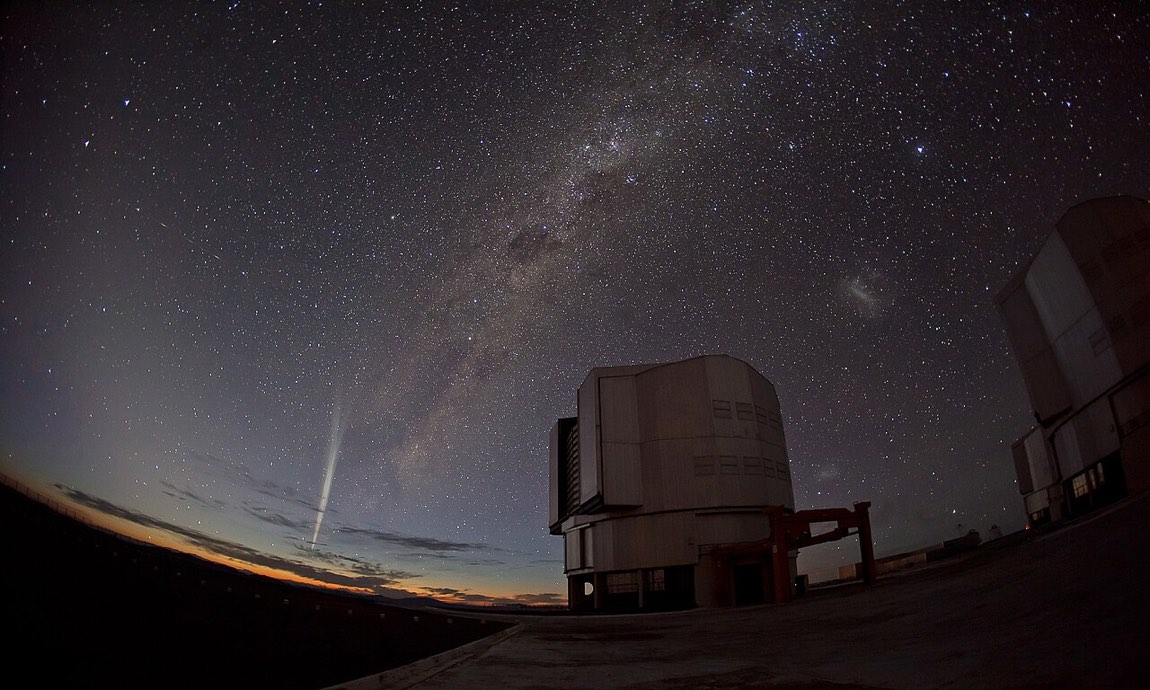
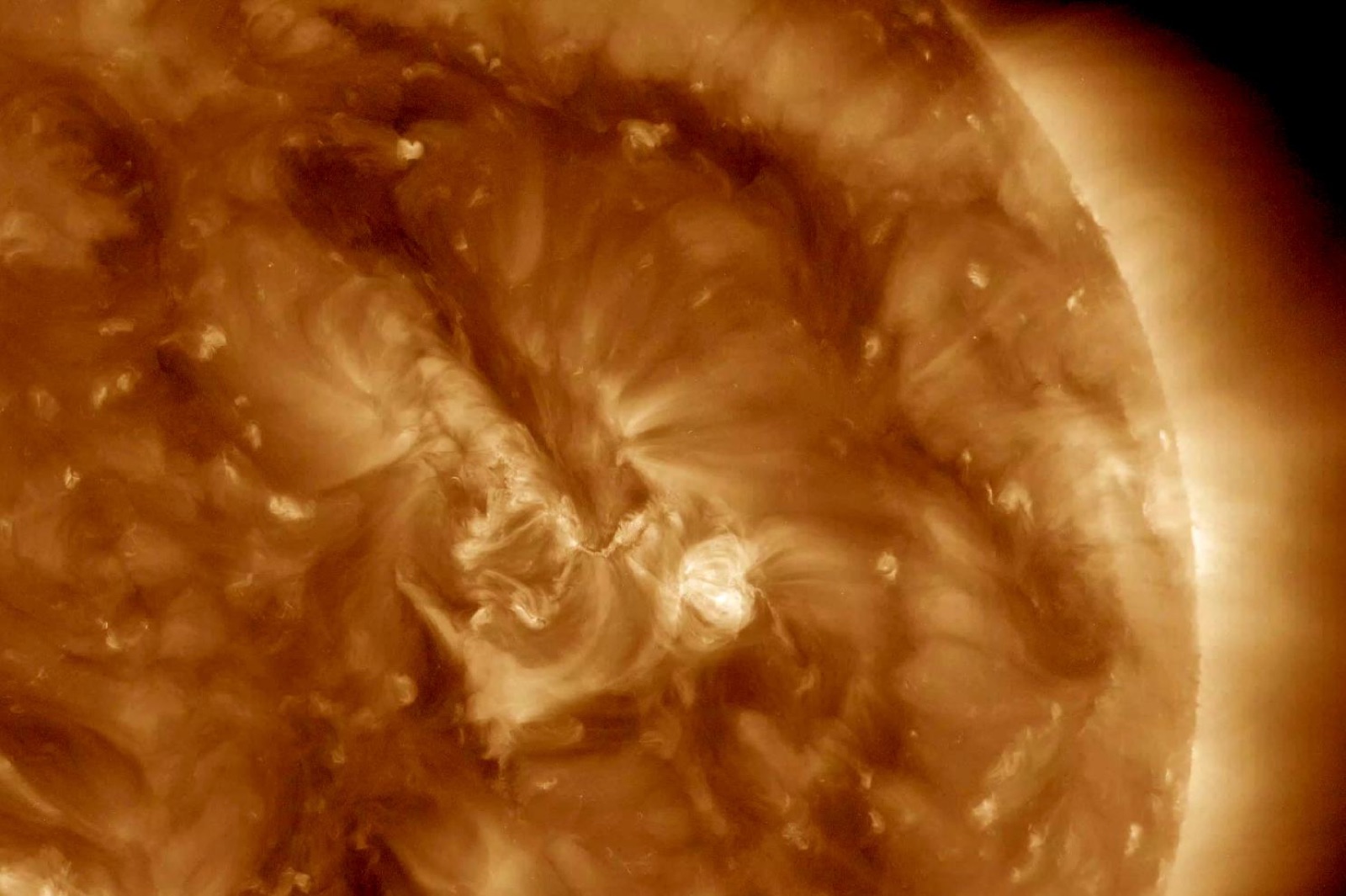
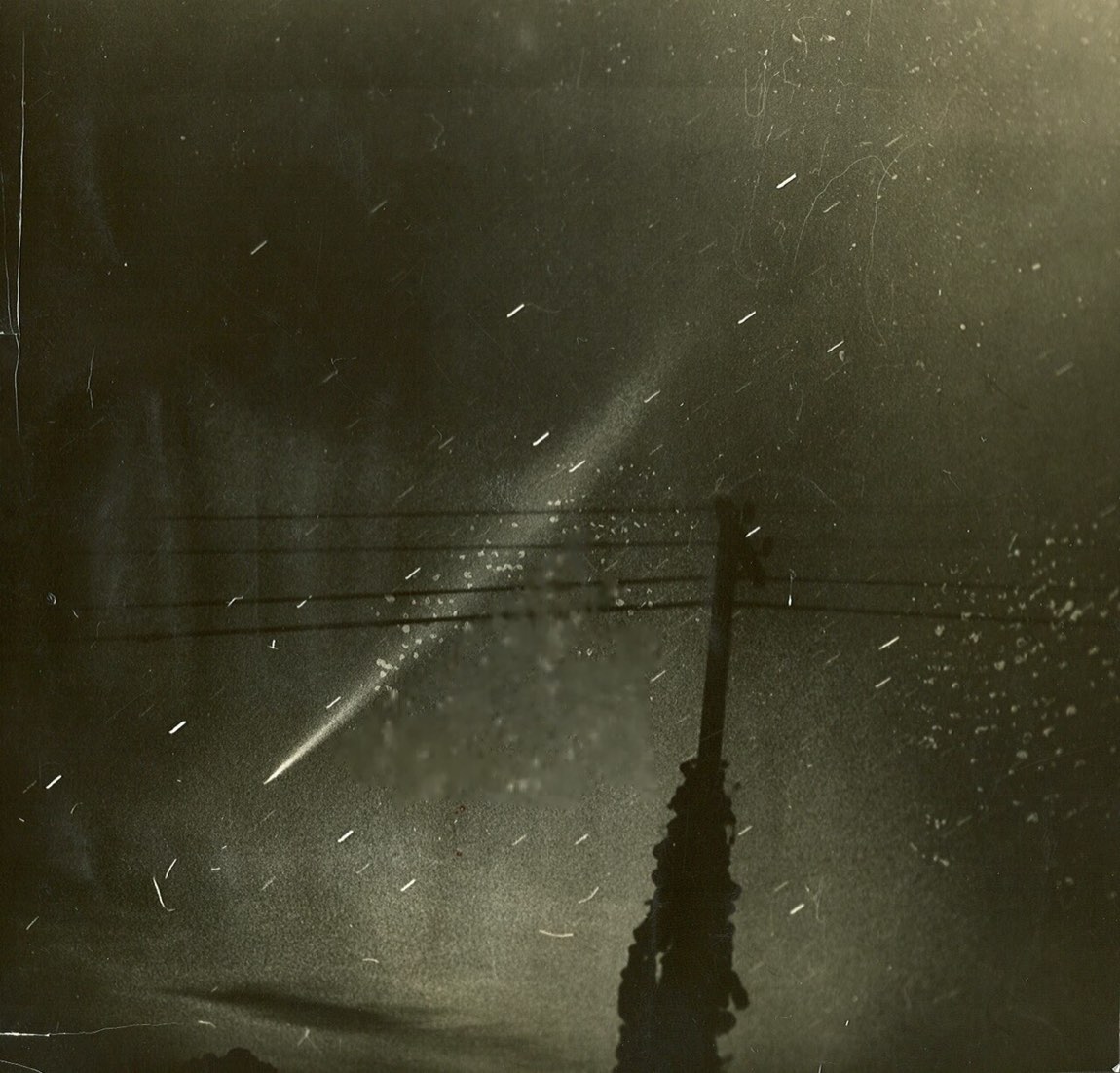
 Photograph · Maynard Pittendreigh ( User:Wmpittendreigh at en.wikipedia ) · CC BY 2.5
Comet · Deep guide
Comet Ikeya–Seki (Great Comet of 1965)
Also called: C/1965 S1 · Great Comet of 1965
A Sun-skimming comet that blazed at magnitude −10, one of the brightest of the last thousand years.
What is it?
Japanese amateur astronomers Kaoru Ikeya and Tsutomu Seki found this comet independently within about 15 minutes of each other in September 1965. Calculations soon showed it was a Kreutz sungrazer whose path closely matched the Great Comet of 1882. On 21 October 1965 it passed only about 1.2 million km from the Sun's centre. Observers in Japan saw it shine at around magnitude −10 near the Sun at noon, and the nucleus later broke into at least two pieces.
The deep dive
Researched for the Atlas from Wikipedia — Comet Ikeya–Seki (7,770 characters read) · updated Nov 14, 2026
01 Two Amateurs, Fifteen Minutes Apart
The discovery of Ikeya–Seki belongs to two Japanese amateur astronomers who never coordinated their efforts yet reached the same patch of sky almost simultaneously. Kaoru Ikeya and Tsutomu Seki independently spotted the comet on 18 September 1965, their observations falling within roughly 15 minutes of each other. At the moment of discovery the comet was an 8th-magnitude object — faint enough to require a telescope — sitting about 10° west of the star Alpha Hydrae and drifting eastward at around 1° per day. A recent typhoon had swept the skies clear, gifting both observers with unusually good seeing conditions. Within days, acceleration and brightening became obvious, drawing professional attention almost immediately. Fred Whipple of the Smithsonian Astrophysical Observatory was among the first to conjecture, from preliminary orbital estimates, that the newcomer was a sungrazer — a comet on a trajectory that would carry it perilously close to the Sun. That early hunch proved spectacularly correct.
02 An Orbit Eerily Like a Famous Ancestor Deeper
Once astronomers refined Ikeya–Seki's orbital elements, a striking resemblance emerged with the Great Comet of 1882, one of the most brilliant comets in recorded history. Both objects shared closely matched orbital properties, and the calculated perihelion distance for Ikeya–Seki came to just 0.0079 AU — equivalent to about 1.2 million kilometers, or roughly 0.7 million miles — placing it among the most extreme sungrazing trajectories known. Even the shape of Ikeya–Seki's light curve as it approached the Sun tracked the 1882 comet's historical brightness record with uncanny fidelity. This similarity was not coincidental: Ikeya–Seki belongs to the Kreutz sungrazer family, a group of comets thought to be fragments of a single large progenitor comet that broke apart long ago. The 1882 comet is itself a Kreutz member, making the two objects likely cousins — or even pieces of the same ancient body — following nearly identical paths around the Sun centuries apart.
03 Brightening That Defied Casual Description
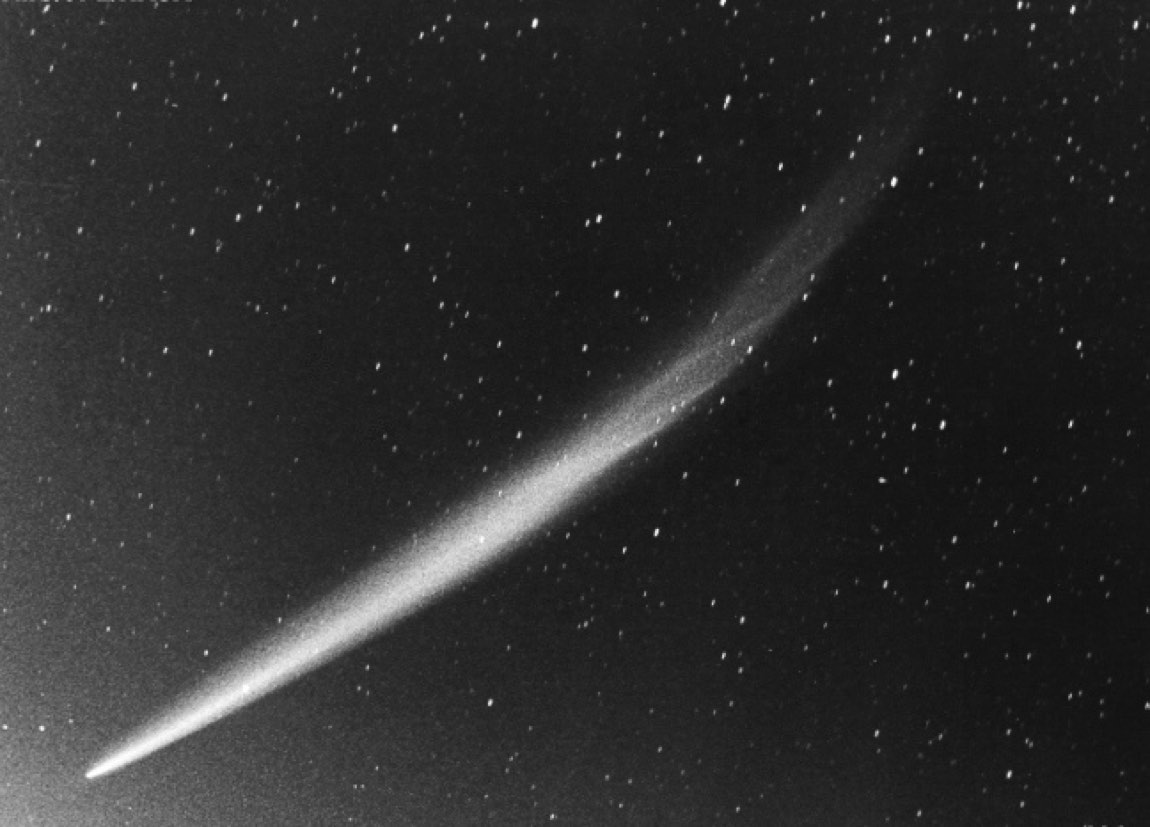
Few comets have brightened as dramatically or as faithfully to prediction as Ikeya–Seki. By 7 October 1965, barely three weeks after discovery, it had reached magnitude +4 — visible to the naked eye under dark skies — and already trailed a tail stretching more than 1° across the sky. By mid-October that tail had grown to 10°. Southern Hemisphere observers, who had the most favorable viewing geometry near perihelion, logged the comet at magnitude 0 on 18 October, comparable to the brightest stars. The brightening then accelerated sharply over the following 60 hours. By 20 October it was easily visible in full daylight, and observers compared its brightness to that of the full Moon. In Japan, where perihelion occurred at local noon, the comet shone at magnitude −10 — a figure comparable to roughly 100 full Moons combined. Observers willing to block the Sun with their hand could even see 2° of its slightly curved tail with the naked eye. It proved to be one of the brightest comets seen in the last thousand years.
04 The Moment of Perihelion
Ikeya–Seki reached perihelion at 21:18 UTC on 21 October 1965, skimming just 450,000 km above the Sun's visible surface — a distance smaller than the Sun's own radius. As seen from Earth at that instant, the comet and the Sun were separated by only a few arcminutes, an almost impossibly close pairing in the sky. The comet's nucleus began to break apart near this moment of closest approach. Japanese observers reported two small fragments detaching from the primary nucleus; those smaller pieces evaporated shortly afterward. After perihelion, the coma faded relatively quickly, dimming to magnitude +3 by 26 October. Yet even as the head faded, the tail performed a remarkable delayed flourish: it stretched to at least 15° by 26 October and reached a maximum of nearly 30° in early November 1965 — equivalent in angular size to 60 full Moons laid end to end across the sky.
 ⤢
05 A Nucleus That Split in Two Deeper
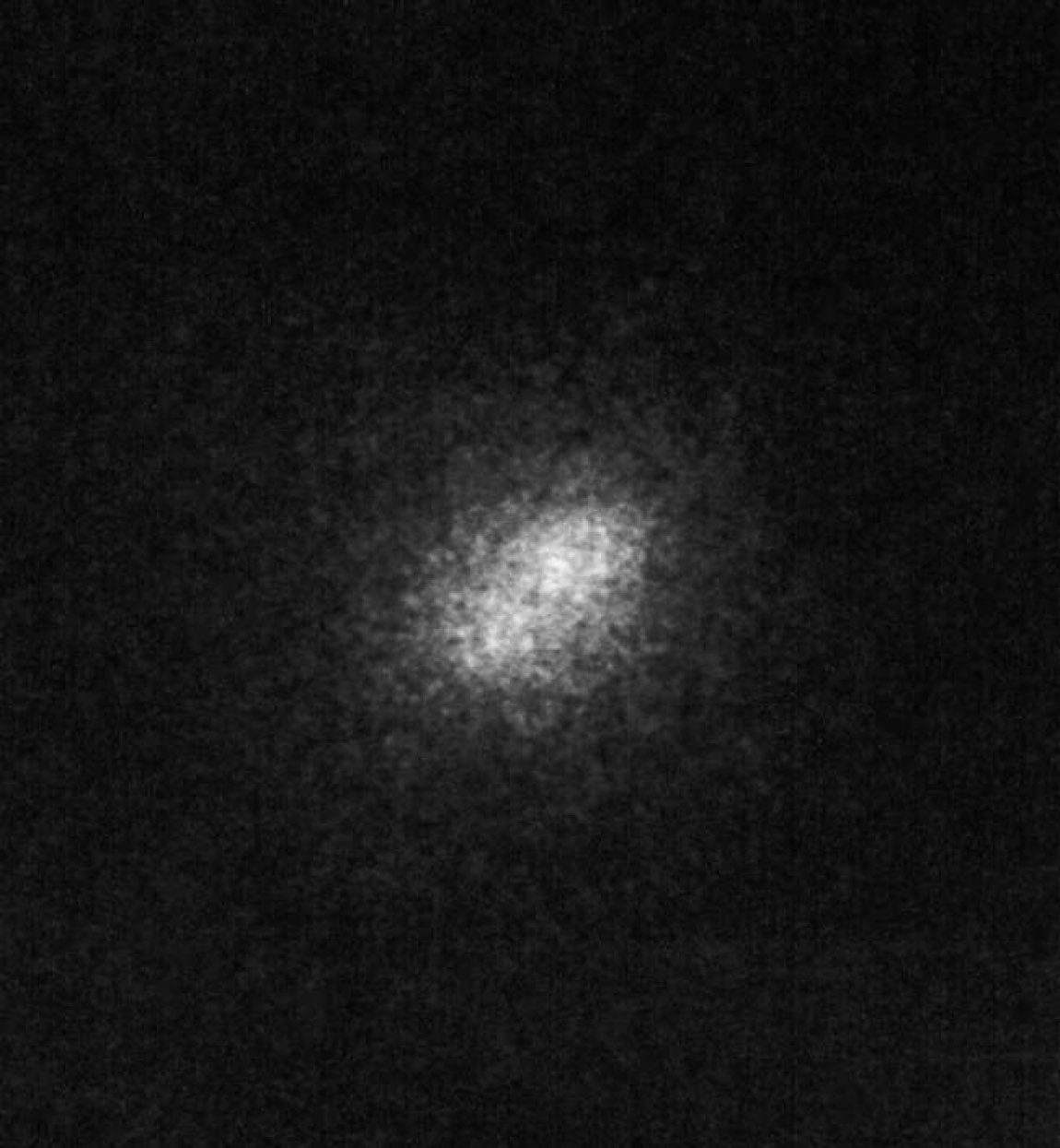
One of the most scientifically valuable events of Ikeya–Seki's apparition was the visible fragmentation of its nucleus. Although small fragments appeared to detach and evaporate near perihelion itself, the main body was slower to show its divisions. By 6 November 1965, two primary components had become visually distinct, differing from each other in both separation and brightness — one was brighter but appeared more diffuse than the other. Their relative motion told the story of a gradual parting: the two pieces drifted apart at approximately 14 m/s, about 31 mph, a pace slower than a highway speed limit. Astronomer Zdenek Sekanina extrapolated the observed positions backward and calculated that the definitive split occurred on 26 October; H. Pohn of the United States Geological Survey independently reached the same date, though Sekanina believed Pohn's result may have traced different fragments. By 1966, the two pieces had widened their separation to nearly a full arcminute in the sky.
06 Why It Faded Faster Than Its Twin Deeper
Although Ikeya–Seki's brightness closely mirrored the Great Comet of 1882 on the inbound leg, its post-perihelion behavior diverged sharply. The 1882 comet remained observable for up to eight months after its perihelion passage. Ikeya–Seki, by contrast, dimmed much more rapidly. The coma had fallen to magnitude 7.4 by 27 November 1965, requiring binoculars, though a 10°-long tail remained visible to the naked eye. The comet dropped below naked-eye visibility entirely in early December 1965. The last photographs were secured before mid-February 1966, after which the comet had faded past magnitude +13. By mid-March 1966, even a 40-inch reflector telescope at the United States Naval Observatory Flagstaff Station could not detect the comet in a 60-second exposure. The fragmentation of the nucleus almost certainly accelerated this decline, dispersing the reservoir of volatiles that would otherwise have sustained a longer, brighter outgassing phase.
07 What Vaporized Near the Sun Deeper
The fiery perihelion passage subjected Ikeya–Seki's nucleus to conditions that vaporized far more than ordinary cometary ices. Observations made with the McMath–Pierce solar telescope at Kitt Peak National Observatory detected emission lines in the comet's coma corresponding to ionized calcium, chromium, cobalt, copper, iron, manganese, nickel, sodium, vanadium, and cyanide. This roster of metallic ions speaks to the extreme temperatures reached when the nucleus skimmed the solar corona. The properties of the ionized iron and nickel emission lines allowed scientists to estimate that the comet reached an effective temperature of around 4800 K near perihelion — hot enough that rock-forming minerals sublimated directly into gas. Before it began to break apart, the nucleus was estimated to have had an effective radius of 4.3 km, roughly the distance across a small city. That modest volume of material produced one of the most spectacular cometary displays in a millennium.
08 A Landmark for Cometary Science
The brightness and orbital geometry of Ikeya–Seki made it an extraordinary target for coordinated professional science. Several major observatories, including Kitt Peak National Observatory, Lick Observatory, and Haute-Provence Observatory, obtained spectrographic observations near perihelion that documented strong emission lines from ionized calcium, iron, sodium, and other metals. A rocket launched from the White Sands Missile Range carried instruments above the atmosphere to observe the comet in ultraviolet light — wavelengths blocked by Earth's air. A NASA-operated Convair 990 aircraft flying out of Hawaii, and a Boeing 707 carrying scientists from Los Alamos National Laboratory, also joined the observational campaign. Astronomer Elizabeth Roemer captured the collective sentiment when she wrote in Publications of the Astronomical Society of the Pacific that the appearance of Comet Ikeya–Seki would "stand as a landmark in cometary physics." Observations from Mauna Kea, Hawaii, contributed direct evidence of the nucleus's fragmentation and of its intense interaction with solar radiation.
 ⤢
09 The Mission That Almost Watched from Space
Ikeya–Seki even touched NASA's human spaceflight program, though in the end Earth-based observers had to carry the scientific load alone. Plans were made to include observation of the comet as part of the Gemini 6A mission, which would have given astronauts a unique vantage above the atmosphere at precisely the period of the comet's perihelion. However, the loss of the Agena target vehicle led to the cancellation of the original Gemini 6 mission profile, and with it the comet observations. Meanwhile, efforts at MIT and Harvard to detect radio emission from the comet yielded negative results, and a pair of rocket launches from Wallops Island intended to gather ultraviolet data also proved unsuccessful. These failures underscored how rare and difficult it is to observe even the brightest comets across every wavelength, while also highlighting how much of the successful science depended on the fortuitous geometry of Ikeya–Seki's orbit relative to Earth.
10 The Kreutz Family and a Lost Giant
Ikeya–Seki's membership in the Kreutz sungrazer group ties it to one of the most dramatic ongoing stories in planetary science. The Kreutz sungrazers are thought to be the gradually dispersing wreckage of a single enormous comet that broke apart — a progenitor whose identity and original size remain subjects of active research. Each member of the family follows a highly elongated orbit that swings inside the Sun's corona, and the shared orbital elements that link them all point back to a common ancestor. The Great Comet of 1882, which Ikeya–Seki so closely resembled in orbital properties and light-curve behavior, is another Kreutz member. So is the Comet of 1106, mentioned in historical records. Whether Ikeya–Seki and the 1882 comet are pieces of the same intermediate-generation fragment, or more distantly related splinters, remains an open question. What is clear is that each sungrazing passage sheds more mass and may eventually produce further fragmentation events similar to what observers witnessed in October 1965.
11 How the Brightness Record Was Measured Deeper
Measuring the brightness of a comet within a few degrees of the Sun in the daytime sky is an observational challenge with no clean solution. As Ikeya–Seki approached perihelion, it moved to ever-lower altitudes and into progressively brighter sky background, making photometric estimates increasingly uncertain. In the Southern Hemisphere, where the viewing geometry was most favorable, observers placed the comet at magnitude 0 on 18 October — a credible measurement made while the comet was still in a dark enough sky for meaningful comparison. The magnitude −10 figure reported from Japan at perihelion was obtained in Japan where the comet was at local noon, requiring observers to work in direct proximity to the Sun. The comparison to full-Moon brightness captures the extraordinary luminosity involved: the full Moon typically reaches about magnitude −12.7, so magnitude −10 represents a comet brighter than a quarter-Moon hanging beside the Sun. These numbers, striking as they are, carry inherent uncertainties given the conditions under which they were obtained.
 ⤢