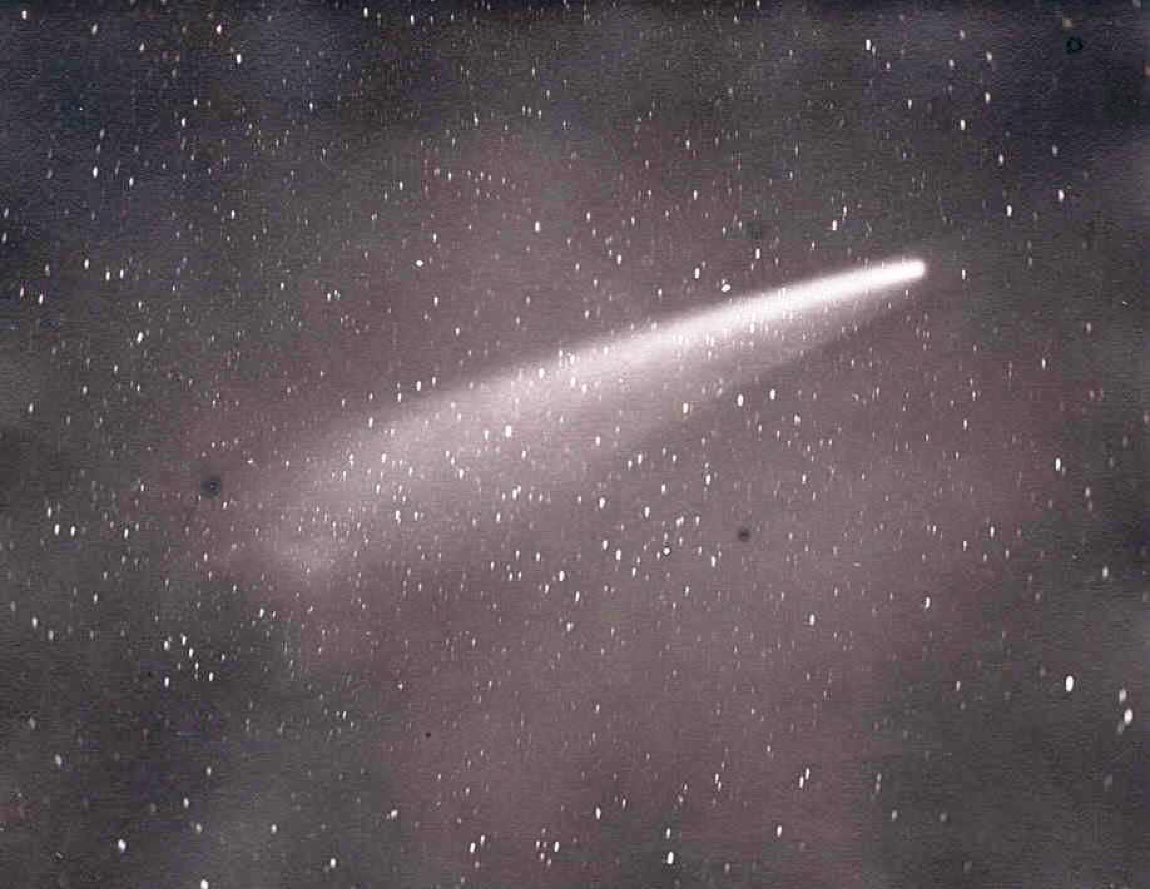
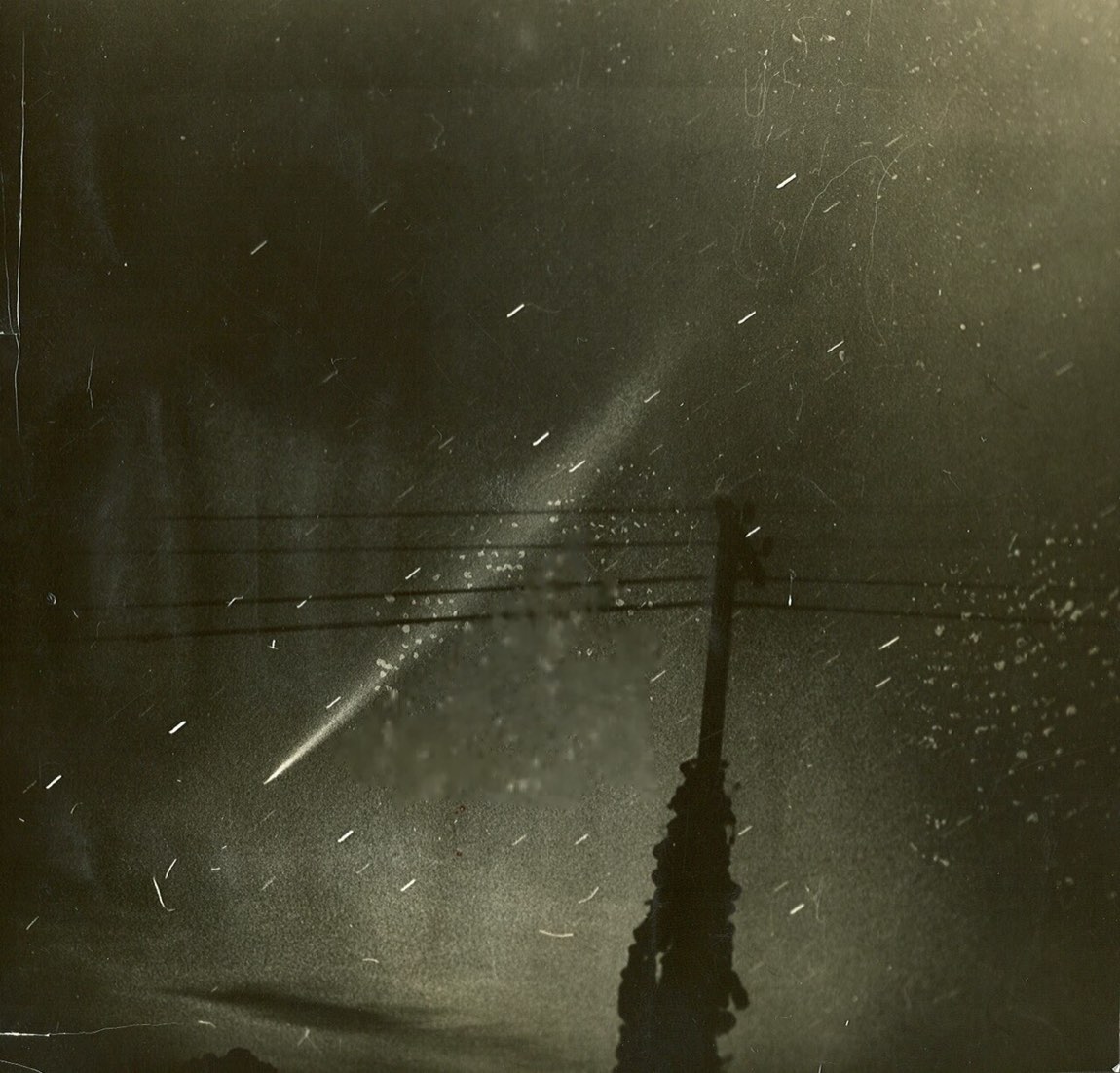
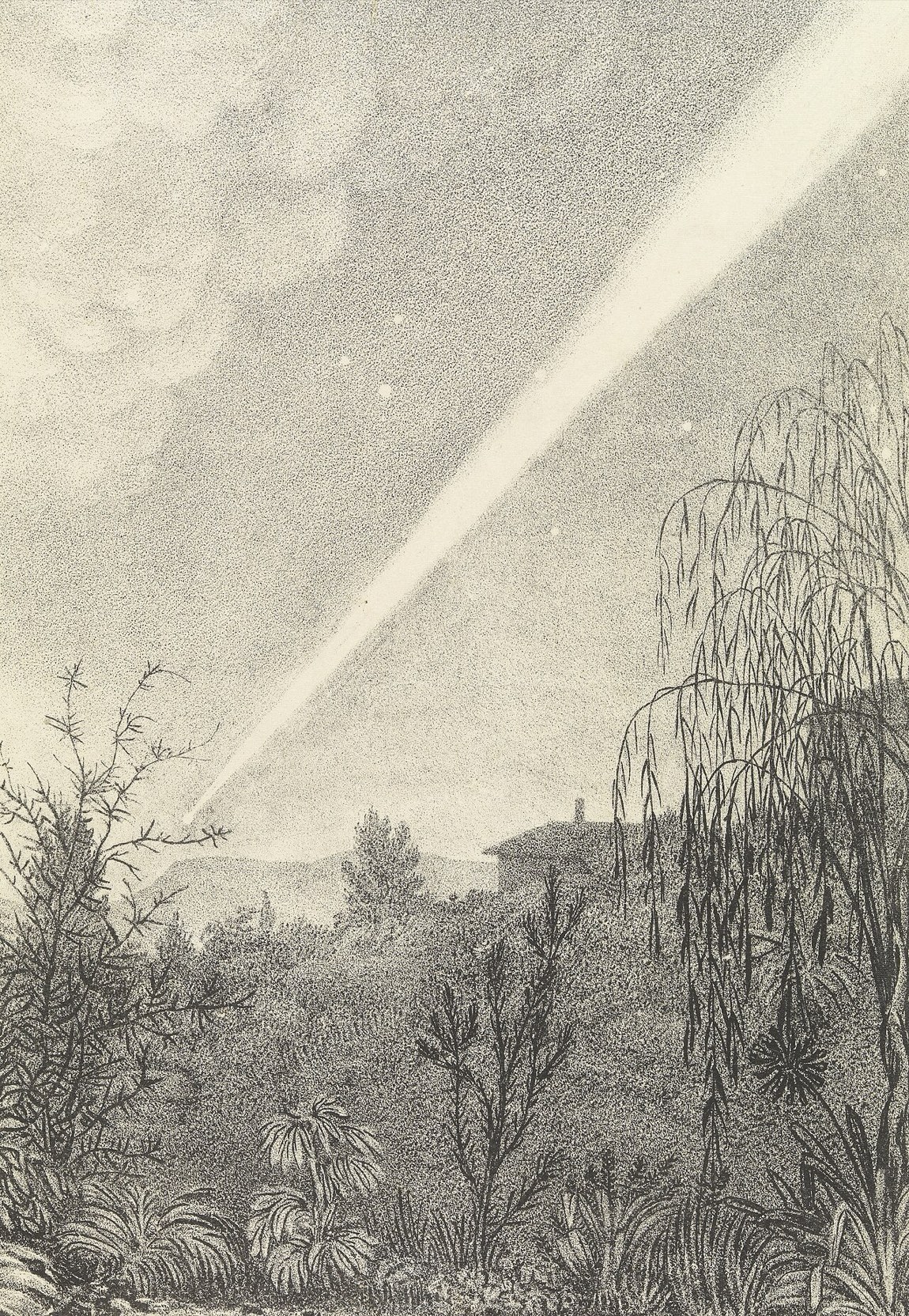
 Photograph · Mary Morton Allport · Public domain
Comet · Deep guide
Great March Comet of 1843
Also called: C/1843 D1 · 1843 I · Great Comet of 1843
A sungrazer seen in broad daylight beside the Sun, with a tail more than two AU long.
What is it?
The Great Comet of 1843 was first seen in early February 1843 and rushed towards an astonishingly close perihelion on 27 February, passing only about 130,000 km above the Sun's surface. Around then it was visible in daylight about a degree from the Sun. Its tail grew to more than two astronomical units long, the longest comet tail known until Hyakutake's was measured in 1996. It belongs to the Kreutz sungrazer family.
The deep dive
Researched for the Atlas from Wikipedia — Great Comet of 1843 (2,715 characters read) · updated Nov 14, 2026
01 A Sungrazer Born from Ancient Breakup
The Great Comet of 1843 belongs to one of astronomy's most dramatic families: the Kreutz sungrazers. These objects are not independent comets that happened to wander close to the Sun; they are fragments of a single enormous parent comet that shattered. Specifically, the comet belongs to the Kreutz Population I subgroup, whose origin has been traced to a catastrophic breakup event in February 1106. That medieval comet itself was apparently no newcomer — recent studies published in 2022 and 2025 traced the orbital lineage even further back, linking both the 1106 comet and the 1843 comet to an object recorded by the Roman historian Ammianus Marcellinus in 363 AD. Each successive close solar passage stresses and splinters these icy bodies, so the comet of 1843 was essentially a child of a child — a surviving shard of a lineage spanning at least fifteen centuries before anyone gave it a formal designation.
02 Skimming the Solar Surface
What makes Kreutz sungrazers extraordinary is how absurdly close they get to the Sun, and the Great Comet of 1843 set a record by any measure known at the time. Its perihelion on February 27, 1843, carried it to roughly 827,000 km from the Sun's center — only about 132,000 km above the solar surface itself. For scale, that gap is barely one-tenth the distance from Earth to the Moon. No other known object had ever been recorded passing so close to the Sun. The gravitational and thermal forces at that distance are almost incomprehensible: surface temperatures on the sunlit face of the nucleus would have soared far beyond the melting point of rock. The fact that any nucleus survived at all speaks to the sheer size of the object before the encounter, though estimates suggest it was substantially disrupted in the process.
03 Seen in Broad Daylight
On the day of perihelion, the comet was visible to the naked eye in broad daylight, observed roughly one degree away from the Sun in the sky. That is about twice the width of a full Moon — close enough to the Sun that most observers would need to deliberately shield their eyes from direct sunlight to catch a glimpse. Daytime comet sightings are exceptionally rare in recorded history, and this event immediately signaled to observers worldwide that something extraordinary was happening. The comet had been first spotted on February 5, 1843, meaning it brightened from an ordinary telescopic discovery to a naked-eye daylight object in just over three weeks. After perihelion, it passed closest to Earth on March 6, 1843, at a distance of 0.84 AU, reaching its greatest brilliance the following day — but by then its geometry was most favorable for Southern Hemisphere observers, leaving many northern astronomers frustrated.
04 The Record-Breaking Tail Deeper
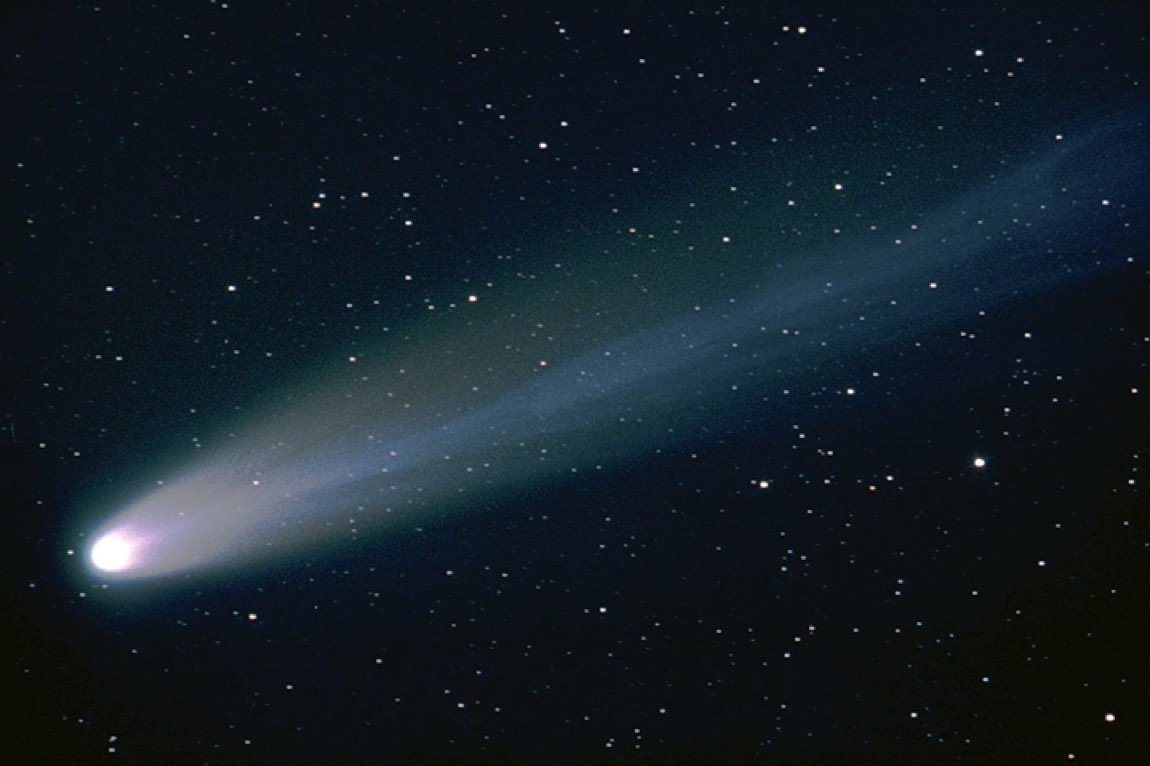
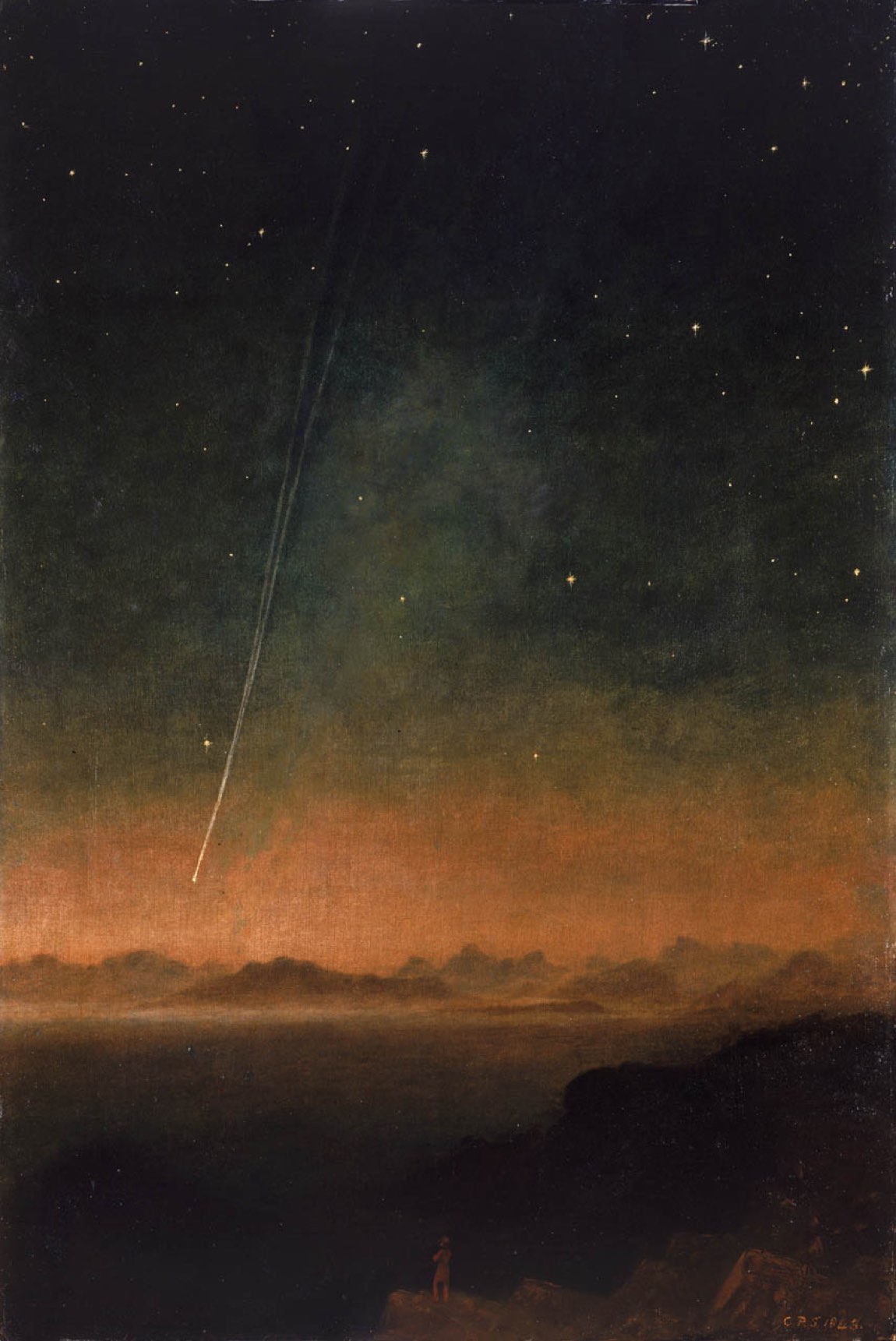
As the comet swung around the Sun, the ferocious solar heating vaporized enormous quantities of ices and dust from the nucleus, driving a tail that stretched to over two astronomical units in length — more than 300 million kilometers, or roughly twice the distance from Earth to the Sun. This made it the longest cometary tail ever measured up to that point, a record it held for more than 150 years. The record finally fell in 1996, when measurements of Comet Hyakutake revealed a tail almost twice as long as the 1843 comet's. Capturing the visual spectacle of the 1843 tail for posterity was astronomer Charles Piazzi Smyth, who created a painting now held in the National Maritime Museum specifically to document the overall brightness and scale of what observers witnessed. That painting remains a rare scientific artifact — an attempt by a working astronomer to record quantitative impressions of brightness in an era before astrophotography.
05 How Big Was the Nucleus? Deeper
Direct measurement of the nucleus of a nineteenth-century comet is obviously impossible after the fact, but researchers in 2022 used reconstructions of Kreutz sungrazer origins to estimate the Great Comet of 1843's physical scale. Their analysis suggested the nucleus had an effective radius of approximately 24.75 km — making it roughly comparable in diameter to a small city's metropolitan area. Its estimated mass before perihelion disintegration was approximately 7.30×10¹⁷ kg, which is in the same general range as mid-sized asteroids. The qualifier "before it disintegrated" is important: the perihelion passage almost certainly fragmented and ablated significant portions of the nucleus, so observers in 1843 were witnessing the comet in its death throes as a coherent body. These estimates carry inherent uncertainties because they depend on models of how the original parent comet broke apart and how individual fragments evolved over centuries.
06 An Orbital Period Nobody Can Pin Down Deeper
Calculating a reliable orbital period for the Great Comet of 1843 is genuinely difficult, and astronomers have landed on strikingly different answers over the decades. Heinrich Kreutz's classical work from 1901 gave 512±105 years, while later analyses produced estimates of 654±103 years, 687 years, and 742 years. The fundamental problem is observational baseline: the comet was only tracked for 45 days, from March 5 to April 19, 1843. Fitting a full elliptical orbit to 45 days of data on a body with a period of centuries leaves enormous room for error. The honest summary, as the evidence stands, is that the orbital period is likely somewhere between 600 and 800 years — a range wide enough to shift the predicted next return by two centuries. This uncertainty is not a failure of astronomy but an honest reflection of how little of a comet's vast orbit can be sampled during a single brief visit to the inner solar system.
07 The Comet That Inspired a Waltz
The cultural impact of the Great Comet of 1843 reached beyond observatories into parlors and concert halls. Mexican composer Luis Baca responded to the spectacle by writing a waltz for piano titled El cometa de 1843. The piece appeared as number 13 in a weekly musical periodical called Instructor filarmónico, periódico semanario musical, Tomo primero, published in Mexico in 1843. The fact that a prominent comet could inspire a popular piano waltz within the same year of its appearance illustrates how deeply visible celestial events penetrated everyday cultural life in the nineteenth century, long before the news cycle made such phenomena routine. Great comets were public events that cut across class and education — everyone who could look up saw the same thing, and artists, composers, and writers responded accordingly. The Baca waltz is a small but vivid reminder that the history of astronomy is also a history of human feeling.
08 A Record That Stood for Over a Century
When the Great Comet of 1843 swept past the Sun, it claimed two records that endured for strikingly long periods. Its perihelion passage was the closest to the Sun of any known object at the time — a distinction rooted not just in its dramatic orbit but in the fact that nothing similar had been carefully documented and measured before. Its tail length of over two astronomical units held the record for the longest measured cometary tail for more than 150 years, until Comet Hyakutake was observed in 1996. Even then, Hyakutake's tail was described as almost twice as long, implying that the 1843 comet's tail was itself not merely a marginal record-holder but a genuinely exceptional structure. These dual records — proximity to the Sun and tail length — are directly connected: the extreme solar heating at perihelion was the energy source that drove such prodigious outgassing and built the enormous tail.
09 Tracing Its Lineage to the Ancient World Deeper
One of the more remarkable threads in modern cometary research involves working backward through orbital mechanics to identify ancient naked-eye comets as ancestors of well-known modern ones. For the Great Comet of 1843, this detective work has been particularly fruitful. Studies published in 2022 and again in 2025 strengthened the orbital connection between the 1843 comet, the comet of 1106, and a comet recorded by Ammianus Marcellinus in 363 AD. Ammianus was a Roman soldier and historian — not an astronomer — which makes the survival of his observation a matter of historical luck rather than systematic sky-watching. The fact that modern orbital integrations can link a brief telescopic observation from 1843 to a historical record from the late Roman Empire, and confidently treat them as fragments of the same disintegrating body, represents a remarkable convergence of celestial mechanics, historical scholarship, and modern computational power. The lineage now spans at least 1,480 years of documented appearances.
10 Why Southern Observers Had the Best View
The timing and geometry of the Great Comet of 1843's visit conspired to give Southern Hemisphere observers a significantly better show than their northern counterparts. At its greatest brilliance on March 7, 1843, the comet's position in the sky favored latitudes south of the equator. This kind of hemispheric inequality in comet visibility is common and stems from the geometry of the comet's orbit relative to Earth's ecliptic plane and the observer's latitude. For northern hemisphere astronomers in Europe and North America, who dominated the professional astronomical institutions of the era, this was a source of considerable frustration. The comet was still visible from the north, but catching it at peak brightness required being in the right place on Earth as well as the right moment in time. The last observation of the comet from anywhere on Earth occurred on April 19, 1843, as it faded back into the outer solar system.
 ⤢