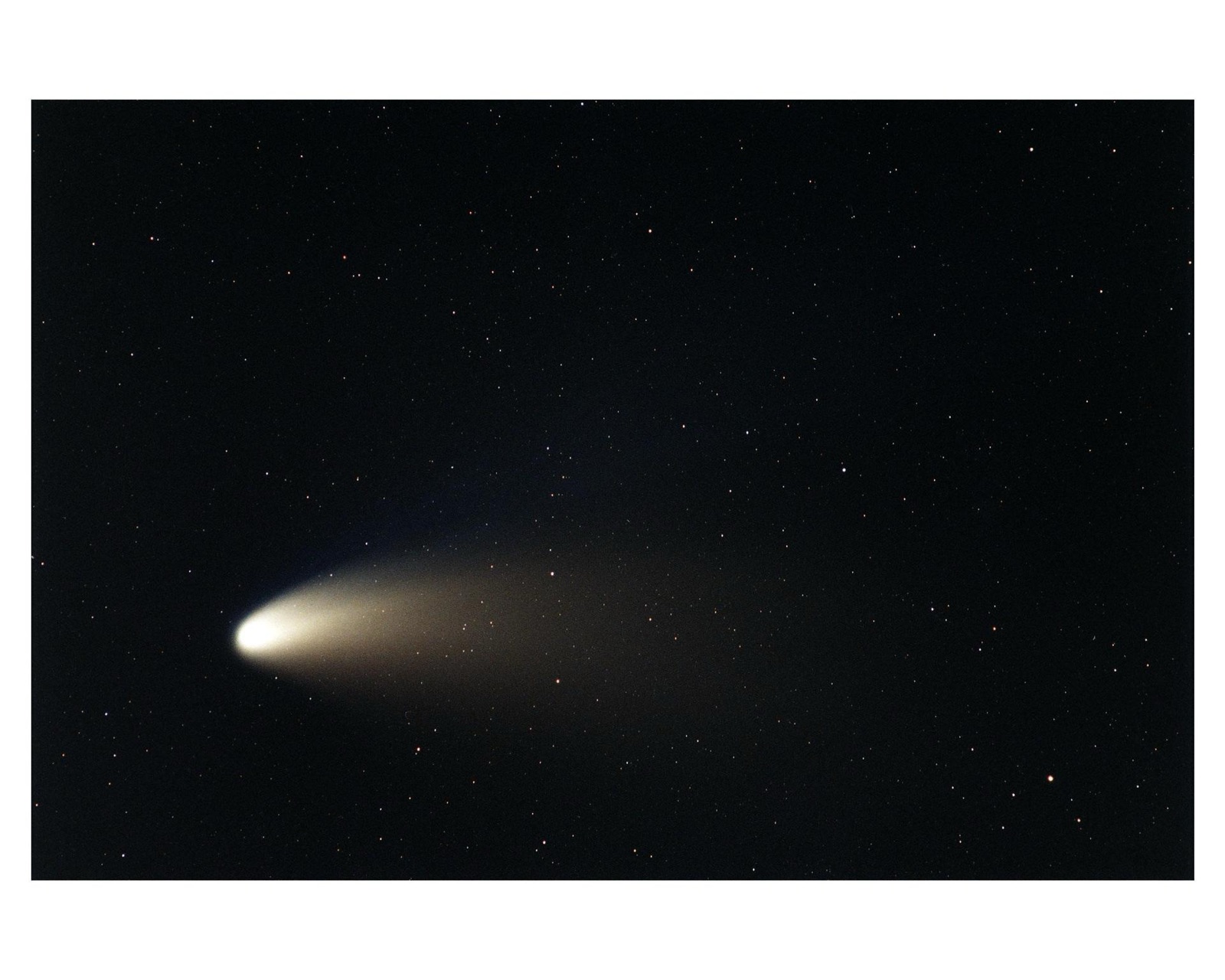
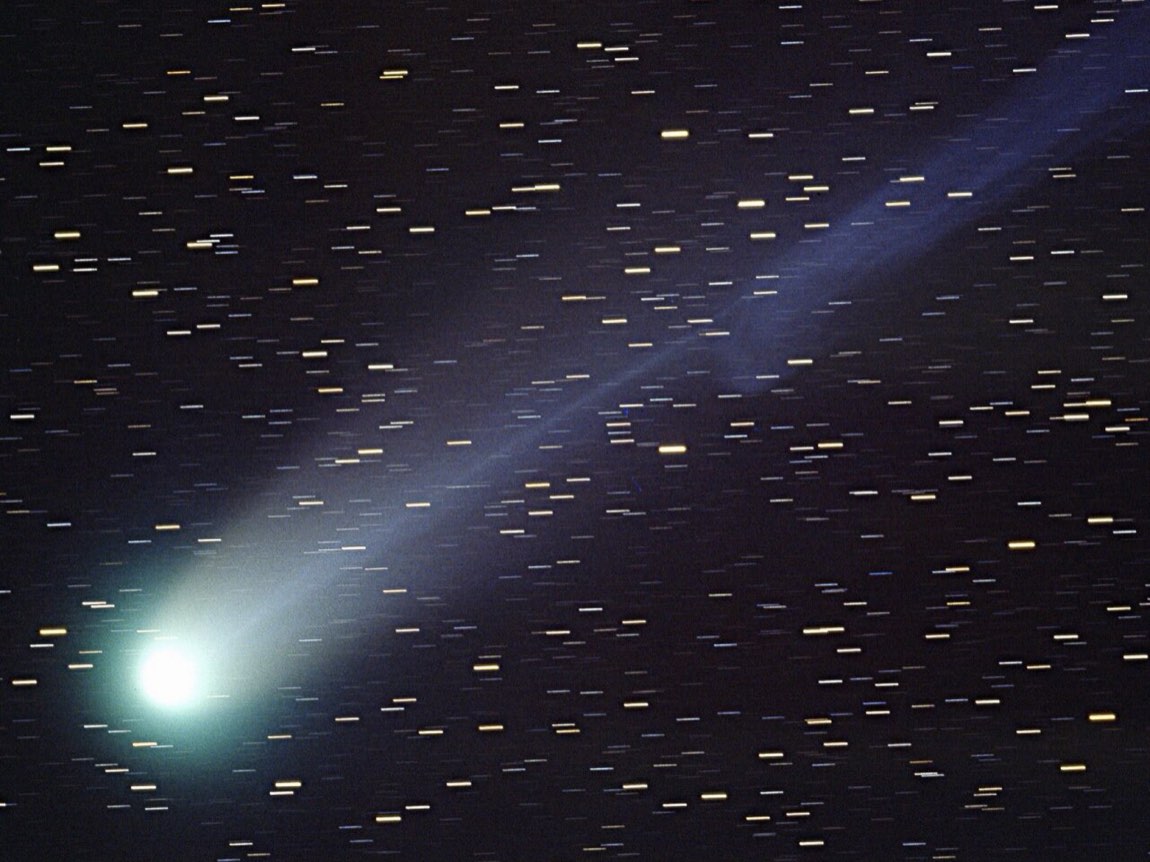
 Photograph · Franz Haar · CC BY-SA 3.0
Comet · Deep guide
Comet Hyakutake (Great Comet of 1996)
Also called: C/1996 B2 · Great Comet of 1996
Swept within 0.1 AU of Earth in 1996 and turned out to have the longest tail ever measured.
What is it?
Comet Hyakutake was found by Japanese amateur astronomer Yuji Hyakutake using large binoculars in January 1996. On 25 March it passed only about 0.1 AU from Earth, one of the closest comet approaches in two centuries, and glowed at about magnitude zero with a tail stretching across much of the sky. It was the first comet seen to give off X-rays, and the Ulysses spacecraft later crossed its tail more than 500 million km from the nucleus, the longest comet tail on record.
The deep dive
Researched for the Atlas from Wikipedia — Comet Hyakutake (12,601 characters read) · updated Nov 14, 2026
01 How Yuji Hyakutake Found It Twice
Yuji Hyakutake was not a professional astronomer but an amateur from southern Japan who had deliberately relocated to Kagoshima Prefecture partly because the nearby rural areas offered dark skies ideal for comet hunting. On the night of 30 January 1996, he was sweeping the sky with an unusually powerful pair of binoculars whose objective lenses measured 150 mm — about 6 inches — across, far larger than typical stargazing binoculars. What made the discovery particularly remarkable was that this was actually his second comet find within weeks. He had already discovered C/1995 Y1 shortly before, and while he was re-examining the patch of sky where that first comet had appeared, he spotted a second object in almost the same position. Barely believing his luck, he waited until morning and reported his observation to the National Astronomical Observatory of Japan. Independent observers confirmed it the same day. At discovery, the new comet glowed at magnitude 11.0 — invisible to the naked eye — with a coma only 2.5 arcminutes across, sitting about 2 AU from the Sun. A precovery image later turned up on a photograph taken on 1 January, when the comet was at 2.4 AU and magnitude 13.3.
02 An Orbit Shaped by Deep Time Deeper
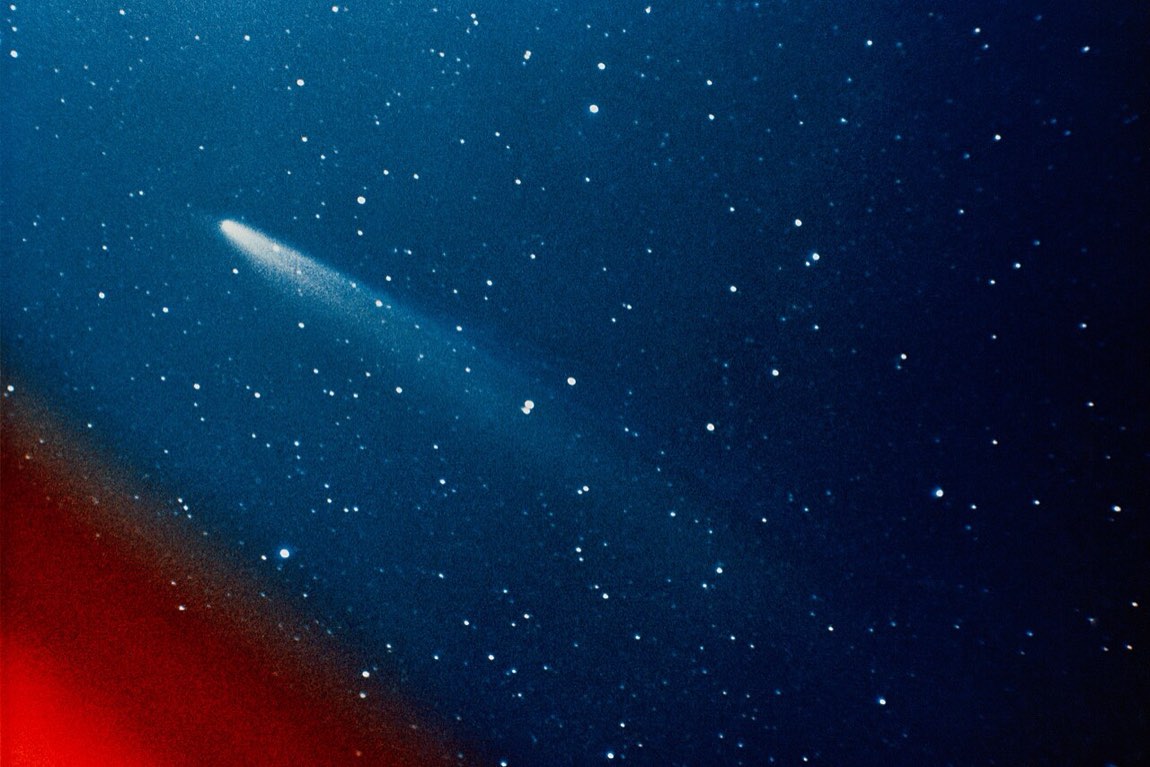
Hyakutake is classified as a long-period comet, meaning its journey around the Sun spans timescales that dwarf recorded human history. Before the 1996 passage, its orbital period was approximately 17,000 years, implying it had last grazed the inner Solar System around the time early humans were painting cave walls in the Upper Palaeolithic. That prior visit means Hyakutake was not a dynamically fresh comet arriving from the Oort Cloud for the first time — a distinction that matters enormously to observers. First-time arrivals can carry a surface coating of highly volatile ices that cause brief, brilliant outbursts before the comet dims disappointingly, as happened with Comet Kohoutek in 1973. Hyakutake's veteran status meant its brightness curve was expected to be more reliable, and so it proved. During the 1996 passage, gravitational tugs from the giant planets reshaped its orbit significantly, stretching the period from roughly 17,000 years to approximately 70,000 years. Barycentric modelling of the orbit predicts the comet will not return to the inner Solar System for that full 70,000-year span, making 1996 the last opportunity any living creature on Earth will ever have to witness this particular visitor.
03 Why It Was Visible All Night Near the Pole
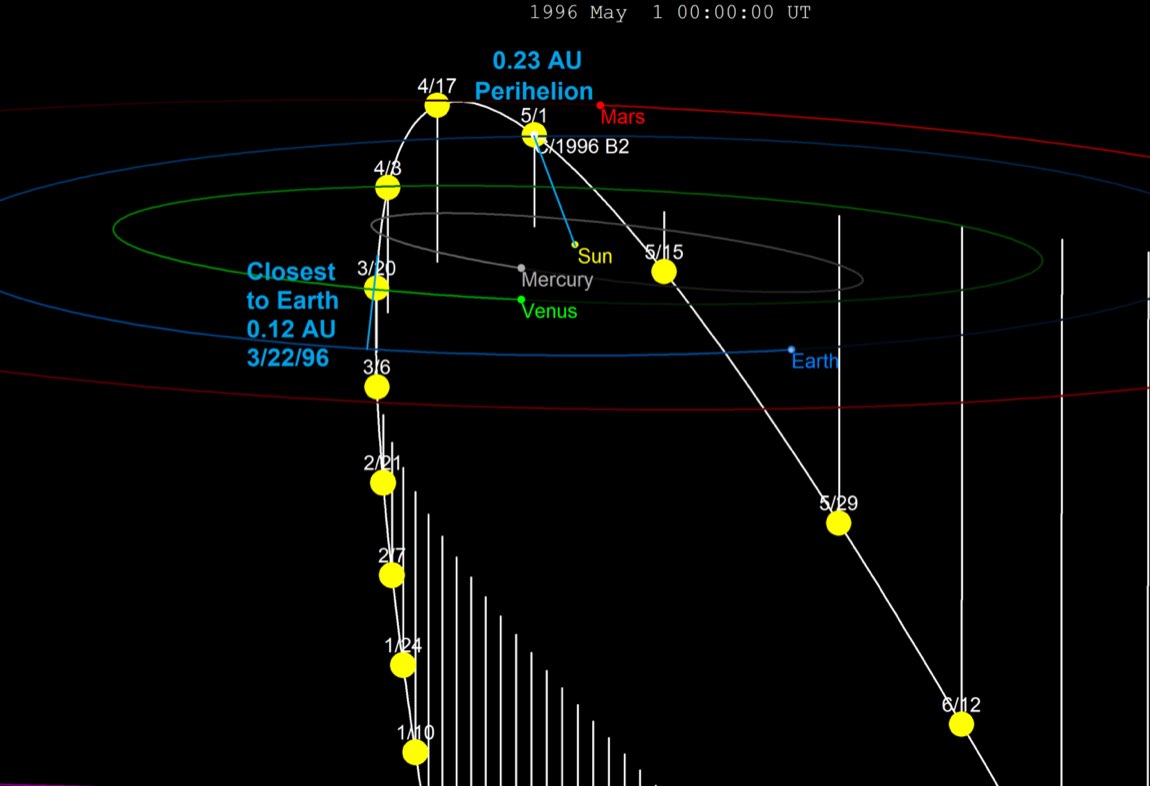
Most comets present observers with a frustrating problem: they are brightest when they are physically closest to the Sun, which also places them close to the Sun in the sky as seen from Earth. That means the brightest views tend to be restricted to twilight hours near the horizon, with a fully dark sky rarely available. Hyakutake was a conspicuous exception. Its orbital geometry carried it on a path that passed very close to the pole star at the moment of closest approach to Earth on 25 March 1996. For observers in the Northern Hemisphere at mid-latitudes, this meant the comet was near the zenith — directly overhead — in a fully dark sky, and it was circumpolar, never dipping below the horizon throughout the night. Combined with its extreme closeness of just 0.1 AU, or 15 million km, this geometry gave the best possible viewing conditions. The comet was moving so fast across the star field that its motion was detectable within a few minutes of watching; it swept across a width equal to the full moon's diameter — half a degree — every 30 minutes, a pace visible in real time.
04 The Tail That Stretched 3.8 AU Deeper
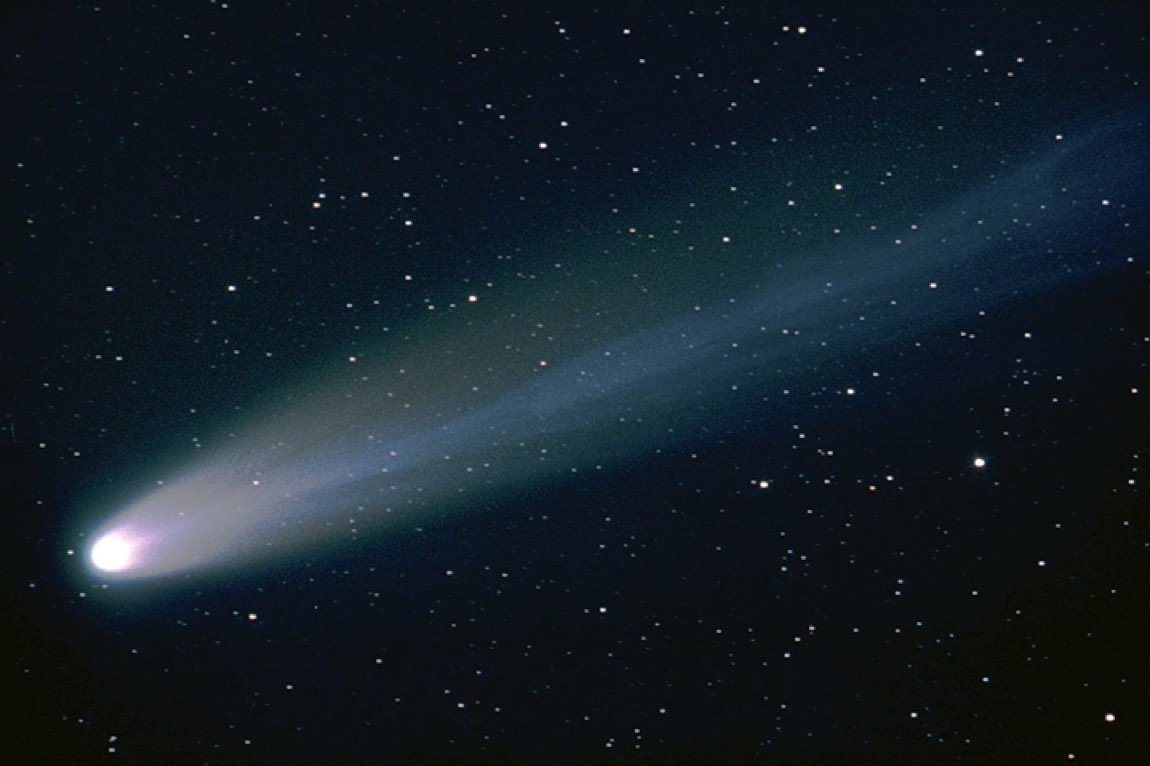
The most astonishing structural discovery about Hyakutake came not from ground-based telescopes but from an accidental spacecraft encounter. On 1 May 1996 — the same day the comet reached perihelion — the Ulysses spacecraft, a joint ESA-NASA mission studying the Sun, unknowingly passed through Hyakutake's ion tail. The evidence was not noticed until 1998, when astronomers reviewing archived data found that Ulysses had recorded a sharp drop in proton flux alongside changes in the direction and strength of the local magnetic field — the classic signature of crossing a cometary plasma wake. By 2000, two independent teams had traced the encounter back to Hyakutake, sitting 500 million km, or 3.3 AU, away. The solar wind was travelling at approximately 750 km/s at the time, and at that speed it would have taken eight days to carry cometary material out to where Ulysses was, at 3.73 AU and roughly 45 degrees out of the ecliptic plane. The geometry and magnetic field orientation matched Hyakutake's orbital plane perfectly. The minimum implied tail length is 570 million km — 3.8 AU — nearly twice the previous record of 2 AU held by the Great Comet of 1843. That record was later surpassed in 2002 by comet 153P/Ikeya-Zhang, whose tail reached at least 7.46 AU.
 ⤢
05 First Detection of X-rays from a Comet Deeper
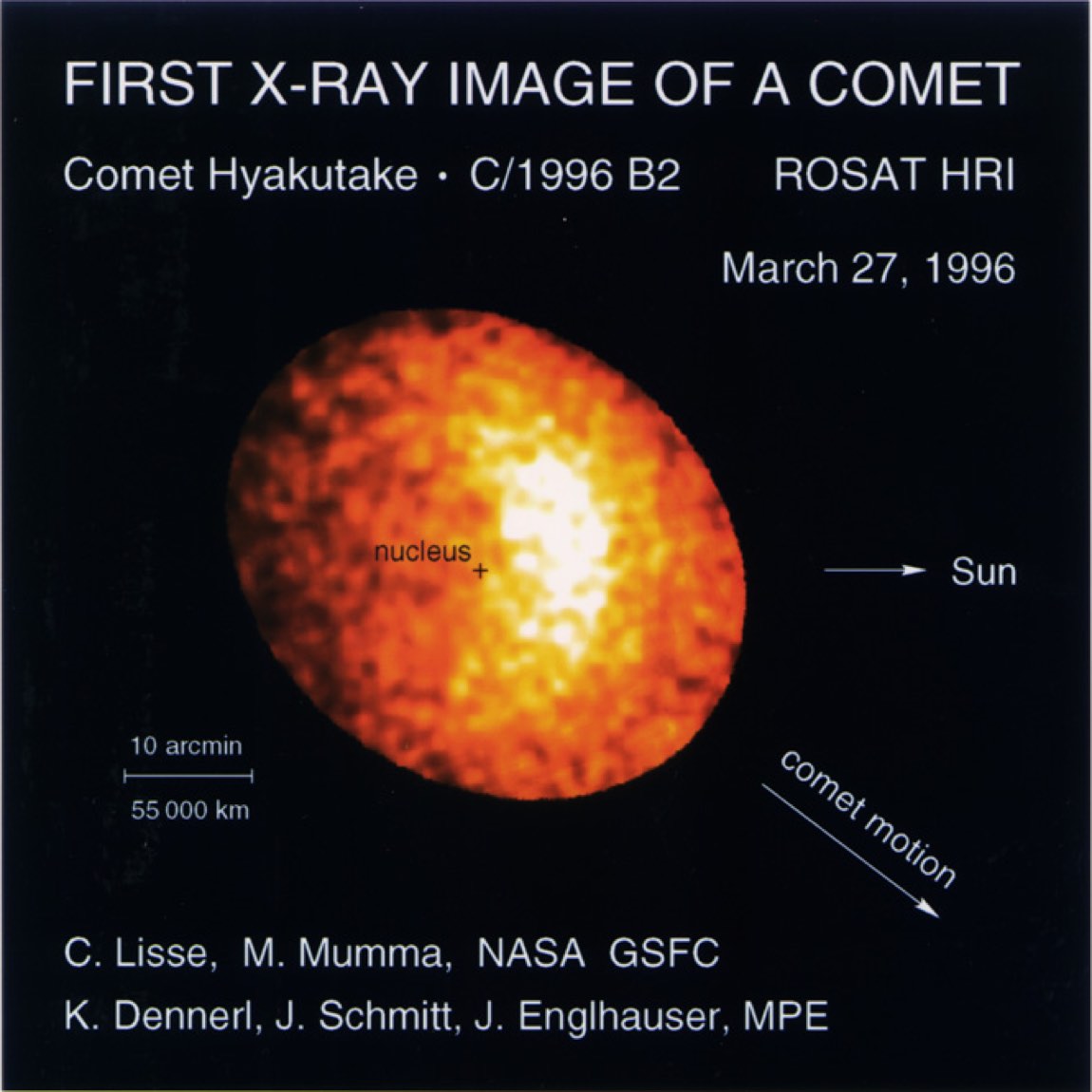
Before 1996, no one had detected X-rays coming from a comet. When ROSAT satellite observations of Hyakutake revealed very strong X-ray emission, it came as a genuine surprise to the scientific community. The emission was brightest in a crescent shape surrounding the nucleus, with the crescent's ends pointing away from the Sun. Thomas E. Cravens was the first to propose an explanation, doing so in early 1997. He and others suggested the dominant mechanism was charge exchange: highly charged carbon, oxygen, and nitrogen ions in the solar wind collide with neutral water, oxygen, and hydrogen molecules in the comet's coma, capturing electrons and releasing energy as X-rays in the process. Simple reflection of solar X-rays, as seen from the Moon, could not account for most of the observed flux because Hyakutake's atmosphere is too tenuous and diffuse for that mechanism to dominate. The discovery transformed cometary science almost immediately — astronomers found that virtually every comet they subsequently examined was emitting X-rays, making charge-exchange emission a universal cometary phenomenon. Detailed confirmation of the charge-exchange mechanism came later, in 2000, from Chandra satellite observations of comet C/1999 S4 (LINEAR).
06 Ethane, Methane, and Interstellar Ice Deeper
Ground-based chemical analysis of Hyakutake's coma produced two firsts in cometary science: ethane and methane were detected in a comet for the very first time. What made the detection scientifically provocative was not merely the presence of these gases but their proportions — ethane and methane were found in roughly equal abundances. That equality carries a significant implication about where and how the comet's ices originally formed. Near the Sun, methane — being more volatile — would have been preferentially removed relative to ethane, so equal abundances point toward formation far from any star, in the cold of interstellar space. To preserve both molecules in comparable quantities, the ices must have condensed at temperatures of 20 K or below, suggesting Hyakutake originated in a denser-than-average interstellar cloud. This makes the comet a potential messenger from conditions that existed before the Solar System itself formed. The deuterium-to-hydrogen ratio in Hyakutake's water ice was measured spectroscopically at approximately 3×10⁻⁴, which is about twice the value found in Earth's oceans of roughly 1.5×10⁻⁴. This elevated D/H ratio creates difficulties for the hypothesis that cometary impacts delivered a large fraction of Earth's ocean water, a debate that remains open.
07 A Tiny Nucleus Working at Full Capacity
Radar measurements from the Arecibo Observatory placed Hyakutake's nucleus at about 4.8 km across — roughly the distance you might drive to a grocery store. For comparison, Halley's Comet measures about 15 km across and Comet Hale-Bopp was approximately 60 km wide. That small size makes Hyakutake's brilliant performance all the more striking. Most comets release gas and dust from only a small fraction of their surface area; the rest is covered by a dark, inert crust. Hyakutake appears to have had most or all of its surface actively outgassing, an unusually high level of activity. Dust production began at an estimated 2×10³ kg per second in early March 1996 and climbed to 3×10⁴ kg/s — thirty tonnes per second — as the comet approached perihelion. Ejection velocities rose in parallel, from 50 m/s up to 500 m/s. Arecibo's radar also revealed that the nucleus was surrounded by a flurry of pebble-sized particles flying outward at a few metres per second. Indirect estimates of nucleus size from infrared emission and radio observations independently agreed with the radar figure, giving scientists confidence in the 4.8 km measurement.
08 Spinning Every 6.23 Hours
As Hyakutake swept past Earth, observers noticed a regular and repeating behaviour: a large puff or blob of material erupted from the nucleus in the sunward direction like clockwork. By timing these outbursts, astronomers were able to measure the comet's rotation period with surprising precision. The interval between major ejections was 6.23 hours, meaning the nucleus completed a full rotation in just over six hours — a little faster than Earth's own day divided by four. A second, smaller ejection event was also detected, occurring on the same 6.23-hour cycle, which served as independent confirmation of the rotation rate. This kind of jet activity, synchronized with rotation, is consistent with one or more particularly active regions on the nucleus surface being repeatedly carried into sunlight and then back into shadow. Such regions heat up, release gas and dust explosively, and then cool as they rotate away from the Sun. The measurement of a rotation period from Earth, without any spacecraft visiting the nucleus, illustrates how much information a close cometary approach can yield even with purely remote observations.
 ⤢
09 The SOHO Satellite at Perihelion
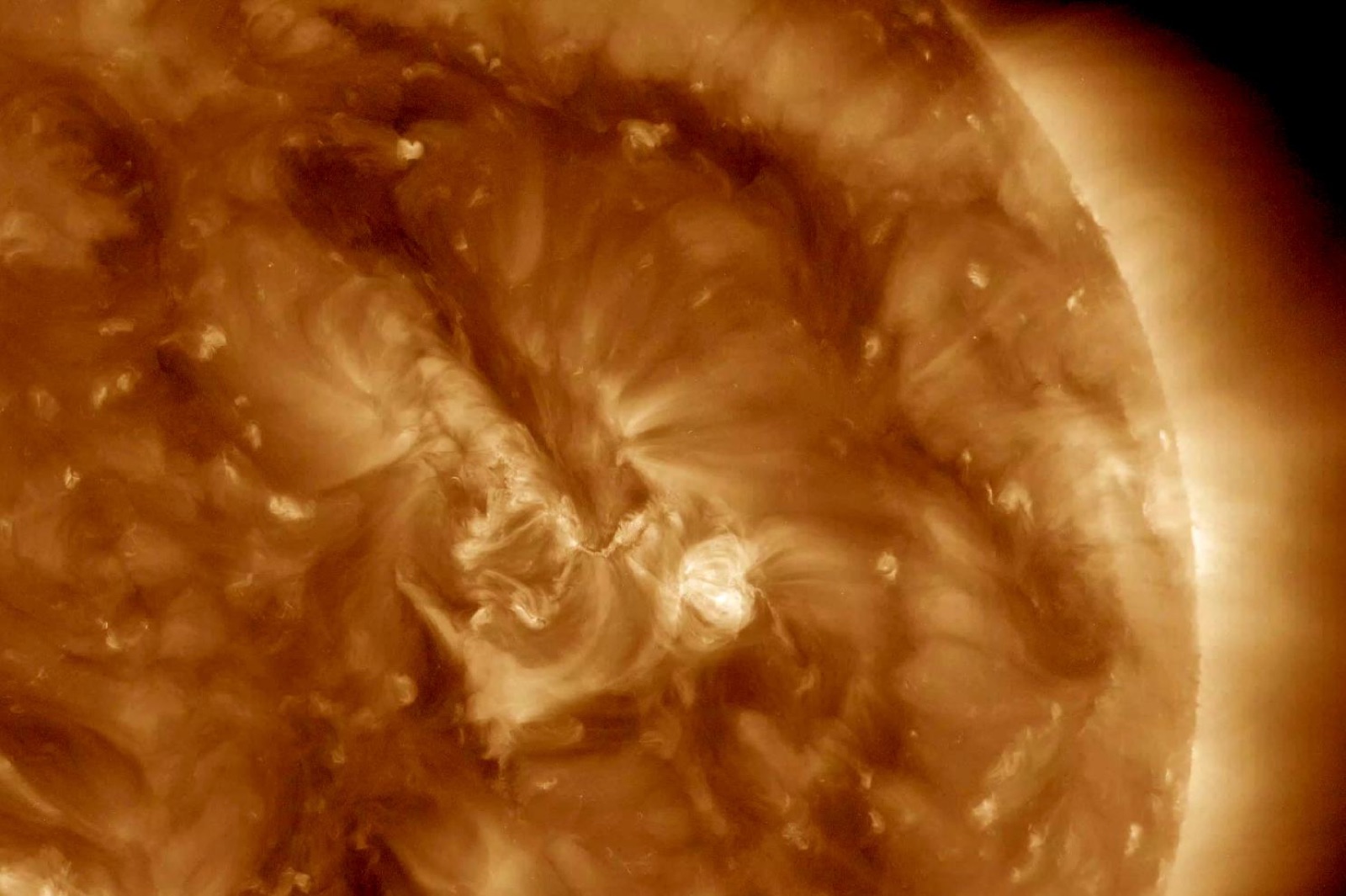
By the time Hyakutake reached perihelion on 1 May 1996, it had moved so close to the Sun — just 0.23 AU, well inside the orbit of Mercury — that observing it from Earth's surface became difficult. The SOHO spacecraft, the Solar and Heliospheric Observatory positioned to monitor the Sun continuously, stepped in and tracked the comet's perihelion passage directly. SOHO recorded not only the comet's close solar approach but also a large coronal mass ejection forming at the same time. Whether this was coincidence or related to the comet's presence is not stated definitively in scientific records of the event. After perihelion, Hyakutake developed a dust tail alongside the gas tail that had been prominent during the Earth flyby, a feature typical of comets as they warm near the Sun and begin lifting heavier dust particles. The comet faded rapidly after its perihelion passage and was lost to naked-eye visibility by the end of May 1996. Its orbital path drove it quickly into the southern sky, it became far less studied, and the last recorded observation was made on 2 November 1996.
10 Colour, Coma, and the View from Earth
To observers standing outside on a clear March night in 1996, Hyakutake was a genuinely unforgettable sight. Its head displayed a striking blue-green colour, thought to result from emissions produced by diatomic carbon — C₂ — combined with sunlight scattered from dust grains in the coma. At closest approach, the coma spanned approximately 1.5 to 2 degrees across the sky, which is about four times the apparent diameter of the full Moon — an enormous fuzzy patch by any standard. The tail stretched up to 80 degrees across the sky at its reported maximum, nearly halfway from horizon to zenith. The comet had already been building toward this spectacle: in early March it had a tail only about 5 degrees long and was at 4th magnitude, faintly visible but unremarkable. By 24 March the tail had grown to 35 degrees and it ranked among the brightest objects in the night sky. The window of peak brightness lasted only a few days, however, which meant that European observers facing unfavourable weather during that narrow interval may have missed the comet's finest showing entirely — unlike Hale-Bopp the following year, which remained bright for weeks and embedded itself deeply in public memory.
11 Open Questions the Comet Left Behind Deeper
Despite the wealth of data collected during the 1996 apparition, Hyakutake raised at least as many questions as it answered. The near-equal abundances of ethane and methane point compellingly toward an interstellar formation environment, but the precise conditions of that cloud — its density, temperature distribution, and chemical environment — remain subjects of active research. The deuterium-to-hydrogen ratio of about 3×10⁻⁴ in the comet's water ice, roughly double the oceanic value of 1.5×10⁻⁴ on Earth, adds complexity to the long-running debate over whether cometary bombardment could have supplied a significant fraction of Earth's water. If Hyakutake is representative of the comets that struck early Earth, the D/H mismatch is difficult to reconcile with that delivery scenario — but whether Hyakutake is typical remains uncertain. The X-ray emission discovered at Hyakutake is now understood to be nearly universal among comets, yet the relative contributions of charge exchange versus other mechanisms can still vary from comet to comet. And the fortuitous Ulysses tail crossing, identified only years after the fact from archived data, underscores how much can be missed during a single apparition and how revisiting old datasets continues to yield new discoveries.
 ⤢