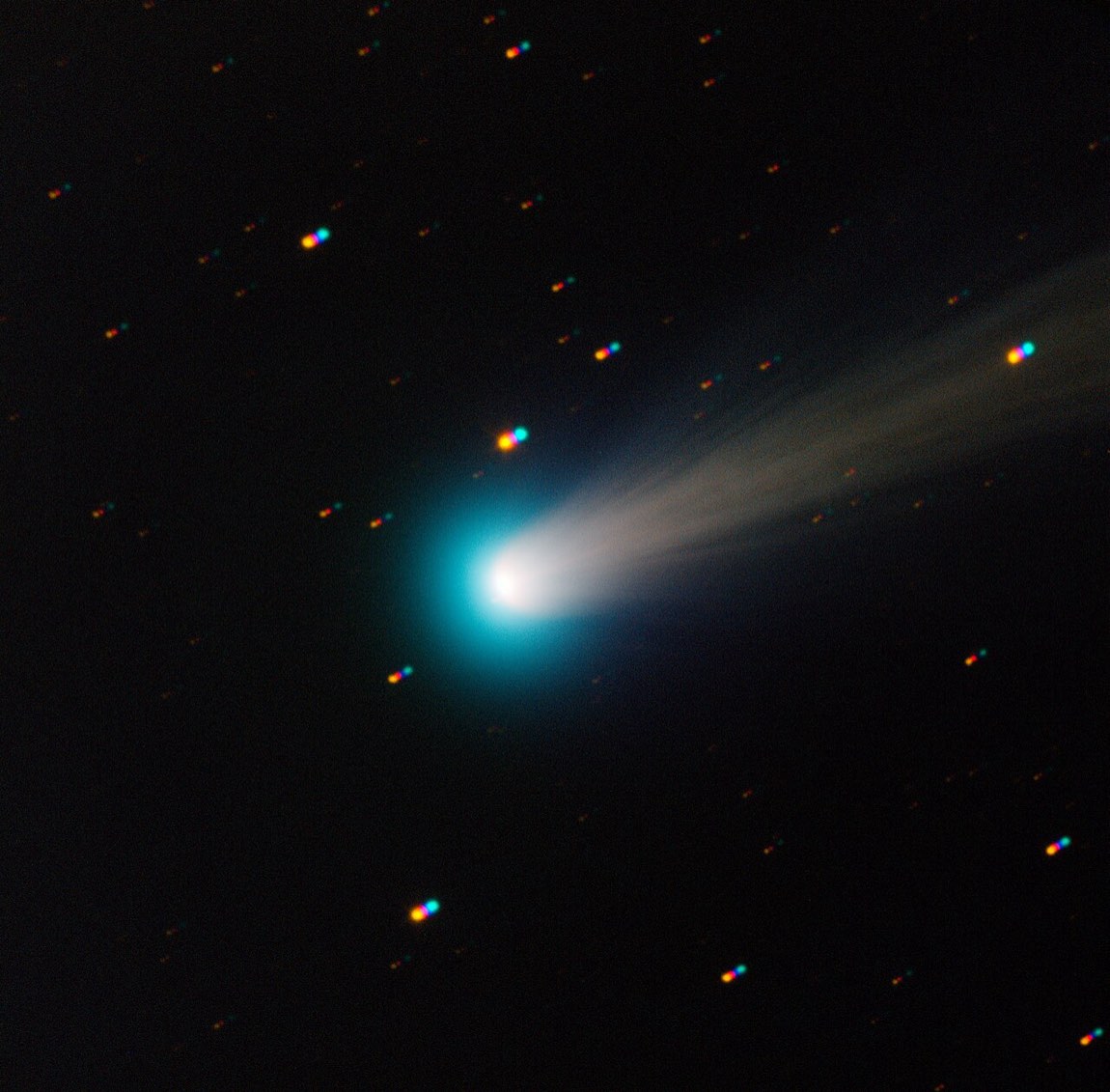
 Photograph · TRAPPIST/E. Jehin/ESO · CC BY 4.0
Comet · Deep guide
Comet ISON
Also called: C/2012 S1 · Comet ISON
Billed as a possible 'comet of the century', it fell apart while grazing the Sun in November 2013.
What is it?
Comet ISON was found in September 2012 by Vitaly Nevsky and Artyom Novichonok using a telescope of the International Scientific Optical Network. It was a newcomer from the Oort cloud on a sungrazing orbit, and early forecasts suggested it might become dazzling. Instead, as it rounded the Sun on 28 November 2013, heat and tidal forces broke it apart. By early December astronomers confirmed it had completely disintegrated.
The deep dive
Researched for the Atlas from Wikipedia — Comet ISON (14,230 characters read) · updated Nov 14, 2026
01 How Two Astronomers Found It in One Night
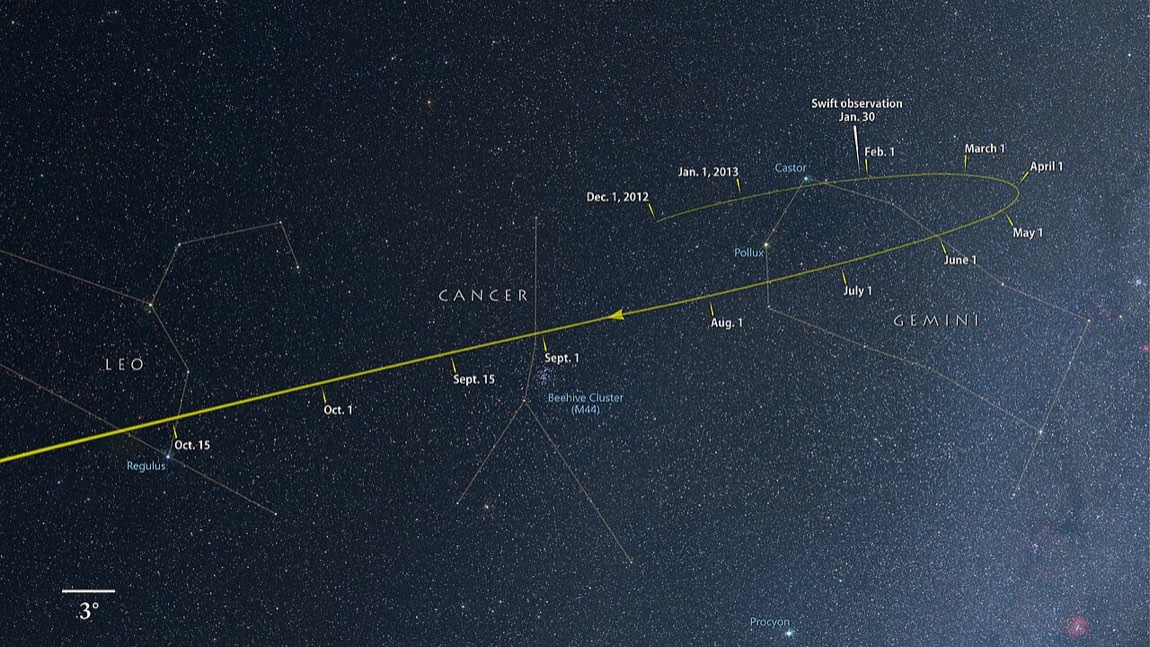
The discovery of Comet ISON almost did not happen on schedule. On the night of 21 November 2012, Vitaly Nevsky and Artyom Novichonok had planned a full observing session, but clouded skies over Kislovodsk, Russia, delayed their work for most of the night. When conditions finally cleared, they turned the International Scientific Optical Network's 0.4-meter reflector toward patches of the constellations Gemini and Cancer. Using CCD imaging and four 100-second exposures, Nevsky processed the data almost immediately afterward with CoLiTec, an automated asteroid-discovery program. The software flagged an unusually bright object moving very slowly across the sky. That sluggish apparent motion was the giveaway: objects that drift slowly against the background stars tend to lie far from Earth, in this case beyond the orbit of Jupiter. The object's apparent magnitude ranged from 19.1 down to as bright as 18.8, making it invisible to the naked eye but detectable by their equipment. The team initially reported it to the Central Bureau for Astronomical Telegrams as an asteroid, but follow-up teams quickly identified a coma about 8 arcseconds across, confirming its cometary nature. The discovery was formally announced by the Minor Planet Center on 24 September 2012.
02 Precovery: Finding It Before It Was Found Deeper
One of the most useful tools in modern comet science is precovery — hunting through archival telescope images taken before an object's official discovery to extend its observational baseline. For Comet ISON, precovery proved immediately productive. Gareth V. Williams analyzed imagery from the Mount Lemmon Survey and found frames taken as early as 28 December 2011, nearly nine months before the comet was formally announced. In those images ISON carried an estimated apparent magnitude ranging from 19.5 to 19.9. Pan-STARRS images from Haleakalā, Hawaii, captured on 28 January 2012 added another data point, with the comet appearing at an estimated magnitude of 19.8 to 20.6. These precovery observations were essential for pinning down ISON's orbit and confirming its trajectory before anyone had deliberately set out to look for it. The ability to reach back nearly a year into archival data illustrates how modern wide-field sky surveys, originally designed to track potentially hazardous asteroids, have become indispensable infrastructure for comet science as well.
03 A Fleet of Spacecraft on One Comet
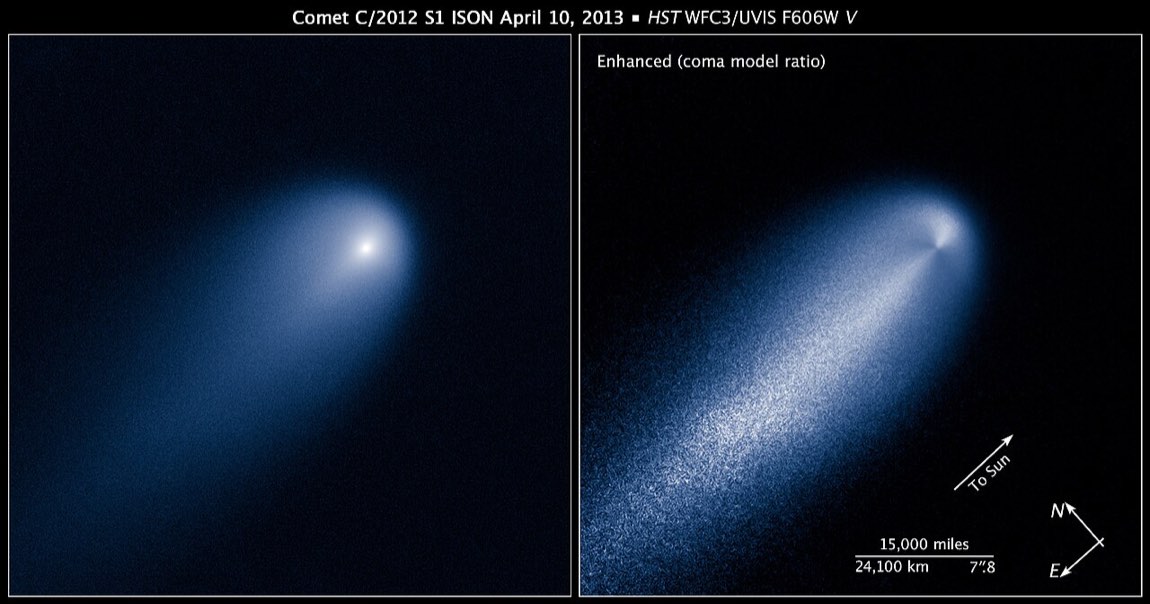
Comet ISON attracted an extraordinary amount of observational firepower. At least a dozen spacecraft imaged it during its journey toward the Sun. Swift and Deep Impact were first, capturing images in January and February 2013 and confirming that ISON was already active, trailing an extended tail. The Hubble Space Telescope weighed in during April and May 2013, measuring the comet's size along with the color, extent, and polarization of its dust. On 13 June 2013, the Spitzer Space Telescope estimated that ISON was releasing carbon dioxide at roughly 1 million kilograms per day — about the mass of a small office building evaporating into space every twenty-four hours. The twin STEREO spacecraft began tracking it in the second week of October 2013. The Mars Reconnaissance Orbiter detected ISON between 29 September and 2 October 2013 as the comet swung within 0.07 AU of Mars. SOHO's LASCO coronagraph picked it up on 27 November as it dove toward the Sun. Even a stratospheric balloon mission called BRRISON was launched on 28 September 2013, carrying a 0.8-meter telescope to 37 kilometers altitude, though a mechanical malfunction drove the telescope past its stow latch and ended that mission prematurely.
04 The Nucleus Kept Shrinking With Every Look Deeper
One of the more unsettling revelations about Comet ISON was how dramatically estimates of its nucleus size shrank as better data arrived. Swift observations in January 2013 suggested a nucleus roughly 5 kilometers in diameter. That was already modest compared to some famous comets, but subsequent analysis cut the number to about 2 kilometers. Mars Reconnaissance Orbiter data were even more sobering, suggesting the nucleus was smaller than 0.8 kilometers across — less than a kilometer from end to end, comparable in scale to a large mountain. This steady downward revision mattered enormously for brightness predictions: a smaller nucleus means less surface area to sublimate volatile ices, less gas and dust to scatter sunlight, and a dimmer comet overall. No obvious rotational variability was detected in data from Deep Impact, the Hubble Space Telescope, or Spitzer, which limited scientists' ability to infer the nucleus's shape or spin rate. The uncertainty in nucleus size also fed directly into uncertainty about whether the object could survive perihelion passage at all.
 ⤢
05 An Orbit Almost Too Extreme to Classify Deeper
ISON's orbital trajectory raised genuinely difficult questions for celestial mechanics. Near perihelion, standard heliocentric two-body solutions could not definitively determine whether the comet was gravitationally bound to the Sun or unbound and destined to leave the Solar System entirely. The resolution lies in using the Solar System's barycenter — the true center of mass of the entire system, shifted from the Sun by the gravitational pull of Jupiter and the other giant planets — rather than the Sun alone as the reference point. When JPL Horizons computed barycentric orbital elements for both an epoch of 1950 and 2050, both solutions came out hyperbolic, with no finite orbital period. Yet the inbound eccentricity calculated at the 1950 epoch was only 1.000000086, an almost imperceptibly small deviation from a parabola, suggesting ISON originated within the Solar System rather than arriving from interstellar space. This placed it firmly in the category of a dynamically new comet from the Oort cloud, making its first and only pass through the inner Solar System after spending millions of years in the deep cold of the outer Solar System.
06 The Great Comet of 1680 Connection That Wasn't
Shortly after ISON's discovery, astronomers noticed that the orbital elements of Comet ISON bore a striking resemblance to those of the Great Comet of 1680, one of the most spectacular comets in recorded history. The similarity was tantalizing: could the two objects be fragments of a single larger body that broke apart long ago? The idea would have fit neatly into the broader story of cometary families, where related objects share ancestry. However, as additional observations of ISON refined its orbit further, the resemblance turned out to be superficial. Further analysis showed the two comets are not related. The episode is a useful reminder of how preliminary orbital solutions, based on a short arc of observations, can suggest connections that dissolve once more data arrive. It also reflects how rare and exciting it felt to have a potential sungrazer with historical echoes — enthusiasm that, in this case, the mathematics ultimately did not support.
07 What the Colors and Chemistry Revealed Deeper
Even before ISON reached the inner Solar System, its chemistry was giving astronomers things to study. October 2013 images displayed a greenish tint in the comet's coma, a color that planetary scientists attribute to the release of cyanogen and diatomic carbon — molecules that fluoresce green when excited by ultraviolet sunlight. This is a characteristic signature seen in many active comets and signals that ISON was thermally processing its volatile ices as it warmed. The Spitzer Space Telescope's June 2013 observation specifically quantified carbon dioxide outgassing at roughly 1 million kilograms per day. Then, on 11 August 2014, long after ISON had disintegrated, astronomers published the first results from the Atacama Large Millimeter Array applied to cometary science, examining the distribution of HCN, HNC, H2CO, and dust inside the comae of ISON and the contemporaneous comet C/2012 F6 Lemmon. These molecular tracers map the chemistry of a comet's coma and help scientists understand how ices sublimate and react as they escape the nucleus.
08 Perihelion: Heat, Tides, and Disintegration
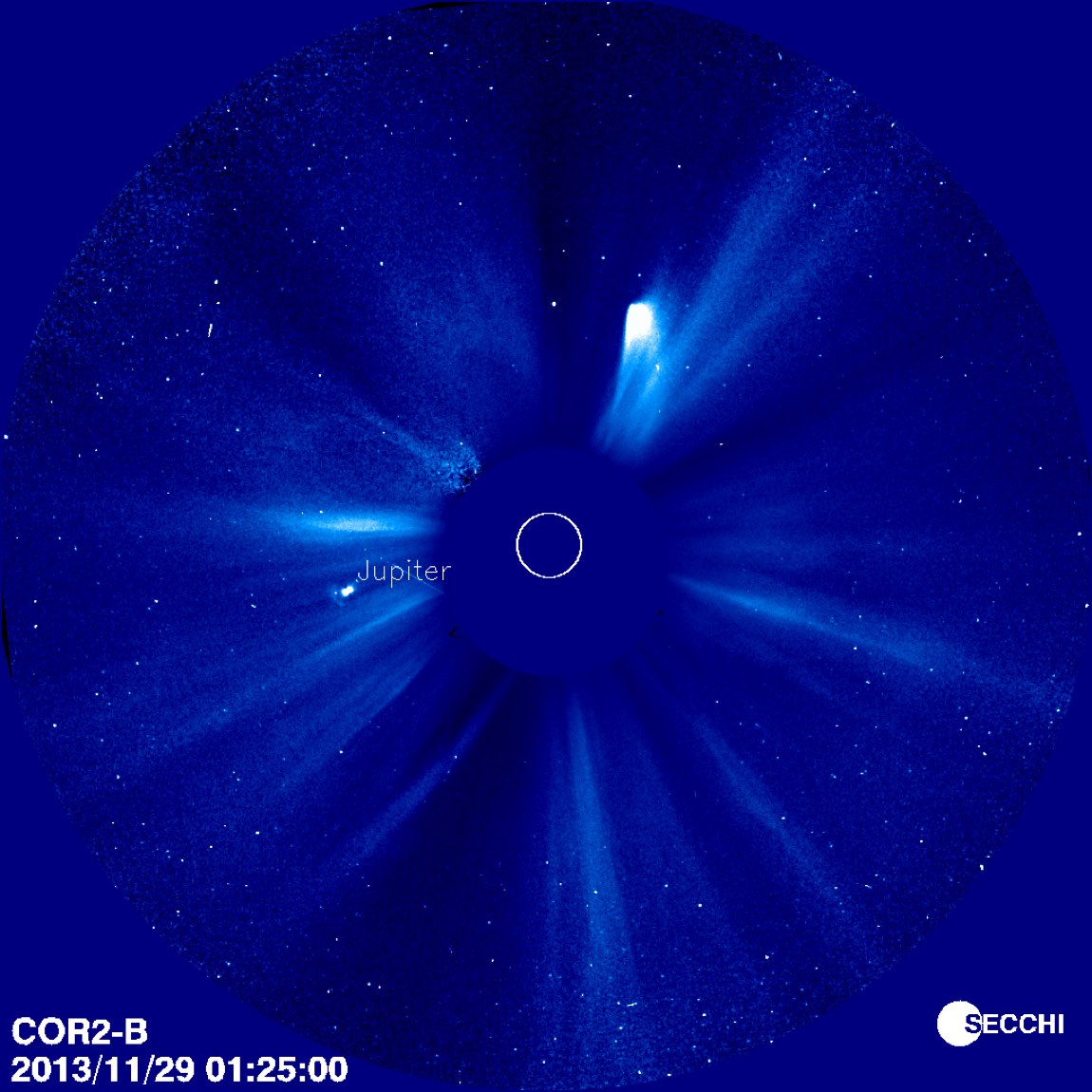
Comet ISON came to perihelion on 28 November 2013, passing just 0.0124 AU from the center of the Sun — about 1,165,000 kilometers above the solar surface when the Sun's own radius is accounted for. At that distance, the calculated temperature reached 2,700 °C, hot enough to melt iron. The comet also passed within its Roche limit, the distance at which the Sun's tidal gravity can overcome the internal cohesion of a small body and pull it apart. Reports on perihelion day suggested partial or complete disintegration from the combined assault of heat and tidal forces. CIOC members spotted a coma-like feature later that same day, sparking brief hope that a fragment had survived. But the coma faded from apparent magnitude 5 on 29 November to below naked-eye visibility at magnitude 7 by 30 November, and by 2 December 2013, the CIOC formally announced complete disintegration. The Hubble Space Telescope found no fragments when it looked on 18 December 2013. A detailed study published on 8 May 2014 concluded the comet had fully disintegrated hours before perihelion, meaning the brief post-perihelion glow was likely dispersing dust rather than a surviving nucleus.
 ⤢
09 The Meteor Shower Nobody Expected to See
Even a comet that fails spectacularly can leave scientific traces. When Earth crossed near Comet ISON's orbital path on 14–15 January 2014, predictions of a meteor shower or noctilucent clouds were considered unlikely, partly because Earth was passing near the orbit rather than through the tail, and partly because meteor showers from long-period comets making a single pass through the inner Solar System are exceptionally rare. Yet on 22 May 2014, the Eurasian Astronomical Society and Sternberg Astronomical Institute announced preliminary results confirming that particles from ISON did enter Earth's atmosphere. Scientists from Ukraine and Belarus coordinated with meteor observation groups around the world, analyzing 54,000 images taken between 10 and 17 January 2014. That effort recorded 43 meteor events linked to material that likely sublimated from ISON at perihelion. The result was modest in scale — 43 events is a far cry from a meteor storm — but it confirmed that at least some physical debris from the comet reached Earth's skies, providing a small but real scientific consolation for a comet that disappointed in almost every other way.
10 The Hype Cycle and What Went Wrong
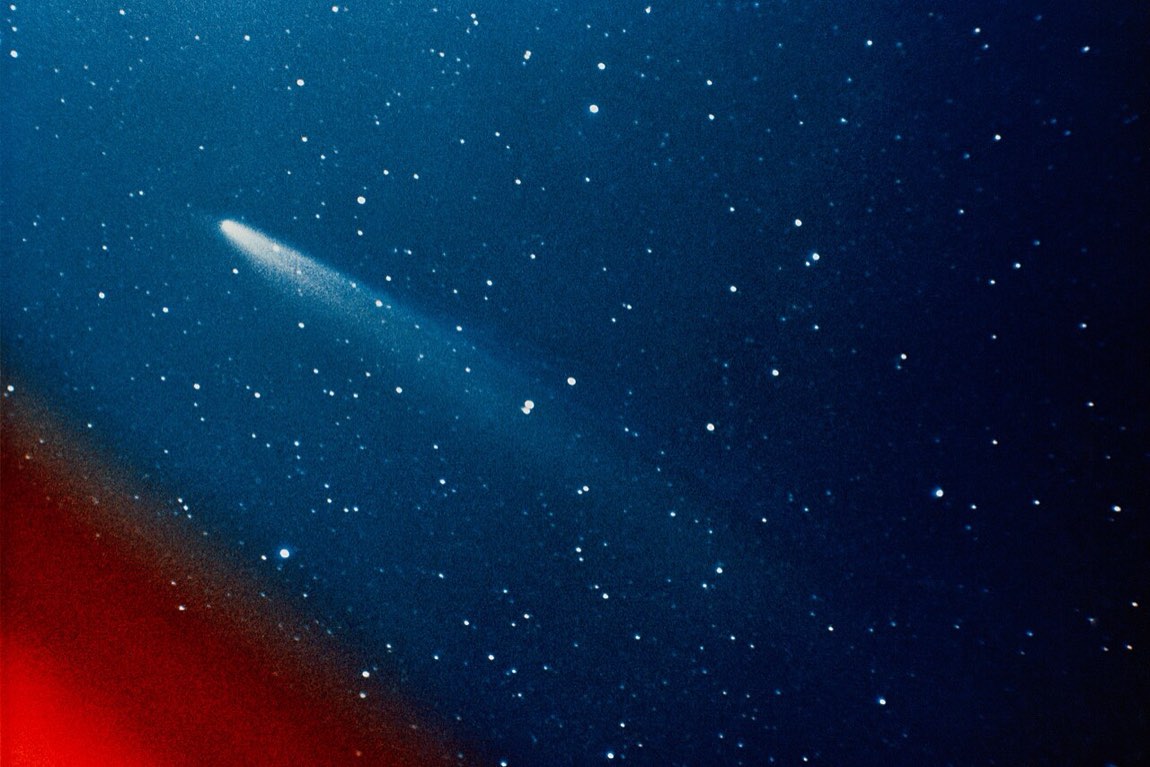
From the moment of its announcement, Comet ISON was engulfed in superlatives. Media outlets dubbed it the "Comet of the Century," and an Astronomy Now columnist wrote in September 2012 that it would "certainly be one of the greatest comets in human history." A February 2013 light-curve analysis based on 1,897 observations projected that if ISON's brightening rate continued at R+4.35 all the way to perihelion, it could reach magnitude −17, outshining the full Moon. Those predictions collapsed when ISON underwent what researchers called a "slowdown event," a behavior also seen in other Oort cloud comets such as C/2011 L4. Even under optimistic assumptions about its surviving perihelion intact, revised estimates put peak brightness at only around magnitude −3 to −5, roughly comparable to Venus rather than the Moon. For context, the brightest comet since 1935, Ikeya-Seki in 1965, reached magnitude −10. Astronomer Karl Battams was explicit that CIOC members never expected ISON to match the most extreme forecasts. The episode drew comparisons to Comet Kohoutek in 1973–1974, another Oort cloud newcomer that generated enormous anticipation and similarly underdelivered — a pattern suggesting that dynamically new comets from the Oort cloud may be systematically prone to overperforming at large distances and fading closer to the Sun.
11 Naming Rules and Why It Isn't Called Nevsky-Novichonok
Comets are traditionally named after their discoverers, so it might seem natural for this comet to carry the names Nevsky and Novichonok. The International Astronomical Union's naming guidelines, however, contain an important exception: when the discovering organization rather than named individuals is credited with the find — typically because the discovery was made by an automated system or a team project — the comet takes the name of that organization. In this case, the initial report to the Central Bureau for Astronomical Telegrams described the object as an asteroid, and it was independent follow-up teams who first formally identified the cometary features. Because of this procedural quirk, credit under IAU rules went to the network rather than the individual observers. The comet therefore became ISON, after the International Scientific Optical Network, the Russia-based organization whose 0.4-meter reflector near Kislovodsk made the detection possible. The formal designation C/2012 S1 follows standard cometary nomenclature: C for a non-periodic comet, 2012 for the year of discovery, S for the half-month of discovery, and 1 indicating it was the first comet found in that interval.
 ⤢