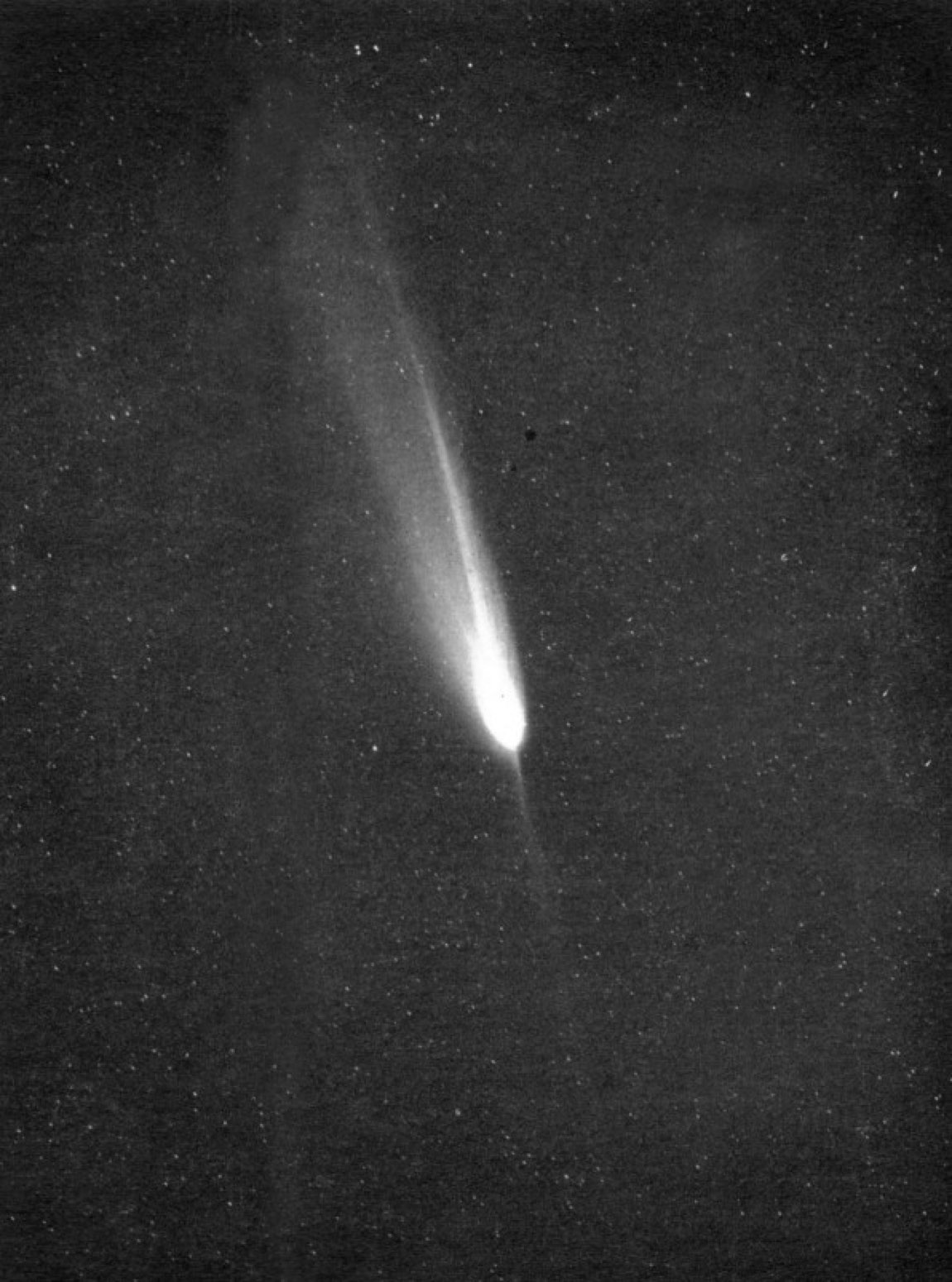
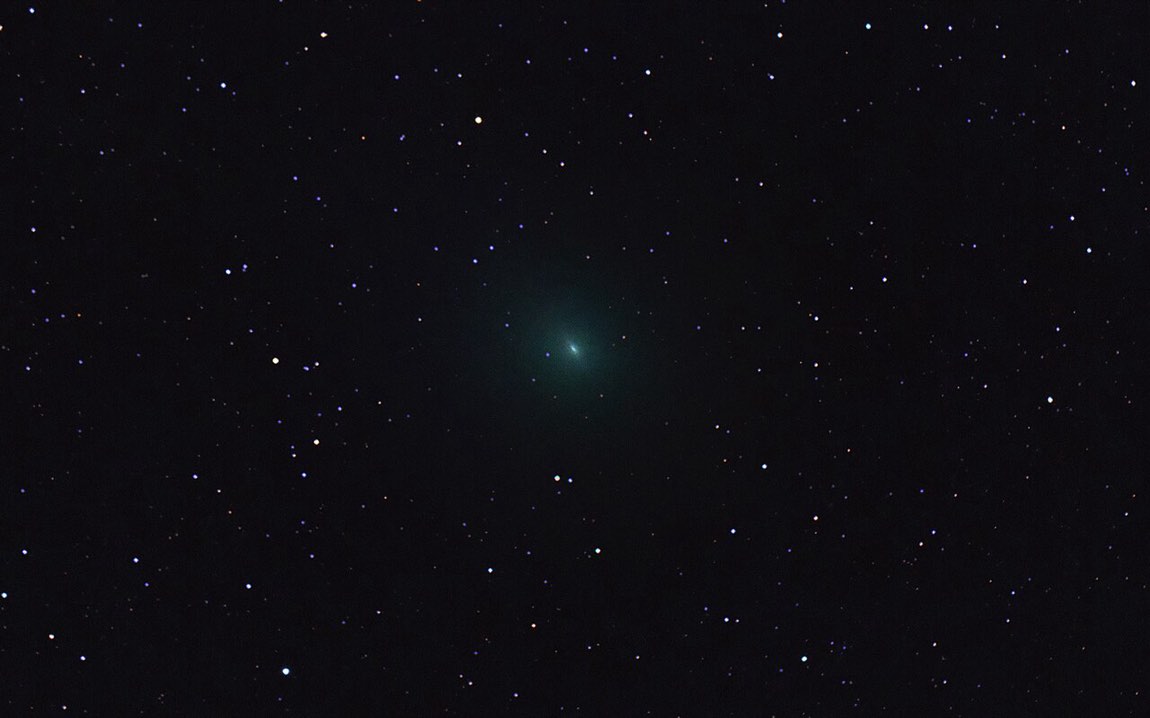
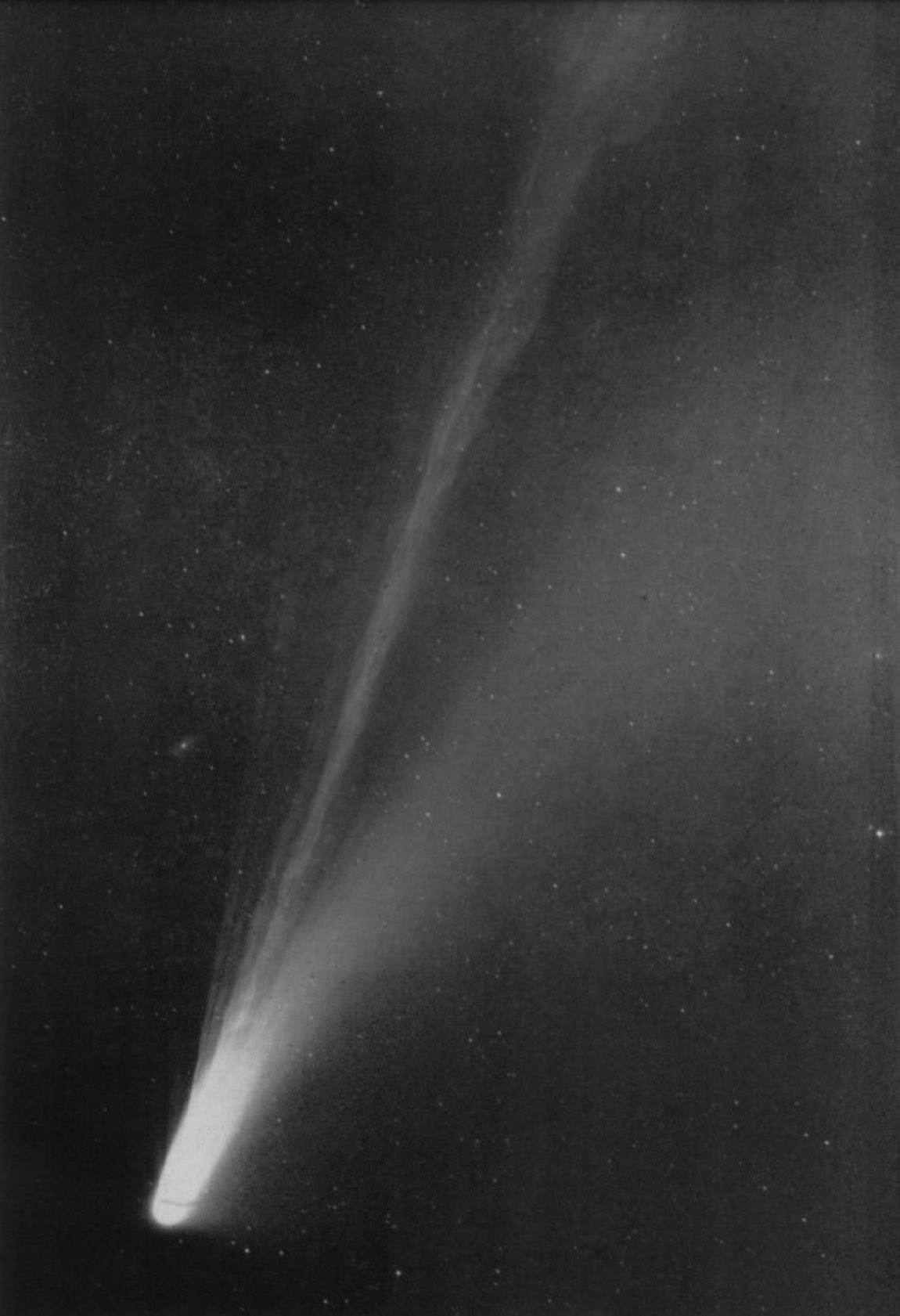
 Photograph · Charles Kearns, George O. Abell, and Byron Hill · Public domain
Comet · Deep guide
Comet Mrkos (C/1957 P1)
Also called: C/1957 P1 · 1957 V
A naked-eye comet of summer 1957 with two tails, one bright and curved, one straight and knotty.
What is it?
This comet is named for Czech astronomer Antonín Mrkos, who spotted it with the naked eye from the Lomnický štít observatory in 1957. Others had seen it days earlier, but his report reached the IAU first. Discovered near perihelion, it brightened to about magnitude 1 in early August and showed a curved dust tail plus a straight gas tail with fast-changing knots. It stayed visible without optical aid until the end of September 1957.
The deep dive
Researched for the Atlas from Wikipedia — C/1957 P1 (Mrkos) (2,079 characters read) · updated Nov 14, 2026
01 The race to claim discovery
Comet Mrkos carries the name of Czech astronomer Antonín Mrkos, but its discovery story is more complicated than a simple first sighting. When Mrkos spotted the comet with the naked eye from the high-altitude observatory on Lomnický štít in Czechoslovakia and announced it on August 2, 1957, observers in Japan had already recorded it three days earlier, on July 29. In astronomy, however, priority is not simply a matter of who looked first — it is a matter of who reported first to the right authority. Because Mrkos's telegram reached the International Astronomical Union before any competing report, the comet was officially named after him. This quirk of telegram timing is a vivid reminder that in twentieth-century astronomy, communication speed was as decisive as observational skill. The episode also illustrates how bright, naked-eye comets tend to be found simultaneously by multiple observers around the world, since there is no need for a telescope — just clear skies and a sharp eye.
02 A sky already crowded with bright comets
Comet Mrkos did not arrive in an empty sky. The year 1957 produced two bright comets reaching naked-eye prominence, the other being Comet Arend–Roland. For skywatchers of that era, two great comets in a single year was an unusual windfall. Both objects have been characterised as great comets, a loose but meaningful designation reserved for comets that become genuinely spectacular to the unaided eye. Having two such visitors in one year made 1957 memorable in amateur and professional observing circles alike. The coincidence also gave astronomers a rare comparative opportunity: two comets passing through the inner solar system at nearly the same time, each offering a spectrum and a physical appearance that could be studied side by side. Comet Arend–Roland is particularly remembered for its striking anti-tail, while Mrkos became notable for the complex, rapidly changing structure of its own tail system.
03 Where in the sky it appeared
When Mrkos first announced the comet's discovery on August 2, 1957, the object was located near Pollux in the constellation Gemini and was already close to perihelion — its nearest point to the Sun. This placement meant it initially shared the sky with the Sun's glare, limiting early observation. It then moved north of the Sun and became accessible in both the evening and morning sky, a configuration that gave observers two daily windows of opportunity. As weeks passed, the comet drifted southward in the sky, crossing from the southern reaches of Ursa Major into Coma Berenices and then into Virgo by September, where it faded to around third magnitude. That migration across three constellations over roughly two months gave patient watchers a slow-motion tour of the summer and autumn sky, with the comet acting as a moving landmark night after night.
04 How bright it really got
Comet Mrkos brightened remarkably fast in the days around discovery. When Mrkos filed his report on August 2, the comet's apparent magnitude was estimated at around 2.0 — comparable to a moderately bright star like Polaris. Just two days later, by August 4, it had reached an estimated peak magnitude of 1.0, rivalling the brilliance of first-magnitude stars such as Regulus or Spica. The magnitude scale is logarithmic, so a difference of one full magnitude represents roughly a factor of 2.5 in brightness; moving from 2.0 to 1.0 in forty-eight hours indicates a genuinely rapid surge in brightness. This peak magnitude of 1.0 is what earns Comet Mrkos its classification as a great comet. After this brief peak the comet slowly faded, remaining visible to the naked eye through the end of September before requiring optical aid. It was last photographed on July 9, 1958, by which point it had faded to a diffuse 19th-magnitude object — roughly 400,000 times dimmer than at peak.
05 Two tails with very different personalities Deeper
One of the most scientifically interesting features of Comet Mrkos was its twin-tail structure, and the two tails behaved in strikingly different ways. At the start of the observing window, one tail was notably brighter and curved in its shape. The other was straight, laced with knots, and initially less prominent. As August progressed, the straight tail gained in brightness and became the more dramatic feature, displaying rapid changes in appearance that observers could track from night to night. Between August 10 and August 15, both tails appeared striated — meaning they showed fine parallel streaks or bands rather than a smooth, continuous glow. This kind of rapid structural variability in a comet's ion tail is now understood to be driven by fluctuations in the solar wind, the stream of charged particles flowing outward from the Sun. The curved tail was almost certainly the dust tail, shaped by radiation pressure, while the straight, knotted tail was the ion or plasma tail, responding directly to solar wind conditions.
06 Sodium and cyanide in the comet's light Deeper
Spectroscopic observations of Comet Mrkos revealed the presence of two chemically significant species: sodium and cyanide. Crucially, the article notes that both were found at predicted values, meaning their detection was not a surprise but a confirmation of theoretical expectations about comet composition at that time. The identification of cyanide — a carbon-nitrogen compound — in a comet's coma places Comet Mrkos within a long tradition of cometary spectroscopy stretching back to the nineteenth century, when cyanogen was first detected in comet spectra and briefly caused public alarm. Sodium in comets is a well-established emission feature, arising from neutral sodium atoms fluorescing in sunlight. The fact that both species appeared at predicted concentrations gave astronomers confidence that their evolving models of comet chemistry were on the right track. This kind of spectrum-matching between observation and prediction is a cornerstone of how planetary scientists build and validate models of small-body composition.
07 The long fade and final detection
After its brief naked-eye spectacular, Comet Mrkos entered a prolonged decline that stretched across nearly a full year of sporadic observing. By the end of October 1957 it had drifted close to the Sun again and was lost in the solar glare, making observation impossible. Astronomers had to wait until the end of January 1958 before the comet re-emerged and could be recovered in telescopes. From that recovery through the spring of 1958, observers tracked its continuing fade. The final confirmed observation came on July 9, 1958, when the comet was photographed as a diffuse object of the 19th magnitude — far beyond naked-eye reach and even requiring significant telescopic effort to capture at all. A diffuse 19th-magnitude object is roughly at the threshold of what photographic plates of that era could record under good conditions. The long baseline between the peak in August 1957 and this last detection gave dynamicists a useful arc of positional data for refining the comet's orbit.
08 A non-periodic visitor from deep space Deeper
Comet Mrkos is classified as a non-periodic comet, meaning it does not return to the inner solar system on a short, predictable cycle the way Halley's Comet does every 75 to 76 years. Non-periodic comets typically arrive from the distant Oort Cloud on orbital paths so elongated that their return periods — if they return at all — can be measured in thousands to millions of years, or they may be on hyperbolic trajectories that will carry them out of the solar system entirely. The formal designation C/1957 P1 encodes this status directly: the leading "C/" indicates a non-periodic comet, as opposed to "P/" for a periodic one. The old-style designation 1957d simply records it as the fourth notable comet of 1957. Its non-periodic nature means astronomers who witnessed it in 1957 were almost certainly seeing it for the first and last time — no living human, and very likely no human ever, will see it brighten in Earth's skies again.
09 The observatory where it was found
Antonín Mrkos made his naked-eye discovery from the observatory on Lomnický štít, a high mountain summit in what was then Czechoslovakia. Lomnický štít stands in the High Tatra mountains and hosts one of the highest-altitude observing stations in central Europe, situated at an elevation that places it above much of the atmospheric turbulence and light pollution affecting lower-altitude sites. Discovering a bright comet with the naked eye rather than through a telescope underscores just how prominent the comet was at the time Mrkos first saw it — and also reflects a tradition of systematic sky-scanning that has historically led to naked-eye comet discoveries. Mrkos himself was a prolific comet discoverer, and finding such a bright object from an established mountain observatory rather than from a backyard is consistent with the institutional, systematic approach to comet hunting that characterized professional astronomy in the mid-twentieth century.
10 What the designation system tells us Deeper
The official designation C/1957 P1 is a compact record of everything the International Astronomical Union needs to categorize this comet unambiguously. The letter C confirms it is a non-periodic comet. The year 1957 marks when it was discovered. The letter P indicates it was found during the second half-month of August — the IAU divides each month into two halves labeled A through Y, with P corresponding to August 16–31, though announcements made in early August would still be assigned to the half-month in which the discovery was processed. The numeral 1 means it was the first non-periodic comet discovered in that half-month interval. The older designation 1957d is a simpler sequential label, marking it as the fourth notable comet of the year 1957. This parallel naming convention — the modern provisional designation alongside the old sequential style — was common for comets of this era, and both designations remain in use in historical literature, which is why the article lists both explicitly.
11 Observing a comet in the 1950s
The story of Comet Mrkos is inseparable from the technology and communication infrastructure of 1957. Observers in Japan recorded the comet on July 29, three days before Mrkos's report reached the IAU, yet Mrkos received the naming credit because his telegram arrived first. In the pre-internet age, the IAU circular telegram was the global clearing house for new comet discoveries, and the speed of a telegraph line literally determined historical credit. For ordinary observers, a comet of magnitude 1.0 needed no special equipment — dark skies and clear weather were sufficient. The comet was visible in both evening and morning sky during different phases of its apparition, with a tail stretching more than 5 degrees across the sky. Five degrees is about the width of three fingers held at arm's length, making the tail a dramatic, unmistakable sight. Photographs from the period would have captured the striated structure visible between August 10 and 15, providing a lasting record of the rapidly evolving plasma tail.