 Photograph · Amédée Guillemin ; James Glaisher (ed., trans.); unspecified illustrator ("[F]ro · Public domain
Comet · Deep guide
Great Comet of 1744 (Comet de Chéseaux)
Also called: C/1743 X1 · Comet de Chéseaux · Comet Klinkenberg–Chéseaux
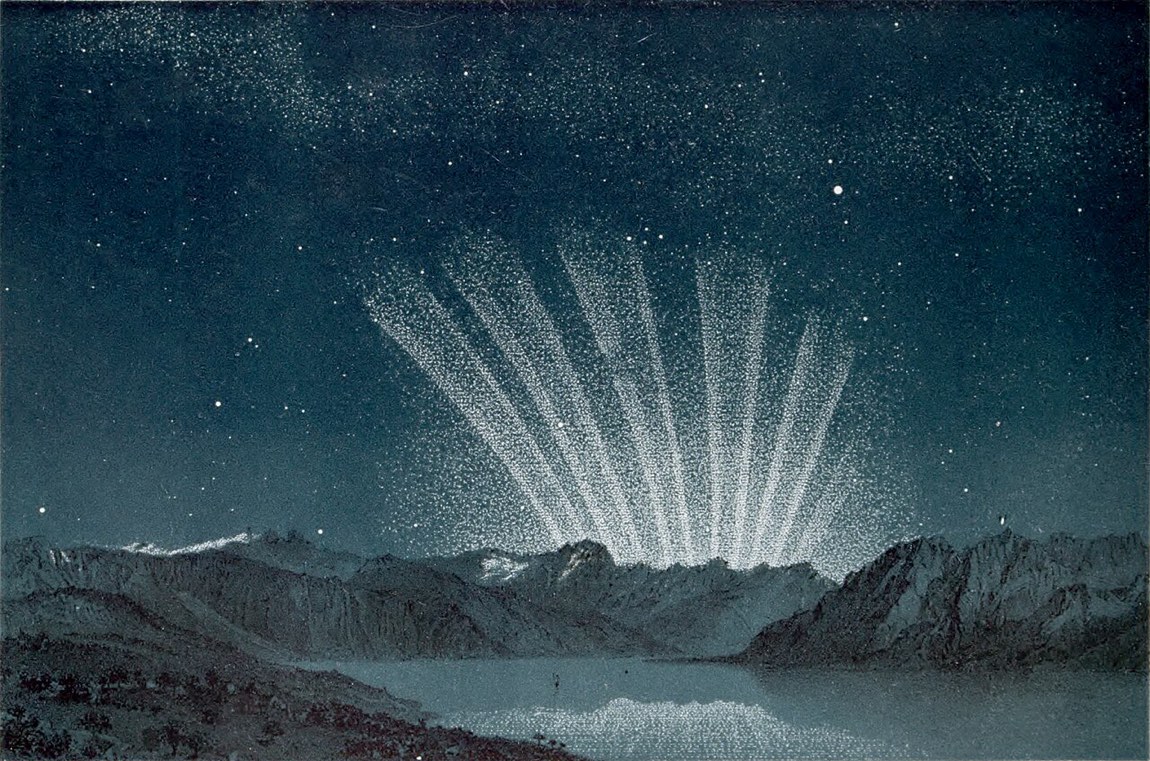
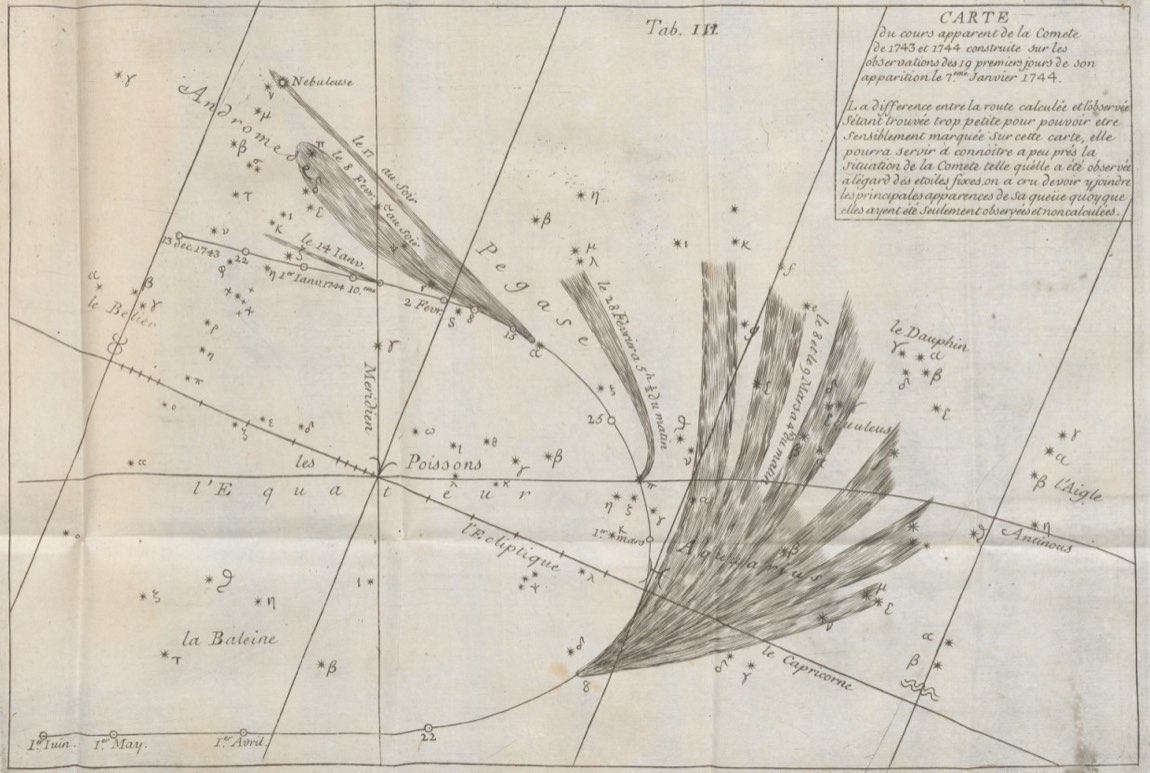
After rounding the Sun it spread a fan of six tails across the dawn sky.
What is it?
The Great Comet of 1744 was spotted in late 1743 by Jan de Munck, Dirk Klinkenberg and Jean-Philippe de Chéseaux. It became one of the most spectacular comets on record, perhaps reaching magnitude −7, and after perihelion on 1 March 1744 it displayed a striking fan of six separate tails. Recent research suggests it may return every 350–400 years, possibly in 2097.
The deep dive
Researched for the Atlas from Wikipedia — Great Comet of 1744 (6,582 characters read) · updated Nov 14, 2026
01 Three Discoverers, One Comet
The story of who actually found this comet is surprisingly tangled. Jan de Munck of Middelburg spotted it first on 29 November 1743, yet history most often attaches the name of Jean-Philippe de Chéseaux to it, partly because Chéseaux published detailed observations from his well-equipped observatory in Lausanne. Dirk Klinkenberg of Haarlem came second, sighting it independently on 9 December 1743, and Chéseaux followed four days later on the 13th. When Chéseaux first recorded it, the comet looked simply like a nebulous star of the third magnitude and lacked any visible tail; he measured the coma — the fuzzy envelope of gas surrounding the nucleus — as five arcminutes across, roughly one-sixth the apparent diameter of the full Moon. The dual credit given to Klinkenberg and Chéseaux in one of the comet's common names reflects how independent discovery was treated in an era before instantaneous global communication, when weeks might pass before observers learned that someone else had beaten them to the same patch of sky.
02 From Faint Smudge to Daytime Spectacle
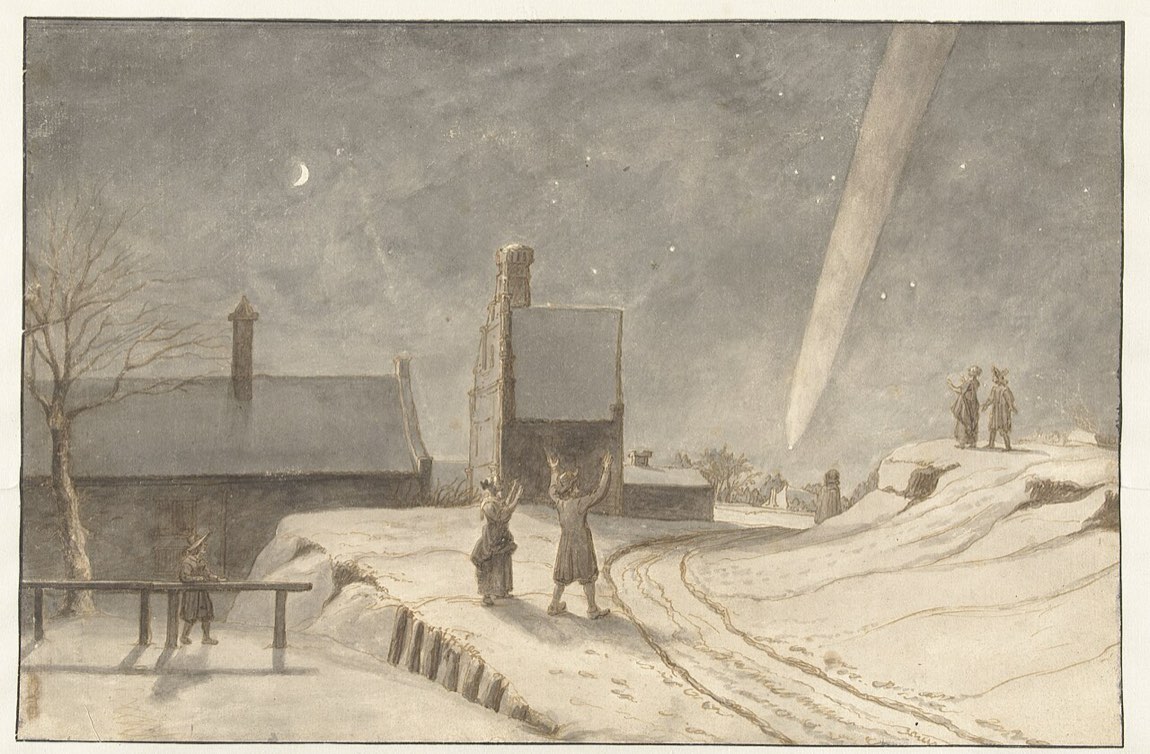
The comet's brightening between late November 1743 and early March 1744 was startling even by the dramatic standards of great comets. When Chéseaux first recorded it in December it was a third-magnitude object, comparable to a moderately bright star. By 18 February 1744 it had reached roughly the brightness of Venus at its most dazzling, an apparent magnitude of −4.6. That already placed it among the brightest objects in the night sky, but it kept going. Near perihelion around 1 March 1744, its apparent magnitude may have climbed as high as −7 — bright enough to be observed in full daylight with the naked eye. For comparison, the full Moon shines at about −12.7, so this comet reached perhaps one-sixteenth of lunar brilliance while competing with the Sun. Its absolute magnitude, the intrinsic brightness corrected for distance, was 0.5, which ranks it sixth highest among all comets in recorded history — a measure of just how genuinely luminous the object itself was, independent of how close it happened to pass by Earth.
03 The Puzzle of Six Separate Tails Deeper
No feature of this comet captured more attention, then or since, than the fan of six distinct tails seen in early March 1744. While other comets occasionally display two tails — one made of ionized gas pushed straight back by the solar wind, another of dust curving along the orbital path — no comet before or since has been convincingly documented showing six simultaneous tails. One explanation proposes that the comet's nucleus was rotating with a period of 4.8 ± 0.4 hours and carried as many as three separate active regions on its surface. As the nucleus rotated, each active area was successively exposed to solar radiation, heated up, and expelled material in a slightly different direction, producing jets that spread into a fan. A second hypothesis connects the tails to 'dust striae,' narrow parallel structures seen in the tails of comets like C/1975 V1 (West) and C/2006 P1 (McNaught). Both explanations remain plausible; no consensus has been reached, partly because observations from 1744 lack the resolution modern astronomers would need to settle the debate definitively.
04 The Tail That Outlasted the Head
One of the most visually dramatic moments in the comet's apparition came as it receded from perihelion in early March 1744. The head of the comet — its bright coma and nucleus — had sunk below the horizon into the glare of morning twilight and was invisible to observers. Yet the enormous tail still reached well above the horizon, rising into dark sky like a ghostly fan of light with nothing visible at its base. It was as though the comet had decapitated itself in the act of departing. Chéseaux made some of the last Northern Hemisphere observations on 9 March. Observers in the Southern Hemisphere, with a better geometric view, continued to follow the comet and by 18 March reported a tail stretching approximately 90 degrees across the sky — equal to the full span from the horizon straight overhead. The last recorded sighting anywhere occurred on 22 April 1744, nearly five months after discovery.
05 Sounds From a Comet? A Curious Report Deeper
Among the more extraordinary details buried in the historical record is a claim found in Chinese astronomical sources from 1744: some observers apparently described audible sounds associated with the comet. If taken at face value, this is physically strange, because comets are far too distant for any mechanical sound wave to travel through the vacuum of space to Earth. The article notes that researchers suggest such sounds, if real, may have resulted from the interaction of cometary or solar-wind particles with Earth's magnetosphere — a mechanism sometimes proposed to explain the similarly disputed sounds occasionally reported during auroral displays. The aurora-sound phenomenon remains scientifically contentious today. Whether any noise in 1744 was truly comet-related, a product of heightened magnetospheric activity, psychological suggestion among excited observers, or simple misattribution is impossible to resolve from records nearly three centuries old. It remains one of the most intriguing and unverifiable footnotes in the comet's history.
06 Records Across Three Continents
The comet of 1744 was not only a European event. It appears in Japanese astronomical records in the Nihon Odai Ichiran, compiled during the Kanpō era. In South Asia, the Tungkhungia Buranji — a medieval Ahom chronicle from the region now known as Assam — records the comet as visible for three successive Assamese months: Push, Magh, and Phagun, corresponding to the Saka year 1665–1666, which aligns precisely with 1743–1744 in the Gregorian calendar. These independent records from Japan and northeastern India demonstrate how phenomenally bright and long-lasting the display was; cultures with very different astronomical traditions all deemed it worth preserving in writing. The existence of observations across three continents also gives modern researchers additional data points for reconstructing the comet's path and brightness profile, supplementing the more detailed European positional measurements that were eventually used to compute orbital solutions.
07 Young Messier's Life-Changing Sky Show
Among the crowd of people who tilted their heads back to watch the comet in early 1744 was a thirteen-year-old boy named Charles Messier. The article describes the experience as having 'a profound and inspirational effect' on him. That effect proved historically consequential: Messier went on to become one of the founding figures of modern observational astronomy and later discovered many comets during his career. He is best remembered today for compiling the Messier Catalogue, the list of nebulae and star clusters that he initially assembled precisely to avoid confusing fuzzy, comet-like objects with actual comets during his searches. It is a remarkable chain of causation — the spectacular fan of tails over Europe in 1744 may have set in motion the career that produced a catalogue still used by amateur astronomers every clear night around the world. Another notable witness was the future Catherine the Great, then known as Sophia, who observed the comet as a young girl while traveling to Russia to be married.
08 Parabolic or Periodic? The Orbit Debate Deeper
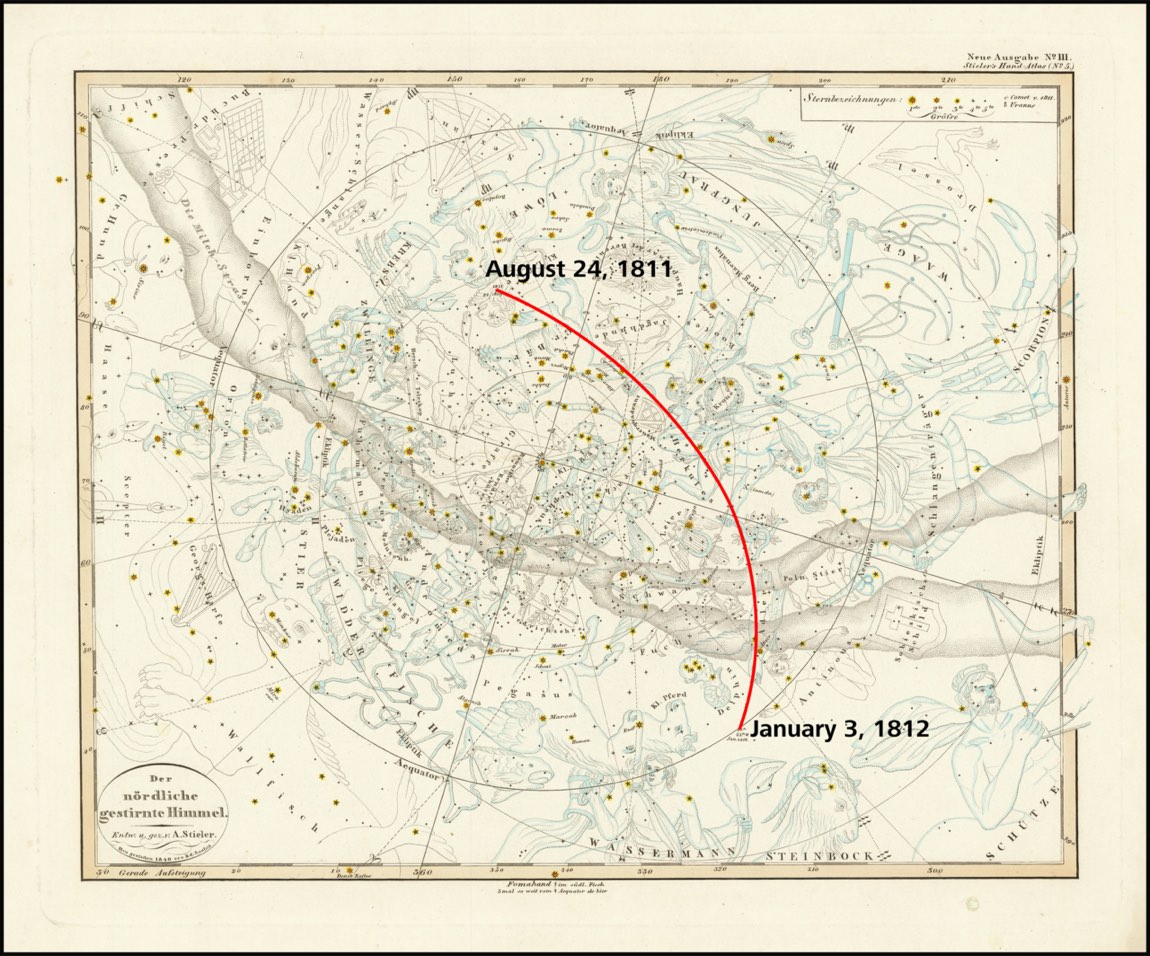
For most of its documented history, the orbit of C/1743 X1 was calculated as parabolic, meaning the comet was treated as effectively unbound — a one-time visitor that would never return. Parabolic fits are mathematically convenient when data are limited. However, researchers Maik Meyer and Gary Kronk re-examined the 1744 observations without imposing parabolic constraints and obtained an eccentricity of 0.995580 and an orbital period of 354 years. When daylight observations — which carry larger uncertainties — are excluded, the period lengthens to about 480 years, so the best estimate is 'a few hundred years.' Crucially, the unrestricted orbit produced smaller residuals than the parabolic solution, meaning it fits the actual observations better. Including gravitational perturbations from the planets, Meyer and Kronk traced the orbit backward to a perihelion around 1405, consistent with the independently documented Great Comet of 1402. Earlier astronomers including Olof Hiorter, Heinrich Wilhelm Matthias Olbers, and Johann Holetschek had already suspected such a connection based on the visual similarity of the two apparitions.
09 Echoes of 1744 Stretching Back to 44 BC Deeper
Meyer and Kronk did not stop at 1402. Integrating the orbit backward through multiple periods, they identified candidate apparitions in 1032, 676, and 336 AD, and even in 44 BC. The 1032 comet is mentioned in a Chinese source with a perihelion suggested to fall in early August, a geometry that would have made observation difficult, lending some plausibility to a missed or brief record. The 676 AD apparition, by contrast, is a bright comet recorded in autumn in many European and Asian sources; the backward-integrated orbit of the 1744 comet predicts a perihelion on 4 November 676, an encouraging match. The 44 BC candidate is tempting but problematic: that year's bright comet is known as Caesar's Comet, famous in Roman history, but the article notes that the observation reports both contradict each other internally and do not fit the predicted appearance well, leaving that link uncertain. The chain of identifications grows progressively less secure the further back it reaches.
10 Could It Return in 2097?
If the periodic interpretation of the orbit is correct, Meyer and Kronk predict that the comet could reach perihelion again around 8 December 2097. That date carries what the article honestly describes as 'significant uncertainties' — a consequence of the imprecision in the original 1744 positional data, the unknown magnitude of planetary perturbations accumulated over centuries, and the unresolved question of whether the orbit period is closer to 354 years or 480 years. The prediction also depends entirely on whether the chain of historical identifications back through 1402, 1032, and 676 is correct. If those links hold, astronomers alive in the late twenty-first century may witness a repeat of one of the most spectacular sky shows in recorded history. If the orbit is truly parabolic, the comet has long since departed the inner solar system and will not return at all. The ambiguity is genuine and unresolved.
11 Perihelion Distance and Solar Encounter Deeper
The comet's perihelion distance was 0.22 astronomical units from the Sun — roughly one-fifth the distance between Earth and the Sun, or less than half the distance of Mercury's closest approach to the Sun. At such proximity the intensity of solar radiation is approximately twenty times greater than what Earth receives, and cometary ices sublimate with tremendous vigor, driving spectacular jets of gas and dust into space. This extreme solar encounter is directly responsible for the comet's extraordinary brightness and its complex tail structures. The perihelion occurred around 1 March 1744, and it was in the days immediately surrounding this date that the comet was visible in daylight and the six-tail fan was reported. The comet's orbital data collected during the 1744 apparition were initially used to compute parabolic orbits, and the perihelion distance of 0.22 AU appears in those solutions — a figure that anchors all subsequent discussions of the comet's physical behavior near the Sun.
 ⤢