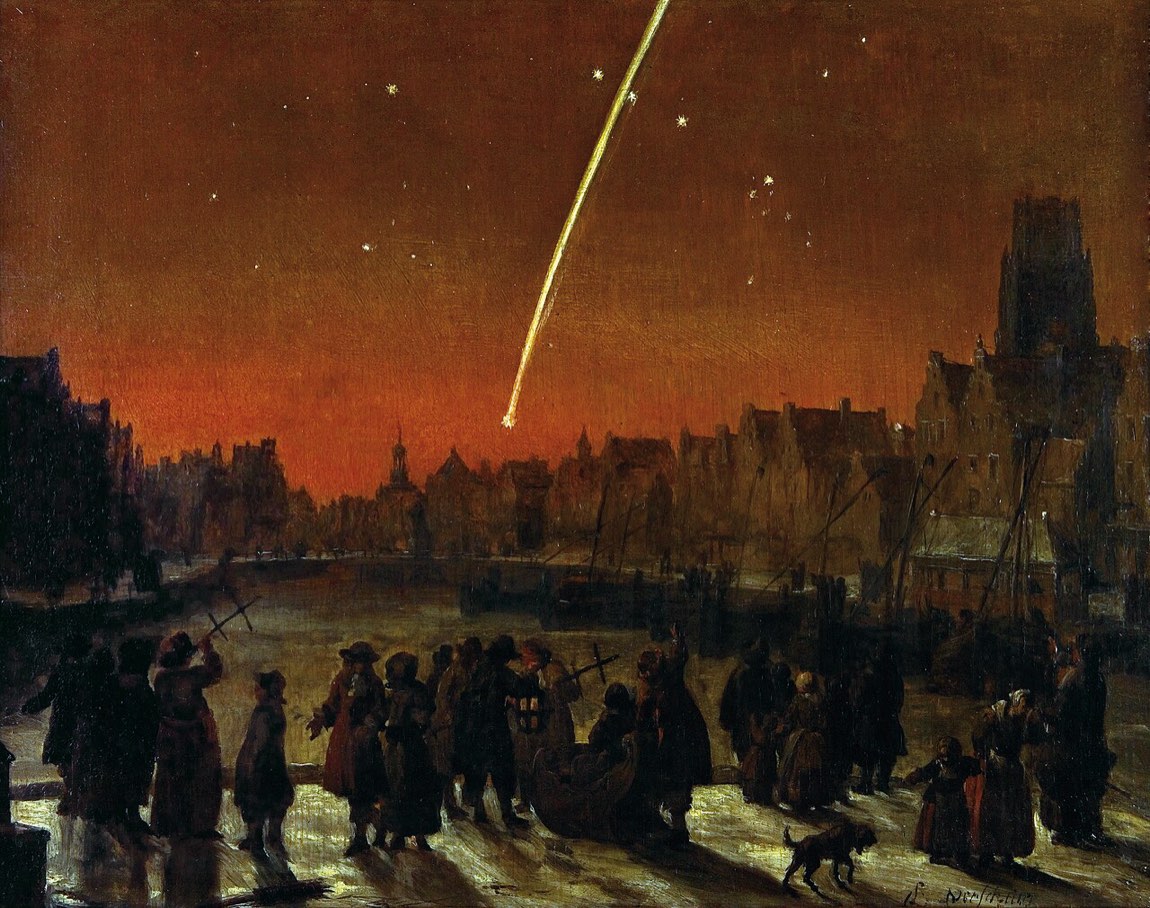
 Photograph · Rijksmuseum · CC0
Comet · Deep guide
Great Comet of 1680 (Kirch's Comet)
Also called: C/1680 V1 · Kirch's Comet · Newton's Comet
The first comet found with a telescope, and the one Isaac Newton used to test the laws of orbits.
What is it?
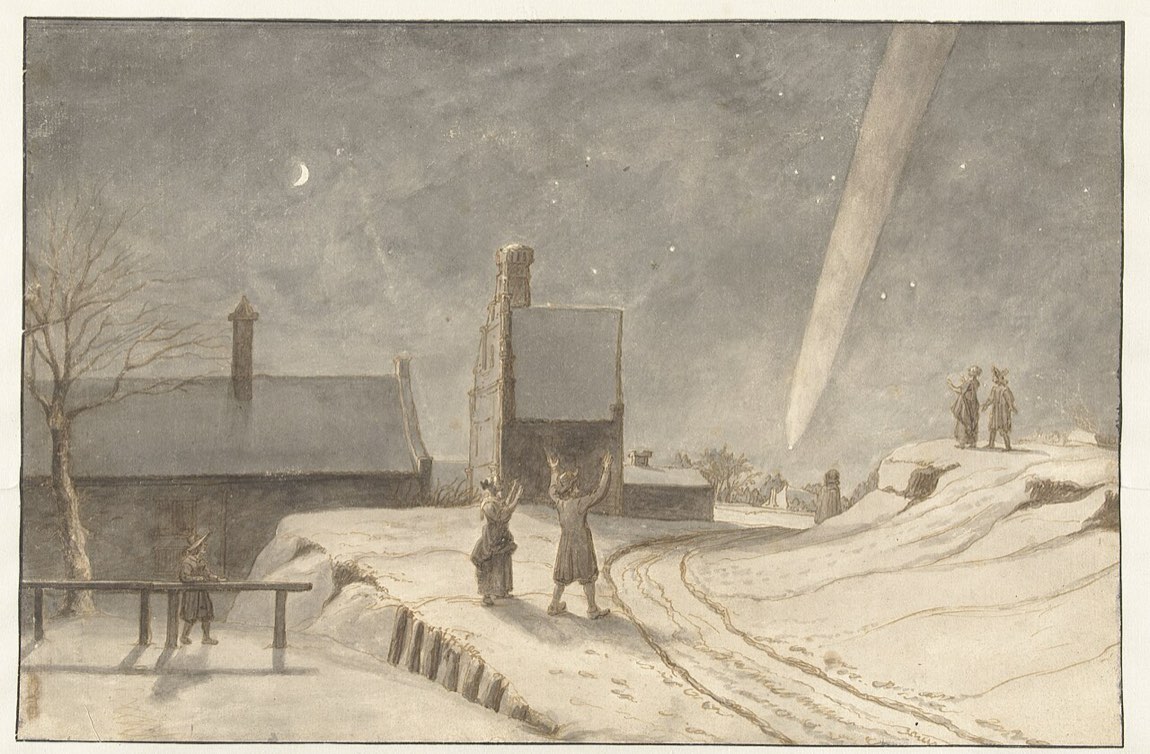
Gottfried Kirch discovered this comet in Coburg, Germany, on 14 November 1680, the first comet ever found using a telescope. On 18 December it swung extremely close to the Sun, then grew a spectacularly long tail as it headed outward, and some reported seeing it in daytime. John Flamsteed proposed that the comets seen before and after perihelion were the same object, and Isaac Newton used its path to check Kepler's laws of planetary motion.
The deep dive
Researched for the Atlas from Wikipedia — Great Comet of 1680 (2,811 characters read) · updated Nov 14, 2026
01 The Night a Telescope Found Its First Comet
Before November 1680, every comet in human history had been discovered by naked eye. That changed on 14 November 1680, when German astronomer Gottfried Kirch swept his telescope across the sky from Coburg and caught something no unaided eye had yet spotted. The comet he found would go on to become one of the brightest of the entire seventeenth century, reportedly blazing visibly even in daylight — an extraordinary achievement for an object that was still weeks away from its closest approach to the Sun. The discovery instantly demonstrated a practical payoff for telescopic astronomy: instruments could reveal celestial events earlier, giving observers more time to track, measure, and study them. Kirch's find set a precedent that has never been reversed. Every professional comet search program since — from patient visual sweepers to modern automated sky surveys — is a direct descendant of that one November night in Coburg.
02 A Suicidal Dive Past the Sun
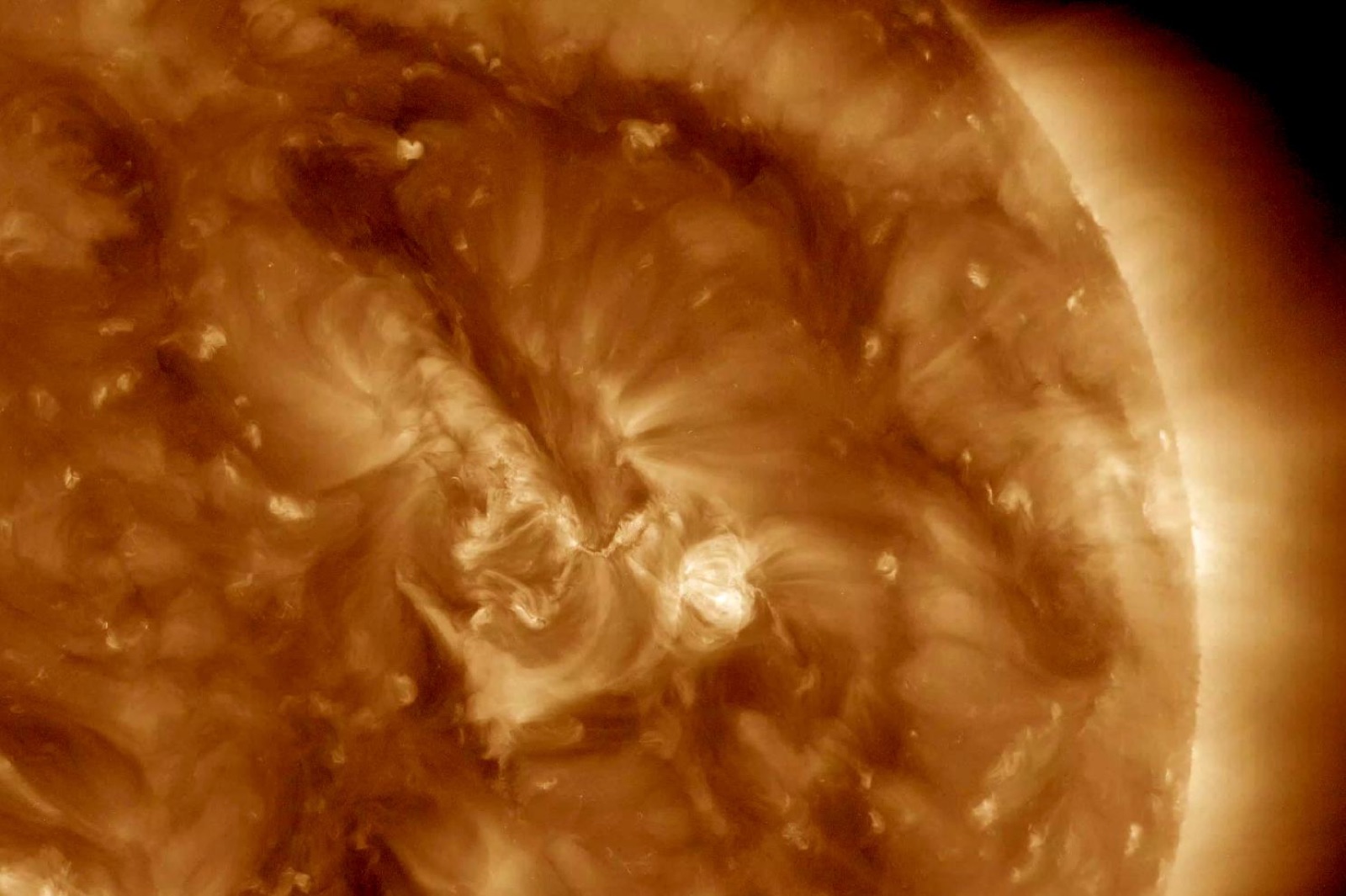
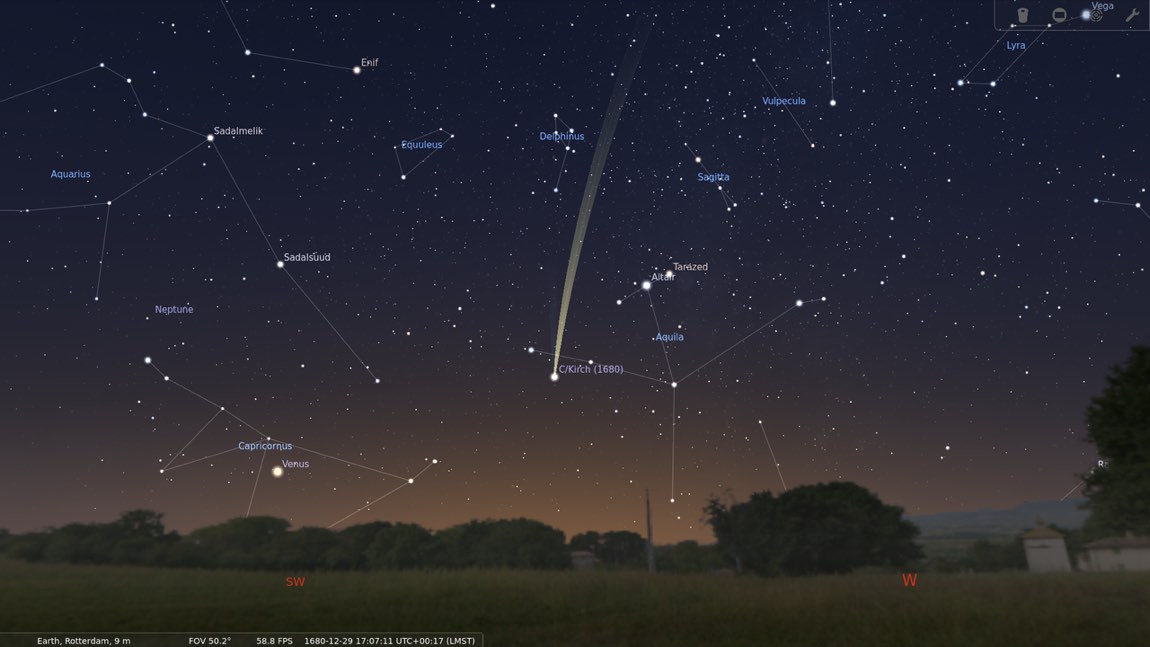
The comet's path around the Sun was almost unimaginably close. On 18 December 1680 it reached perihelion at just 0.00622 AU — roughly 930,000 km from the Sun's center, which works out to only 1.34 solar radii. Put another way, the comet skimmed a mere 0.34 solar radii above the actual solar surface, passing about 235,000 km from that surface — closer than the Moon is to Earth. At that distance, solar radiation and tidal forces are ferocious, yet the nucleus survived. The comet is classified as a sungrazer, but crucially it does not belong to the famous Kreutz family of sungrazers, which all share a common ancestor. The Great Comet of 1680 arrived on its own trajectory, making its survival even more notable. Having survived the encounter, it swung back outward and reached its peak visual brightness on 29 December 1680, more than a week after perihelion — a reminder that brilliance on the outbound leg can rival or exceed the inbound display.
03 An Orbit Measured in Millennia Deeper
Most comets that swing through the inner solar system do so on timescales human civilizations can relate to — decades or centuries. The Great Comet of 1680 operates on a far grander clock. JPL Horizons calculates a barycentric orbital period of roughly 10,400 years for the comet. That figure means the last time this object passed through the inner solar system, early anatomically modern humans were navigating the tail end of the last ice age. By the time it returns, our entire recorded history will represent only a small fraction of one orbital lap. The comet was last observed on 19 March 1681, and as of 2026 it is approximately 260 AU from the Sun — about 39 billion km out, or roughly six times farther away than Neptune's average distance. It is receding into a region of the solar system that no spacecraft has yet reached, invisible to all but the most determined observers.
 ⤢
04 Newton, Kepler, and a Comet as a Laboratory
Isaac Newton seized on the Great Comet of 1680 as a rare opportunity to test Kepler's laws against a real moving body. Planets had long served this purpose, but a comet with such a precisely measured, extreme orbit offered a far more demanding trial. If Kepler's geometric rules truly governed all motion around the Sun — not just the circular-ish paths of planets — they should describe a wildly elongated cometary orbit just as accurately. Newton demonstrated that they did. This confirmation strengthened the case for universal gravitation and fed directly into the arguments Newton was building for his Principia Mathematica. The comet effectively became a proof-of-concept that the same mathematical laws binding Earth to the Sun also controlled visitors from the deep outer solar system, unifying celestial mechanics in a way no planet alone could have demonstrated so dramatically.
05 Flamsteed's Insight and a Stolen Credit Deeper
In late 1680 and early 1681, astronomers watched what appeared to be two separate comets: one approaching the Sun and one receding from it. It was John Flamsteed, England's first Astronomer Royal, who first proposed that these were not two objects but a single comet making a hairpin turn around the Sun. Newton initially rejected the idea — the geometry seemed implausible to him. He later changed his mind entirely and, with the assistance of Edmond Halley, used observational data that Flamsteed had collected to confirm the single-comet hypothesis. The problem was that Newton did not give Flamsteed credit for the original insight or for providing the crucial data. This episode became one of several bitter disputes between Newton and Flamsteed, illustrating how scientific priority and data ownership were contested in seventeenth-century astronomy in ways that feel strikingly modern.
06 Eusebio Kino and a Landmark New World Publication
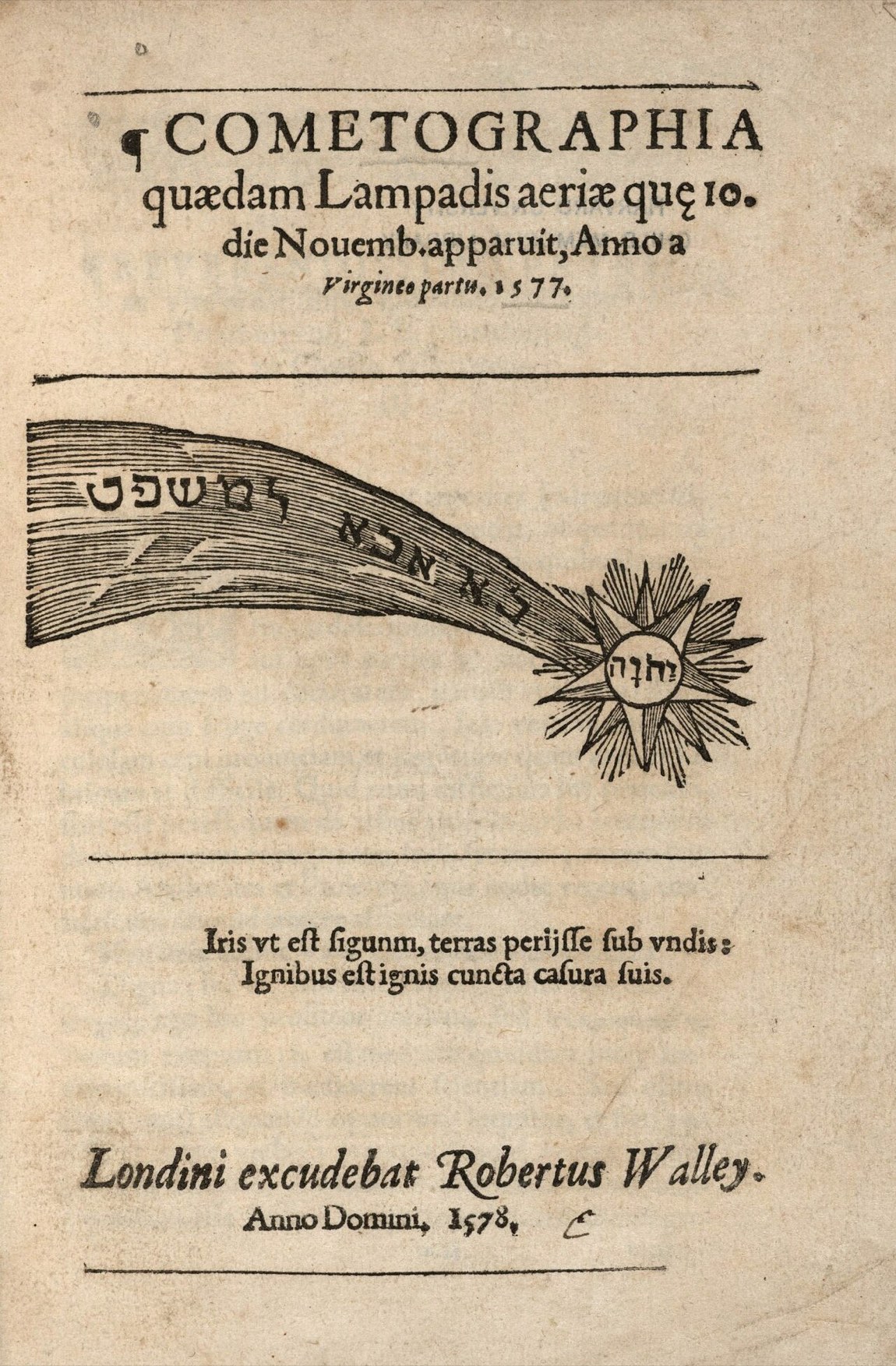
While European astronomers debated the comet's nature, a Spanish Jesuit priest named Eusebio Kino was making his own careful observations from a very different vantage point. Delayed during a voyage to Mexico, Kino began tracking the comet from Cádiz in late 1680. When he eventually reached Mexico City, he published his findings as Exposición astronómica de el cometa — rendered in English as Astronomical Account of the Comet — in 1681. The work holds a distinction beyond its astronomical content: it is considered among the earliest scientific treatises published by a European in the New World. Kino's systematic charting of the comet's course contributes observational data from a southern perspective that complemented European records, and his publication represents an important moment in the spread of scientific practice to the Americas. His contribution is now acknowledged alongside Kirch's discovery as part of the comet's full observational history.
 ⤢
07 A Buccaneer's Logbook Entry
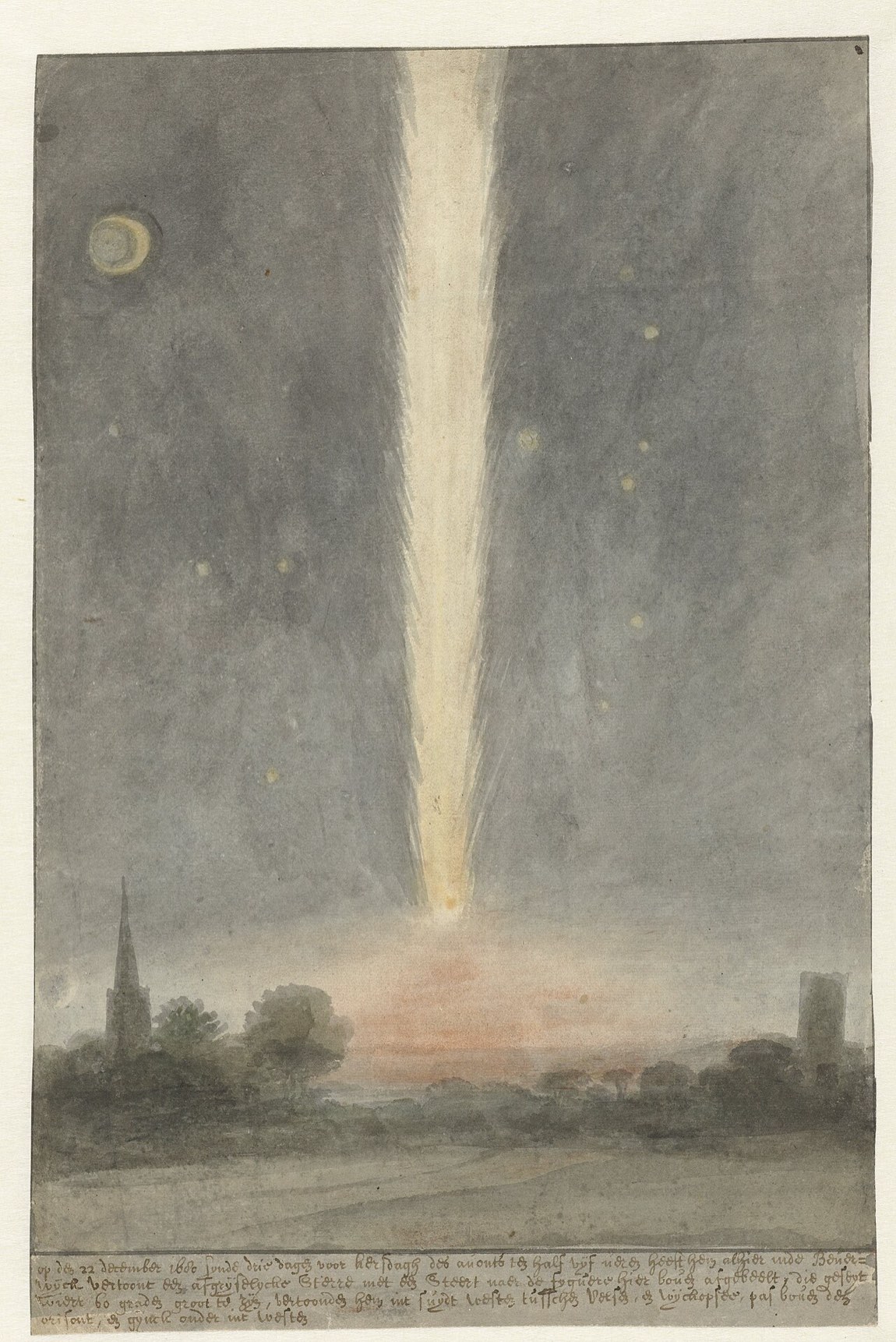
Not all observers of the Great Comet of 1680 were astronomers. Basil Ringrose, sailing with the buccaneer crew of Captain Bartholomew Sharpe in the Pacific, recorded the comet in his log on 19 November 1680 — just days after Kirch's discovery on the other side of the world. Ringrose noted that the comet's body appeared dull while its tail stretched 18 to 20 degrees across the sky in a pale color, pointing north-northwest. That tail extent is enormous: for comparison, your outstretched fist held at arm's length covers about 10 degrees, so the tail spanned nearly two fist-widths. Ringrose also recorded that Spanish prisoners aboard reported strange sights seen at Lima, Guayaquil, and other cities around the same period. The entry is a reminder that the comet was a shared global spectacle, witnessed and interpreted across vastly different cultures and circumstances simultaneously.
08 Why This Sungrazer Stands Apart Deeper
The term sungrazer evokes a family of comets — the Kreutz group — that all trace their lineage to a single giant progenitor that broke apart long ago. Members of that family follow nearly identical orbits and plunge toward the same region of the solar corona. The Great Comet of 1680 is explicitly not one of them. Despite matching the defining characteristic of a sungrazer — a perihelion distance so small it passes through or near the outer Sun — its orbital geometry is distinct. This independence means it arrived on a trajectory with no known relatives, making its origin harder to constrain. It also means its survival of the solar encounter cannot be attributed to any particular composition or structural advantage shared with the Kreutz family. The comet stands as a singular event rather than one episode in an ongoing fragmentation sequence, adding to its scientific and historical uniqueness.
09 How the Comet Was Named — and by Whom
The comet carries three informal names that reflect different aspects of its legacy. Kirch's Comet honors Gottfried Kirch, the German astronomer who discovered it telescopically on 14 November 1680 — the first such discovery in history. Newton's Comet acknowledges Isaac Newton's use of it to test Kepler's laws and advance the case for universal gravitation, cementing its place in the history of physics as well as astronomy. The Great Comet of 1680 is the more descriptive popular name, referencing its exceptional brightness and the spectacular long tail that made it one of the most visually dramatic comets of the seventeenth century. Its formal designation is C/1680 V1, following the modern IAU naming convention that encodes the year and the half-month of discovery. The multiple names reflect a genuine truth: this single object played meaningful roles for the history of telescopic discovery, celestial mechanics, and popular wonder all at once.
 ⤢