 Diagram · Morn · CC0
Comet · Deep guide
Great Comet of 1811
Also called: C/1811 F1 · Napoleon's Comet · Comet Flaugergues
Visible to the naked eye for about 260 days, and popularly blamed for Napoleon's war with Russia.
What is it?
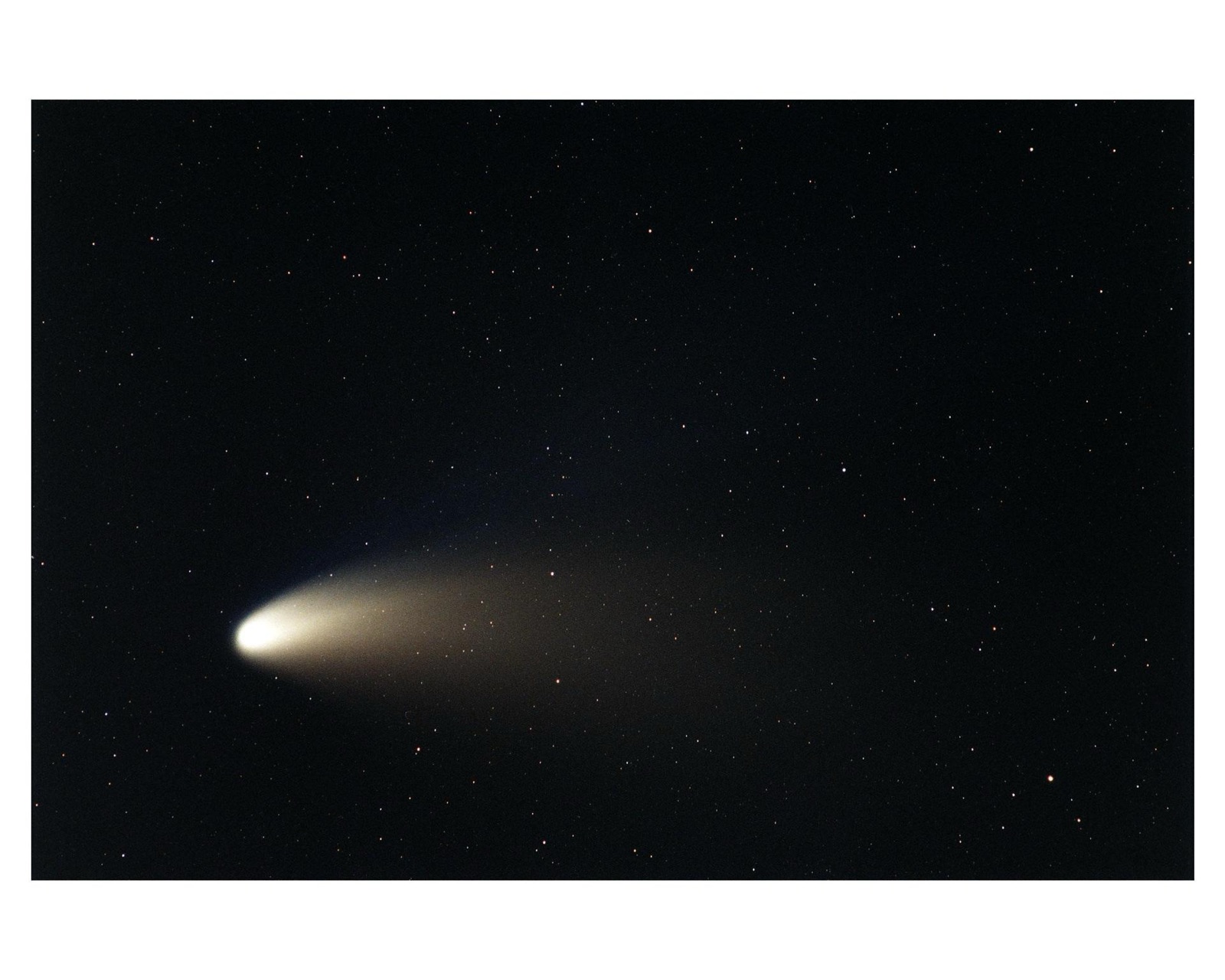
The Great Comet of 1811 was discovered by French astronomer Honoré Flaugergues in March 1811. It stayed visible without a telescope for around 260 days, a record that held until Hale–Bopp in 1997. William Herschel measured a tail about 25 degrees long that autumn, and at its brightest it shone at about magnitude zero. Many people at the time linked it to Napoleon's invasion of Russia, and it was nicknamed Napoleon's Comet.
The deep dive
Researched for the Atlas from Wikipedia — Great Comet of 1811 (6,132 characters read) · updated Nov 14, 2026
01 How Flaugergues Found It First
On March 25, 1811, French amateur astronomer Honoré Flaugergues spotted the comet at a distance of 2.7 AU from the Sun — roughly the distance between the Sun and the asteroid belt — placing it in the now-defunct constellation Argo Navis. Moonlight then swamped the sky for several days, temporarily hiding the comet from observers. On April 11, Jean-Louis Pons independently rediscovered it, and that same night Franz Xaver, Baron Von Zach confirmed Flaugergues' original sighting. Because Flaugergues reached it first, he is credited with the discovery. The episode illustrates a recurring pattern in comet history: a large, slow-moving object can be found weeks before it becomes spectacular, giving astronomers months of advance notice. In this case, the early detection allowed Heinrich Wilhelm Matthäus Olbers — working from the first provisional orbit computed by Johann Karl Burckhardt in June 1811 — to predict confidently that the comet would become brilliantly bright later that year, a forecast that proved entirely correct.
02 An Enormous Coma Bigger Than the Sun
The most physically remarkable feature of C/1811 F1 was not its tail but its coma — the vast cloud of gas and dust surrounding the nucleus. Astronomers estimated that the coma may have reached over 1 million miles across, making it roughly 50 percent larger than the Sun itself. To put that in perspective, you could line up more than 100 Earths side by side across that cloud and still have room to spare. Despite this extraordinary size, the coma was produced by a nucleus estimated at only 30 to 40 km in diameter, comparable in scale to a small city. That compact, intensely active core was evidently shedding material at a prodigious rate. This combination — a relatively modest nucleus generating an outsized coma — led astronomers to characterize the nucleus as exceptionally large and active compared to typical comets. The comet never passed particularly close to either Earth or the Sun, yet still put on a stunning display, a behavior that drew direct comparisons to Comet Hale–Bopp nearly two centuries later.
03 Watching It Cross the Sky Month by Month Deeper
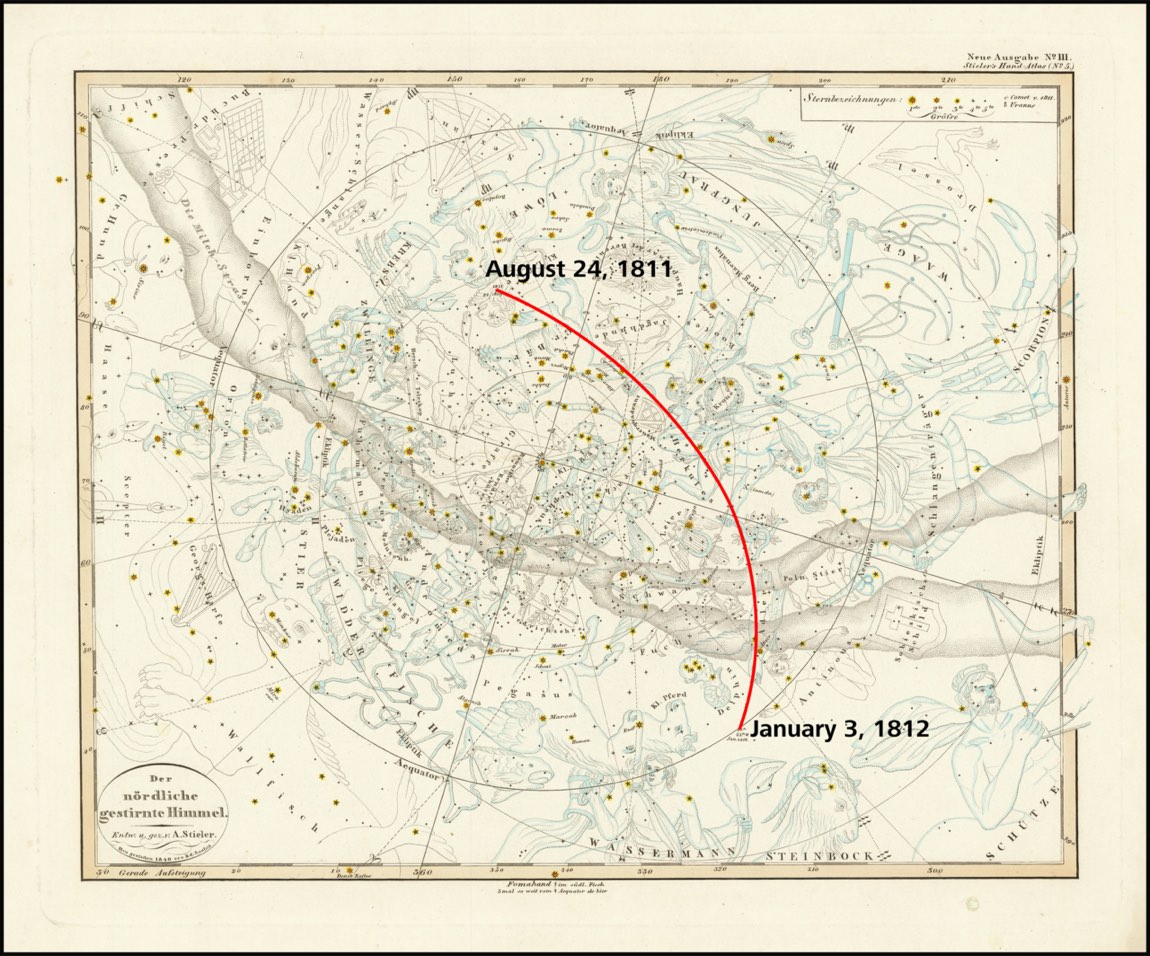
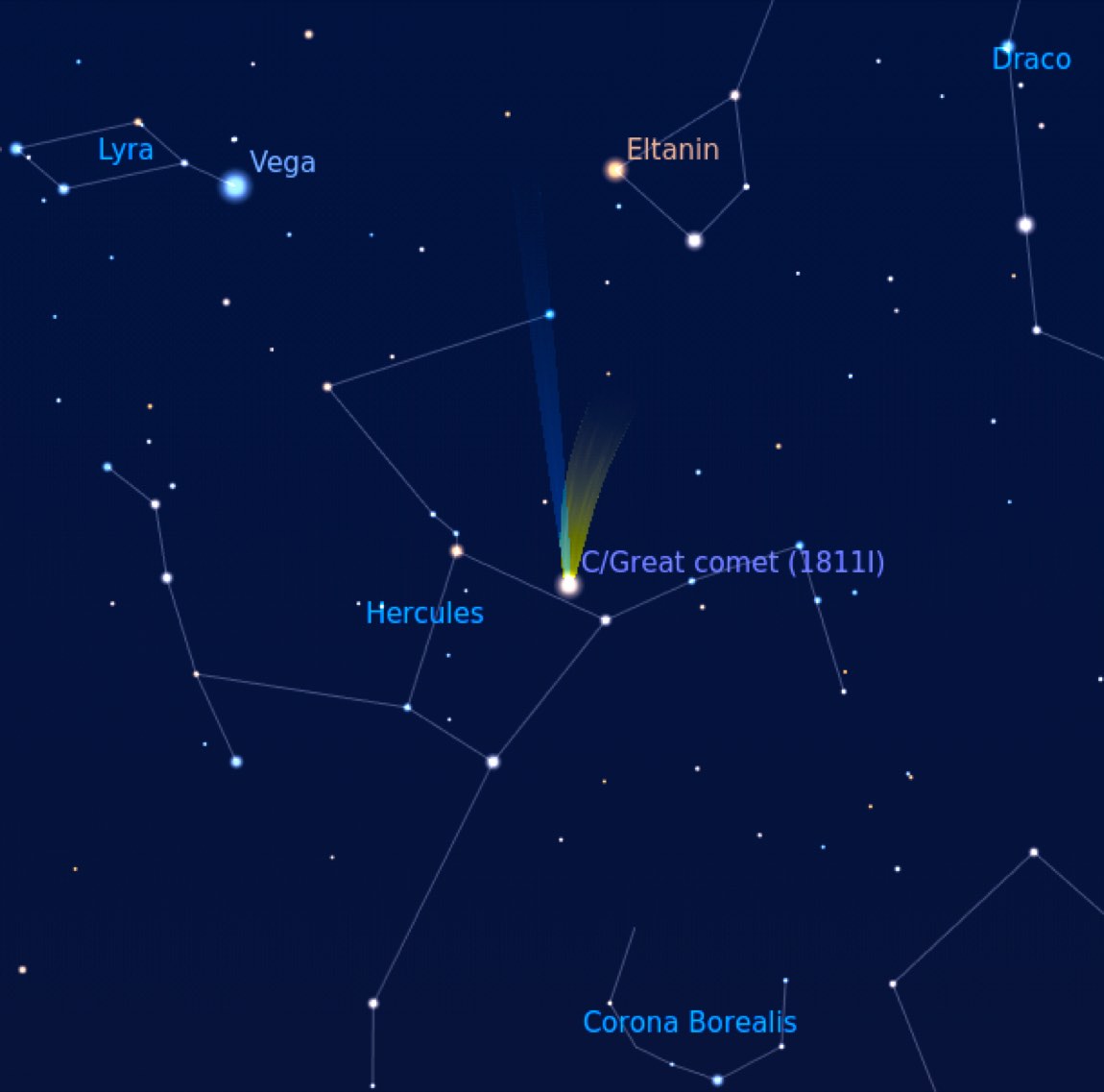
Tracking C/1811 F1 from discovery to final observation reveals how dramatically a comet can change. From May through August 1811, its low altitude above the horizon combined with evening twilight made it frustratingly difficult to observe, even for experienced astronomers. By August, both Flaugergues and Olbers had recovered it in the constellation Leo Minor, with Olbers noting through a comet seeker a small but distinct tail split into two rays forming a parabolic shape. That same month, James Veitch of Inchbonny became the first person in the United Kingdom to sight it. By September, now crossing Ursa Major, the comet had grown into a conspicuous evening object as it approached perihelion. William Herschel recorded that by October 6 the tail had stretched to 25 degrees of arc — equal to 50 full Moon widths laid end to end. After perihelion, brightness declined steadily through early 1812. The last telescopic observation was made by Vincent Wisniewski at Novocherkassk on August 12, 1812, when it had faded to barely apparent magnitude 11, far below naked-eye visibility.
04 A Record of Visibility Held for 186 Years
C/1811 F1 remained visible to the naked eye for approximately 260 days, a record that stood as the longest documented naked-eye visibility for any comet until Comet Hale–Bopp appeared in 1997. At its brightest, in October 1811, the comet shone at apparent magnitude 0 — rivaling the brightest stars in the sky such as Vega and Arcturus — while still sitting 1.2 AU from Earth, nearly the same distance as Earth is from the Sun. The sheer duration of visibility meant that millions of people across the Northern Hemisphere had months to watch it evolve, track its tail, and assign it meaning. The comet's brightness at that distance underscores how intrinsically luminous it was; a fainter or less active comet at the same range would have been a minor telescopic target. William Henry Smyth, who also witnessed the celebrated Donati's Comet years later, judged that the 1811 comet's branched tail and veiled nucleus were of greater interest than Donati's as a purely visual spectacle.
05 An Orbit Stretching Nearly 3,000 Years Deeper
The orbital arithmetic for C/1811 F1 is striking in its timescales. Before its 1811 perihelion passage on September 12, the comet's orbital period was approximately 2,742 years, meaning its previous visit to the inner solar system would have been around 931 BCE. After perihelion, gravitational tugs from the planets reshaped the orbit slightly. Computing the barycentric orbital period using an epoch of 2200 — after the comet has fully cleared the planetary region — yields a period of about 2,974 years. That adjustment shifts the predicted return date to around the year 4785. These long periods place C/1811 F1 firmly in the category of long-period comets, thought to originate in the distant Oort Cloud. The difference between the pre- and post-perihelion periods, more than 230 years, is a direct measure of how much the giant planets collectively nudged the comet's path during its single passage through the inner solar system.
06 How Artists and Writers Captured the Comet
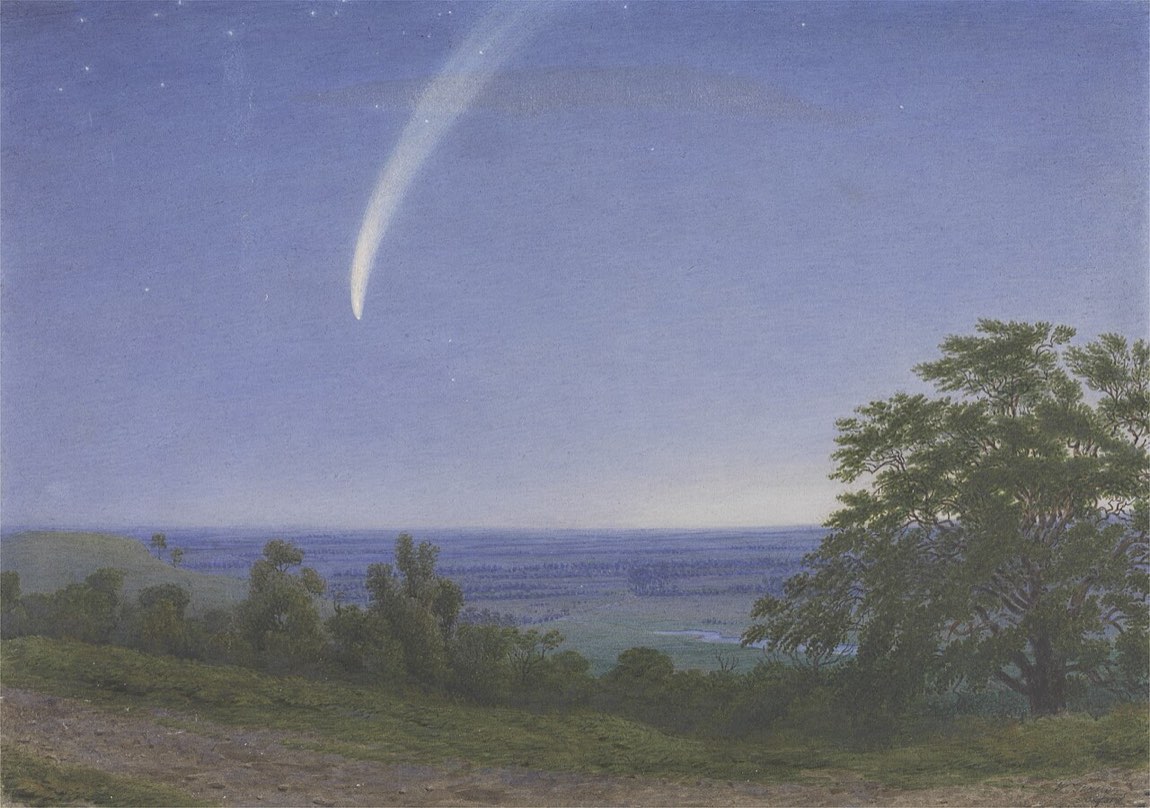
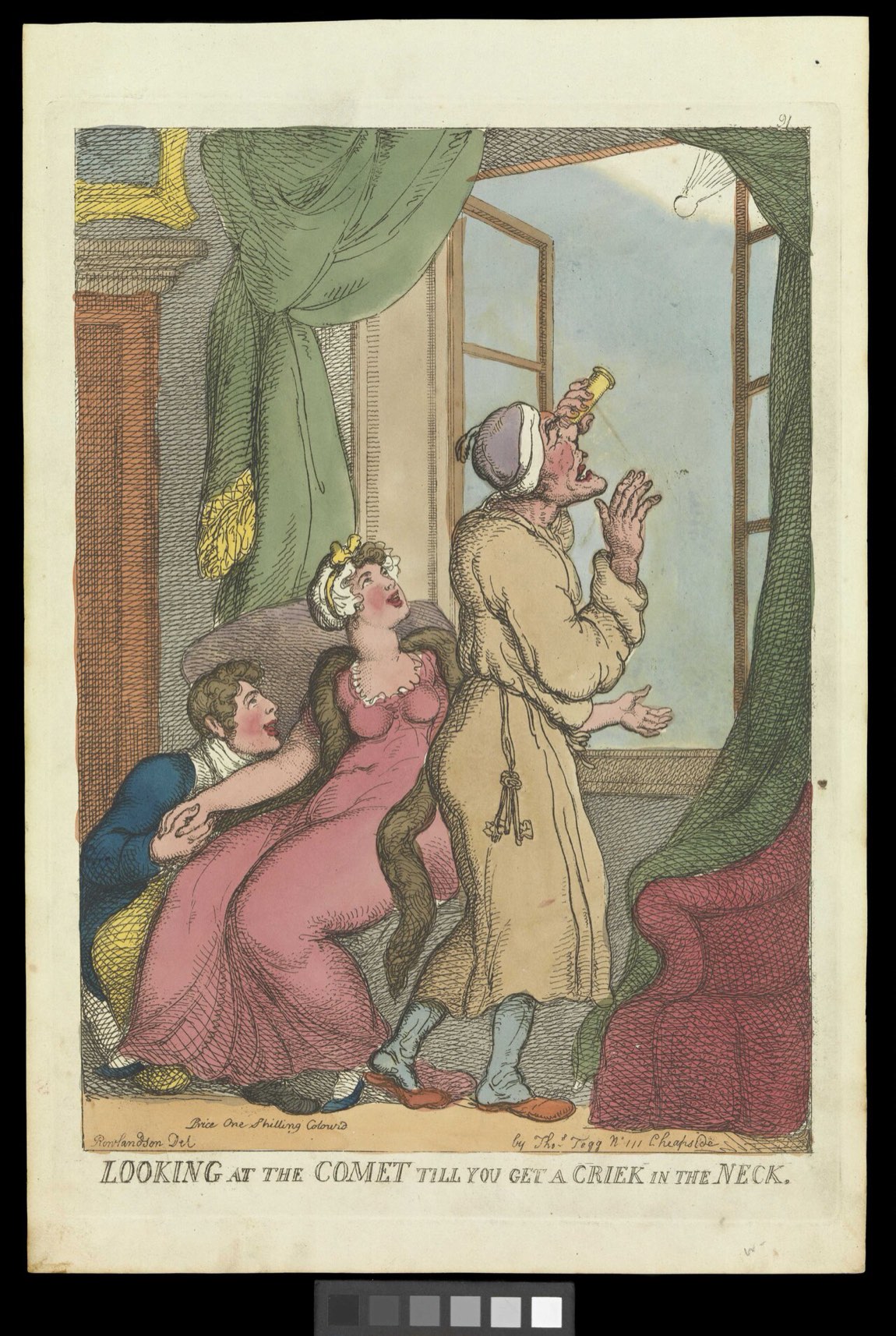
The comet's months-long presence in the sky gave artists unusual opportunity to study and record it. John Linnell and William Blake both witnessed C/1811 F1 and produced multiple sketches of it. Blake's engagement may have gone further: scholars suggest the comet possibly influenced his famous panel The Ghost of a Flea, though the article notes this connection with appropriate caution. In literature, Leo Tolstoy placed the comet at the emotional midpoint of War and Peace, where the character Pierre gazes at an "enormous and brilliant comet" said to portend "all kinds of woes and the end of the world" — directly evoking popular anxieties of the era. The comet appears again in Adam Mickiewicz's Pan Tadeusz and in Victor Hugo's Les Misérables. Thomas Hardy used it as a divine source of revival for a dying hero in Two on a Tower. The musical Natasha, Pierre & The Great Comet of 1812 built its very title around the object, with composer Dave Malloy citing "cosmic epicness" as his rationale for including it.
 ⤢
07 Napoleon, War, and a Sky Full of Omens
Few comets have been burdened with as much political and military symbolism as C/1811 F1. It was popularly linked to Napoleon's invasion of Russia and to the War of 1812, earning the informal name "Napoleon's Comet" in common speech. Such associations were not unique to European audiences. In China, leaders of the Eight Trigram Sect interpreted the comet as an auspicious blessing for their effort to overthrow the Qing dynasty, and they launched their uprising in 1813. Among Native American communities, the comet was read as a vindication of Shawnee leader Tecumseh, whose name translated as "shooting star"; the comet was seen as an omen during his largely unsuccessful campaign that year to build a pan-Native American military alliance. The comet was also reportedly visible during the New Madrid earthquakes in December 1811 — a primary account from the first steamship to descend the Ohio River toward the Mississippi describes a "fiery comet rushing athwart the horizon" on the same day as the earthquake's most severe shocks.
08 Comet Wine: When the Sky Flavored the Harvest
The year 1811 turned out to be an exceptionally favorable one for wine production, and merchants seized on the comet's fame to market their vintages as "Comet Wine," selling bottles at premium prices for many years after the event. Whether the comet had any causal connection to the harvest quality was never established, but the association proved commercially durable. The idea remained culturally potent long enough to inspire a 1992 film: Year of the Comet, a romantic comedy adventure starring Penelope Ann Miller, Tim Daly, and Louis Jourdan — the last film Jourdan made before retiring — centers on the pursuit of a contemporarily discovered bottle of wine from 1811, bottled for Napoleon. The story of comet wine illustrates a broader pattern in which extraordinary celestial events get absorbed into everyday commerce and storytelling, lending an aura of cosmic significance to things as earthly as a glass of wine.
09 Harriet Martineau's Exasperating Night
Among the most human accounts of the 1811 comet comes not from an astronomer but from the English writer Harriet Martineau, who was nine years old when the comet dominated the sky. In her Autobiography, she described night after night climbing with her entire family to the long windows at the top of her father's warehouse, only to be "exasperated" by the universal excitement around her — because she simply could not see the comet. She noted wryly that this was "the fact," inviting philosophers to make of it what they would, while adding that she had "remarkably good eyes." The vignette is a small gem of first-person astronomical history: it captures how the comet commanded collective attention across households and social classes, turning rooftops and warehouses into impromptu observatories, and yet also hints that even a magnitude-0 object in a dark pre-industrial sky could somehow elude a child straining to find it among unfamiliar constellations.
10 Olbers, Herschel, and What They Noticed Deeper
Several leading astronomers of the era made observations that together built a detailed picture of the comet's evolution. Heinrich Wilhelm Matthäus Olbers played two distinct roles: first as a predictor, using Burckhardt's June 1811 orbital calculations to forecast that the comet would become extremely bright, and then as an observer who successfully recovered it in Leo Minor during August and noted the double-rayed parabolic tail through a comet seeker. William Herschel, the most celebrated telescopic observer of the age, documented the tail's growth, recording that by October 6 it had extended to 25 degrees — a measurement that required careful positional work to separate true tail length from background star fields. William Henry Smyth provided a retrospective comparison years later, judging the comet's branched tail and veiled nucleus superior in visual interest to even Donati's Comet, one of the nineteenth century's other great naked-eye comets. These layered observations, from orbital mechanics to naked-eye description to instrumented measurement, illustrate how early nineteenth-century astronomy combined mathematical prediction with systematic sky watching.
11 Why Hale–Bopp Finally Broke the Record
For 186 years, C/1811 F1 held the record for longest naked-eye visibility at approximately 260 days. That record was finally surpassed when Comet Hale–Bopp appeared in 1997. The article draws a direct parallel between the two comets: both became spectacular without passing unusually close to Earth or the Sun, and both possessed extremely large, active nuclei. The 1811 comet's nucleus was estimated at 30 to 40 km in diameter, while Hale–Bopp's nucleus was later measured at roughly 60 km — larger still, which helps explain why Hale–Bopp ultimately eclipsed its predecessor's record. The comparison is scientifically meaningful: it suggests that intrinsic nucleus size and activity level, rather than favorable geometry alone, determine how long and how brightly a comet performs. Both objects serve as end-members of a class of rare, giant comets that announce themselves months before perihelion and linger long after.
 ⤢