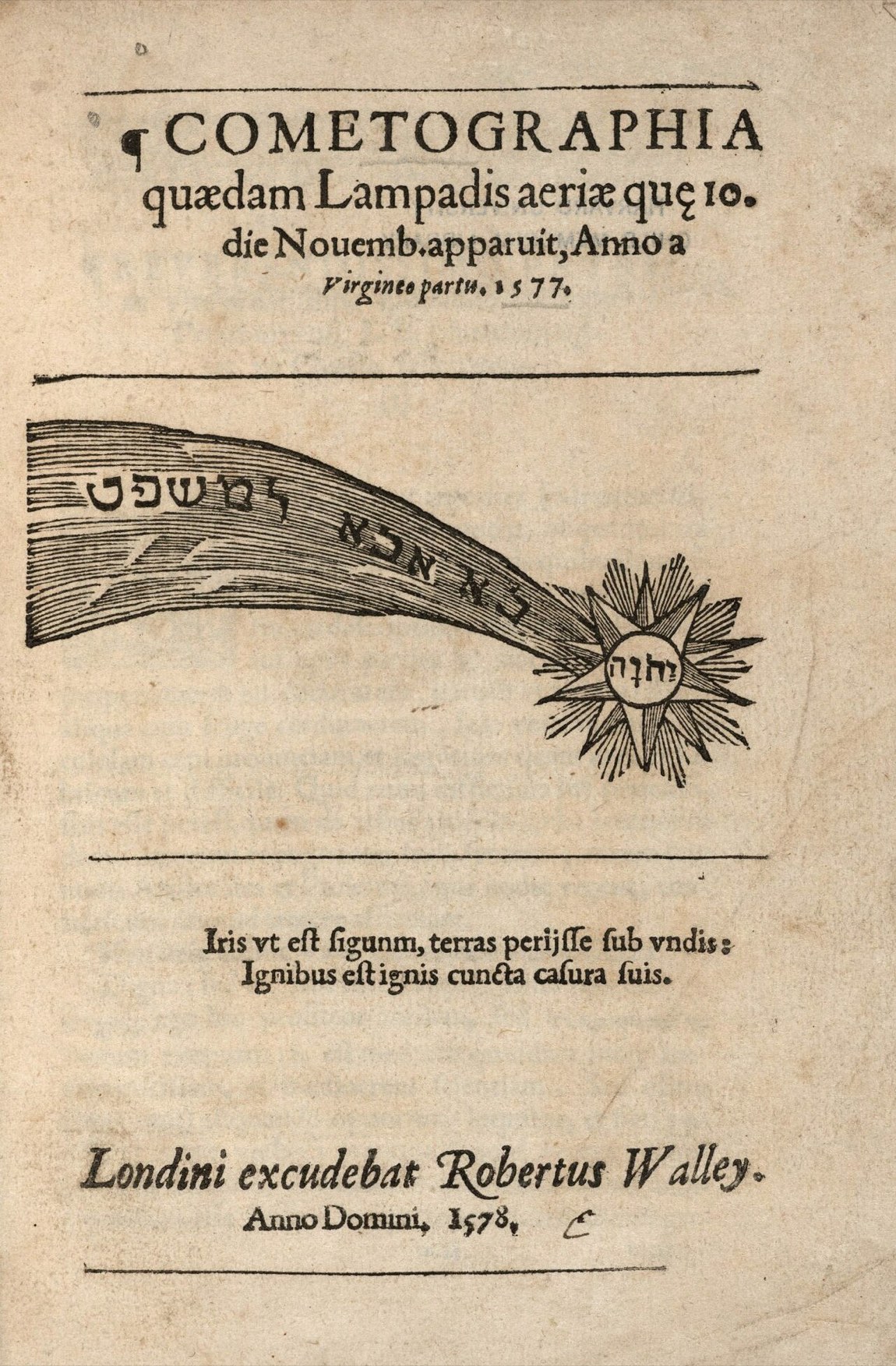
 Photograph · Laurence Johnson (author), Robertus Walley (publisher) · Public domain
Comet · Deep guide
Great Comet of 1577 (Tycho's Comet)
Also called: C/1577 V1 · Tycho's Comet
Tycho Brahe's measurements proved it lay far beyond the Moon, shattering old ideas about the heavens.
What is it?
The Great Comet of 1577 was first seen in Peru on 1 November 1577 and watched around the world until January 1578. Danish astronomer Tycho Brahe made careful position measurements and showed it was much farther away than the Moon, disproving the old belief that comets were weather in Earth's atmosphere. Some saw it as an evil omen, while Michael Mästlin used it to support Copernicus's Sun-centred model.
The deep dive
Researched for the Atlas from Wikipedia — Great Comet of 1577 (10,948 characters read) · updated Nov 14, 2026
01 How Tycho Brahe First Spotted the Comet
The story of Tycho Brahe's first glimpse of the Great Comet of 1577 is disarmingly ordinary. According to accounts, he had spent the day fishing and was returning home when, slightly before sunset on 13 November, he noticed the comet in the sky. From that unremarkable starting point, Brahe became the most distinguished observer and documenter of the entire event. Working from the island of Hven, near Copenhagen, he brought to bear the full weight of his precision instruments and methodical temperament. He used a 16-inch radius quadrant to measure the comet's altitude and azimuth, and a simple sextant — essentially a graduated sixth of a circle — to compare the comet against fixed, known celestial objects. These were not casual sketches in a journal. Brahe made thousands of precise measurements of the comet's path, producing a dataset so reliable that it outlasted the theoretical frameworks of his own era and fed directly into the work of the next generation of astronomers. His notebooks even included sketches showing the comet traveling close to Venus, rendered within a geocentric diagram with the other planets orbiting the Sun.
02 Proving the Comet Lay Beyond the Moon Deeper
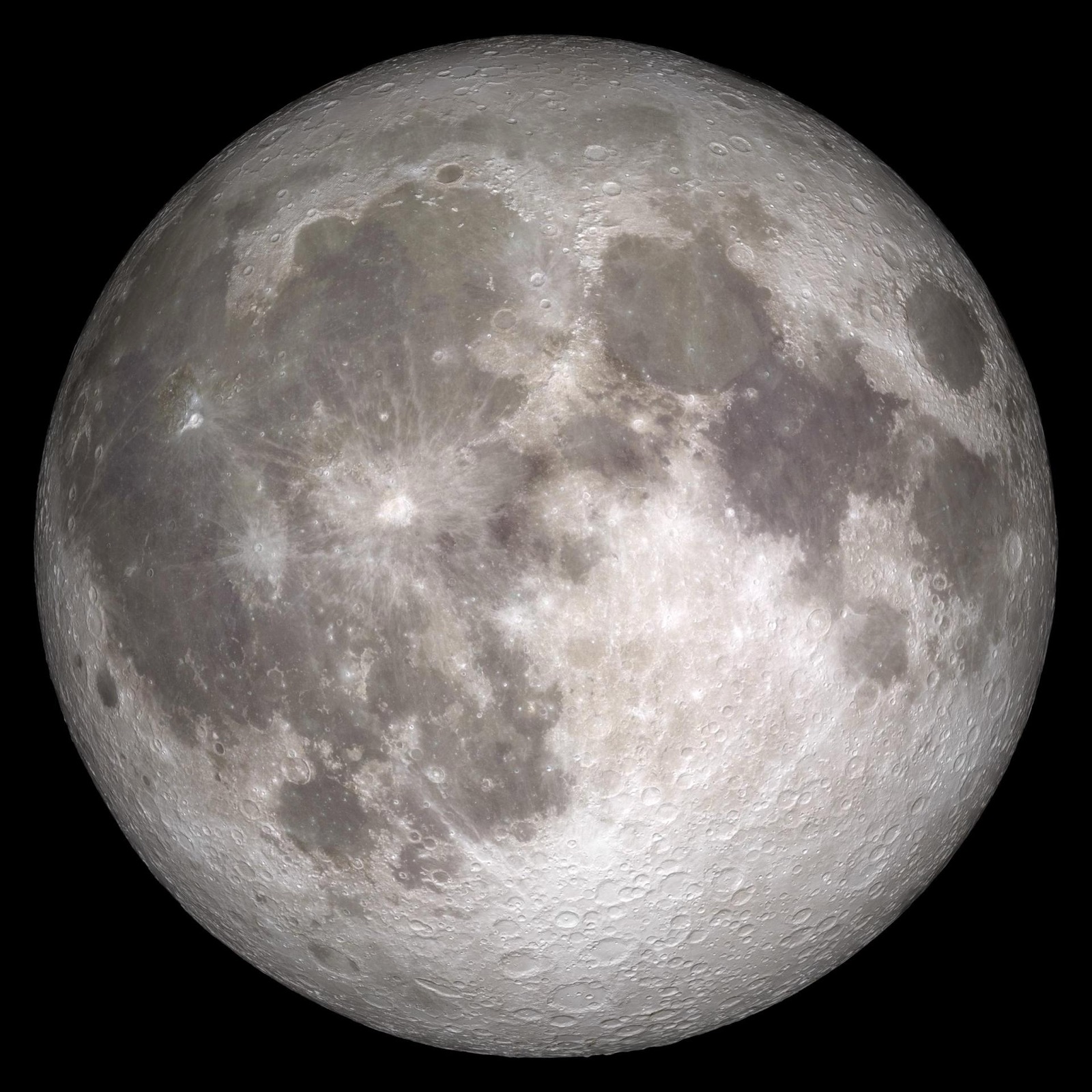
One of Brahe's most consequential achievements with this comet was demonstrating, through careful geometry, that it lay far beyond the Moon's orbit. He accomplished this through parallax comparison: he compared the comet's position as seen from Hven, near Copenhagen, with the position recorded simultaneously by Tadeáš Hájek in Prague. When both observers looked at the Moon at the same time, it appeared in noticeably different positions against the background stars — that is normal parallax shift for a nearby body. When they looked at the comet, however, it appeared in approximately the same place for both of them. Because the comet showed far less parallax shift than the Moon, it had to be much more distant. Brahe concluded the comet was beyond the Moon's orbit and probably around three times further away still. He was honest about the limits of his work: he could not supply meaningful or correct figures for exactly how far outside the atmosphere the comet sat. Nevertheless, the qualitative conclusion — that this was a heavenly object, not an atmospheric one — was well supported. His finding also extended to the comet's physical behavior: he noted that the coma faced away from the Sun, an observation with lasting significance for understanding comet structure.
03 What This Comet Did to the Theory of Celestial Spheres
For centuries, natural philosophers had believed that the planets were carried through the sky on solid, invisible crystalline spheres nested around the Earth. The Great Comet of 1577 posed an obvious problem: if such spheres existed, how could a comet move through them freely, tracing its own independent path? Johannes Kepler, who was Brahe's assistant during his time in Prague, believed that the comet's very behavior and existence was proof enough to displace the theory of celestial spheres entirely. This view, the article notes, turned out to be overly optimistic about the pace of change — the old theory did not collapse overnight. Brahe's data also fed Kepler's broader theorizing about the laws of planetary motion and the realization that planets move in elliptical rather than circular orbits. Meanwhile, Michael Mästlin found in the comet a different kind of theoretical utility. Because he considered comets to be heavenly objects, he argued that each comet carries its own orb. Those orbs, he proposed, fill the spatial gaps left in Copernicus's planetary system — gaps that the heliocentric model had introduced but not satisfactorily explained. The comet thus served as theoretical putty for competing models of the cosmos.
04 Galileo's Dissenting View and Its Rejection Deeper
While Brahe's finding that comets were heavenly objects gained wide acceptance and remained a topic of serious debate well into the seventeenth century, not everyone agreed. Galileo took a sharply contrarian position: he claimed that comets were optical phenomena rather than real physical objects traveling through space. The practical consequence of this claim was significant — if a comet were merely an optical effect, then measuring its parallax would be meaningless, since there was no actual body whose distance could be triangulated. This argument was a direct challenge to the entire methodology that Brahe had used so carefully. However, Galileo's hypothesis was not widely accepted by the astronomical community. The weight of observational evidence and the logical coherence of Brahe's parallax argument proved more persuasive. The debate illustrates how even the most celebrated scientific minds of an era can defend positions that the evidence eventually overturns — and how a single comet's passage could simultaneously advance knowledge, sharpen disagreement, and reveal the limits of theory.
05 A Global Web of Independent Observers
The Great Comet of 1577 was not a European event — it was a planetary one, watched by people across the world who had no way of communicating with each other in real time. The first recorded observation was made in Peru on 1 November, where accounts described the comet seen through clouds with a brightness like the Moon. On 6 November it appeared in the Nahuatl-language Codex Aubin as a "smoking star." On 7 November, the architect Pirro Ligorio in Ferrara, Italy, described it as shimmering from "a burning fire inside the dazzling cloud." Japanese astronomers recorded it on 8 November with Moon-like brightness and a white tail spanning over 60 degrees of sky — roughly the width of twelve full moons placed side by side. Ottoman astronomer Taqi al-Din Muhammad ibn Ma'ruf recorded its passage, while in India, Abu'l-Fazl ibn Mubarak wrote about it in his Akbarnama, noting a long tail and claiming the comet was visible for five months. Ārif Qandahārī described it as a bright star with many small fragments resembling a cypress tree and called it the "long tailed star." The comet was also recorded by Chinese historians in the History of Ming.
 ⤢
06 Omens, Politics, and a Sultan's Blame
Across cultures, the comet arrived freighted with meaning, and that meaning was often dangerous for those who studied it professionally. Sultan Murad III of the Ottoman Empire saw Taqi al-Din's observations not as a scientific achievement but as evidence of a bad omen for war. When plague spread through the region, the Sultan blamed the astronomer al-Din directly for the catastrophe the comet had supposedly heralded. In India, Abu'l-Fazl ibn Mubarak and Ārif Qandahārī connected the comet to the assassination of Shah Ismail of Persia, son of Shah Tahmasp, on 26 November 1577 — an event that occurred while the comet was still visible. Ārif Qandahārī, however, treated the comet as a "brilliant sight" and assigned no explicit evil to it, a notably measured response. In Vietnam, the comet made such an impression that King Lê Thế Tông changed his era name to Quang Hưng — meaning "bright and rising" — in the following year, 1578. In Ireland, the Annals of the Four Masters described it as a "wonderful star" with a curved, bow-like tail whose brilliance "illuminated the earth around, and the firmament above."
07 Queen Elizabeth and the Open Window
Among the most vivid human stories attached to the Great Comet of 1577 is the account preserved by Henry Howard, Earl of Northampton, in his 1583 polemic against prophetic superstition. When the comet appeared, courtiers urged Queen Elizabeth I — then at Richmond — not to look at it, citing the traditional belief that comets were evil omens specifically threatening to princes and monarchs. Elizabeth's response was theatrical and deliberate. She ordered the window opened, looked directly at the comet, and declared "Iacta est alia" — the dice are thrown. She stated that her trust in God's providence was too firmly planted to be frightened by celestial light that either had a natural explanation or lacked any scriptural warrant to threaten rulers. Howard read this as a pointed rejection of astrological fear, and the anecdote proved durable enough to be cited again nearly a century later in an anonymous pamphlet about the Great Comet of 1680. Elizabeth's act was framed not merely as personal courage but as a philosophical statement: that the wise, in the Latin proverb Howard quoted, subdue the stars — "Sapiens domabitur astris."
08 The Comet in Art, Print, and Personal Memory
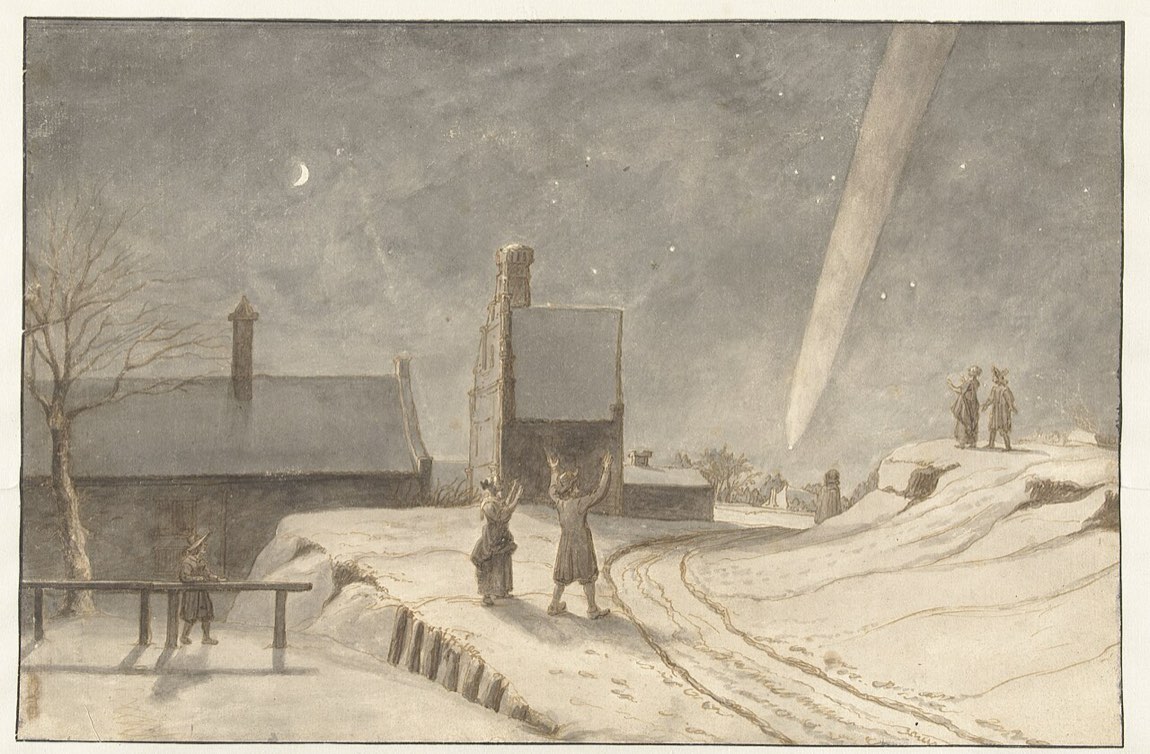
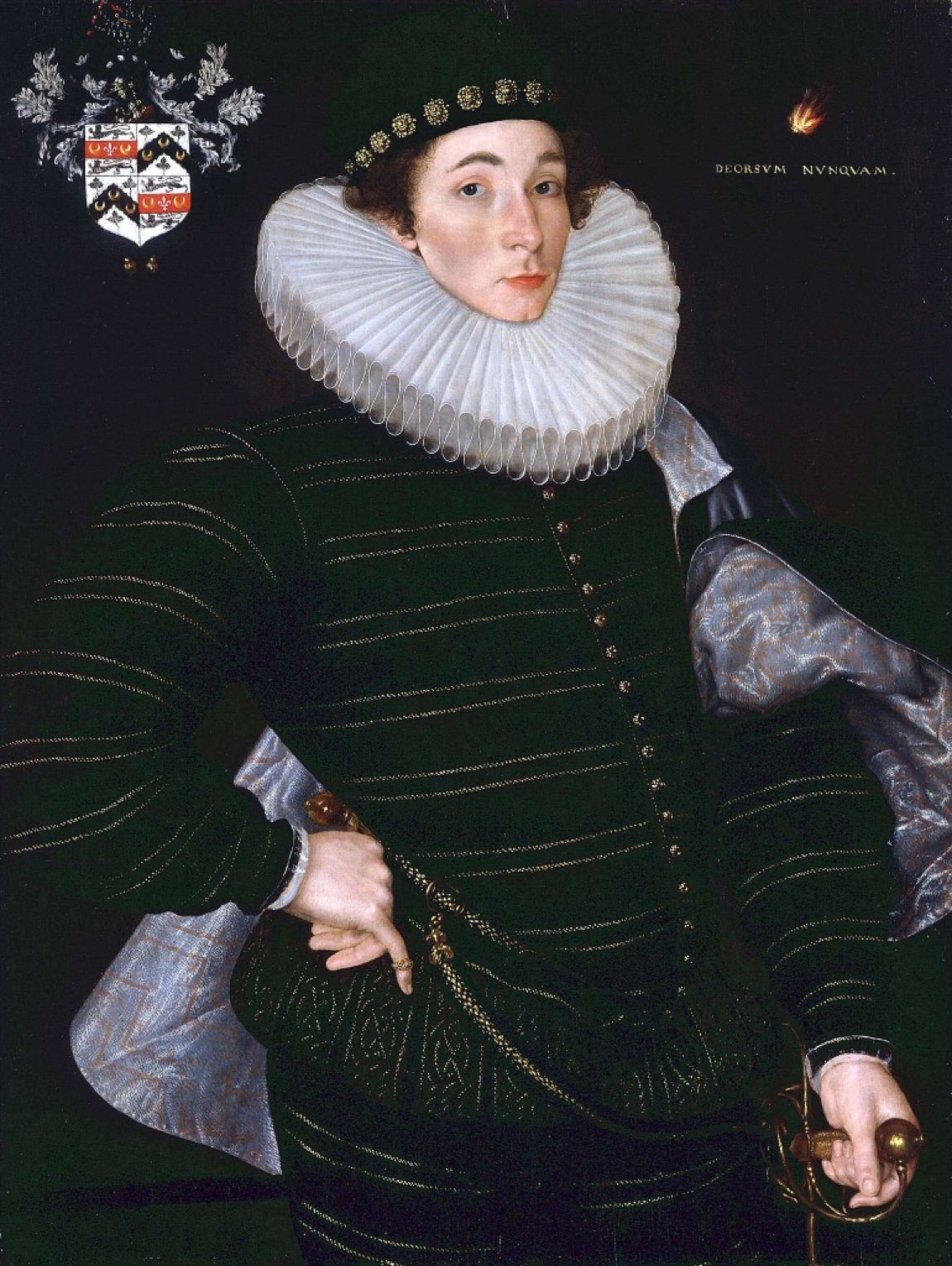
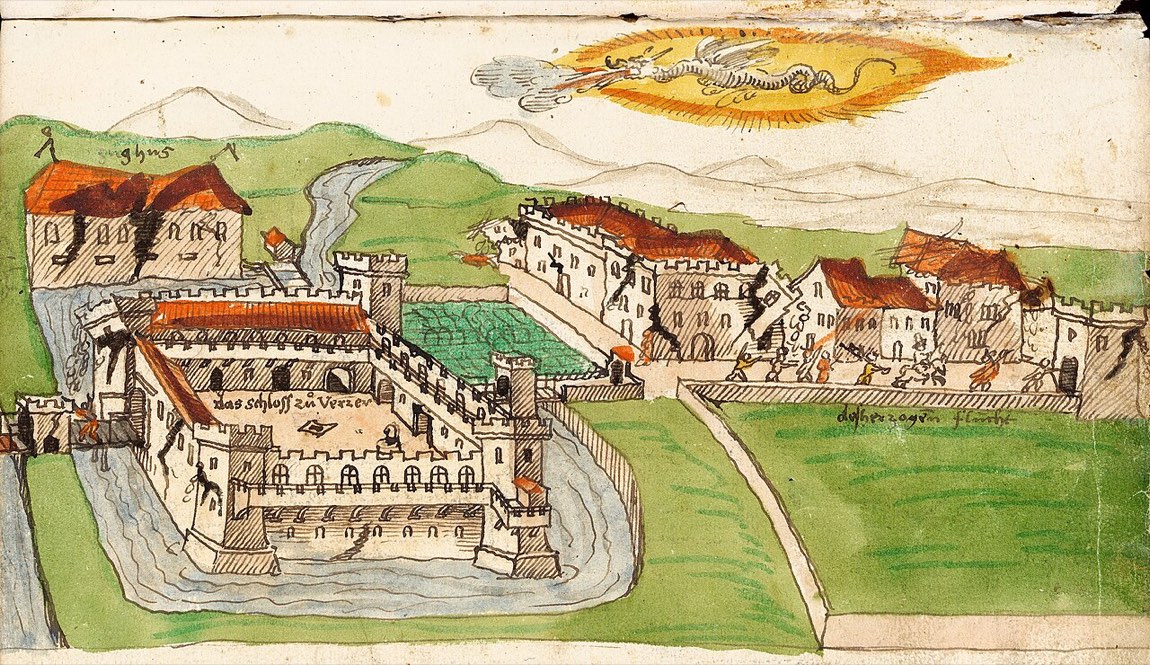
The passage of the comet generated a remarkable outpouring of cultural production. Artist Jiri Daschitzky made an engraving depicting the comet as it passed over Prague on 12 November 1577, leaving a visual record that outlasted any newspaper account. Cornelis Ketel painted the portrait of Richard Goodricke around 1578; Goodricke had reached adulthood in 1577 and apparently regarded the comet as an omen significant enough to have it incorporated into his official portrait. Helisaeus Roeslin produced one of the more elaborate visual representations of the Great Comet, described in the article as "an interesting, though crude, attempt." Numerous comet tracts were also produced by Brahe and other astronomers, documenting the comet's movement in detail. Early newspapers of the era, known as broadsides, spread news of the comet to general readers who had no access to scholarly texts. Even Rabbi Hayyim ben Joseph Vital recorded the comet in precise personal terms in his Book of Visions, noting it appeared on Rosh Hodesh Kislev and lingered for more than fifty nights — a rare first-person diary entry embedded in a text otherwise devoted to dreams and spiritual interpretation. And Johannes Kepler, who would later reshape astronomy, first saw the comet as a young boy, taken out to watch it by his mother.
09 Where the Comet Is Now
The Great Comet of 1577 is classified as a non-periodic comet, meaning it does not return on a predictable schedule the way periodic comets like Halley's do. Its last recorded observation was made on 26 January 1578, just under three months after its first observation in Peru. Using JPL Horizons, astronomers have calculated that the comet is currently approximately 324 AU from the Sun — equivalent to about 48.5 billion kilometers. To put that in perspective, Neptune, the outermost recognized planet, orbits at roughly 30 AU, so this comet is now more than ten times farther from the Sun than Neptune. It is still receding, drifting silently into the outer reaches of the solar system on a trajectory that will not bring it back to the inner solar system on any timescale meaningful to human civilization. Its perihelion — the closest point to the Sun during its 1577 passage — occurred on 27 October 1577, four days before anyone recorded seeing it, and the comet was then tracked until it faded from view in late January of the following year.
10 The Lasting Puzzle of Comet Distances Deeper
Even with Brahe's meticulous parallax work, the precise distance of the comet from Earth in 1577 remained uncertain. Brahe was clear-eyed about this limitation: while he could demonstrate convincingly that the comet was beyond the Moon and probably around three times further away than the Moon, he acknowledged he could not supply meaningful or correct figures for the comet's exact distance from Earth's surface or the edge of the atmosphere. The parallax method he employed — comparing positions seen from Hven and Prague simultaneously — was the right approach, but the comet's vast distance meant the parallax shift was tiny, pushing against the precision limits of his instruments. This measurement problem was distinct from the broader theoretical debate: Galileo's claim that comets were optical illusions was not a refinement of Brahe's measurement technique but a rejection of the entire exercise. The community ultimately sided with Brahe's framework, and his insistence on treating the comet as a real, measurable physical object traveling through space set the methodological standard for all subsequent comet observation. The uncertainty about exact distances in 1577 would only be fully resolved centuries later, as instruments and mathematical techniques improved far beyond what any seventeenth-century astronomer could command.
 ⤢