Comet · Deep guide
Comet Elenin (C/2010 X1)
Also called: C/2010 X1 · Comet Elenin
An Oort cloud comet that broke apart in 2011, despite online rumours it was a threat to Earth.
What is it?
Comet Elenin was discovered by Russian amateur astronomer Leonid Elenin on 10 December 2010, using a remote robotic telescope in New Mexico. At discovery it was extremely faint, around magnitude 19.5. It became the subject of baseless rumours about a collision with Earth, but it never posed any danger. In August 2011 it began to disintegrate, and by mid-October it could not be seen even in large telescopes.
The deep dive
Researched for the Atlas from Wikipedia — C/2010 X1 (Elenin) (5,232 characters read) · updated Nov 14, 2026
01 How Elenin Was Found in the Dark
Leonid Elenin discovered the comet bearing his name on 10 December 2010, but he never peered through an eyepiece to do it. Working from Russia, he operated a robotic telescope remotely — a machine belonging to the International Scientific Optical Network situated near Mayhill, New Mexico. The detection was carried out by an automated software package called CoLiTec, designed specifically to flag moving or fading objects in streams of telescope images. At the moment of discovery, the comet glowed at apparent magnitude 19.5, roughly 150,000 times too faint for the unaided eye to register. To put that in perspective, the full Moon is about a trillion times brighter. The find is a vivid example of how modern amateur astronomers, armed with remote-access agreements to professional-grade hardware and smart detection algorithms, can compete with large institutions in the race to catalog the solar system's most elusive visitors.
02 A Coma That Grew Larger Than the Sun
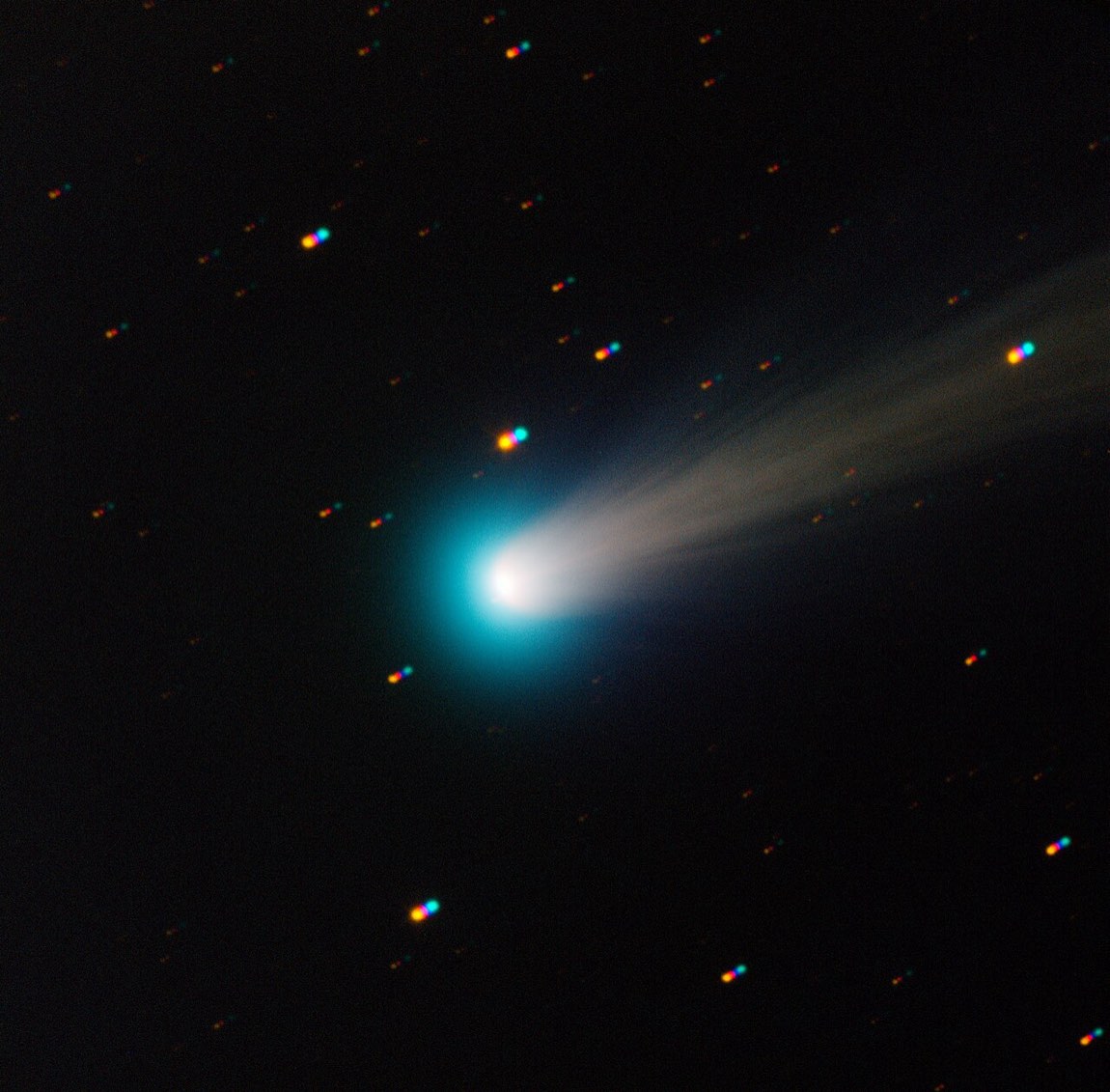
Even though the comet's solid nucleus was only about 2 km across before it broke apart, the gossamer cloud of dust and gas surrounding it — the coma — swelled to extraordinary proportions as Elenin fell toward the Sun. By April 2011, the coma measured roughly 80,000 km in diameter, already wider than six Earths side by side. By 21 May 2011 it had exceeded 100,000 km, and by August 2011 it had ballooned past 200,000 km — larger than the Sun itself, whose diameter is about 1.39 million km. Cometary comas routinely achieve this because even a trickle of outgassing from a small nucleus can inflate a nearly weightless haze across an enormous volume in the vacuum of space. The coma's size is not a measure of the comet's danger or substance; it is simply a testament to how thin and expansive sublimating ice can become when there is nothing to hold it in.
03 Brightness Forecasts and Why They Failed
Before disintegration, the Minor Planet Center's ephemeris projected that Elenin would reach about 6th magnitude in September and October 2011 — just at the threshold of naked-eye visibility under dark skies. Some observers and commentators anticipated a modest but genuine naked-eye comet. Those predictions assumed the nucleus would remain intact and that coma activity would continue strengthening. Neither assumption held. Brightness estimates between 22 May and 4 June 2011 ranged from magnitude 13.1 to 13.8, closing on 10 by late July and reaching roughly 8.3 by mid-August — still about five times fainter than the naked eye can detect under a completely dark sky. After disintegration began, the comet faded below magnitude 10.5 by mid-September, and was down to around magnitude 12 as seen by the STEREO-A spacecraft. By October 2011 it was projected at magnitude 14 and still fading. The article notes honestly that comet brightness depends critically on coma activity level, making such forecasts inherently uncertain for any comet.
04 A Coronal Mass Ejection Delivers the Fatal Blow
On 19 August 2011, comet Elenin was struck by a coronal mass ejection — a billion-tonne plasma eruption blasted outward from the Sun. The impact is identified in the article as the trigger for the comet's disintegration, drawing a parallel to comet C/1999 S4, which broke apart in a similar fashion. Coronal mass ejections carry magnetic fields and charged particles energetic enough to strip and disturb a comet's coma, and a structurally fragile nucleus held together more by ice than by rock can be pushed past its mechanical limits. Within weeks of the event, Elenin had faded dramatically. By mid-October 2011 there had been no confirmed ground-based sighting even using the 2.0-metre Faulkes Telescope North, which has a limiting magnitude of around 20.5 — an instrument capable of imaging objects 100 million times fainter than the naked-eye limit. The dust cloud remnants only became visible again to ground-based telescopes around 21 October 2011.
05 STEREO Spacecraft Catch a Forward-Scatter Experiment Deeper
Because the orbit of Elenin is nearly coincident with the ecliptic plane — it has an inclination of only 1.84° — the geometry between the STEREO spacecraft, the comet, and the Sun aligned in an unusually favorable way. Between 1 August and 12 August 2011, NASA repeatedly rolled the STEREO-B spacecraft to observe forward scattering of sunlight off the comet's dust. By 14 August 2011, Elenin was visible in STEREO-B without any need to roll the craft at all. Forward scattering occurs when observers are positioned nearly between a comet and the Sun, causing dust grains to scatter light very efficiently back toward the observer — the same principle that makes car headlights dazzle in foggy conditions. Had Elenin survived perihelion intact, scientists planned to study the dust scattering function simultaneously from two different vantage points: Earth and a STEREO spacecraft. That rare two-point measurement was lost when the comet broke apart, and SOHO subsequently failed to detect the expected forward-scattering signal in late September.
06 The Debris Field and Its Ghostly Twin
After disintegration, the post-breakup appearance of C/2010 X1 was visually compared by observers to the debris field of Comet Shoemaker-Levy 9 as it looked on 23 June 1993 — a loosely connected train of fragments and dust rather than a coherent, condensed object. The dust cloud remnants began to show up again in ground-based telescopes around 21 October 2011. Meanwhile the remnant of the comet made its closest approach to Earth on 16 October 2011, passing at 0.2338 AU (34.98 million km; 21.73 million mi) — a distance slightly closer than Venus ever comes to Earth — at a relative velocity of 86,000 km/h. That same week, Elenin made its closest apparent pass in the night sky near comet 45P/Honda–Mrkos–Pajdušáková on the morning of 8 October, and appeared to move close to Mars on 15 October, providing an incidental visual tableau of several solar system objects crowded in the same region of sky.
07 An Orbit Measured in Tens of Millions of Years Deeper
Elenin did not originate from the inner solar system. Before it entered the region of the planets — computed at an epoch of 1800 — it had a barycentric orbital period measured in tens of millions of years, with an aphelion distance of roughly 97,000 AU, equal to about 1.53 light-years. That places its origin in the outer Oort cloud, the spherical halo of icy bodies extending to the very fringes of the Sun's gravitational influence. At those distances, the comet's orbit was loosely bound and chaotically sensitive to perturbations by passing stars. Near perihelion, using an August 2011 epoch, astronomer Kazuo Kinoshita calculated a heliocentric orbital period of around 600,000 years — but that figure is itself uncertain because planetary gravity continues to reshape the orbit. The article explains that for objects of such high eccentricity, barycentric coordinates (measured from the solar system's true center of mass) are more stable than heliocentric ones. Using JPL Horizons data from an observed arc of 271 days, the barycentric orbital elements for the epoch 2200 actually generate a hyperbolic orbit with an eccentricity of 1.0004, meaning Elenin will never return.
08 Why Orbital Period Is Not a Fixed Number Deeper
One subtlety the article highlights is that the concept of a fixed orbital period breaks down for long-period comets like Elenin. Because the comet swings through the inner solar system and passes relatively close to the giant planets, gravitational tugs from Jupiter and the others continually alter its trajectory. The osculating orbit — the best-fit ellipse calculated at any single moment — changes every time the comet receives a planetary kick. This is why astronomers prefer to compute the orbit at an epoch after the comet has fully left the planetary region, where further perturbations are minimal, and to anchor that calculation to the barycenter of the solar system rather than to the Sun alone. The Sun itself orbits the barycenter, which can lie outside the solar surface depending on where Jupiter and Saturn are, so using a moving reference point introduces additional drift into long-baseline predictions. These technical distinctions matter enormously for a comet that may not return for hundreds of thousands — or now, given its hyperbolic exit — perhaps never.
09 Closest Solar Pass and Earth Encounter Numbers
Elenin reached perihelion — its closest point to the Sun — on 10 September 2011, passing at 0.4824 AU (72.17 million km; 44.84 million mi). That is roughly halfway between the orbits of Mercury and Venus, close enough to subject the comet to intense solar radiation and wind, but not so close as to guarantee destruction on its own. The closest approach to Earth followed five and a half weeks later, on 16 October 2011, at 0.2338 AU (34.98 million km) and a relative velocity of 86,000 km/h — fast enough to cross the entire continental United States in about three minutes. The comet had already disintegrated by then, so rather than a bright visitor, Earth received only a dispersing cloud of dust. The article also records that the minimum angular separation between the Sun and the comet in the sky occurred on 26 September at just 1.9°, and that between 28 July and 10 October the comet remained within 45 degrees of the Sun, making ground-based observation very difficult during the most critical phase of its disintegration.
10 Magnitude 15 to Invisible: A Six-Month Arc
Tracing the comet's brightness across its final months reveals a dramatic rise and collapse. In April 2011, Elenin sat around magnitude 15 — roughly the same brightness as Pluto — with its coma already 80,000 km wide. Over the following months it brightened steadily, reaching the 13s in late May and approaching magnitude 10 by late July. The mid-August peak of around magnitude 8.3 still fell five times below the naked-eye threshold. Then the collapse: below 10.5 by mid-September after the CME impact, around magnitude 12 from STEREO-A's perspective, and projected at magnitude 14 and dropping through October. By mid-October 2011, the 2.0-metre Faulkes Telescope North — powerful enough to see objects down to magnitude 20.5 — could record no confirmed sighting of the comet at all. The comet came to opposition on 14 March 2011 at 178° from the Sun and again on 22 November 2011 at 175° from the Sun, those two dates bookending its entire observed apparition from first brightening to final fade.