 Photograph · William Turner · Public domain
Comet · Deep guide
Donati's Comet (Great Comet of 1858)
Also called: C/1858 L1 · Great Comet of 1858 · Comet Donati
A gracefully curved beauty of 1858 and the first comet ever photographed.
What is it?
Donati's Comet was discovered by Italian astronomer Giovanni Battista Donati on 2 June 1858. By autumn it had grown into the most brilliant comet of the 19th century after the Great Comet of 1811, and it was also the first comet ever captured in a photograph. It is a long-period comet that should not return for well over a thousand years.
The deep dive
Researched for the Atlas from Wikipedia — Comet Donati (6,263 characters read) · updated Nov 14, 2026
01 A Faint Smudge That Became a Spectacle
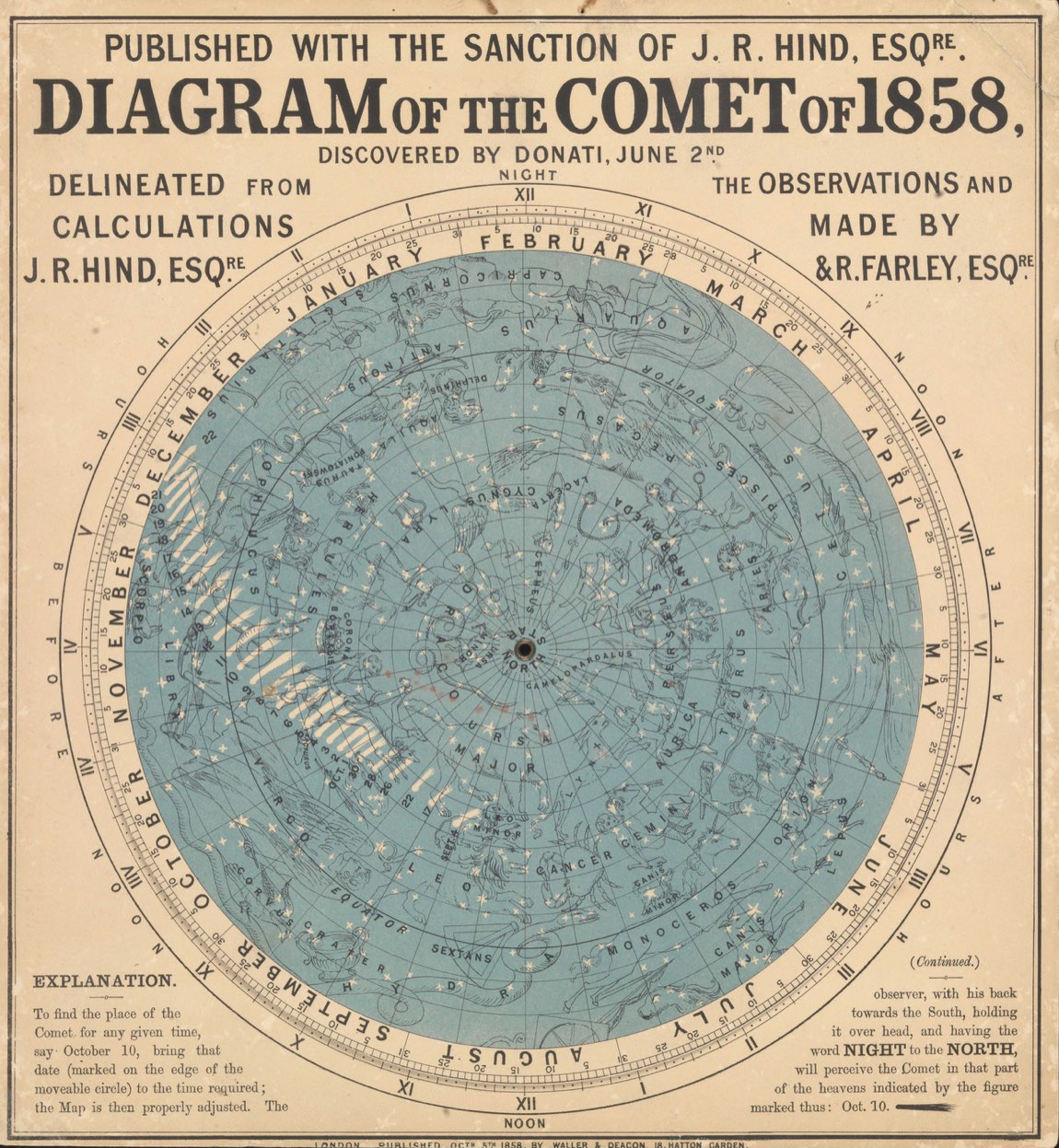
When Giovanni Battista Donati first caught sight of the comet on June 2, 1858, from the Florence Observatory, it looked like nothing more than a small nebula-like object of magnitude 7 — far too dim to see without a telescope, sitting near the "head" of the constellation Leo. For weeks it barely changed. It was not until mid-August that it finally brightened enough to cross the threshold of naked-eye visibility. Then the transformation accelerated dramatically. By October, what had been a faint smudge had become one of the most brilliant comets of the entire nineteenth century, trailing a long, scimitar-like dust tail alongside a prominent separate gas tail across the sky. Northern Hemisphere viewers had a particularly fine vantage point for much of the apparition, and the comet was noted as occupying a uniquely striking position in the sky compared with other great comets of the era. Southern Hemisphere observers continued to follow it with the naked eye into November, and the very last detection came on March 4, 1859, when William Mann, chief assistant at the Royal Observatory at the Cape of Good Hope, glimpsed it as a faint nebulosity — nearly nine months after its discovery.
02 The First Comet Ever Photographed
Donati's Comet earned a permanent place in the history of science by becoming the first comet ever captured in a photograph. The achievement came on September 27, 1858, and the photographer was not a professional astronomer but W. Usherwood, a portrait photographer based in Walton-on-the-Hill, Surrey. He used a 7-second exposure through an f/2.4 portrait lens — the kind of fast, wide-aperture glass normally used for studio sittings — and managed to record the bright region around the comet's nucleus together with part of its tail. That original photograph is preserved today in archival storage at Harvard College Observatory's Astronomical Photographic Glass Plate Collection at the Center for Astrophysics. The very next night, September 28, astronomer George Phillips Bond photographed the comet through a telescope at Harvard College Observatory, making that the first telescopic comet photograph. Bond experimented with increasing exposure times and ultimately needed six full minutes to record a usable image, later writing that "only the nucleus and a little nebulosity 15 arcseconds in diameter acted on the plate" in that exposure. These two photographs, taken on consecutive nights by people with entirely different backgrounds, mark the moment astrophotography began.
03 George Bond's Monumental Study Deeper
The person who did the most to turn observations of Donati's Comet into lasting science was George Phillips Bond, working alongside his father William Cranch Bond. G. P. Bond gathered his own detailed observations and systematically incorporated the records of many other astronomers into a comprehensive monograph titled An Account of the Great Comet of 1858. The work is considered his most important scientific contribution. In recognition of it, Bond was awarded the Gold Medal of the Royal Astronomical Society — a distinction that made him the first American ever to receive that honor. The Bond family's work at Harvard College Observatory, combined with the comet's exceptional visibility, made the 1858 apparition one of the most thoroughly documented cometary events of the nineteenth century. The monograph stands as an early model of collaborative, synthesizing science: rather than reporting only his own telescope time, Bond treated the comet as a shared object of study and gathered the wider community's data into a single authoritative account. That approach, unremarkable today, was forward-looking for its era.
04 Calculating an Orbit Over 1,700 Years Long Deeper
Pinning down the orbit of Donati's Comet required serious mathematical labor. Friedrich Emil von Asten and George William Hill both computed orbits from the observations, with Hill's solution drawing on nearly 1,000 measured positions — an unusually large dataset for the time. The resulting orbital inclination is 116.9°, meaning the comet travels in a retrograde direction relative to the planets, looping around the Sun in the opposite sense to Earth. The barycentric orbital period, calculated with an epoch of 2200, is approximately 1,739 years. That extraordinary span explains why the comet will not pass near Earth again until somewhere around the year 3600. As of 2023, JPL Horizons places the comet at 147 AU from the Sun — roughly five times the distance of Neptune — and it is still moving outward at 2.4 km/s, or about 5,400 mph. At that rate and distance, it is heading toward the cold, dark outer reaches of the solar system where it will spend most of its very long year before gravity slowly curves it back toward the inner planets many centuries from now.
05 Dangerously Close to Venus's Path Deeper
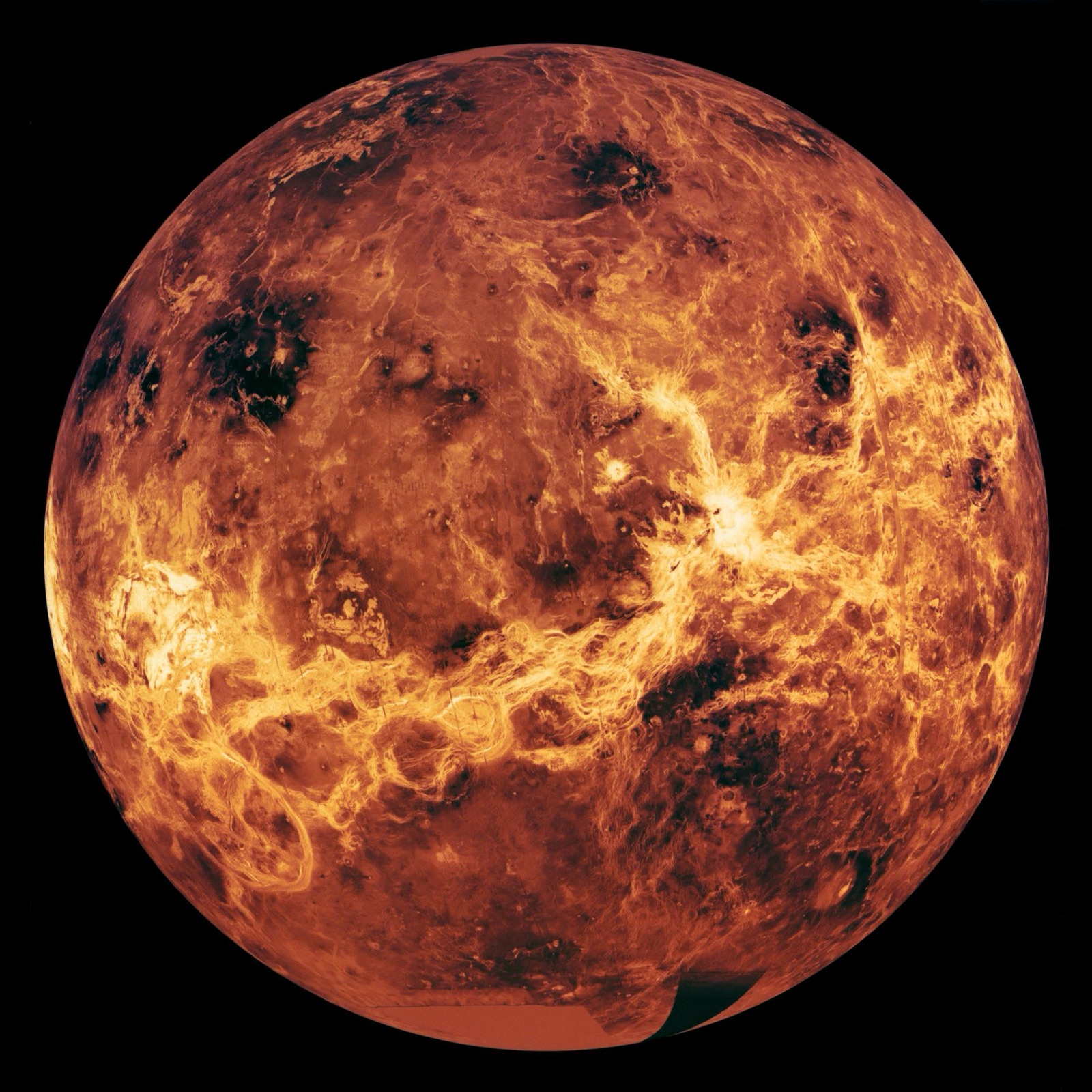
One of the more striking details buried in the orbital data is how closely Donati's Comet's path approaches Venus. The minimum orbital intersection distance between the two is just 0.0047 astronomical units — roughly 700,000 kilometers, or about 440,000 miles. To put that in perspective, Venus itself is only about 12,000 kilometers across, so the comet's orbital path comes within a distance equal to roughly 58 Venus diameters of the planet's own orbit. The article notes this is the smallest known distance at which a great comet can approach a terrestrial planet. The orbital geometry also raises the possibility that the comet produces a detectable meteor shower in Earth's northern hemisphere, as debris shed along its path could intersect Earth's orbit. Whether that shower is actually strong enough to observe has not been definitively confirmed, but the geometric setup makes it plausible and is an open area of interest.
06 Public Frenzy, Then Fascination
The cultural atmosphere into which Donati's Comet arrived was already charged with anxiety about comets. In Paris and elsewhere, a period of near-hysteria had taken hold, partly fueled by incorrect calculations from astronomer John Russell Hind that suggested a comet would strike Earth in June 1857. That collision never came, of course, but public nerves were still sensitive when Donati's object brightened into view the following year. This time, though, the mood shifted. Clear autumn skies across much of Europe gave Northern Hemisphere observers an unobstructed view of one of the most beautiful comets anyone alive had ever seen. English astronomer William Henry Smyth called it "one of the most beautiful objects that I have ever seen." Giovanni Battista Donati himself, previously a relatively obscure figure, became something of an astronomical hero overnight. The comet became the most-observed of the nineteenth century, and its impact on public enthusiasm for astronomy was lasting. Traces of its distinctive curved tail shape appeared in magazine illustrations, commercial art, household objects, and children's books well into the early years of the twentieth century.
 ⤢
07 The Night Lincoln Watched the Sky
Among the many people who stopped to look up at Donati's Comet in the autumn of 1858 was Abraham Lincoln, then a candidate for a seat in the United States Senate in the middle of his famous series of debates with Stephen Douglas. On the night of September 14, 1858 — the eve of their third debate — Lincoln sat on the porch of his hotel in Jonesboro, Illinois, to watch what he called "Donti's Comet" pass overhead. It is a small but vivid detail: one of the most consequential political campaigns in American history unfolding beneath the same sky that was mesmerizing astronomers and artists across the Atlantic. The debates themselves would not win Lincoln the Senate seat, but they elevated his national profile and helped put him on the path to the presidency two years later. The comet, indifferent to all of this, continued its slow brightening toward perihelion, which it reached in late September.
08 Alfred Russel Wallace Sees It from Tidore
While Europeans marveled at the comet from city rooftops and country fields, the naturalist Alfred Russel Wallace watched it from a far more remote vantage point: the island of Tidore in the Malay Archipelago, in what is now Indonesia. Wallace, who was then in the midst of the fieldwork that would lead to his independent formulation of natural selection, initially mistook the comet's nucleus for a fire burning on a hilltop. Looking more carefully, he recognized the object and later wrote one of the most detailed eyewitness accounts left by any non-astronomer. He described the nucleus as a "distinct disc of brilliant white light" visible to the naked eye, with the tail rising at an angle of about 30° to 35° above the horizon and curving slightly downward. The portion of the tail nearest the nucleus he judged to be three or four times as bright as the brightest part of the Milky Way. He also noted a sharply defined upper edge contrasting with a lower margin that gradually faded — a classic optical signature of a cometary dust tail shaped by solar radiation pressure.
09 The Comet in Paint, Poem, and Canvas
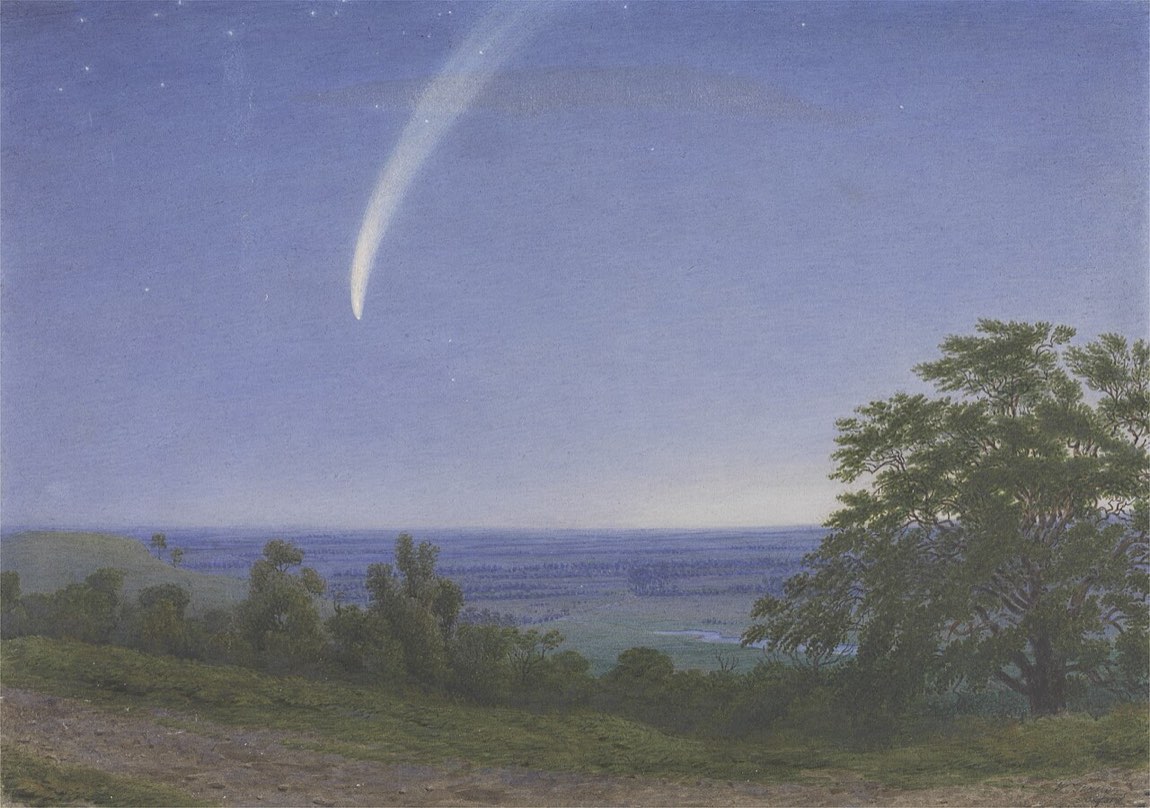
Donati's Comet left a richer trail in art than almost any other astronomical event of the nineteenth century. Painter William Dyce captured it as a streak and star in the early evening sky of his work Pegwell Bay, Kent — a Recollection of October 5th 1858, a painting that embeds the comet within a scene of ordinary people on a beach, making the cosmic intrusion quietly dramatic. William Turner of Oxford recorded the comet in multiple sketches and at least one painting. Samuel Palmer depicted it in a work titled The Comet of 1858, as seen from the Heights of Dartmoor. And decades after the apparition ended, the comet inspired Thomas Hardy's 1902 poem The Comet at Yell'ham, drawn from his own childhood memories of seeing it. That a celestial object first glimpsed as a magnitude 7 smudge in June could — by October — be vividly remembered forty years later and turned into poetry speaks to just how commanding its presence must have been in the night sky during those weeks of peak visibility.
10 Why It Ranked Among the Century's Best
Donati's Comet earned its reputation not from a single dramatic feature but from a combination of favorable circumstances arriving together. It was bright enough — rivaled in the nineteenth century only by the Great Comet of 1811 — to be unmistakably spectacular to anyone who looked up. It was best placed for Northern Hemisphere observers, where the largest concentrations of astronomers, artists, and literate urban populations lived. The autumn months of September and October 1858 brought fine weather across much of Europe, keeping skies clear at the comet's peak. And the comet's physical appearance was genuinely extraordinary: the long, curving dust tail and the separate, straighter gas tail together gave it an unusually complex and beautiful silhouette. It was nearest the Earth on October 10, 1858, allowing observers across both hemispheres to study it at its most impressive. All of these factors aligned in a way that made the 1858 apparition a generational event — something people who saw it did not forget and did not stop talking about for decades.
11 Open Questions That Remain Unanswered Deeper
Even now, Donati's Comet leaves some questions unresolved. The orbital period of approximately 1,739 years is described as an approximation with an epoch of 2200, and the predicted return around the year 3600 carries the uncertainty that any multi-millennium dynamical forecast must carry — small gravitational perturbations from the giant planets accumulate over centuries and can shift the actual return date by years or more. The question of whether the comet generates a detectable meteor shower in Earth's northern hemisphere is stated as a possibility rather than a confirmed fact: the orbital proximity to Venus's path creates the geometric conditions, but the article does not indicate the shower has been conclusively identified. And while the comet was extensively observed and photographed in 1858, the physical nature of its nucleus — its size, composition, rotation rate — remains uncharacterized, since those questions could not be answered by nineteenth-century technology and no spacecraft has studied it. It is simply too far away now, at 147 AU and receding, to examine.
 ⤢