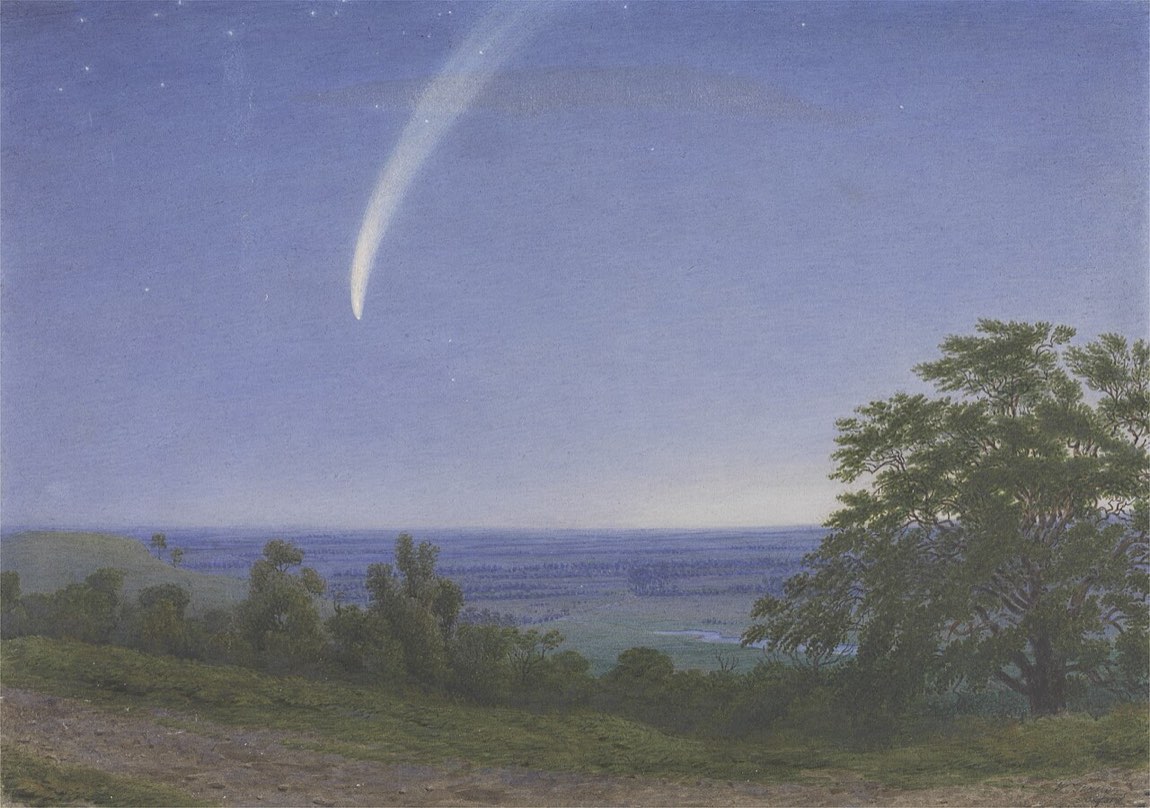
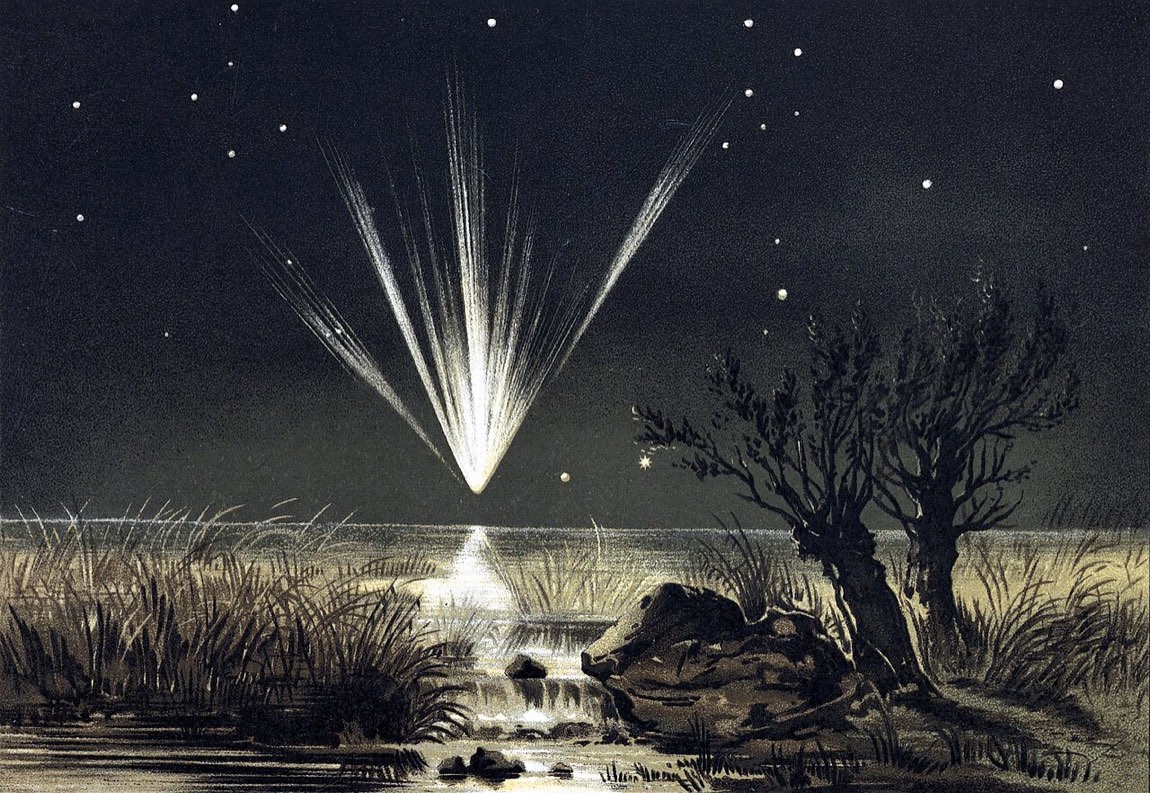
 Photograph · Edmund Weiss · Public domain
Comet · Deep guide
Great Comet of 1861 (Comet Tebbutt)
Also called: C/1861 J1 · Comet Tebbutt · 1861 II
For two days in 1861 Earth passed through its tail.
What is it?
John Tebbutt discovered this comet from Windsor, Australia, on 13 May 1861. It reached perihelion on 12 June and then swept to within about 0.13 AU of Earth on 30 June. For about two days Earth was actually inside the comet's tail, and observers saw streamers converging towards the distant head, with the tail spanning over 90 degrees. It was one of the brightest comets of the 19th century and should return in the 2260s.
The deep dive
Researched for the Atlas from Wikipedia — C/1861 J1 (Tebbutt) (9,542 characters read) · updated Nov 14, 2026
01 John Tebbutt's Accidental Masterpiece
John Tebbutt was a comet hunter working from Windsor, New South Wales, Australia — far from the great observatories of Europe — when, on the evening of May 13, 1861, he swept his marine telescope across the western sky and caught a faint, diffuse glow near the star Lacaille 1316 in the constellation Eridanus. The object was so feeble that when he tried to measure its position using the bright stars Procyon, Sirius, and Canopus as references, their superior brilliance completely overwhelmed it. He had to slide a coloured glass filter into his sextant just to keep the mystery object visible. Without a comprehensive nebula catalogue on hand, he could not rule out that it was simply a known fuzzy object, so he chose to watch and wait. That patience paid off enormously. By his own account, the decision not to dismiss it gave him "one of the best opportunities for introducing myself to the astronomical world" — an understatement for a discovery that would become one of the eight brightest comets of the entire nineteenth century.
02 A Month's Head Start from the Southern Sky
Because Tebbutt found the comet on May 13, 1861, a full month before it reached perihelion on June 12, the southern hemisphere had an exclusive viewing window that the northern hemisphere entirely missed. The comet did not become visible in the northern hemisphere until June 29 — but crucially, by then, word of the discovery had not yet travelled fast enough to warn northern observers. People across North America, Europe, and Asia stepped outside on late-June evenings and were stunned by an enormous comet they had never heard was coming. Diarists from Louisiana to Montana to Bangkok all recorded versions of the same astonishment: no one had warned them. This communications gap, entirely ordinary in the pre-telegraph era of international science, meant the comet arrived as a complete surprise to most of the world's population. At its discovery, the comet already shone at apparent magnitude +4 — bright enough to see with the unaided eye — and it would grow dramatically more spectacular in the weeks that followed.
03 When Earth Flew Through a Comet's Tail
The closest approach on June 30, 1861, placed the comet a mere 0.1326 AU from Earth — just 19.84 million kilometres, or about 12.33 million miles away. That distance is extraordinary enough, but what makes the encounter almost unprecedented in recorded history is that for two full days around that close approach, Earth was actually inside the comet's tail. Observers who looked carefully could see streams of cometary material converging in perspective toward the distant nucleus, like looking down a long tunnel whose far end pointed at the comet's head. The comet's tail stretched more than 90 angular degrees across the sky — literally spanning half the visible vault of heaven. At its peak, the comet shone somewhere between magnitude 0 and −2, rivalling the brightest stars in the sky. Martin Bienvenu, aboard a ship in Bangkok, actually measured the tail with a quadrant and recorded 93 degrees 50 minutes of arc — a precise, independent confirmation of observers across two hemispheres who all described the tail as reaching halfway or more across the heavens.
04 Shadows Cast by Comet Light Deeper
Among the most dramatic physical effects recorded during the June 30 close approach was an optical phenomenon that pushed the comet into genuinely rare territory: it was bright enough to cast shadows at night. The astronomer J. F. Julius Schmidt, one of the most experienced comet observers of the nineteenth century, watched from the Athens Observatory as the great comet projected shadows onto the observatory's walls. This effect, noted formally by Schmidt in 1863, results from a process called forward scattering, where fine dust particles in the comet's coma and tail preferentially scatter sunlight toward an observer positioned between the comet and the Sun. Earth's geometry on June 29 placed the comet just 11.5 degrees — equivalent to 23 Sun-widths — from the Sun as seen from Earth, putting observers in precisely the right geometry to experience intense forward scattering. Only a handful of comets in recorded history have been luminous enough and favourably positioned enough to cast perceptible shadows, making Schmidt's direct observation at Athens one of the most cited single-night comet observations of the century.
05 Calculating the Orbital Period: Three Attempts Deeper
Pinning down the orbital period of a long-period comet from a single observed apparition is a notoriously difficult problem, and the history of calculations for C/1861 J1 illustrates why. The first serious attempt came from Heinrich Kreutz, who computed an elliptical orbit with a period of about 409 years as part of his doctoral dissertation in 1880. That figure pointed to a previous appearance sometime in the middle of the fifteenth century. In 1995, Ichiro Hasegawa and Shuichi Nakano proposed — based on five historical observations — that the comet was identical to C/1500 H1, first recorded on 7 May 1500. Then in 2014, Richard L. Branham refined the period further to 364.96 ± 0.51 years by incorporating planetary perturbations into the calculations, a correction that meaningfully tightened the link between the 1500 and 1861 apparitions. When the barycentric orbital period is computed for the comet outside the planetary region using an epoch of 1900, the result is about 406 years, pointing to a return around the year 2267 — a figure that forward-propagation of the orbit independently confirms.
06 Did Comet Tebbutt Spawn a Meteor Shower? Deeper
Because C/1861 J1 and C/1861 G1, known as Comet Thatcher, share many similar orbital characteristics, astronomers once hypothesised that the two were related — specifically that in some earlier perihelion passage, Thatcher had broken off from what would become Tebbutt. The Thatcher comet is itself notable as the parent body of the Lyrid meteor shower, so if the two comets truly shared an origin, C/1861 J1 might have played a role in that shower's history. However, in 2015, Richard L. Branham Jr. used modern computing technology and statistical analysis to calculate a corrected orbit for C/1861 J1 and disproved the proposed relationship. The two comets of 1861, despite superficially similar orbital characteristics, do not share a common origin. This episode illustrates a recurring challenge in comet science: orbital similarities that look compelling to the eye can dissolve when precise mathematics is applied, and what seems like a tidy story of cometary fragmentation turns out to be coincidence.
07 Deep Space Exile: Tebbutt at 100 AU and Beyond
By 1992, just 131 years after its spectacular appearance, Comet Tebbutt had already travelled more than 100 AU from the Sun — that is, more than 15 billion kilometres, farther out than the dwarf planet Eris, which itself sits at the remote outer edge of the known solar system. For a sense of scale, 100 AU is roughly 2.5 times the distance from the Sun to Neptune. The comet continues to recede and will not reach aphelion — the most distant point in its orbit — until around 2063, more than two centuries after its famous close brush with Earth. After aphelion, it will begin the long fall back toward the inner solar system, eventually returning to perihelion around the year 2267. No living person, nor their grandchildren, nor several subsequent generations will witness that return. The comet currently drifts in complete darkness, undetectable by any telescope, a frozen nucleus carrying the memory of its fiery 1861 passage.
08 A Global Audience of Stunned Witnesses
Few comets have left as rich a documentary record as C/1861 J1, precisely because its peak brightness coincided with the American Civil War and the widespread habit of journal-keeping it encouraged. Raphael Semmes, commanding the Confederate raider CSS Sumter, watched the comet mirror itself in the calm waters of the Gulf of Mexico on the night his vessel escaped New Orleans. Kate Stone, a diarist in northeast Louisiana, saw what she took to be a large star like Venus with a dimly visible train of light and noted that two meteors fell nearby — prompting the boys around her to claim it was "a big star chased by little ones trying to regain its orbit." From Fort Jefferson, Florida, Emily Holder wrote that "many wondered if the world was not coming to an end." In British Columbia, a surveyor named Charles Wilson compared it favourably to the great comet of 1858 in both size and splendour. Each account, from Bangkok to Vicksburg to Hong Kong, independently confirms the comet's extraordinary reach and brilliance.
09 How Long It Remained Visible
The Great Comet of 1861 maintained naked-eye visibility for approximately three months — a duration that places it firmly in the elite category of truly great comets rather than those that flare briefly and fade. Tebbutt's initial detection on May 13 at apparent magnitude +4 was itself already within naked-eye range, though the comet would grow far more dramatic over the following weeks. By the middle of August 1861, the comet had faded enough that it was no longer visible without optical aid. However, it had not vanished entirely: telescopic observers continued to track it until May 1862, nearly a full year after discovery. Sarah Lois Wadley, writing from Vicksburg on July 7, noted that although she had gone out to see it, "its brightness was beginning to wane" and she regretted having been too unwell to observe it at its spectacular peak. This trajectory — bright discovery, stunning maximum, slow telescopic fade — is characteristic of large, well-endowed comets making a close Earth approach.
10 Magnitude Range and What It Means Deeper
At discovery on May 13, 1861, the comet registered an apparent magnitude of +4, which sits right at the threshold of unaided-eye visibility under good dark-sky conditions. That was already remarkable given the comet was still a month from perihelion. By the time it made its closest approach to Earth on June 30, estimates placed the comet between magnitude 0 and −2 — a range spanning roughly 6 magnitudes of brightness from discovery to peak. Each step of one magnitude represents a brightness ratio of about 2.5 times, so a swing of 6 magnitudes corresponds to the comet becoming roughly 250 times brighter than when first detected. At magnitude −2, the comet would have been comparable in raw brightness to Jupiter near opposition, easily casting shadows and remaining visible even in partly moonlit skies. The uncertainty in the peak estimate — the difference between magnitude 0 and −2 — reflects the genuine difficulty of calibrating brightness for extended objects whose coma and tail contribute light spread over a large area of sky rather than concentrated in a point.
11 The Role of Forward Scattering in Its Brilliance Deeper
The extraordinary brightness of C/1861 J1 near closest approach was not simply a function of proximity to Earth and Sun; geometry amplified it considerably through the physics of forward scattering. When fine dust particles in a comet's coma are illuminated from behind — that is, when the Sun, the comet, and the observer are nearly aligned with the comet in the middle — the dust scatters sunlight preferentially in the forward direction, dramatically increasing the apparent brightness of the coma. On June 29, 1861, the comet stood only 11.5 degrees from the Sun as seen from Earth, equivalent to a separation of just 23 Sun-widths. This placed Earth almost directly in the forward-scattering direction of the comet's dust. The result was a brightness enhancement beyond what distance and solar illumination alone would predict — and, in the most extreme demonstration of that effect, the comet produced enough light to cast visible shadows at night, as Schmidt directly observed and later reported in 1863. This combination of close approach and optimal scattering geometry may never have been simultaneously achieved by any other comet in modern historical records.
12 Tebbutt's Legacy and Self-Awareness
What makes Tebbutt's own account in his Astronomical Memoirs particularly vivid is his frank admission that he almost let the discovery slip away. He had no comprehensive nebula catalogue — the standard reference tool that any comet hunter needed to confirm that an unfamiliar fuzzy patch was not simply a known deep-sky object. Without that catalogue, he could not immediately rule out a mundane explanation. His deliberate choice to continue watching, he acknowledged directly, was what saved the discovery. His language is quietly self-deprecating and precise: he describes the object as "hardly distinguishable" in a small telescope and notes the "greatest difficulty" in estimating distances to reference stars. Yet underneath the modesty runs a clear awareness of what he had found. The phrase "introducing myself to the astronomical world" suggests a man who understood the magnitude of his opportunity even in the moment of maximum uncertainty. Working from Australia rather than a European institution, Tebbutt turned a chance sweep of the western sky into the defining observational event of his career and one of the great comet discoveries of the nineteenth century.