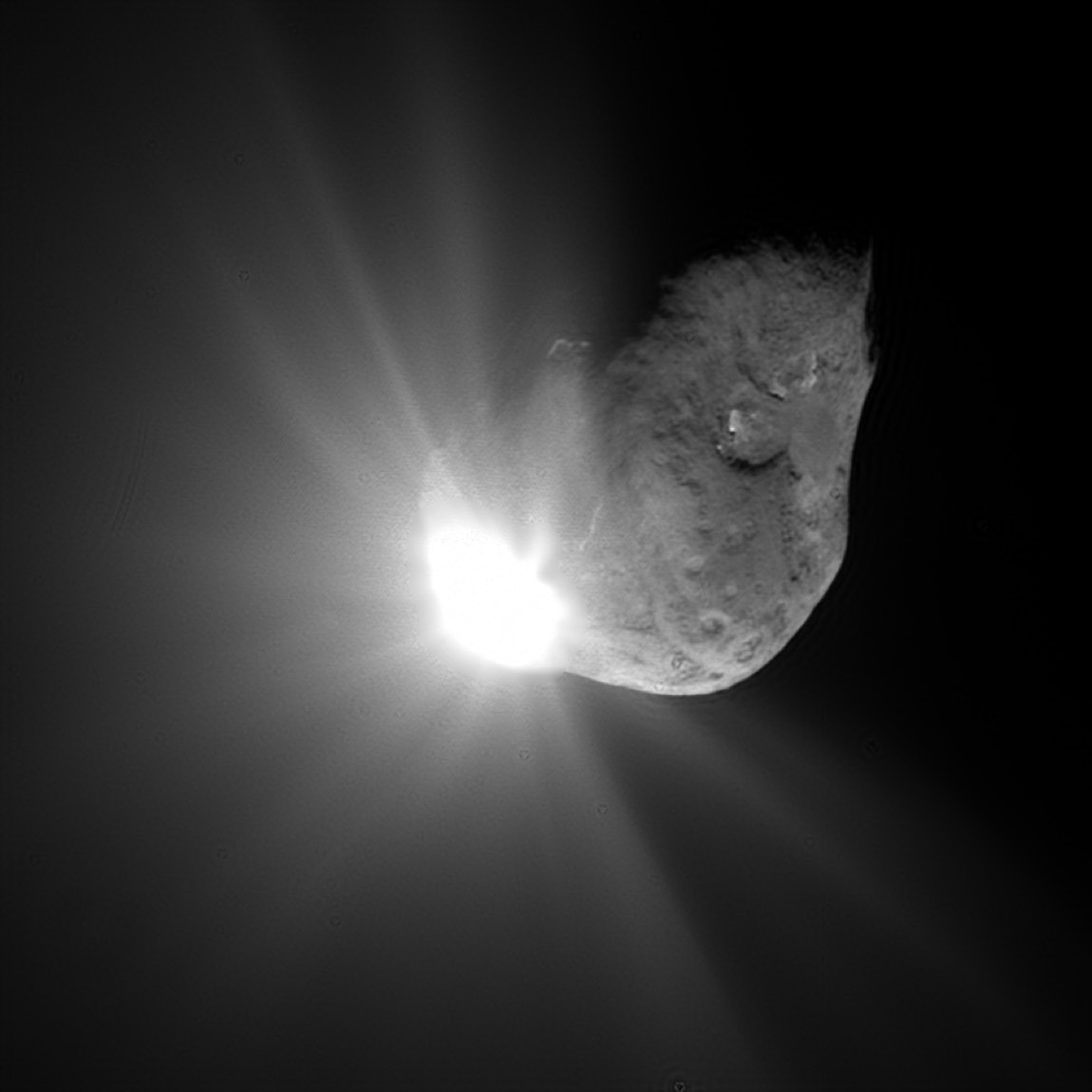
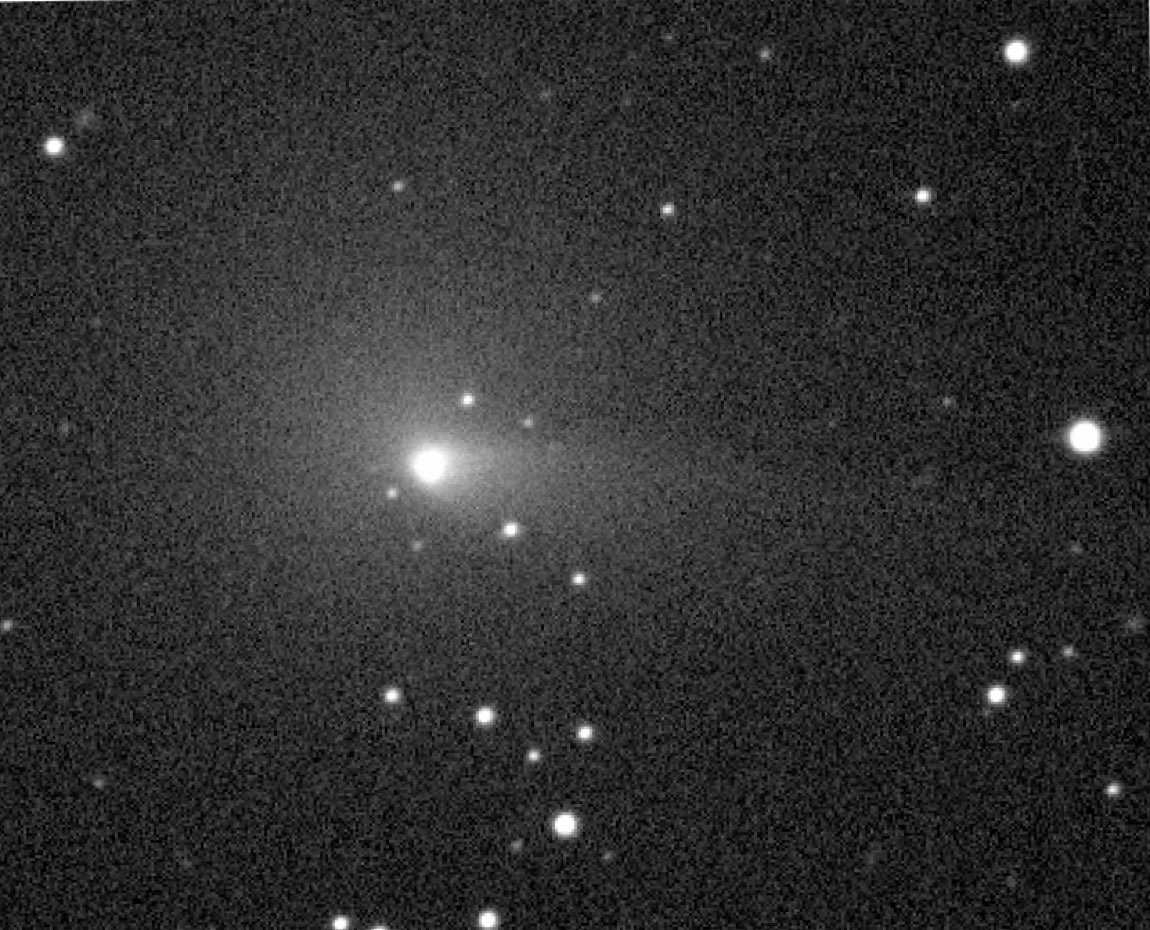
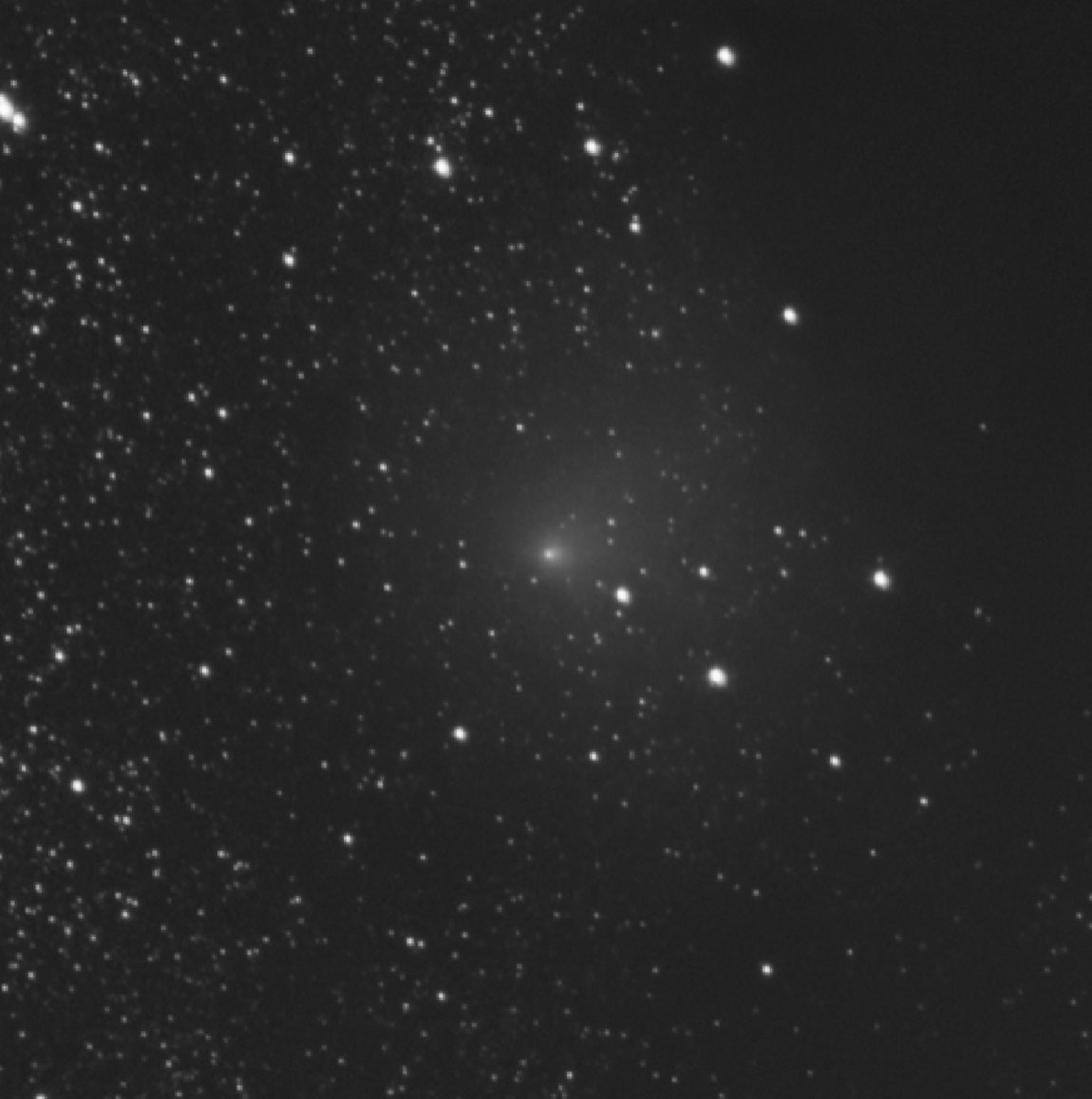
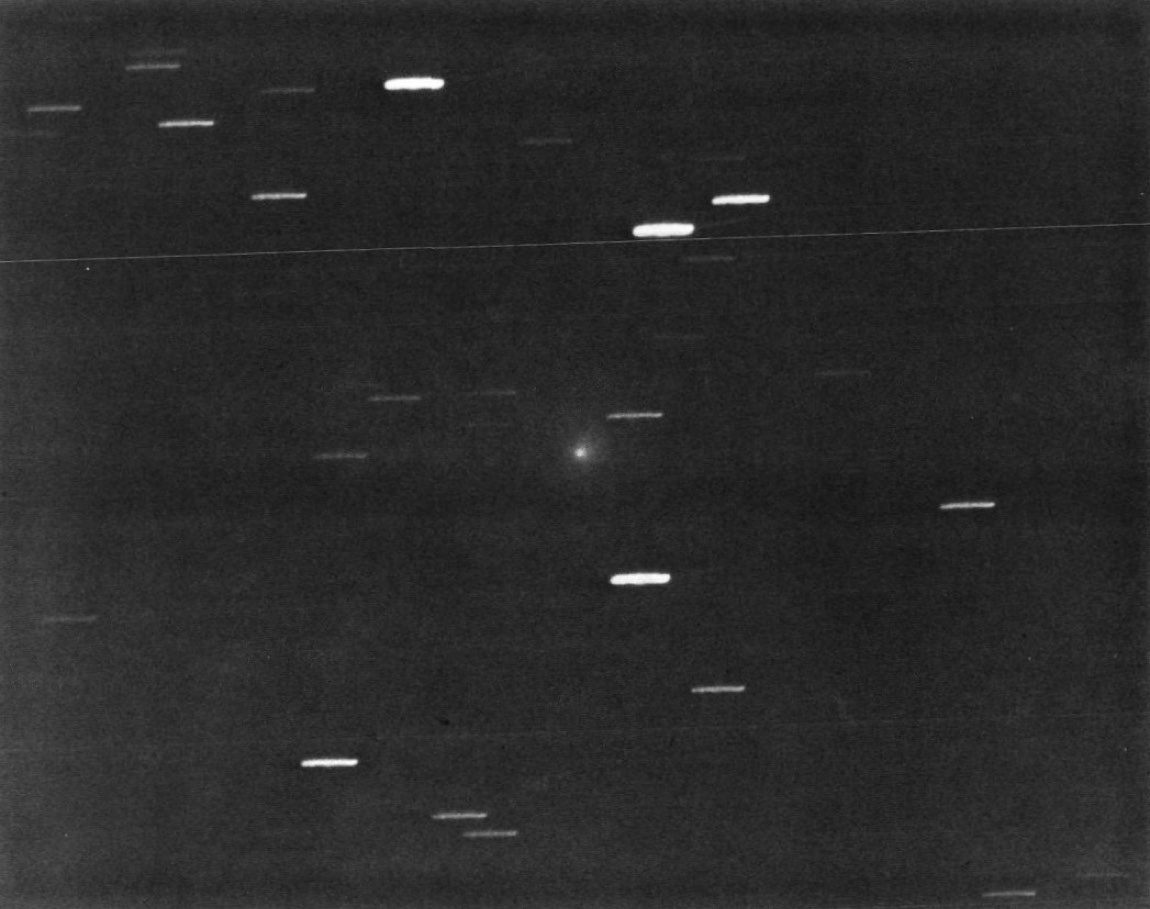
 Photograph · YayLol123 · CC BY-SA 4.0
Comet · Deep guide
Comet d'Arrest (6P)
Also called: 6P/d'Arrest · d'Arrest's Comet
A faint periodic comet that has been followed for more than 170 years.
What is it?
6P/d'Arrest was discovered by German astronomer Heinrich Louis d'Arrest in Leipzig in June 1851. It travels between the orbits of Mars and Jupiter on a loop that takes about six and a half years. Its nucleus is about 3.2 km across and spins every 6.7 hours. At its next perihelion in March 2028 it is expected to reach only about magnitude 11, a target for telescopes.
The deep dive
Researched for the Atlas from Wikipedia — 6P/d'Arrest (2,842 characters read) · updated Nov 14, 2026
01 A comet discovered across three nights
Heinrich Ludwig d'Arrest first caught sight of this comet from Leipzig, Germany, over the course of June 28–30, 1851. That three-night window of observation was enough to establish its identity as a new periodic comet — the second of three comets d'Arrest would eventually have named after him. What makes the discovery story richer is that the comet may not have been truly new at all. In 1991, a collaborative study involving researchers from Rome's Istituto Astrofisica Spaziale and Slovakia's Astronomical Institute independently proposed that 6P/d'Arrest is the very same comet that French astronomer Philippe de La Hire recorded in 1678 — more than 170 years before d'Arrest ever pointed a telescope its way. The word 'independently' matters here: two separate teams reached the same conclusion without coordinating, lending the idea significant credibility, though the phrasing 'suggested' in the literature signals it remains a historical inference rather than an absolute certainty.
02 An orbit between two planetary giants
Every 6.54 years, 6P/d'Arrest completes a full loop around the Sun, tracing a path that carries it between the orbits of Mars and Jupiter. At its closest approach to the Sun — perihelion — it reaches 1.35 AU, a distance that places it comfortably inside the inner solar system but still well outside Earth's orbit. For context, 1.35 AU is roughly 202 million kilometres, about 1.35 times the Earth–Sun distance. That relatively modest perihelion means the comet receives enough solar heating each pass to become moderately bright, expected to reach around apparent magnitude 11 at its next perihelion on March 31, 2028. Magnitude 11 is too faint for the naked eye — you would need binoculars or a small telescope — but it is well within reach of backyard astronomers with modest equipment under dark skies.
03 What the coma's chemistry reveals Deeper
During the comet's 2008 apparition, astronomers turned the infrared spectrograph at the Keck Observatory on its coma and detected five distinct molecules: water (H₂O), methanol (CH₃OH), ethane (C₂H₆), formaldehyde (H₂CO), and ammonia (NH₃). Water is the dominant volatile in most comets and its presence here is unremarkable, but the abundances of the other four tell a more nuanced story. Ethane, formaldehyde, and ammonia were all found to be relatively depleted compared to what astronomers typically see in other comets. This depletion pattern is scientifically significant because cometary volatile ratios are thought to record conditions in the region of the protoplanetary disk where the comet originally formed — or at minimum, reflect how the nucleus has been chemically altered over billions of years of solar heating. A comet with an unusual chemical fingerprint like this one becomes a useful data point for understanding diversity in the comet population.
04 A spinning nucleus and a revised clock Deeper
The solid nucleus of 6P/d'Arrest is estimated to be about 3.2 km in diameter — roughly the length of 32 football pitches placed end to end. Measuring how fast such a small, distant object rotates is genuinely difficult, and the history of this measurement illustrates how scientific results get refined over time. Photometric observations made during the comet's 1976 apparition yielded a rotation period of approximately 5.17 ± 0.01 hours. That figure stood for decades until a fresh periodogram analysis of the comet's lightcurve in 2003 suggested a significantly longer period of around 6.67 ± 0.03 hours. A periodogram technique searches for repeating patterns in brightness data, and the 2003 result implies the comet takes about 29 percent longer to complete one spin than the earlier estimate suggested. Whether outgassing jets from the active nucleus affect the rotation over successive perihelion passages is an open question the article does not resolve.
05 The 1976 close approach and its legacy
On August 12, 1976, comet 6P/d'Arrest passed within just 0.151 AU of Earth — roughly 22.6 million kilometres, or about 59 times the distance from Earth to the Moon. That close passage made the comet an unusually accessible observational target that year, and astronomers took full advantage of it. The photometric rotation measurements that produced the original 5.17-hour spin estimate came from this apparition. Interestingly, the same year also saw a formal mission study that proposed flying a spacecraft to the comet — suggesting that the 1976 opportunity had raised d'Arrest's profile in planetary science circles. The apparition stands as a landmark in the comet's observational record precisely because proximity amplifies both the brightness and the detail available to ground-based observers.
06 The spacecraft mission that never flew
As early as 1966 — well before space agencies had ever visited a comet up close — scientists were drawing up concrete plans to send a probe to 6P/d'Arrest. The proposal called for a Mariner-type spacecraft, the same heritage as the successful Mars missions of that era, to be launched aboard an Atlas-Centaur rocket by April 1976. The trajectory would have brought the spacecraft to within 100,000 km of the comet approximately 115 to 145 days after launch. That encounter distance is comparable to the gap between Earth and the Moon multiplied by about 260 — close enough to image the nucleus and sample the coma environment, but not a rendezvous or landing. The mission never came to fruition. No explanation is given in the historical record as to why it was cancelled, but its existence shows how d'Arrest attracted serious mission planning attention nearly a decade before Halley's Comet became the target of the famous 1986 fleet of spacecraft.
07 CONTOUR: the mission lost before it arrived
6P/d'Arrest came within reach of a real spacecraft flyby when it was selected as one of three targets for NASA's CONTOUR mission, alongside comets 2P/Encke and 73P/Schwassmann–Wachmann. CONTOUR — the Comet Nucleus Tour — was successfully launched in 2002, but the mission ended in disaster when contact with the spacecraft was lost soon after it reached orbit. Had everything worked, CONTOUR planned to fly past d'Arrest in 2008, after visiting the other two comets in sequence. The 2008 date would have coincided exactly with the apparition during which Keck Observatory was conducting its infrared spectroscopy of the coma, meaning ground-based and spacecraft data could potentially have been compared directly. Instead, only the ground-based observations survived, and 6P/d'Arrest remains unvisited by any spacecraft.
08 Three sample-return proposals, zero selections Deeper
The story of proposed missions to 6P/d'Arrest did not end with CONTOUR. Around 2007, the comet was included among nine comets examined in a preliminary study for a comet surface sample return mission. That early survey eventually fed into a more competitive process under NASA's New Frontiers Program, which by the 2010s had narrowed the field to three finalist mission concepts explicitly focused on cometary surface samples: CONDOR, CORSAIR, and CAESAR. All three were serious, peer-reviewed proposals with engineering teams behind them. Ultimately, however, none of these comet missions was selected. The winning New Frontiers proposal was Dragonfly, a rotorcraft lander destined for Saturn's moon Titan. The two comets most recently and intensively studied — 67P/Churyumov–Gerasimenko and 88P/Howell — were the preferred targets in those finalist proposals, edging d'Arrest out of serious contention for sample return.
09 An unfavorable apparition and what it means
Not every return of a comet is an observing opportunity. The 2015 apparition of 6P/d'Arrest was notably poor: from October 2014 through May 2015, the comet maintained a solar elongation of less than 30 degrees, meaning it remained close to the Sun in the sky for approximately seven consecutive months. Solar elongation measures the angular separation between an object and the Sun as seen from Earth; at less than 30 degrees, a comet is typically buried in twilight or daylight glare and inaccessible even to professional telescopes. This kind of unfavorable geometry is a normal consequence of orbital mechanics — a comet's path and Earth's path around the Sun sometimes align poorly from an observational standpoint. By contrast, the most recent perihelion in September 2021 was more accessible, with a solar elongation of about 95 degrees and an apparent magnitude of roughly 10, making it visible to small telescopes.
10 Preparing to watch it in 2028
The next perihelion of 6P/d'Arrest falls on March 31, 2028, when the comet will be 1.35 AU from the Sun and is expected to brighten to around apparent magnitude 11. That brightness sits just below the threshold of naked-eye visibility — the human eye under ideal conditions can typically detect objects to about magnitude 6 or 6.5 — but magnitude 11 is comfortably within reach of binoculars or a small amateur telescope with an aperture of 70 mm or more. Observers planning to watch the 2028 return will want to monitor solar elongation forecasts as the date approaches, since the unfavorable geometry of 2015 is a reminder that an accessible perihelion on paper can still be obscured by poor sky geometry. No specific orbital information about the 2028 viewing geometry beyond the perihelion date and distance is provided in current records.
11 Open questions from a chemically odd comet Deeper
The depleted abundances of ethane, formaldehyde, and ammonia detected in d'Arrest's coma in 2008 set it apart from the broader comet population, but the interpretation of that difference remains an active area of inquiry. Cometary volatile ratios can reflect where in the protoplanetary disk a body formed, with more distant formation zones typically preserving more exotic ices. Alternatively, repeated perihelion passages gradually bake off the more volatile layers of a nucleus, altering surface chemistry over time. D'Arrest's relatively short 6.54-year orbital period means it has made many more perihelion passages than long-period comets, which could account for some depletion. Distinguishing between primordial composition and evolutionary processing requires more data — ideally from a spacecraft that could sample material from depth rather than just reading the gases boiling off the sunlit surface. That data, as the mission history shows, has yet to arrive.
 ⤢