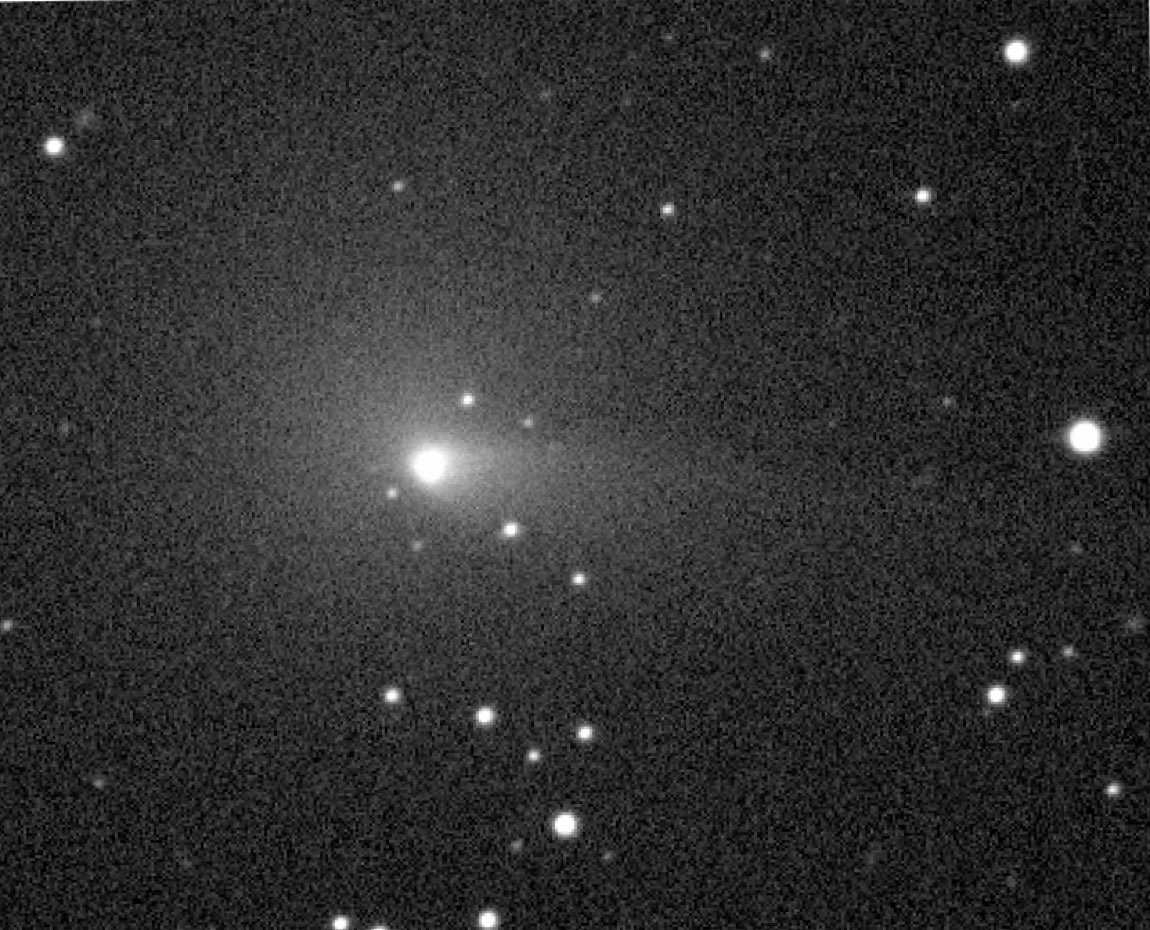
 Photograph · NASA/JPL-Caltech/ZTF · Public domain
Comet · Deep guide
Comet Pons–Winnecke (7P)
Also called: 7P/Pons–Winnecke · Comet Pons-Winnecke
A six-year comet whose debris causes the unpredictable June Boötid meteors.
What is it?
Comet Pons–Winnecke was discovered by Jean-Louis Pons at Marseille in 1819 and recovered by Friedrich Winnecke in Bonn in 1858. It is a Jupiter-family comet about 5 km wide that circles the Sun roughly every six years. It is the parent of the June Boötid meteor shower, which usually shows only a few meteors an hour but has occasionally flared up to around 100 an hour.
The deep dive
Researched for the Atlas from Wikipedia — 7P/Pons–Winnecke (3,610 characters read) · updated Nov 14, 2026
01 Two Astronomers, One Comet, 39 Years Apart
The comet carries a hyphenated name because two different astronomers independently found it nearly four decades apart. Jean Louis Pons, working at Marseille, spotted it first on 12 June 1819. Pons was a remarkably prolific comet hunter — arguably the most successful visual discoverer in history — but this particular comet was later lost. It was Friedrich Winnecke, observing from Bonn, who recovered it on 9 March 1858, unaware at first that he was looking at the same body Pons had catalogued. Once orbital calculations confirmed the two sightings were the same object on a repeating path, convention awarded the comet its dual name. This kind of recovery story was common in the nineteenth century, when comets could slip unobserved through several orbits before anyone noticed them again. The gap between Pons's discovery and Winnecke's recovery spans roughly six complete orbits of the comet, meaning it looped around the Sun and back perhaps five or six times with no one watching.
02 The Night a Collision Scare Was Ruled Out
Early orbital calculations made ahead of the comet's 1921 apparition produced an alarming result: the computed path of Pons–Winnecke looked as though it might actually intersect Earth's orbit at the same moment Earth was there. A collision scenario was briefly on the table. Fortunately, astronomy is a discipline where better data almost always resolves such scares, and observations made on 10 April of that year refined the trajectory enough to rule out any impact. The episode is a reminder that early ephemerides — the tables of predicted positions — can carry large uncertainties when a comet has not been tracked carefully through many returns. Just six years after the scare, in June 1927, the comet made its historically closest confirmed approach to Earth, passing within only 0.04 AU, which works out to about 6.0 million kilometres. For scale, that is roughly 15 times the distance from Earth to the Moon. No comparable close approach is expected during the twenty-first century.
03 How Jupiter Keeps Reshaping This Comet's Path Deeper
Pons–Winnecke belongs to the Jupiter-family comets, a class whose orbits are strongly sculpted by gravitational nudges from Jupiter. The comet's current perihelion sits at 1.1 AU, which keeps it just outside Earth's orbit, and its aphelion reaches 5.6 AU, just beyond Jupiter's domain. That balance is not permanent. A close approach to Jupiter in July 2037 will tug the perihelion inward to 0.982 AU, and further gravitational evolution is expected to push it to 0.85 AU by 2062. That progressive inward drift matters for several reasons: a smaller perihelion means more intense solar heating, potentially greater outgassing activity, and a geometry that historically produced spectacular meteor showers. The impressive June Boötids outbursts of 1916, 1921, and 1927 all coincided with an era when the comet's perihelion was migrating outward in the opposite direction, scattering meteoroids into Earth's path. Future inward migration may set the stage for renewed shower activity in the coming decades, though precise predictions remain difficult.
04 A Nucleus That Spins and Brightens Unevenly Deeper
Direct imaging of a comet nucleus is exceptionally difficult, so astronomers infer physical properties indirectly. For Pons–Winnecke, photometric measurements from the European Southern Observatory detected systematic brightness variations in the coma — the fuzzy envelope of gas and dust surrounding the nucleus. Those fluctuations are most naturally explained by a rotating, irregularly shaped or patchily active nucleus that presents different cross-sections and active regions to sunlight as it spins. The data constrain the rotation period to somewhere between 6.8 and 9.5 hours, a relatively wide range that reflects genuine measurement uncertainty rather than a precise determination. The nucleus itself is estimated at 5.2 km in diameter — roughly the length of Manhattan from the Financial District to Midtown. During the 2021 apparition, dust production was measured at less than 150 kg per second, a figure that, while sounding large, is actually modest compared to more vigorous comets.
05 What the Comet Is Made Of Deeper
Gas composition measurements carried out at the Calar Alto Observatory in Spain gave astronomers a chemical fingerprint of Pons–Winnecke. The overall composition turned out to be typical of other Jupiter-family comets, with one notable exception: the comet shows some depletion in C3 compounds, a molecular species involving chains of carbon atoms that is tracked as a tracer of certain carbon-bearing ices. Depletion in C3 can suggest that surface or near-surface layers have been chemically processed, perhaps by repeated solar heating across many apparitions. Beyond the gas phase, the observations also yielded a dust-to-gas mass ratio of 2, meaning the comet sheds roughly twice as much mass in solid dust grains as in gas. That ratio places it in the dust-rich category, suggesting a relatively solid, consolidated interior or a surface covered in refractory material — debris left behind as volatile ices sublimate away over successive orbits around the Sun.
06 The June Boötids: An Unpredictable Rain of Meteors
Every year between roughly 22 June and 2 July, Earth passes through a stream of debris shed by Pons–Winnecke over many orbital cycles, producing the June Boötids meteor shower. Peak activity falls around 28 June. What sets the June Boötids apart from most annual showers is their dramatic unpredictability. In quiet years the rate can drop as low as 2 meteors per hour — barely noticeable. In outburst years the same shower has delivered up to 100 meteors per hour, and the 1998 event pushed even higher, reaching around 200 meteors per hour at its peak. This variability reflects the uneven, clumped distribution of meteoroids in the stream rather than a steady, well-mixed ribbon of debris. The shower also occasionally produces very bright events: two fireballs detected in July 2008 and July 2009 reached apparent magnitudes of −20 and −9 respectively, putting them in the class of exceptionally rare bolides that can briefly rival or exceed the brightness of the full Moon.
07 An Outburst Record That Surprised Astronomers
During its 2021 return to the inner solar system, Pons–Winnecke proved unexpectedly energetic. Observers recorded eight distinct outbursts over the course of the apparition — sudden, temporary surges in brightness caused by localized releases of gas and dust from the nucleus, possibly triggered by the fracturing of a surface crust or the exposure of a fresh volatile-rich pocket. What made this particularly striking is that most of those outbursts were ten times greater in intensity than outbursts observed from comparable Jupiter-family comets, with the article specifically citing 49P/Arend–Rigaux as a comparison. Such prolific outburst activity in a single apparition is unusual and raises questions about what is happening beneath the comet's surface. Is there a structurally weak area that keeps rupturing? Are particular volatiles concentrated near the surface? The 2021 observations add Pons–Winnecke to a short list of comets that reward long, patient monitoring rather than just a snapshot near perihelion.
08 The Mission That Never Flew to This Comet
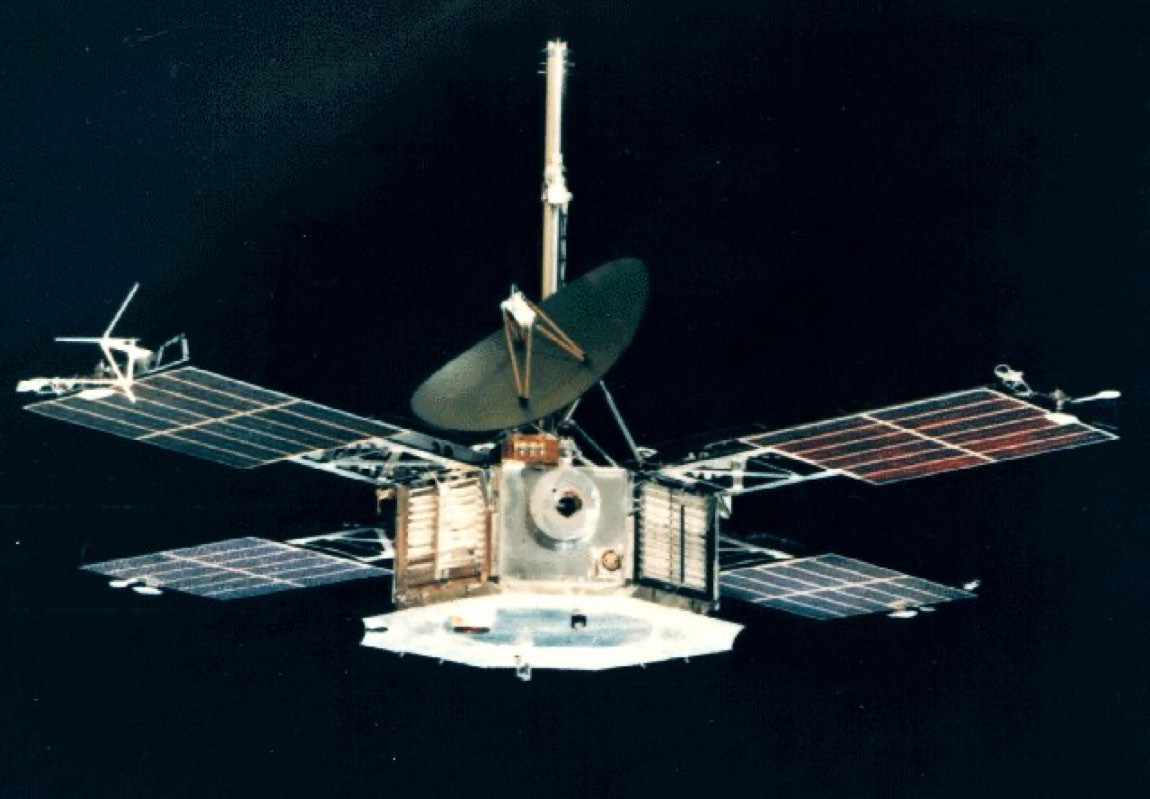
Long before robotic comet encounters became standard planetary science, the Jet Propulsion Laboratory drew up plans in the 1960s to send a spacecraft past Pons–Winnecke. The proposed mission would have used a flight spare of the Mariner 4 spacecraft — the same design that had returned the first close-up images of Mars in 1965 — and aimed for a closest approach of 5,000 km from the comet in 1969. The concept was technically plausible, but it ran into a fundamental problem: the comet's ephemeris was poorly defined at the time, meaning scientists could not predict its position accurately enough to reliably guide a spacecraft toward it. Ground-based optical tracking was inadequate for the job. The spare spacecraft was redirected and ultimately flew past Venus in 1967 as Mariner 5. It is a small historical footnote, but it illustrates how the precision of orbital knowledge has always gated what deep-space exploration is actually possible.
09 A Future Rendezvous with Comet Interceptor
Space agencies do not give up on a comet easily. In 2019, the European Space Agency placed 7P/Pons–Winnecke on the list of ten backup targets for its Comet Interceptor mission. The spacecraft is scheduled to launch in 2029 and is primarily designed to intercept a dynamically new comet arriving from the outer solar system for the first time — an object that has never been baked by the Sun and therefore preserves the most pristine material from the early solar system. If no suitable primary target is identified in time, mission controllers could redirect the spacecraft toward Pons–Winnecke instead, with a flyby pencilled in for 28 September 2033. Such a visit would transform our understanding of a comet we have only observed remotely, allowing in situ measurements of its gas chemistry, dust properties, and nucleus structure at close range — possibly clarifying the puzzle of its unusually prolific outburst behaviour.
10 Observing Pons–Winnecke from the Ground
Pons–Winnecke is not a naked-eye spectacle under ordinary circumstances. At its last perihelion on 27 May 2021, it reached an apparent magnitude of approximately 11 — well below what the unaided eye can detect, which cuts off around magnitude 6 or 7 under a dark sky. It required at minimum a good pair of binoculars or a small telescope to see the comet directly. The solar elongation at that perihelion was 107 degrees, meaning the comet was reasonably well placed in the sky relative to the Sun, which helps ground-based observers. By 12 June 2021 it had moved to 0.44 AU from Earth — about 66 million kilometres — still within a comfortable range for telescopic observation. The 2015 perihelion, by contrast, occurred with a solar elongation of only 24 degrees, placing the comet uncomfortably close to the Sun in the sky and making observation very challenging. The upcoming 25 August 2027 perihelion, with a solar elongation of 63 degrees, will offer somewhat limited but workable viewing geometry.
11 Open Questions About This Familiar Stranger Deeper
Despite more than two centuries of observation since Pons first noted it in 1819, significant mysteries remain about this comet. The rotation period is known only to within a 2.7-hour window — between 6.8 and 9.5 hours — which is a wide uncertainty for a body that has been watched at multiple apparitions. The mechanism behind its unusually frequent and large outbursts in 2021 is unexplained; whether this is a recurring feature of every return or a one-time event tied to a particular surface collapse is unknown. The C3 depletion in its gas coma hints at chemical processing across its history, but how that processing occurred and what it implies about the comet's original composition is an open research question. Future close approaches — especially the Jupiter encounter in July 2037 that will reshape its orbit — offer natural experiments for watching how a comet responds to dynamical change. And if Comet Interceptor does fly past it in 2033, many of these questions could finally receive definitive answers.
 ⤢