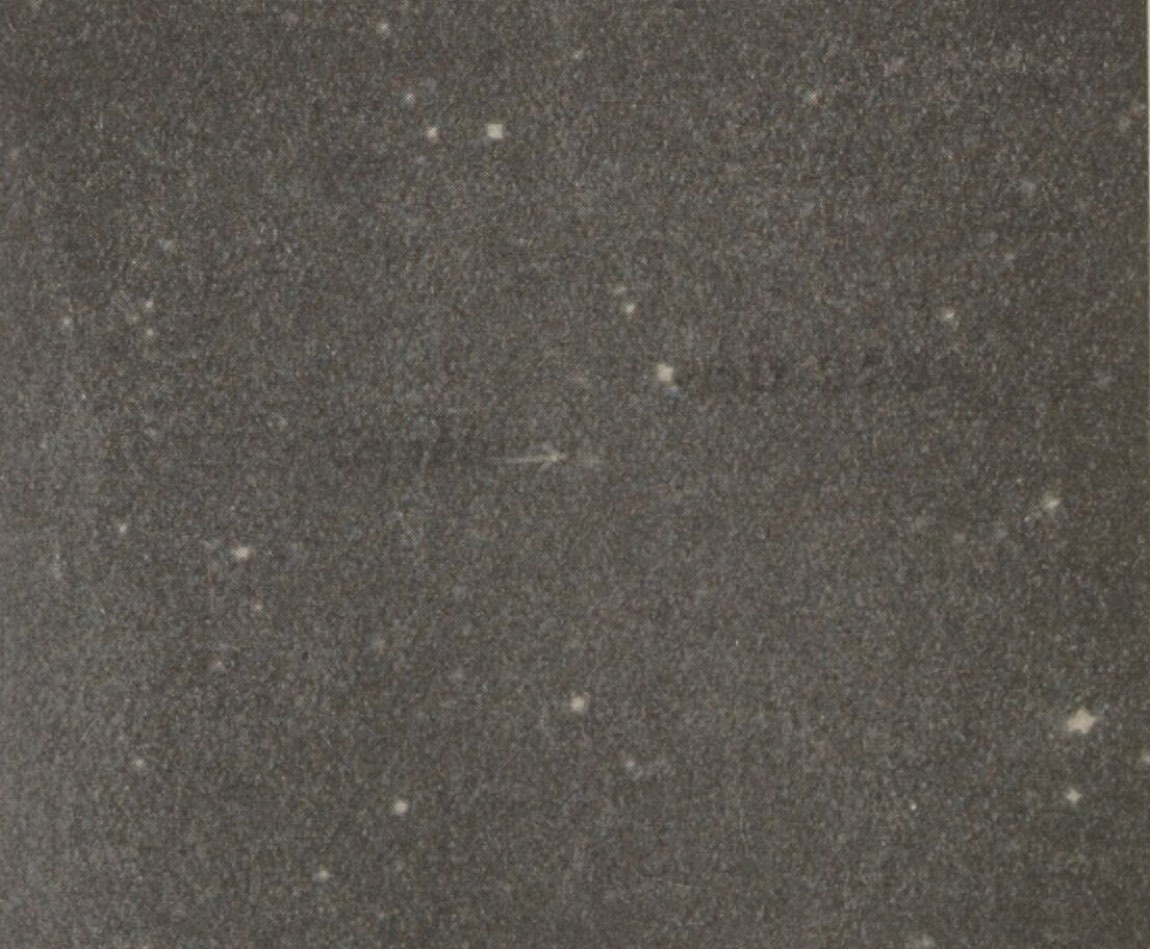
 Photograph · Ferdinand Quénisset · Public domain
Comet · Deep guide
Comet Crommelin (27P)
Also called: 27P/Crommelin · Comet Pons-Coggia-Winnecke-Forbes
One of the few comets named after the person who calculated its orbit, not its discoverer.
What is it?
27P/Crommelin was first seen by Jean-Louis Pons in 1818 and spotted at later returns by several observers, which is why it was once called Comet Pons–Coggia–Winnecke–Forbes. In 1930 British astronomer Andrew Crommelin showed these sightings were one comet, and it was renamed in his honour. It is a Halley-type comet that returns about every 28 years; its next perihelion is in 2039.
The deep dive
Researched for the Atlas from Wikipedia — 27P/Crommelin (2,198 characters read) · updated Nov 14, 2026
01 Four Discoveries, One Comet
Comet Crommelin has the unusual distinction of being independently discovered three separate times across more than a century before anyone realized all three sightings were the same object. Jean-Louis Pons spotted it first from Marseille on February 23, 1818, tracking it for just four days before bad weather cut his observations short. Johann Franz Encke — the same mathematician who characterized the famous short-period comet bearing his name — tried to compute an orbit from Pons's sparse data but was left with unacceptably large errors, so the object drifted into obscurity. Then, 55 years later, Jérôme Coggia and Friedrich Winnecke independently caught it again in November 1873, only to lose it within days. A third independent discovery came in November 1928 when Alexander Forbes spotted it from Cape Town, South Africa, with Harry Wood confirming it two days later at the Union Observatory. It was Andrew Crommelin who finally did the detective work, threading together the 1818, 1873, and 1928 apparitions into a single consistent orbit and proving they were all one and the same traveler making repeated circuits of the inner solar system.
02 The Man Who Got the Credit
Andrew C. D. Crommelin was a British astronomer who performed the critical orbital calculations in 1930 that linked three apparently unrelated comet sightings into a single periodic body. Because of this work, the comet was named in his honor rather than after any of its four discoverers. This makes Comet Crommelin one of only five known comets that carry the name of someone other than the person or persons who first observed it — a genuinely rare distinction in a field where the tradition of naming comets after discoverers is otherwise nearly universal. The comet's full formal name, Comet Pons-Coggia-Winnecke-Forbes, acknowledges all four independent observers who recorded it without recognizing its identity: Pons in 1818, Coggia and Winnecke in 1873, and Forbes in 1928. The dual naming convention preserves both the historical record of observation and the intellectual credit owed to the astronomer who made sense of that record. Crommelin's work is a reminder that in comet science, understanding an orbit can be just as significant a contribution as being the first to glimpse a fuzzy smudge in the night sky.
03 A Halley-Type Comet in a Rare Club Deeper
Comet Crommelin belongs to the category known as Halley-type comets, which by classical definition are periodic comets with orbital periods between 20 and 200 years. With a period of almost 28 years, Crommelin sits near the short end of that range — it completes roughly three orbits in the time Halley's Comet takes to finish two. This middle-ground period places it in an interesting dynamical category: too slow to be one of the Jupiter-family comets that dominate the short-period population, yet far more frequent a visitor than the long-period comets that swing in from the outer solar system on timescales of centuries or millennia. Halley-type comets are thought to originate from the scattered disk or the inner Oort Cloud, though the exact source reservoir remains a matter of ongoing discussion among dynamicists. The classification also implies a certain orbital inclination and eccentricity regime distinct from Jupiter-family objects. For observers, a roughly 28-year period means that a person who sees Crommelin as a child might realistically observe it again as an adult in their mid-thirties — a generational rhythm that is longer than a sunspot cycle but shorter than a human working career.
04 An Early Link to Comet Biela Deeper
When John R. Hind produced a rough orbital calculation in 1872 from the 1818 Pons sighting, he noticed something intriguing: the orbit appeared close to that of Comet Biela, a famous periodic comet that had fragmented and disintegrated in the mid-nineteenth century. Edmund Weiss, building on Hind's work, later speculated that the Pons comet might actually have been a fragment of Biela's comet. This was a plausible hypothesis at the time, because cometary breakups were known to scatter debris into related orbits, and the two apparitions did share some orbital similarities. However, Crommelin's later and more precise calculations established the comet as its own distinct object with a well-defined orbit that could be traced through three separate apparitions spanning over a century. The Biela connection was ultimately not confirmed. The episode is a good illustration of how difficult it is to establish cometary identity from fragmentary observations separated by decades, and how easy it is to mistake coincidentally similar orbits for a physical relationship that may not exist.
05 The 2011 Return: From Faint to Naked-Eye
On its most recent return, comet watchers recovered 27P/Crommelin on May 12, 2011, when it was glowing at an apparent magnitude of 18.7 — roughly 25,000 times too faint to be seen without a telescope, comparable to the dimmest objects visible to large amateur instruments under perfect skies. Over the following weeks, as the comet plunged closer to the Sun, it brightened dramatically. By perihelion on August 3, 2011, it had climbed to magnitude 10.7, still requiring binoculars but within reach of a wide audience of amateur astronomers. That is a brightening of about eight full magnitudes, corresponding to a flux increase of roughly 1,500 times. The comet was then followed until January 2012 as it faded back into the depths of the solar system. After perihelion, it continued its outward journey and on July 11, 2015, it passed approximately 1.5 AU — about 220 million kilometers — from Saturn, an event recorded in observational logs though the comet would have been very faint by that point, well past its brief period of prominence.
06 Why 2039 Will Be a Distant Show
The next perihelion is expected around May 27, 2039, but observers are already managing expectations. At that closest solar approach, Crommelin will be 0.74 AU from the Sun — a bit closer than Earth's own distance, which should drive reasonable activity — but it will simultaneously sit 1.73 AU from Earth. That Earth distance is about 259 million kilometers, roughly 1.7 times the distance from Earth to the Sun. The article notes explicitly that this geometry represents approximately the maximum near-perihelion distance from Earth that the comet can achieve, meaning the 2039 return is essentially a worst-case scenario for observers in terms of Earth–comet separation at the moment of peak activity. When a comet is active but far away, its brightness suffers on two counts: the coma and tail are lit by more distant sunlight, and the reflected light has a greater distance to travel before reaching our eyes. Whether the 2039 apparition will be accessible to amateur telescopes or require professional instruments will depend on the comet's intrinsic activity level, which can vary from return to return.
07 A Close Earth Flyby — in 2120
While the 2039 return will offer unfavorable viewing geometry, the orbital calculations reveal a much more promising future event. On December 22, 2120, Comet Crommelin will pass just 0.297 AU from Earth — about 44.4 million kilometers, or roughly 115 times the distance from Earth to the Moon. For context, 0.297 AU is closer than Mars ever gets to Earth during opposition. If the comet is comparably active during that apparition as it was in 2011, the reduced Earth distance alone would make it substantially brighter — possibly a striking naked-eye object. Of course, predicting a comet's brightness a full century ahead is inherently uncertain; comets can outburst dramatically or fall disappointingly quiet depending on how their icy nuclei evolve over successive perihelion passages. Still, the 2120 date stands out in the orbital ephemeris as the kind of close approach that planetary scientists and comet enthusiasts mark as a genuinely significant future event, one that will hopefully be observed with instruments and understanding far beyond what exists today.
08 The Role of Bad Weather in Comet History
It is worth pausing on how profoundly weather shaped the observational history of this comet. When Pons first spotted it in February 1818, he managed only five days of observation before clouds ended his work. That brief window was not enough for anyone to reliably compute an orbit — a task that benefits greatly from an extended arc of positional measurements. Had Pons been granted even a few more clear nights, Encke's subsequent orbital attempt might have succeeded, the comet might have been recognized as periodic immediately, and its next returns in 1845 and 1873 might have been anticipated rather than re-discovered by accident. Similarly, the 1873 apparition was lost within about six days of Coggia's initial observation on November 10. Each premature curtailment by weather reset the clock on understanding this object. The story is a vivid reminder that before the age of robotic survey telescopes operating regardless of human schedules, the progress of astronomical knowledge was deeply contingent on local meteorology. A patch of clouds over Marseille in 1818 set back the recognition of a periodic comet by more than a century.
09 How the Comet Got Lost Between Returns Deeper
Comet Crommelin is implicitly referenced in connection with the concept of a "lost comet" — a periodic comet that is not recovered at an expected return because it was not observed long enough at discovery to establish a reliable predictive orbit. After the 1818 Pons sighting, no one could compute a good enough orbit to know when or where to look next. The 1873 Coggia-Winnecke sighting was similarly short-lived. Without a reliable orbital solution linking the appearances, observers in intervening years had no specific target to search for, and the comet presumably passed perihelion in 1845 and again in 1900 without being recognized. Comets can be lost for multiple reasons: insufficient observational arc at discovery, strong perturbations by Jupiter or other planets that shift the orbit between returns, or simply being too faint at the predicted location for available instruments to detect. In Crommelin's case the primary culprit was the initial data quality. The eventual recovery and linkage across three apparitions — covering 110 years of observations — stands as a testament to the painstaking archival and computational work that orbit determination demands.
10 Orbital Naming and the Five Exceptions Deeper
The convention of naming comets after their discoverers is so deeply embedded in astronomical tradition that the International Astronomical Union maintains it as a formal guideline: typically up to three independent discoverers may share a comet's name. This makes it genuinely unusual that Comet Crommelin is named for someone who never discovered it at all. Among the entire catalog of known comets, it is reportedly one of only five cases where the naming credit went to a person who performed orbital or computational work rather than observational discovery. The other four members of this exclusive group are not identified in this article, but Crommelin's inclusion reflects a judgment by the community that linking three independent sightings separated by decades into a single coherent orbit was an intellectual contribution significant enough to override the standard naming rule. The comet's alternative formal name — Pons-Coggia-Winnecke-Forbes — does preserve discoverer credits and contains four names, itself an unusually long roster that reflects how fragmented and complicated the observational history was before Crommelin made sense of it all.
11 Observing Crommelin: Past and Future
The 2011 return gives amateur astronomers a useful calibration point for future planning. Recovery required equipment capable of reaching magnitude 18.7, which means a substantial telescope under dark skies, or a CCD camera on a moderate aperture instrument. The comet then became accessible to binoculars around magnitude 10.7 at perihelion on August 3 — bright enough to show a coma and perhaps a short tail to patient observers. For the 2039 return, the unfavorable Earth distance of 1.73 AU at perihelion means the comet will likely be noticeably fainter than in 2011 from an observer's perspective, even if the comet itself is similarly active. Amateur observers planning to observe the 2039 apparition should be prepared for a telescopic target rather than a naked-eye spectacle. The dramatically closer pass in 2120 — 0.297 AU from Earth — represents the more exciting long-term prospect, though that observation will fall to future generations. For now, the 2039 return is the nearest opportunity to study Crommelin directly, even if the geometry is unfavorable.