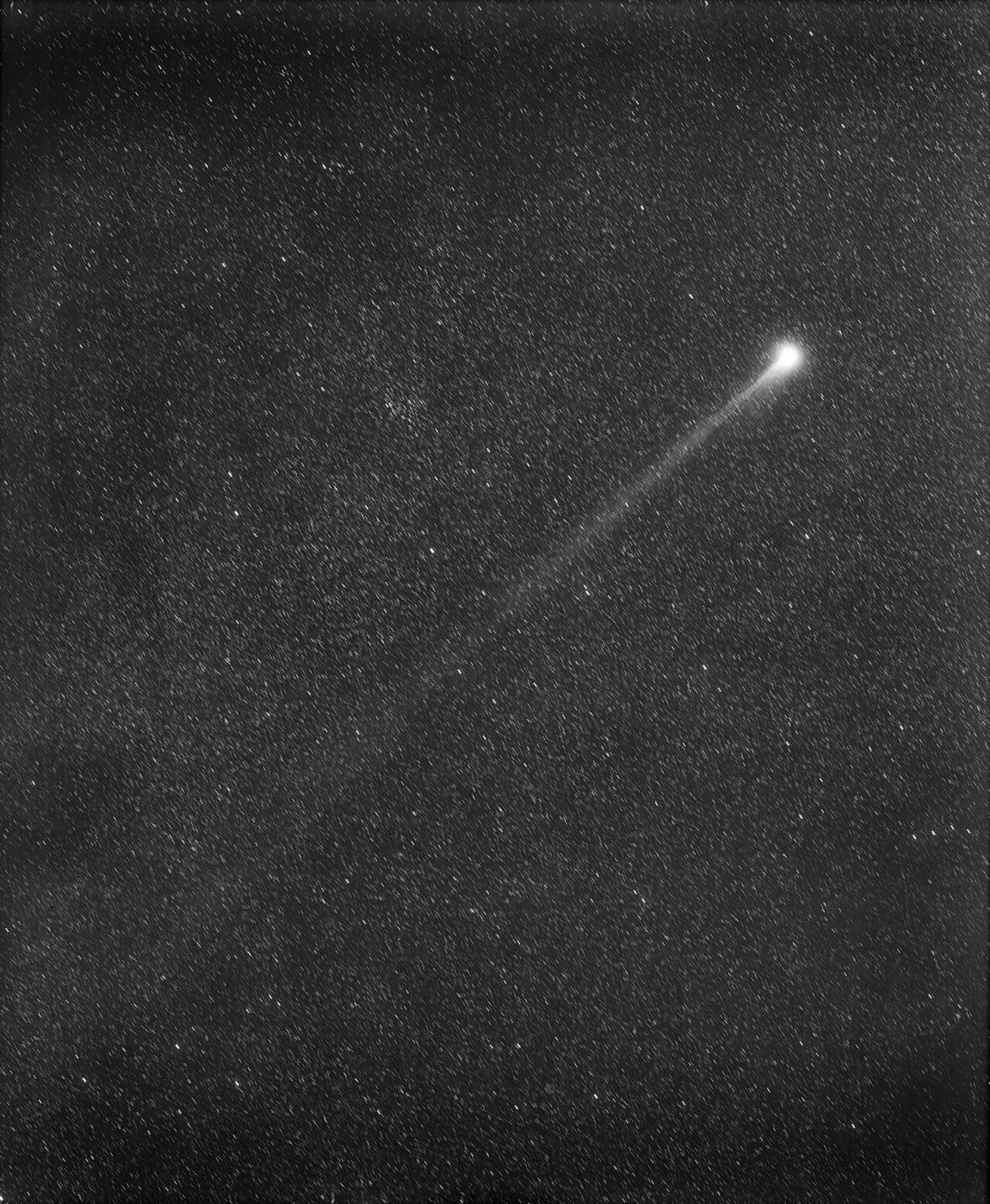
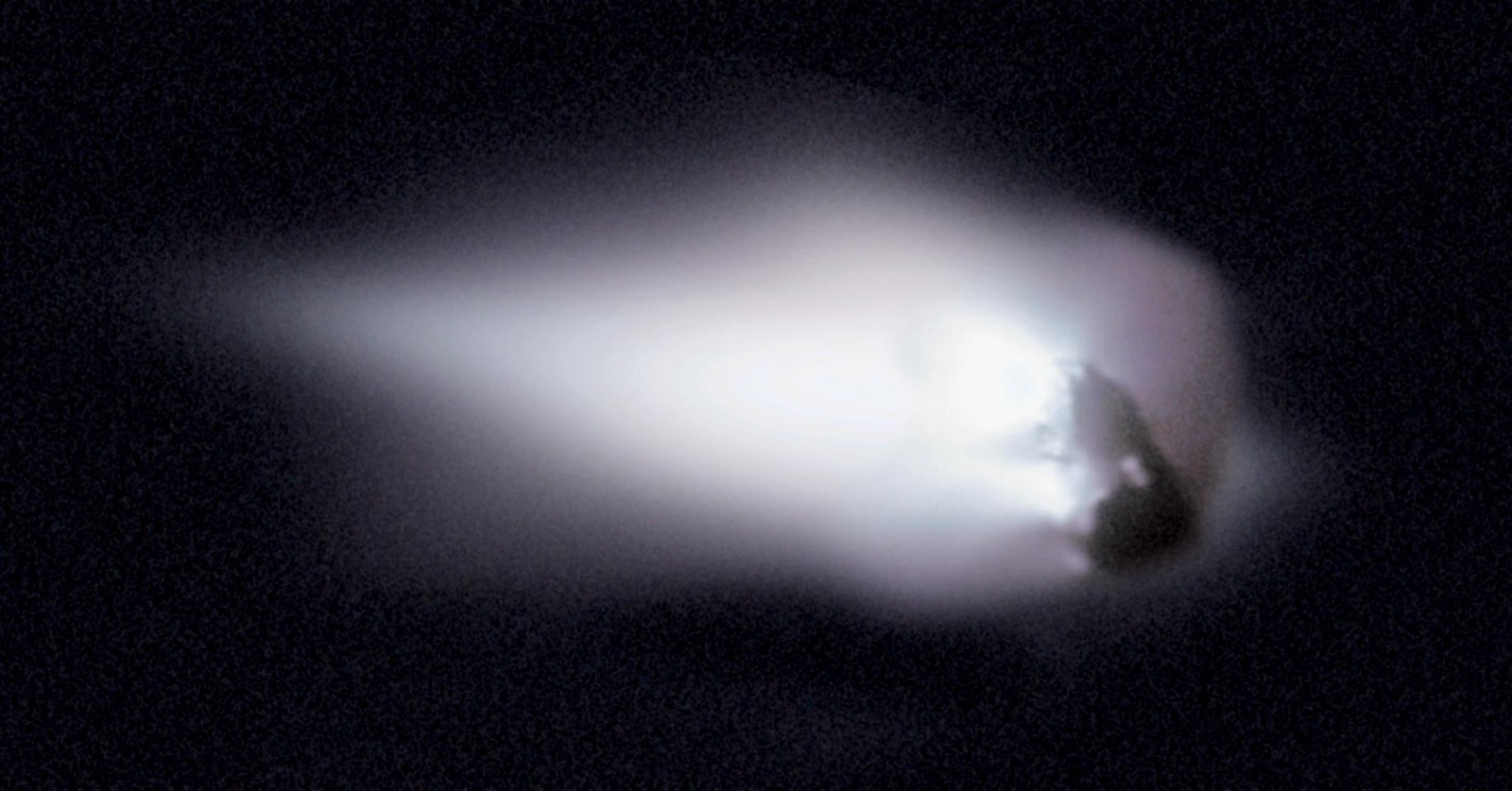
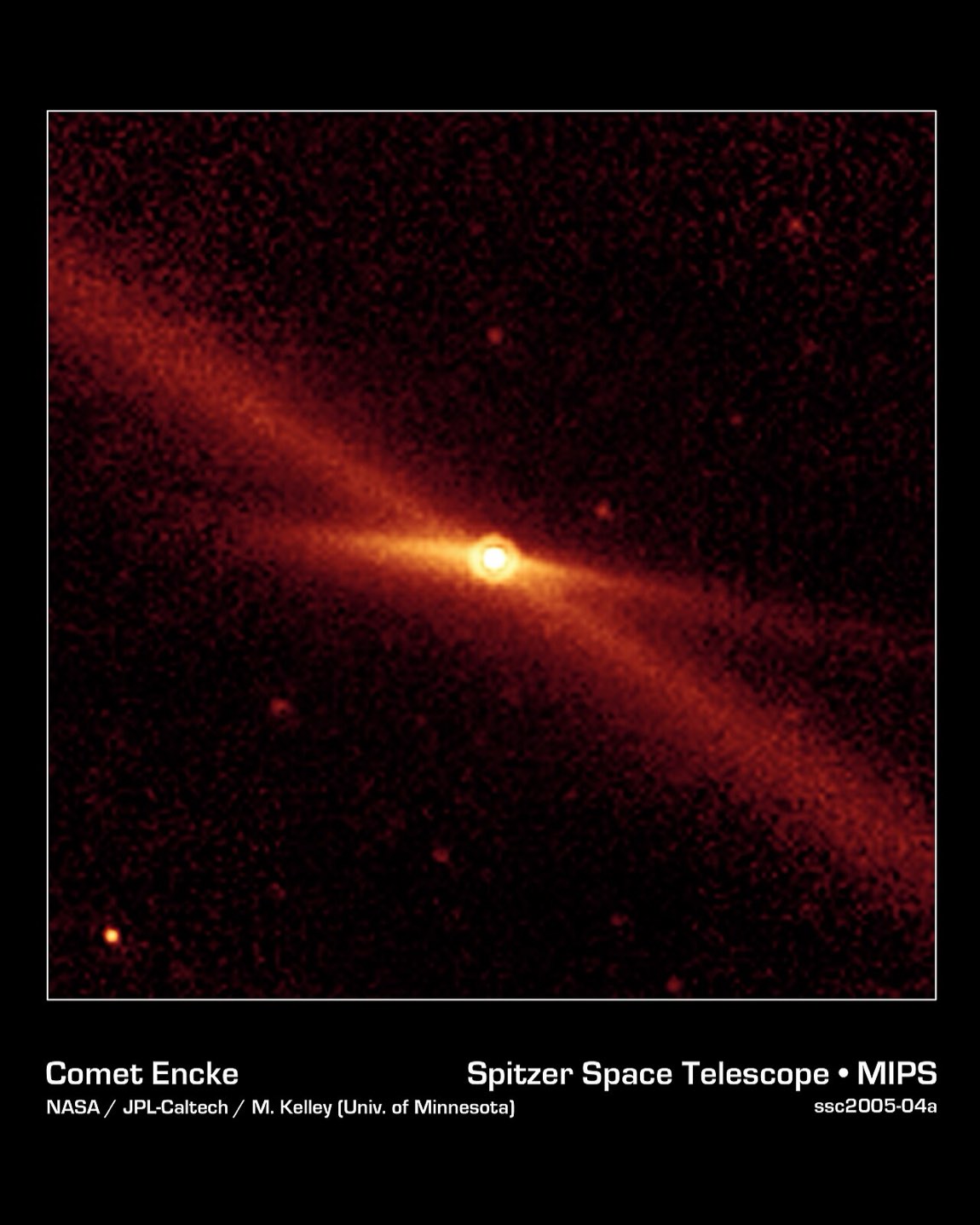
 Photograph · NASA/JPL-Caltech/M. Kelley (Univ. of Minnesota) · Public domain
Comet · Deep guide
Comet Encke (2P/Encke)
Also called: 2P/Encke · Encke's Comet
Orbits the Sun every 3.3 years and leaves behind the Taurid meteors.
What is it?
Encke's Comet, designated 2P, has one of the shortest orbits of any well-known comet. Pierre Méchain first recorded it in 1786, but in 1819 Johann Franz Encke calculated its orbit and showed earlier sightings were the same comet, so it carries his name. Its nucleus is about 4.8 km across and very dark, reflecting under 5% of sunlight. Debris from Encke feeds the Taurid meteor showers in autumn and the daytime Beta Taurids in summer.
The deep dive
Researched for the Atlas from Wikipedia — Comet Encke (10,334 characters read) · updated Nov 14, 2026
01 How Encke Got Its Name — and Almost Didn't
The naming of Comet Encke is a small drama of scientific credit. Pierre Méchain spotted it first on 17 January 1786, with Charles Messier independently noting it the same year. Caroline Herschel rediscovered it in 1795, and Jean-Louis Pons found it yet again in 1818 — each observer believing they had a new comet. It was Johann Franz Encke who, through what the historical record calls "laborious calculations," tied sightings from 1786, 1795, 1805, and 1818 together into one repeating object and published his conclusions in Correspondance astronomique in 1819. He then correctly predicted the comet's return in 1822, which was confirmed by Carl Ludwig Christian Rümker at Parramatta Observatory on 2 June 1822. Convention awarded the comet Encke's name — but Encke himself argued it should be called Pons's Comet, after the man who made the final pre-identification sighting. That preference was never widely adopted, leaving Encke in the company of Halley as one of the rare comets named for the person who calculated its orbit rather than the person who first saw it.
02 An Orbit Shaped by Planetary Bullying Deeper
Comet Encke follows one of the most chaotic orbital paths among well-known comets, largely because it ventures so deep into the inner Solar System on such a short 3.3-year cycle. Its low orbital inclination keeps it near the ecliptic plane, the same flat region where the planets travel, maximising the number of gravitational nudges it receives. Jupiter exerts the strongest influence: Encke currently sits close to a 7:2 mean motion resonance with that planet, meaning it completes roughly seven orbits for every two of Jupiter's. That resonance may also trap larger fragments shed by the comet — or shed by an older, larger progenitor body — in stable orbits of their own. Despite all this jostling, Encke's perihelion distance is remarkably stable. Between 1769 and 2103, its closest solar approach varies only between 0.330 AU in 2050 and 0.347 AU back in 1782 — a range of less than 2.5 million kilometres across more than three centuries of continuous planetary perturbation.
03 Racing Around the Sun at Bullet Speed
When Comet Encke swings through perihelion, its closest point to the Sun at 0.34 AU — roughly a third of Earth's orbital distance — it is moving at 69.5 kilometres per second. That is 250,000 kilometres per hour, or about 65 times faster than a rifle bullet. Among numbered comets below the designation 321P, only 96P/Machholz passes closer to the Sun than Encke does. The comet's minimum possible approach to Earth's orbit is 0.167 AU, or about 25.0 million kilometres. It passed 0.19 AU from Earth on 4 July 1997, and a close approach of roughly 0.17 AU is forecast for 30 June 2172. Such near-Earth encounters recur on a rough 33-year cycle. On 18 November 2013, it also made a notably close pass of Mercury, coming within just 0.02496 AU — 3.734 million kilometres — of that planet, a figure significant enough to leave a measurable mark on Mercury's thin atmosphere.
04 The Taurids: A Meteor Family With Deep Roots
Comet Encke is believed to be the source of an entire family of related meteor showers collectively called the Taurids. Observers encounter them as the Southern Taurids and Northern Taurids throughout November, and as the Beta Taurids during late June and early July. The debris stream is old enough and wide enough to produce showers across months rather than the brief peak typical of younger streams. The near-Earth asteroid designated (828534) 2004 TG10 is considered a likely inactive fragment of Encke that broke away from the comet roughly 4,000 to 4,500 years ago — a chip of cometary nucleus now dark and silent, orbiting among the same debris that creates the Taurid meteors. In 2019 astronomers planned a targeted search campaign specifically looking for further fragments during the Taurid swarm's passage between July 5–11 and July 21 – August 10 of that year, but no new objects were reported.
05 Mercury's Calcium Spikes and an Unlikely Source Deeper
Among the more unexpected consequences of Encke's orbit is an apparent influence on Mercury's exosphere — the planet's vanishingly thin outer atmosphere. NASA's MESSENGER spacecraft, which began orbiting Mercury in March 2011, carried the Mercury Atmospheric and Surface Composition Spectrometer. That instrument detected periodic surges in calcium levels that could not be explained simply by the general background of interplanetary dust filling the inner Solar System. The working explanation is impact vaporization: tiny dust particles strike Mercury's surface with enough energy to knock calcium-bearing molecules into the atmosphere. Because the spikes are seasonal and periodic rather than continuous, they point to a concentrated, recurring source of dust — most plausibly a cometary debris field associated with Encke. Measurements aboard MESSENGER also detected what may be a meteor shower striking Mercury itself, something far outside the common experience of meteor science, which has historically focused exclusively on Earth.
06 Encke's Role in a Discredited Physics Theory Deeper
In the nineteenth century, Comet Encke became key evidence in debates about luminiferous aether — the hypothetical medium through which light was believed to travel. Astronomers observed that Encke's successive returns arrived slightly early, as if the comet were losing time against its own schedule. An 1860 school manual stated the finding plainly: Encke's comet was losing about two days in each successive period of 1,200 days. With no other mechanism available, scientists attributed the acceleration to drag from an aether permeating outer space. Edgar Allan Poe even referenced the supposed shortening of Encke's orbit in his story "The Unparalleled Adventures of One Hans Pfaall." The actual explanation, invisible to nineteenth-century astronomers, is outgassing: the comet's nucleus emits jets of gas that act like rocket thrusters, nudging the orbit in ways that depend on which direction the pole is pointing. Encke's pole tumbles on an 81-year cycle, so it accelerates for roughly half that period and decelerates for the other half — a subtlety that an 1860 textbook had no means of knowing.
07 First Comet Ever Detected by Radar
In 1980 Comet Encke claimed a milestone that no comet had reached before: it became the first comet ever detected by radar. The observations were conducted from the Arecibo Observatory, the giant radio dish in Puerto Rico, and the specific purpose was to measure the size of Encke's nucleus rather than relying on optical brightness estimates alone. That nucleus diameter came out at 4.86 kilometres — a solid body roughly the size of a small city. Only four years later, in April 1984, the Pioneer Venus Orbiter observed Encke in ultraviolet light and obtained measurements of its rate of water loss. These two milestones, radar sizing and ultraviolet spectroscopy from an orbiting spacecraft, gave scientists their first quantitative physical picture of a comet's core long before any dedicated comet mission had flown. The comet has been observed at every perihelion since 1818 with one exception: the 1944 passage was missed, almost certainly because of the disruption caused by World War II.
08 A Tail Torn Off and Regrown in Hours
On 20 April 2007 the STEREO-A spacecraft captured something remarkable: the tail of Comet Encke was temporarily ripped completely away from the nucleus. The culprit was a coronal mass ejection — a blast of magnetised solar particles hurled outward from the Sun. The magnetic field disturbances carried by that ejection disrupted the comet's ion tail, severing it from the coma. What made the event scientifically significant was not just the destruction but the recovery: the tail grew back as the comet continued shedding fresh dust and gas into space. This episode gave researchers a real-time demonstration that cometary tails are not permanent structures but dynamic, continuously replenished features that can be erased and rebuilt on timescales of hours. It also showed that coronal mass ejections carry sufficient magnetic force to reshape structures tens of millions of kilometres from the Sun.
09 The Missions That Never Reached Encke
Comet Encke has attracted serious spacecraft mission proposals for decades, yet none has succeeded in reaching it. In the 1970s both NASA's Goddard Space Flight Centre and the Jet Propulsion Laboratory put forward competing concepts for a flyby in 1980: Goddard proposed a pair of probes launched directly at the comet, while JPL favoured using solar electric propulsion or a Pioneer-class spacecraft. Germany's DLR independently proposed a mission using a spacecraft derived from the Helios solar probes. All three proposals went unfunded. NASA's Comet Nucleus Tour mission, known as CONTOUR, came closest to success: it was designed to fly past Encke in November 2003. CONTOUR was destroyed in August 2002 when it broke apart shortly after firing its solid rocket motor to leave Earth orbit, never reaching interplanetary space. As of the article record, no spacecraft has made a confirmed close observation of Encke, leaving it one of the most studied yet unvisited comets in the Solar System.
10 Photographing Encke Near Its Farthest Point Deeper
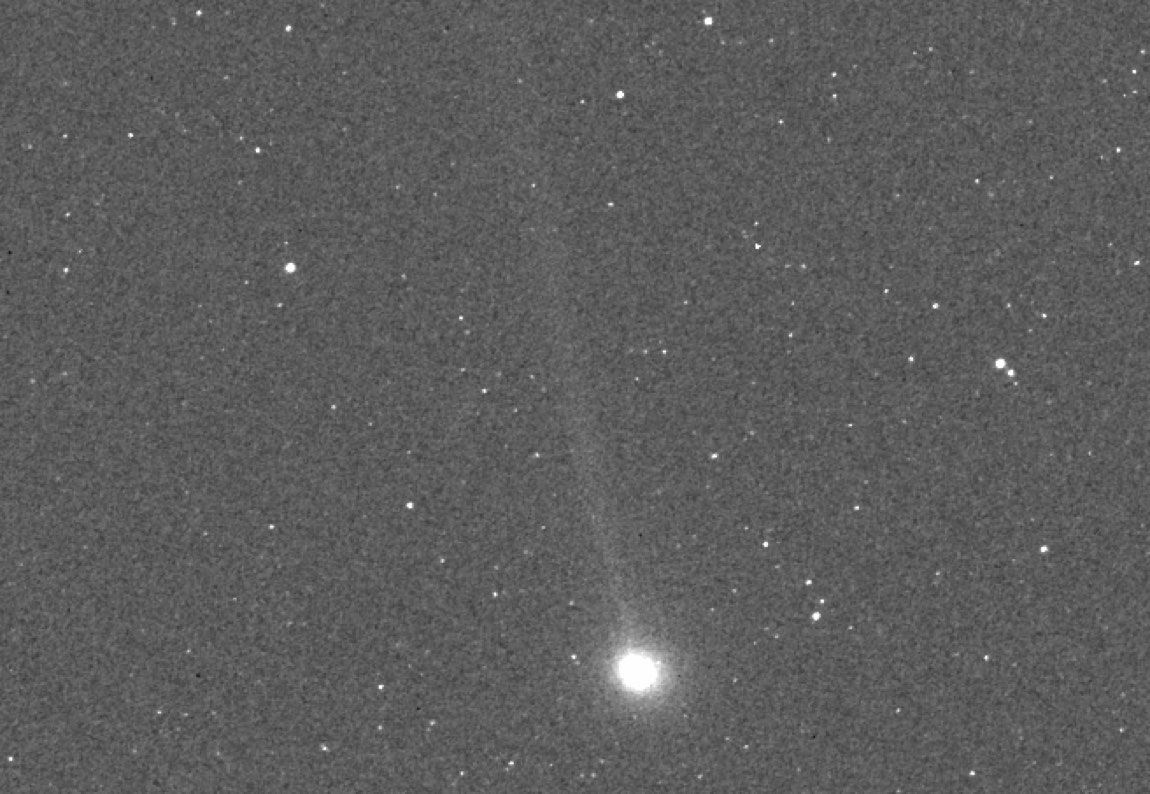
Catching Comet Encke near aphelion — its farthest point from the Sun — is a genuine technical challenge because the nucleus is then cold, inactive, and extremely faint. The first serious attempt came on 2 July 1913 using the 60-inch telescope at Mount Wilson Observatory, but the photographic plate was lost in the mail, an almost comic end to a difficult observation. A second attempt with the same telescope on 1 September 1913 did record an object about 1.5 arcminutes from the comet's predicted position, but orbital uncertainties were too large to confirm the identification at the time. A recalculation in the 1970s placed the revised predicted position only 2.0 arcseconds in right ascension and 4.6 arcseconds in declination from the imaged object, strongly suggesting it was indeed Encke. A more organised campaign around the aphelion of 3 September 1972 saw multiple teams succeed: Elizabeth Roemer and G. McCorkle on 15 August, R. E. McCrosky and C.-Y. Shao on 5 September, and Roemer again with M. R. Gonzales on 13 September.
11 Ancient Symbols and a Comet Connection
Among the more unusual threads in Encke's story is a proposed link to ancient cultural symbolism. One theory holds that the swastika shape, which appeared independently across multiple ancient cultures, could have been inspired by the visual appearance of an active comet viewed nearly head-on, its curved outgassing jets forming a pinwheel pattern. Comet Encke has sometimes been proposed as the specific comet responsible. In their 1982 book Cosmic Serpent, Victor Clube and Bill Napier reproduced an ancient Chinese catalogue of cometary shapes from the Mawangdui Silk Texts — a catalogue that includes a swastika-shaped comet — and suggested some drawings relate to the breakup of Encke's progenitor. Fred Whipple noted in his 1985 book The Mystery of Comets that Encke's polar axis is only 5 degrees from its orbital plane, an orientation that would have presented a pinwheel-like profile to ancient observers when the comet was more active. These ideas remain speculative but illustrate how a single comet can reach into cultural as well as scientific history.
12 Tunguska: A Fragment of Encke?
The Tunguska event of 30 June 1908 — a massive aerial explosion over a remote Siberian forest that flattened roughly 2,000 square kilometres of trees — has never been conclusively explained. One hypothesis, put forward by Slovak astronomer Ľubor Kresák, is that the impactor was a fragment of Comet Encke. The timing fits with the Beta Taurid meteor shower, which peaks in late June and early July and is associated with Encke's debris stream. Under this scenario, a chunk of cometary material, likely a loose, icy aggregate rather than a solid rock, entered the atmosphere and released its energy explosively before reaching the ground, leaving no crater. The theory is not universally accepted and competes with asteroid-fragment explanations. It is one of more than one theory, as the article notes, linking Encke to actual impacts of cometary material on Earth, reminding observers that this small, regularly returning comet is not merely a distant spectacle.
 ⤢