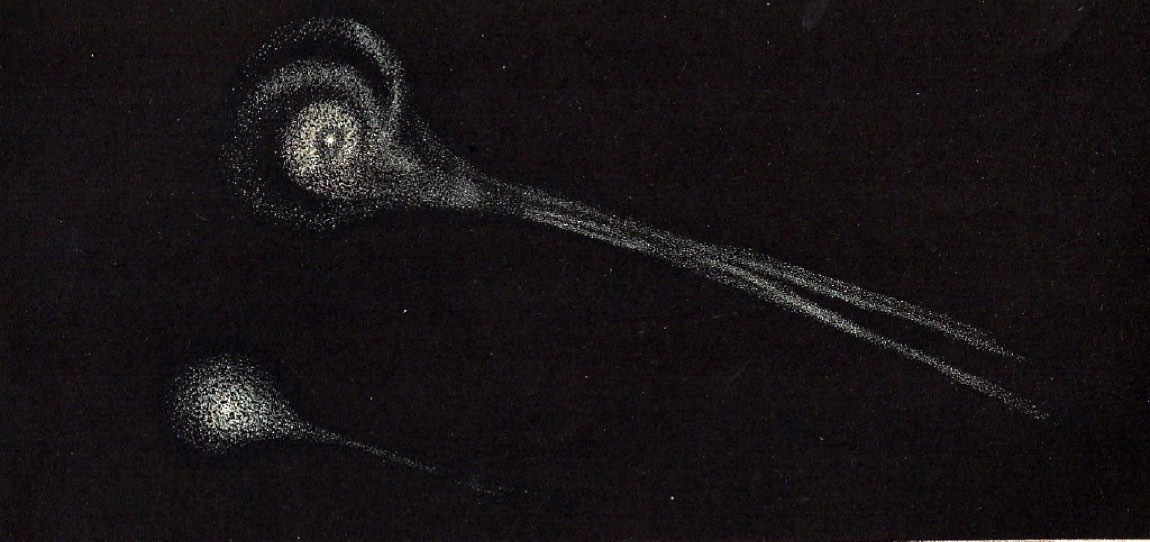
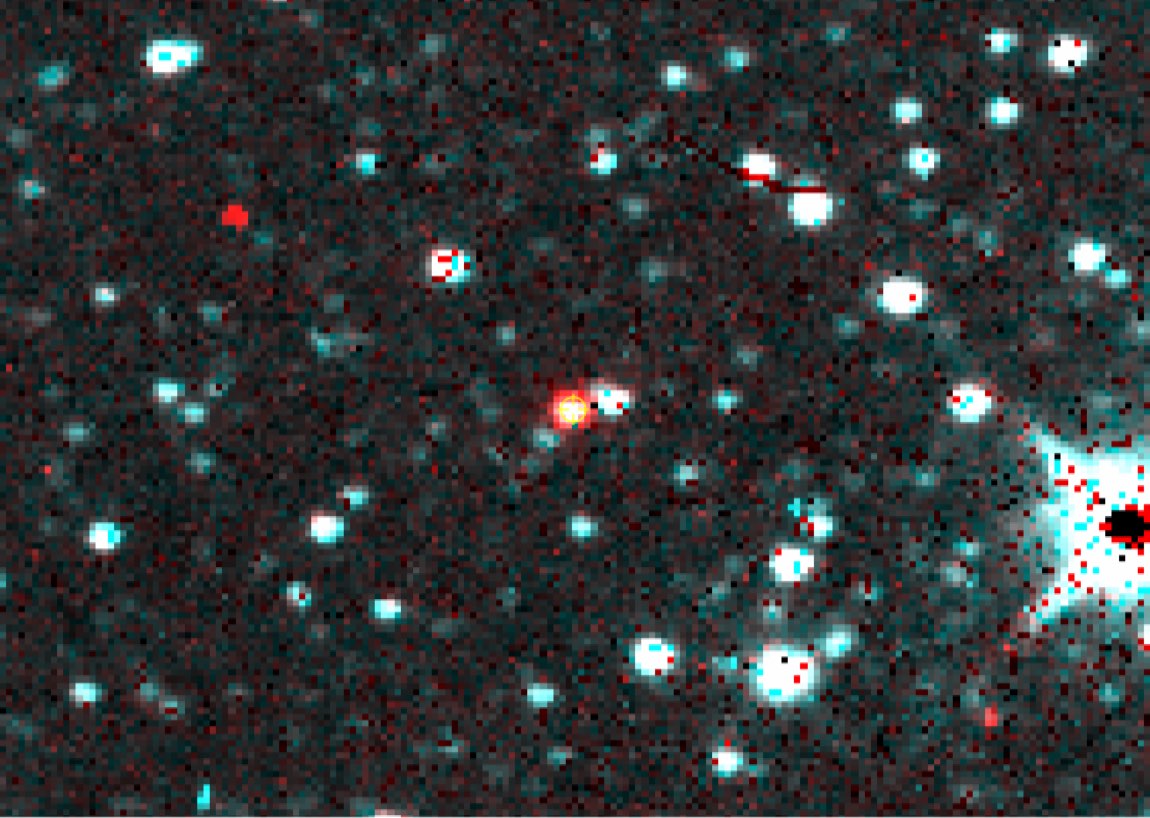
 Photograph · Near-Earth Object Wide-field Infrared Survey Explorer (NEOWISE), which is a join · Public domain
Comet · Deep guide
Comet Blanpain (289P)
Also called: 289P/Blanpain · D/1819 W1 · 2003 WY25
A comet lost for nearly two centuries, then found again as a tiny, nearly dead nucleus.
What is it?
Jean-Jacques Blanpain discovered this comet at Marseille in November 1819, but it was not seen again and was listed as lost. In 2003 a newly found asteroid-like object turned out to share its orbit, and the comet was confirmed recovered in 2013. It has a nucleus only about 160 m in radius and probably broke apart around 1819. It is the parent of the Phoenicid meteors, which produced a meteor storm in 1956.
The deep dive
Researched for the Atlas from Wikipedia — 289P/Blanpain (5,023 characters read) · updated Nov 14, 2026
01 A comet mistaken for a dead asteroid
For nearly two centuries, 289P/Blanpain simply vanished from the sky. After Jean-Jacques Blanpain spotted it on 28 November 1819 and Jean-Louis Pons independently confirmed it on 5 December of the same year, the comet was never seen again — earning the dreaded 'D' designation, standing for Disappeared or Dead. The turnaround came in 2003 when astronomer Marco Micheli and colleagues calculated the orbital elements of a newly discovered asteroid, 2003 WY25, and found they matched the lost comet's path with striking probability. Two years later, David C. Jewitt trained the University of Hawaii's 2.2-metre telescope on Mauna Kea toward the object and detected a faint coma — a wispy envelope of gas and dust that only comets produce. That observation strongly supported the idea that 2003 WY25 was either the lost comet itself or a surviving fragment of it. Official recognition as periodic comet 289P finally came in July 2013, closing a nearly 200-year chapter of astronomical mystery.
02 The enormous 2013 outburst that confirmed it
The event that clinched 289P's identity as a living comet was dramatic by any measure. In July 2013, the Pan-STARRS survey first caught the object in images taken on 4 July, showing it at around magnitude 20 — roughly as faint as objects ten thousand times dimmer than the naked-eye limit. Then it exploded in brightness by nine full magnitudes, one of the largest observed comet outbursts on record. At its peak it reached about magnitude 17.5, grew a coma spanning roughly 30 arcseconds across the sky, and threw out a broad tail. Astronomers estimated that the comet shed approximately 10⁸ kilograms of dust during the event — equivalent to around 1 percent of the comet's entire mass lost in a single eruption. At the time, 289P sat about 3.9 AU from the Sun, roughly the distance of the asteroid belt's outer edge, making the outburst all the more surprising at such a remote location.
03 The smallest cometary nucleus ever measured Deeper
When the University of Hawaii's 2.2-metre telescope examined 289P, astronomers faced the challenge of separating the nucleus's true size from the glow of surrounding coma. Working with an assumed albedo of 0.04 — the standard average reflectivity for short-period comets — they derived a nucleus radius of only about 160 metres, or roughly 520 feet. To put that in perspective, that is smaller than many city blocks and far tinier than the nuclei of famous comets like Halley or Wild 2. At the time of that measurement it held the record as the smallest known cometary nucleus. The researchers were careful to flag real uncertainty: the coma's contaminating light and the unknown phase function of the surface both introduce error, so the figure should be taken as an estimate. Nonetheless, the extreme smallness of the nucleus has direct consequences for understanding the comet's feeble activity and its relevance as a target for sample-return missions.
04 Rotation, dust, and remarkably weak outgassing Deeper
NEOWISE observations made during the 2019–20 apparition gave scientists their most detailed physical portrait of 289P. The comet's rotation period was measured at either 8.8536 ± 0.386 hours or 15.6 hours, with the shorter value considered more probable. Dust production proved exceptionally modest: ejected dust masses were 4,100 ± 200 kilograms inbound and 1,700 ± 200 kilograms outbound, with production rates of only 0.01 to 0.02 kilograms per second. The resulting fractional active area — the proportion of the nucleus surface that is actually outgassing — was just 3.8 ± 1.9 × 10⁻⁵, the smallest ever reported for any comet. The nongravitational acceleration, which measures how rocket-like outgassing nudges the comet off a pure gravitational orbit, was about an order of magnitude weaker than typical well-studied comets. NEOWISE also found no excess emission at 4.6 micrometres, indicating that the comet carries negligible amounts of carbon dioxide and carbon monoxide — volatile ices that drive activity in many other comets.
05 How close it passes and what that means
289P makes regular, relatively close passes by Earth. On 12 December 2003, it swung within 0.025 AU of our planet — about 3.7 million kilometres, or roughly ten times the distance to the Moon. After the December 2019 perihelion, it came to 0.091 AU on 11 January 2020, about 13.6 million kilometres away. The next close approach is scheduled for 6 November 2035, when it will close to 0.082 AU, or 12.3 million kilometres. The comet's Earth Minimum Orbit Intersection Distance currently sits at 0.015 AU, about 2.2 million kilometres — a measure of the closest the two orbits can theoretically bring the bodies together. These regular, predictable, reasonably close encounters are part of why mission planners consider 289P attractive: a spacecraft does not need enormous fuel reserves to reach it, and multiple windows exist within a single decade.
06 The Phoenicid meteors and a contested parentage
Every year, Earth passes through the Phoenicid meteor stream, and 289P/Blanpain has been the leading candidate for its source ever since the first Phoenicid meteor storm lit up skies in 1956. That storm was traced to dust trails laid down from the late 18th through the early 19th centuries, the very era when Blanpain first observed the comet. Orbital analysis of 2003 WY25 reinforced this connection, and many researchers concluded that the comet was probably already fragmenting during its 1819 return. Elevated Phoenicid activity was again observed on 2 December 2014, when Earth crossed trails deposited in the early 20th century — suggesting the comet was still active then, though less vigorously than two centuries before. However, a 2025 study raised doubts: the nucleus is simply too small to account for the total mass of the entire meteoroid stream on its own. The study proposed that two other comets, 46P/Wirtanen and 104P/Kowal, may have additionally contributed debris, leaving the question of sole parentage genuinely open.
07 A comet apparently breaking apart over centuries Deeper
Several independent lines of evidence suggest that 289P has been fragmenting over a timescale of centuries rather than a sudden single event. The original 1819 observer Blanpain described the nucleus as "very small and confused" — an ambiguous description that hints at a loosely organised or already disrupted body. Orbital analysis suggests the comet was likely breaking up at the time of that apparition. The enormous 2013 outburst, in which roughly 1 percent of the comet's mass was shed in one episode, further points to a structurally weak body shedding material episodically. The tiny fractional active area measured by NEOWISE — the smallest ever recorded — could mean that most of the nucleus surface is an inert rubble of processed material, with only minute patches still capable of sublimating. The 2025 study questioning whether the nucleus alone could supply the Phoenicid stream's total mass also implies that significant material was lost in the past, possibly including sizable fragments that now orbit independently.
08 Jean-Jacques Blanpain and his one-comet legacy
The comet's name honours Jean-Jacques Blanpain, who made his discovery on 28 November 1819. Beyond this single discovery, the article provides little detail about Blanpain himself, but the comet's subsequent story is remarkable for how thoroughly it erased his achievement for nearly two centuries. The independent co-discoverer, Jean-Louis Pons, was one of the most prolific comet hunters of his era, yet even Pons's confirmation could not secure further observations sufficient to maintain the comet's orbital solution. The irony is that the object Blanpain found was so small and so faintly active that it essentially hid in plain sight as an unremarkable asteroid until modern wide-field digital surveys and infrared space telescopes had the sensitivity to detect its residual cometary behaviour. The 'D' designation attached to it for nearly 200 years was eventually replaced by the 'P' of a confirmed periodic comet and the number 289 — a quiet vindication of Blanpain's original report.
09 Pan-STARRS and the rediscovery in outburst
The formal recovery of 289P owed everything to the Pan-STARRS survey, a wide-field imaging system designed to scan the entire accessible sky repeatedly and catch transient events. The first detection in the 2013 campaign came on 4 July, when the object appeared at around magnitude 20. Because Pan-STARRS operates systematically rather than pointing at known targets, it caught the comet mid-outburst entirely by chance — the survey was simply doing its job. The outburst's nine-magnitude brightening is what made the object conspicuous enough to trigger follow-up. Without the outburst, the nucleus in its quiescent state might have been too faint for routine detection given its tiny size and weak activity. The event thus illustrates how modern sky surveys transform comet science: objects that would have remained permanently lost in earlier eras can now be recovered and characterised when they reveal themselves through unusual activity.
10 Two proposed missions and why they chose it
289P/Blanpain has attracted attention from two separate space agencies planning missions in the 2030s. Japan's Next Generation Small-Body Return mission, known as NGSR, has proposed the comet as its primary target, with the explicit goal of returning a cometary sample to Earth — the first such achievement since NASA's Stardust mission delivered material from comet Wild 2. The article states that 289P was chosen for its favourable orbital characteristics and small size, though the specifics of that orbital advantage are not elaborated. Separately, the European Space Agency's Comet Interceptor mission has listed 289P as a backup target, with a planned flyby date of 23 November 2035 if the comet is selected. That date aligns closely with the November 2035 close Earth approach, illustrating how the comet's orbital timing makes it accessible during a narrow window that both agencies have independently identified as an opportunity.
11 Observing 289P: when and how well it performs
Under normal, non-outburst conditions, 289P/Blanpain is an extremely challenging target for amateur and even professional telescopes, given its nucleus radius of only about 160 metres and its record-low fractional active area. The 2013 outburst temporarily lifted it to around magnitude 17.5, which is within range of large amateur instruments under dark skies, but that was an exceptional event. The article notes that the comet was better placed for observation near and after the December 2019 perihelion, with its closest Earth approach in that cycle occurring on 11 January 2020 at 0.091 AU. The next favourable opportunity comes around the November 2035 close approach at 0.082 AU. Because the comet's normal quiescent brightness is not specified in the article, observers should check current ephemeris data before attempting to locate it, and should be aware that another major outburst like 2013 would be required to make it readily detectable with modest equipment.