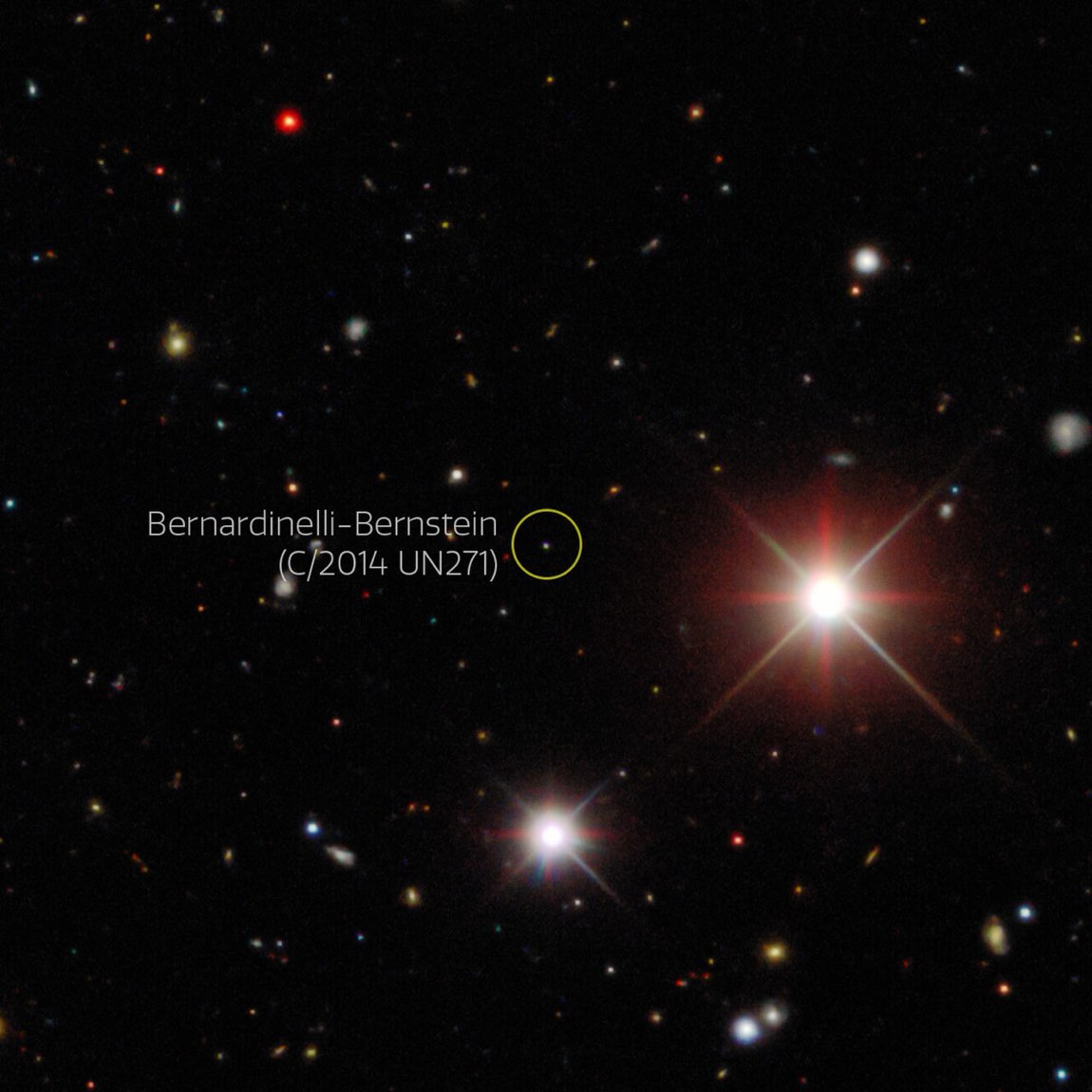
 Photograph · Dark Energy Survey/DOE/FNAL/DECam/CTIO/NOIRLab/NSF/AURA/P. Bernardinelli & G · CC BY 4.0
Comet · Deep guide
Comet Bernardinelli–Bernstein (C/2014 UN271)
Also called: C/2014 UN271 · 2014 UN271 · Comet BB
The largest Oort cloud comet known, with a nucleus more than 100 km across.
What is it?
C/2014 UN271 was discovered by Pedro Bernardinelli and Gary Bernstein in archive images from the Dark Energy Survey. When first imaged in October 2014 it was 29 AU from the Sun, almost as far as Neptune, the greatest distance at which a comet has been discovered. Its nucleus is estimated at roughly 120 km across, making it the largest known Oort cloud comet. It will come no closer than about 11 AU, just beyond Saturn, around January 2031, so it will never be a naked-eye sight.
The deep dive
Researched for the Atlas from Wikipedia — C/2014 UN271 (Bernardinelli–Bernstein) (15,799 characters read) · updated Nov 14, 2026
01 How the comet was hiding in plain sight
Bernardinelli–Bernstein was not found by a telescope pointed deliberately at the outer Solar System — it was hiding inside a mountain of archival data. Pedro Bernardinelli and Gary Bernstein were running an algorithm-assisted search for slowly-moving trans-Neptunian objects through images collected by the Dark Energy Survey (DES) at Cerro Tololo Inter-American Observatory in Chile. The comet turned up in 42 DES images spanning 10 October 2014 to 26 November 2018, glowing at 22nd apparent magnitude — roughly 400,000 times too faint for the naked eye. At that point it looked like nothing more than a point of light, indistinguishable from an asteroid. What gave it away as a comet was the shape of its path: the long observation arc revealed a near-parabolic trajectory aimed inward from the Oort cloud. The discovery was formally announced by the Minor Planet Center on 19 June 2021. Within days, astronomers found it in even older images from Paranal Observatory's VISTA survey, pushing the earliest confirmed sighting back to 15 November 2010, when the comet was 34.1 AU — roughly 5.1 billion kilometres — from the Sun.
02 A coma igniting billions of kilometres from the Sun
Most comets only begin to visibly outgas when solar heat is strong enough to boil their ices — typically inside the orbit of Jupiter. Bernardinelli–Bernstein breaks that rule dramatically. Cometary activity was first reported just three days after the discovery announcement, on 22 June 2021, by Tim Lister at Las Cumbres Observatory in Sutherland, South Africa, and independently by Luca Buzzi at the SkyGems Remote Telescope in Namibia. At that moment the comet was 20.2 AU from the Sun, more than twice Jupiter's distance, yet it was already one magnitude brighter than predicted and showing a slightly asymmetric coma up to 15 arcseconds across. Going further back, TESS satellite images from September 2018 revealed a diffuse coma at least 43 arcseconds wide when the comet was 23.8 AU out, and re-examination of DES images pushed signs of activity back to 2017, at 25.1 AU. The coma's brightness has been growing exponentially since 2017. As of 2025, only five other comets have ever been confirmed active at heliocentric distances greater than 20 AU, making BB one of the most remote cometary outgassers ever recorded.
03 What is actually powering activity so far out Deeper
At 20–25 AU, sunlight is roughly 400–625 times weaker than at Earth, far too faint to sublimate water ice efficiently. The exponential brightening of Bernardinelli–Bernstein's coma at those distances is instead consistent with sublimation of more volatile ices — most likely carbon dioxide (CO₂) or ammonia (NH₃) — from the nucleus surface. Carbon monoxide (CO) is another candidate supervolatile that is probably present, but its emissions had not yet been detected as of the article's coverage. Infrared observations by the NEOWISE spacecraft in November 2020, when the comet was 20.9 AU from the Sun, placed only an upper limit on CO outgassing — roughly ten times the outgassing rate of Comet Hale–Bopp at the same distance. Analysis of the coma's shape in TESS images from 2018–2020 suggests the coma is made of submillimetre-sized dust grains ejected at low speeds of around 10 m/s — about the pace of a sprinting human. Those gentle ejection speeds imply the comet had been active for two to ten years before the 2018 TESS observations, meaning activity may have begun even before the initial DES detection at 29.0 AU.
04 A nucleus darker than coal
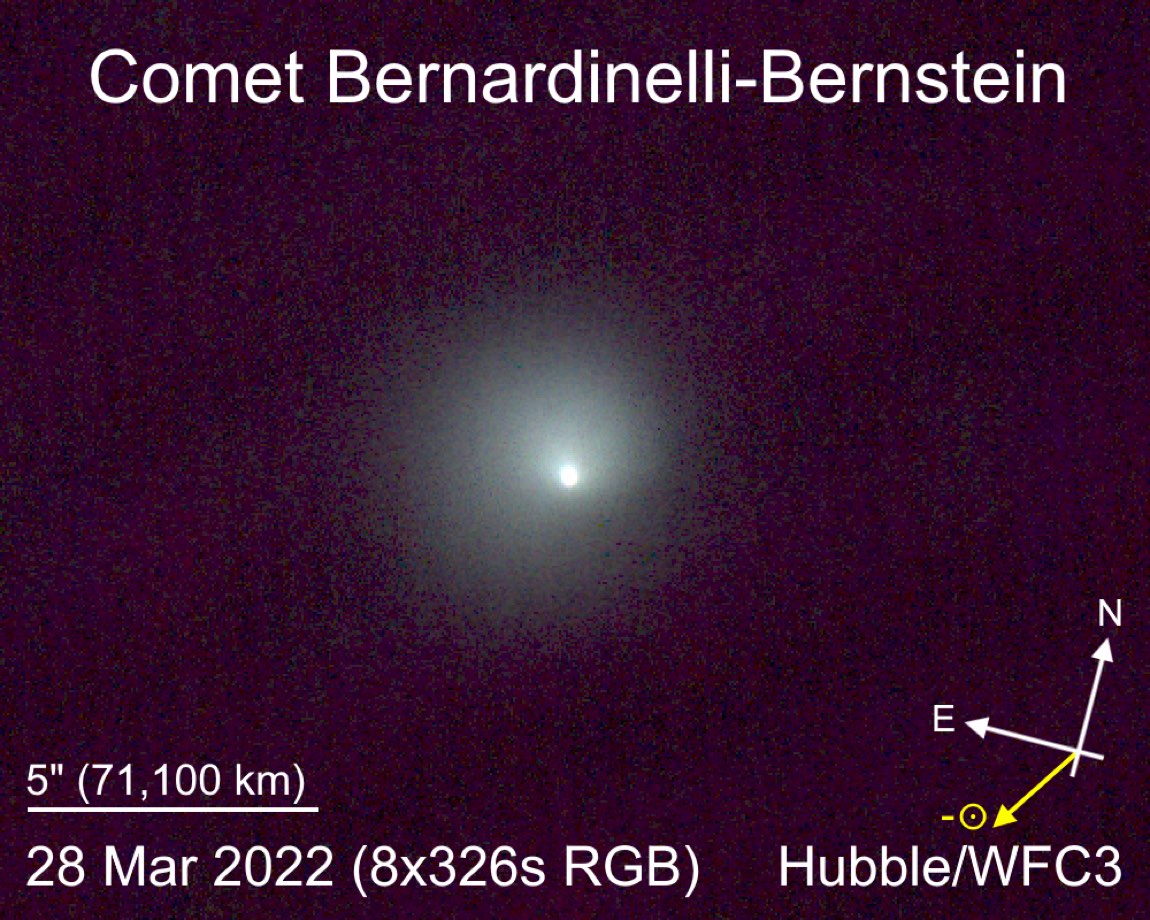
The surface of Bernardinelli–Bernstein is extraordinarily dark. Radio thermal emission measured by the Atacama Large Millimeter Array (ALMA) in 2021 gave a maximum nucleus diameter of 137 ± 17 km. Hubble Space Telescope observations in 2022 confirmed a large size, placing a lower limit of 119 ± 15 km. Working from that minimum diameter and the nucleus's visual absolute magnitude of 8.63 ± 0.11, astronomers calculated a maximum geometric albedo of just 4.4% ± 1.2% — meaning the surface reflects less than one-twentieth of the sunlight that hits it. Coal reflects roughly 4–5% of visible light, so BB's nucleus is comparable to some of the darkest natural material humans mine from the Earth. The low albedo is consistent with other comet nuclei across both short- and long-period populations and is generally attributed to a surface coating of carbon, organic compounds, and sulfides produced when cosmic rays break apart molecules over millions of years. Optically, the surface appears moderately red — more reflective at longer wavelengths — similar to, but slightly less red than, most long-period comets.
 ⤢
05 The record-breaking scale of its nucleus
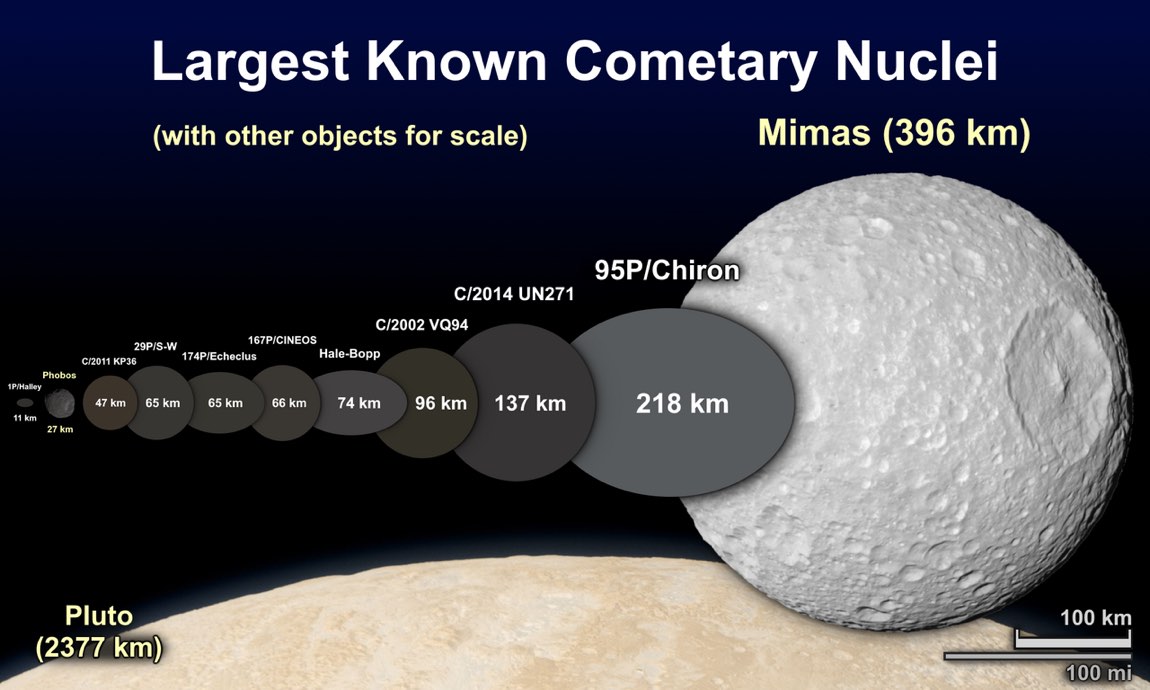
Even at its conservative lower-bound diameter of 119 km, Bernardinelli–Bernstein is more than 50 times larger across than a typical comet, which is usually less than 2 km in diameter. The previous record holder for largest known long-period comet was C/2002 VQ94 (LINEAR) at 96 km, followed by the famous Comet Hale–Bopp at 74 km. BB eclipses both. Among all known comets, only the active centaur 95P/Chiron, with a diameter of approximately 215 km, is larger. NASA's rough mass estimate for BB is 450 quadrillion kg — about 450 million billion kilograms — which is approximately 100,000 times the mass of a typical comet. That extraordinary mass carries a practical consequence: the nucleus is gravitationally strong enough to recapture icy ejecta that falls back onto its surface after being thrown off, a behaviour also observed on Comet Hale–Bopp after its perihelion. This means BB's surface chemistry could evolve differently from smaller comets, which simply shed material into space and never recover it.
06 The 2021 outburst: a sudden violent sneeze
On 9 September 2021, instruments at Las Cumbres Observatory caught the comet doing something sudden and dramatic: it brightened by 0.65 magnitudes compared to images taken earlier the same day, temporarily reaching an apparent magnitude of 18.9. The outburst was reported publicly on 14 September. Calculations based on how quickly and how much the comet brightened indicate that between 10 and 100 million kg of dust — the equivalent of roughly 10,000 to 100,000 tonnes — was ejected in a short period. At the time, the comet was about 19.9 AU from the Sun, still more than three times farther than Jupiter. The comet's brightness faded back to the 19th magnitude by December 2021. Such outbursts are well documented on other comets and are thought to arise when pockets of volatile material suddenly vent through weaknesses in the surface crust. What makes this one noteworthy is simply the colossal distance at which it occurred — a reminder that BB is not waiting for the inner Solar System to wake up.
07 An orbit shaped across 1.5 million years Deeper
Bernardinelli–Bernstein is visiting the inner Solar System for what is almost certainly the first time since its orbit was last shaped by the distant reaches of the galaxy. Its inbound orbit, calculated back to the year 1600 by JPL Horizons, has a semimajor axis of roughly 21,000 AU — about 0.3 light-years. That places its previous aphelion, the farthest point from the Sun, at around 42,000 AU (0.7 light-years) in the outer Oort cloud, which BB left approximately 1.5 million years ago. Planetary perturbations will reshape its outbound orbit: once BB swings past perihelion and climbs back out through the planetary region, it will travel outward on a path with an aphelion of roughly 59,000 AU (0.9 light-years) and an orbital period of approximately 5 million years. The object is only very loosely bound to the Sun and is susceptible to nudges from the galactic tide during its long Oort cloud sojourn. Its trajectory is classed as dynamically new — a comet making its first close pass past the Sun — which is consistent with its large size, since comets lose mass and volatile content with each perihelion passage and fade over time.
08 Why it will never be a naked-eye spectacle
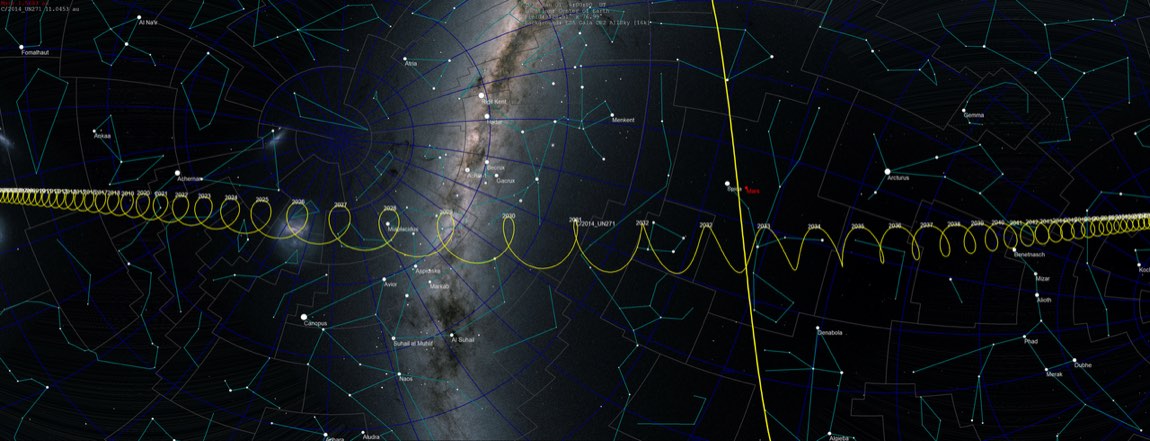
Despite its immense nucleus, Bernardinelli–Bernstein will disappoint anyone hoping for a Great Comet. Its perihelion on around 22 January 2031 brings it only to 10.95 AU from the Sun — just outside Saturn's aphelion of 10.1 AU — meaning it never enters the inner Solar System where comets typically flare into brilliance. At its brightest, the comet is not expected to exceed the brightness of Pluto (magnitude 13–16), and is more likely to reach only the brightness of Pluto's moon Charon, at magnitude 16.8. Even if it reaches magnitude 13, observers would need a telescope with at least a 200 mm aperture to see it visually. Geography adds another limitation: the comet reaches its maximum southern declination of −76° in January 2027 and will not rise above the horizon at locations north of latitude 14° N — meaning the vast majority of the Northern Hemisphere population cannot view it at all during its peak period. It will not cross the celestial equator until 2034, by which point it will be fading on its outbound journey.
 ⤢
09 The uncertain spin of a giant nucleus Deeper
How fast Bernardinelli–Bernstein rotates remains genuinely unresolved. Continuous monitoring by NASA's TESS satellite in both 2018 and 2020 found no detectable periodicity, placing an upper limit of 0.3 magnitudes on how much the nucleus brightness varies as it spins. When Bernardinelli and his DES collaborators analyzed ground-based datasets from 2018 and earlier, they found an apparent variability of about 0.2 magnitudes but again no clear period — and they cautioned that small dust outbursts could mimic rotational brightness changes, making the true rotational variability potentially even smaller. A competing result appeared in April 2022, when astronomers Ignacio Ferrin and A. Ferrero, working from the Minor Planet Center's long-term light curve database, reported a rotation period of 20.6 ± 0.2 days with an amplitude of 0.5 ± 0.1 magnitudes. That amplitude directly conflicts with the TESS upper limit and the DES findings. The disagreement has not been resolved, and the rotation period of one of the largest comets ever found remains an open question.
10 Mapping what a future mission might look like Deeper
No space mission to Bernardinelli–Bernstein has been proposed as of 2022, and no existing approved mission can be redirected toward it. The European Space Agency's Comet Interceptor mission, set to launch in 2029, is designed for long-period comets passing within Earth's orbit and cannot reach BB's distant perihelion. However, a 2021 study by the Initiative for Interstellar Studies mapped out what a dedicated flyby mission would require. A spacecraft similar to New Horizons, using the same launch vehicle but skipping a Jupiter gravity assist, could reach BB by August 2033 if launched in October 2029. That August 2033 date is significant: it is when the comet crosses the ecliptic plane at 11.9 AU from the Sun, making it geometrically convenient for spacecraft arriving from the inner Solar System. Flyby trajectories using Jupiter gravity assists widen the launch window to as early as 2020–2027. Arrival velocities relative to the comet would be 12–14 km/s in all scenarios. A full rendezvous — staying in orbit around BB — is theoretically possible using a Jupiter gravity assist after the comet crosses the ecliptic, with launch dates in 2030–2034 and flight durations of roughly 14–15 years.
11 What occultations can teach us without landing Deeper
One way to learn more about Bernardinelli–Bernstein without sending a spacecraft is to watch it pass in front of a star — an event called a stellar occultation. When a comet drifts across a bright background star, the starlight dims for a fraction of a second, and careful timing of that dip from multiple ground stations can reveal the comet's precise size, shape, and position with far better accuracy than direct imaging allows. It can also reveal surrounding dust structures and potentially the presence of satellites. Astronomers identified a handful of such opportunities for BB between 2021 and 2025. The first attempt was made from Australia and New Zealand on 19 September 2021, but poor weather prevented any detection. Occultation campaigns remain one of the best low-cost tools astronomers have for characterising distant comets, and the ALMA diameter measurement of 137 ± 17 km itself carries a caveat — up to 24% of the thermal signal could come from an unseen dust coma rather than the nucleus, which is exactly the kind of ambiguity a successful occultation could resolve.
12 Why giant comets are so rarely discovered
If comets this large exist, why haven't we found more of them? Part of the answer is a process called fading. Comets on bound orbits around the Sun lose mass, ice, and volatile compounds every time they swing through the inner Solar System. Each passage leaves the comet a little smaller, dimmer, and less active than before. Over millions of years, they dwindle into inert, dark rubble that blends in with ordinary asteroids. A comet the size of Bernardinelli–Bernstein that had made dozens of previous perihelion passes would have shed enormous amounts of material and become far harder to detect. BB, by contrast, appears to be dynamically new — arriving on its first close approach to the Sun in roughly 1.5 million years, and perhaps ever. Its enormous size is therefore at least partly a product of its pristine condition. The same fading phenomenon also means that when we do find a giant active Oort cloud comet, it is almost certainly a first-timer, preserving chemistry and structure largely unchanged since the formation of the Solar System roughly 4.5 billion years ago.
 ⤢