 Photograph · Unknown author Unknown author · Public domain
Comet · Deep guide
Comet Arend–Roland (Great Comet of 1957)
Also called: C/1956 R1 · Great Comet of 1957
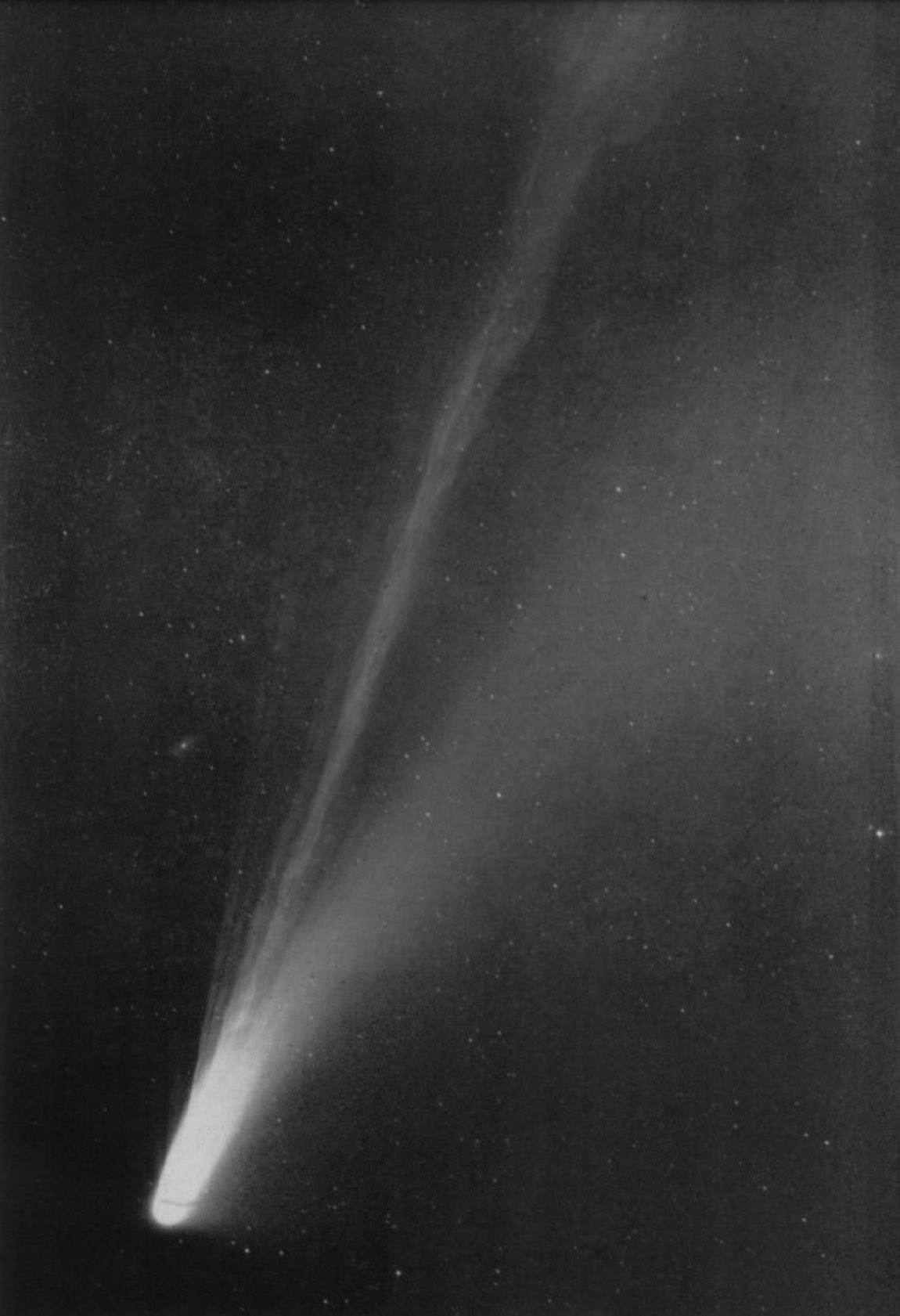
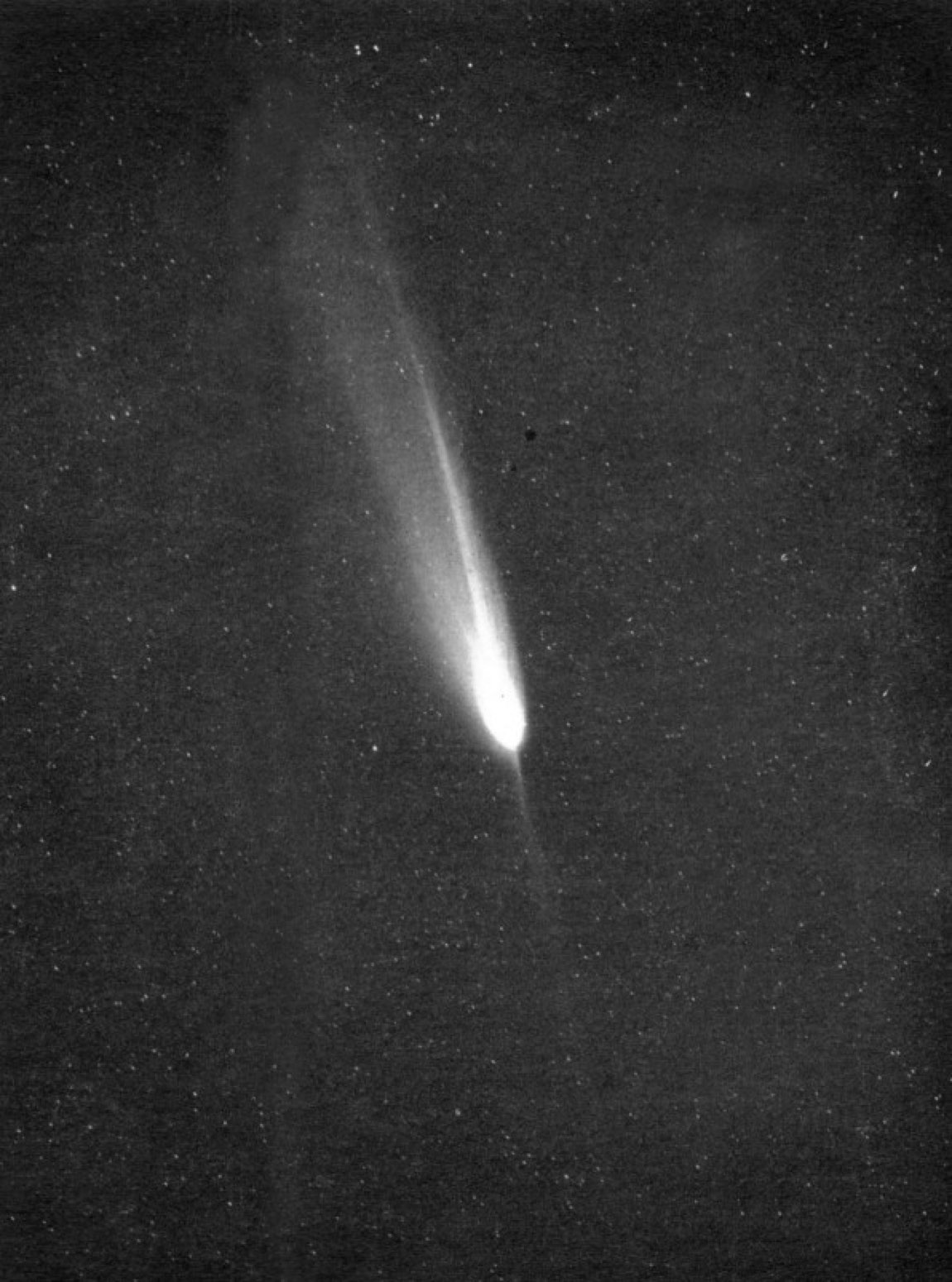
Famous for its spike-like 'anti-tail' that seemed to point toward the Sun.
What is it?
Belgian astronomers Sylvain Arend and Georges Roland found this comet on photographic plates in November 1956. After perihelion in April 1957 it became an easy naked-eye object, and around 22–25 April it showed a striking anomalous tail, or antitail, pointing sunward and stretching up to 12 degrees. Its path is slightly hyperbolic, so it is leaving the Solar System for good. It was the subject of the very first episode of the BBC's The Sky at Night.
The deep dive
Researched for the Atlas from Wikipedia — Comet Arend–Roland (4,339 characters read) · updated Nov 14, 2026
01 How Two Astronomers Found It by Accident
On the night of November 6, 1956, Belgian astronomers Sylvain Arend and Georges Roland were doing something entirely routine: using a double astrograph at the Uccle Observatory in Brussels to photograph and catalog minor planets. Comets were not on their agenda. Yet when they examined their photographic plates, something unexpected stared back — a fuzzy object with a strong central condensation and a short tail, sitting at visual magnitude 10, faint enough to be invisible to the naked eye but unmistakable in a photograph. Because it was the eighth comet discovered in 1956, it was initially catalogued as Arend–Roland 1956h. That early catch — months before the comet would put on its real show — was enormously valuable to the scientific community. Observing programs could be planned, specialized equipment prepared, and telescope time reserved well in advance of perihelion. The serendipitous discovery during a minor-planet survey turned out to be one of the most scientifically productive lucky breaks in mid-twentieth-century comet astronomy.
02 A Naming System With Multiple Lives
Few celestial objects have worn as many official labels as Arend–Roland. Its first name, 1956h, simply meant it was the eighth comet found that year. Because it reached perihelion third among comets in 1957, it was rechristened 1957 III. Eventually the International Astronomical Union settled on the now-standard format: C/1956 R1 (Arend–Roland). Every character in that string carries meaning. The "C/" signals that the comet is non-periodic — it will not return. "1956" anchors the discovery year. "R" designates the specific half-month of discovery, equivalent to September 1–15. "1" means it was the first comet reported from that fortnight. The discoverers' names follow in parentheses as a human flourish inside an otherwise clinical code. This layered naming reflects how comet nomenclature evolved during the twentieth century, with each successive designation preserving a different kind of information: discovery sequence, perihelion timing, orbital type, and the people who first saw it.
03 Orbital Calculations and a Surprising Wavy Pattern Deeper
The orbital elements for Arend–Roland were computed by astronomer Michael Philip Candy, who used early observations to predict perihelion passage on April 8, 1957 — a prediction that proved correct. The comet was tracked over a period of 520 days, allowing unusually precise orbital elements to be derived. But when scientists examined the full distribution of those elements, they found something troubling: a wavy pattern that could not be explained by gravity alone. Two interpretations competed. One invoked non-gravitational forces — probably outgassing thrust from the comet's nucleus itself — that subtly perturbed the orbit. When orbital solutions were recomputed by Marsden in 1970 to include non-gravitational forces varying as the inverse square of heliocentric distance, the numbers shifted noticeably. The competing explanation was more dramatic: the comet may have originated not from the Oort cloud at the edge of our Solar System but from interstellar space entirely. The hyperbolic orbit it traveled was fast enough to escape the Solar System forever, lending at least circumstantial support to the interstellar origin hypothesis, though the debate was never fully resolved.
04 The Antitail: A Spike Pointing at the Sun
Most cometary tails stream away from the Sun, pushed outward by solar wind and radiation pressure. Arend–Roland broke that visual rule dramatically. By April 22, 1957, observers noticed a prominent antitail — a spike of material that appeared to jut toward the Sun rather than away from it. It spanned 5 degrees of arc on that date, roughly ten times the width of the full Moon. The antitail continued growing, reaching its maximum extent of 12 degrees on April 25, before vanishing entirely by April 29. The phenomenon was not supernatural; it arose because dust particles released by the comet between February 6 and March 1, 1957, spread along the orbital plane. When Earth's viewing angle crossed that plane, the flat sheet of dust appeared foreshortened into what looked like a forward-pointing spike. It was an optical geometry trick, but a spectacular one, and its timing and extent were recorded in sufficient detail for scientists to trace exactly when the responsible dust had been ejected — weeks before perihelion.
05 An Erupting Dust Factory Near the Sun Deeper
The scale of material Arend–Roland shed near perihelion is staggering. At closest approach to the Sun on April 8, 1957, the comet was releasing an estimated 75,000 kilograms of dust every second — roughly 83 tons per second, comparable to emptying a large dump truck every fraction of a heartbeat, continuously. Simultaneously it was liberating approximately 1.5 × 10³⁰ gas molecules per second. Six days before perihelion, on April 2, scientists believe an outburst of dust occurred, a sudden surge in activity above the already-high baseline rate. Over the full arc of its inner Solar System passage, Arend–Roland contributed material to the zodiacal cloud — the diffuse band of dust that stretches along the ecliptic plane and causes the zodiacal light visible from dark sites. Estimates of the total dust released range widely, from 3 × 10⁸ to 5 × 10¹⁰ kilograms, a spread of more than two orders of magnitude that reflects genuine uncertainty in how particle sizes and ejection velocities are modeled. Even at the low end of that range, the quantity would fill roughly 120 Olympic swimming pools.
06 The Tail's Changing Shape Night by Night
Throughout April and May 1957, skywatchers who followed Arend–Roland closely were rewarded with a tail that refused to stay the same. At maximum, the main tail stretched 15 degrees across the sky — thirty times the apparent diameter of the full Moon, long enough to span a large portion of a raised fist at arm's length. But its structure was equally compelling. On April 16, distinct streamers were visible within the tail. By April 29, the tail had split into three separate beams — a dramatic fragmentation of what had been a single luminous fan. Streamers appeared again on May 5. This variability probably reflected real changes in the ejection rate and direction of material from the nucleus, combined with the changing geometry as Earth moved relative to the comet. The tail's behavior during this period provided early evidence that cometary activity is not steady but episodic, driven by localized active regions on the nucleus that switch on and off as different surface patches rotate into sunlight.
07 Radio Silence: A Historic Failed Experiment
Arend–Roland earned a quiet but historically important scientific footnote: it was the first comet for which astronomers attempted to detect radio emissions at multiple frequencies. The reasoning was straightforward — comets release vast quantities of gas and dust, and astronomers wondered whether any of that activity would produce detectable signals in the radio band. The efforts, carried out in 1957, returned nothing. The comet was radio-silent as far as the instruments of the era could tell. That failure was not forgotten; it set a baseline and shaped expectations for future attempts. Comets were not successfully detected in radio wavelengths until the 1973 passage of Comet Kohoutek — sixteen years later. In hindsight, the failed 1957 radio campaign with Arend–Roland was the opening move in a long search, and the technology and techniques that eventually worked with Kohoutek were built in part on understanding why earlier attempts had come up empty.
08 The Night a Comet Launched a TV Institution
On April 24, 1957 — just sixteen days after perihelion — the BBC aired the very first episode of The Sky at Night, its long-running astronomy program. The subject of that debut broadcast was Comet Arend–Roland, then still visible in northern skies and fading from its peak of magnitude −1. The timing was not coincidence; the comet's spectacular appearance gave the new program an immediate, tangible subject to put in front of a general audience. The Sky at Night would go on to become one of the longest-running programs in television history, but its origin is permanently tied to the brightest comet of 1957. Carl Sagan also captured the comet's public impact in his 1980 book Cosmos, recounting an anecdote from his time on duty at an observatory near Chicago. A late-night phone call from an inebriated man asked what the "fuzzy thing" was in the sky. When Sagan described it as "a snowball, one mile wide," the caller paused and then demanded to speak to a "real 'shtronomer."
09 Fading Fast: The Brightness Curve After Perihelion
Arend–Roland peaked at magnitude −1, bright enough to be easily visible in daylight-adjacent twilight conditions and comparable to some of the brightest stars in the sky. The decline afterward was rapid and unforgiving. By the start of May — less than a month after perihelion — the comet had faded to visual magnitude 5.46, sitting right at the edge of naked-eye visibility under ideal dark skies. By May 8 it had dropped to magnitude 7, definitively below what an unaided human eye can detect under any conditions. On May 29, just seven weeks after peak brightness, it had fallen to magnitude 8.55, requiring at least a decent pair of binoculars. This steep brightness curve is characteristic of a comet that was powered almost entirely by solar heating: once it swung past perihelion and began retreating, solar input dropped sharply, outgassing slowed, and the coma and tail that had made it spectacular quickly dispersed. The comet would never again approach the Sun — its hyperbolic trajectory guaranteed a one-way trip out of the Solar System.
10 A One-Way Journey: The Hyperbolic Trajectory Deeper
The orbital designation "C/" in C/1956 R1 carries a profound implication: Arend–Roland is classified as a non-periodic comet, and in this case the reason is especially absolute. The comet was traveling on a hyperbolic orbit, meaning its velocity exceeded the local escape velocity of the Solar System. No gravitational nudge could bend that path back into a closed ellipse. Once it rounded the Sun and headed outward, it was gone permanently — no future return, no second perihelion, no possibility of observation by any future earthbound astronomer. Its ultimate origin remains contested. It may have been a long-period Oort cloud object scattered inward by a gravitational perturbation and then accelerated to escape velocity by the Sun's gravity combined with non-gravitational outgassing forces. Alternatively, the wavy pattern in its orbital elements and the hyperbolic excess velocity raised the possibility that it arrived from interstellar space in the first place — predating the confirmed interstellar object 1I/ʻOumuamua by six decades. The question was not definitively answered by the available data.
11 Early Warning: What a Five-Month Lead Time Enabled
When Arend and Roland found their comet in November 1956, perihelion was still nearly five months away. At that moment, the comet sat 2.5 AU from the Sun and 1.7 AU from Earth — far out in the Solar System, still building toward its peak. That extended lead time was scientifically invaluable. Observing committees could assign telescope time thoughtfully rather than scrambling. Specialized instruments for spectroscopy, photometry, and radio detection could be calibrated and positioned. The comet spent its pre-perihelion months in the constellation Pisces, reaching magnitude 7.5–8 by February — still faint, but trackable and providing months of baseline data on how its brightness and structure evolved as it warmed. Michael Philip Candy's early orbital calculation allowed confident prediction that the comet would put on a prominent display in April in the northern hemisphere. That prediction allowed the BBC, among others, to plan programming around it. The contrast with comets discovered days or weeks before perihelion — leaving almost no preparation time — was stark, and Arend–Roland became something of a model case for what systematic photographic sky surveys could enable.