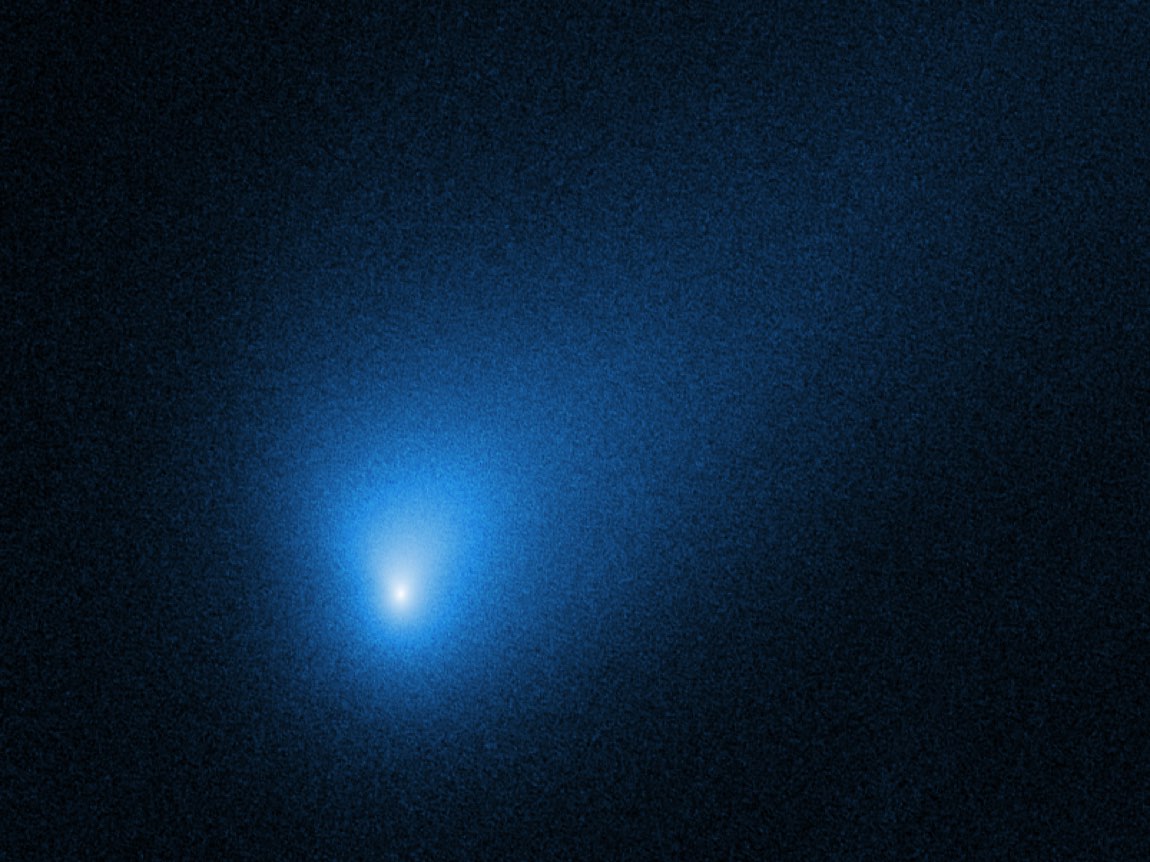
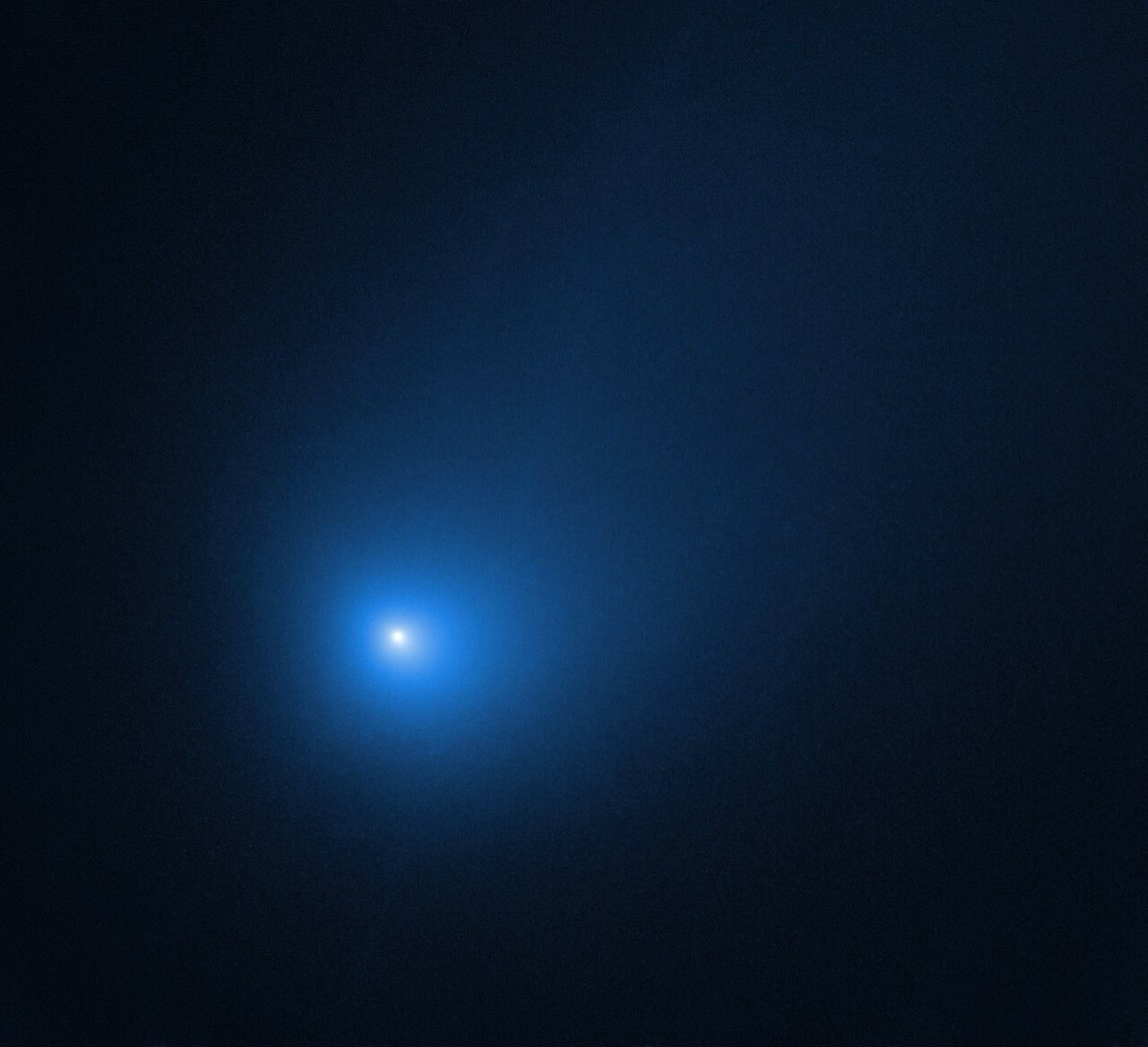
 Photograph · NASA, ESA, and D. Jewitt (UCLA) · Public domain
Comet · Deep guide
2I/Borisov
Also called: C/2019 Q4 (Borisov) · 2I · Comet Borisov
The first comet confirmed to come from another star system.
What is it?
2I/Borisov was discovered by amateur astronomer and telescope maker Gennadiy Borisov in Crimea in August 2019. Its orbit is strongly hyperbolic, with an eccentricity of about 3.36, so it is not bound to the Sun and came from interstellar space. Unlike 1I/ʻOumuamua two years earlier, it had an obvious coma and tail like an ordinary comet. It passed closest to the Sun on 8 December 2019, about 2 AU away, and is now leaving the Solar System.
The deep dive
Researched for the Atlas from Wikipedia — 2I/Borisov (13,577 characters read) · updated Nov 14, 2026
01 The Amateur Who Found an Alien Comet
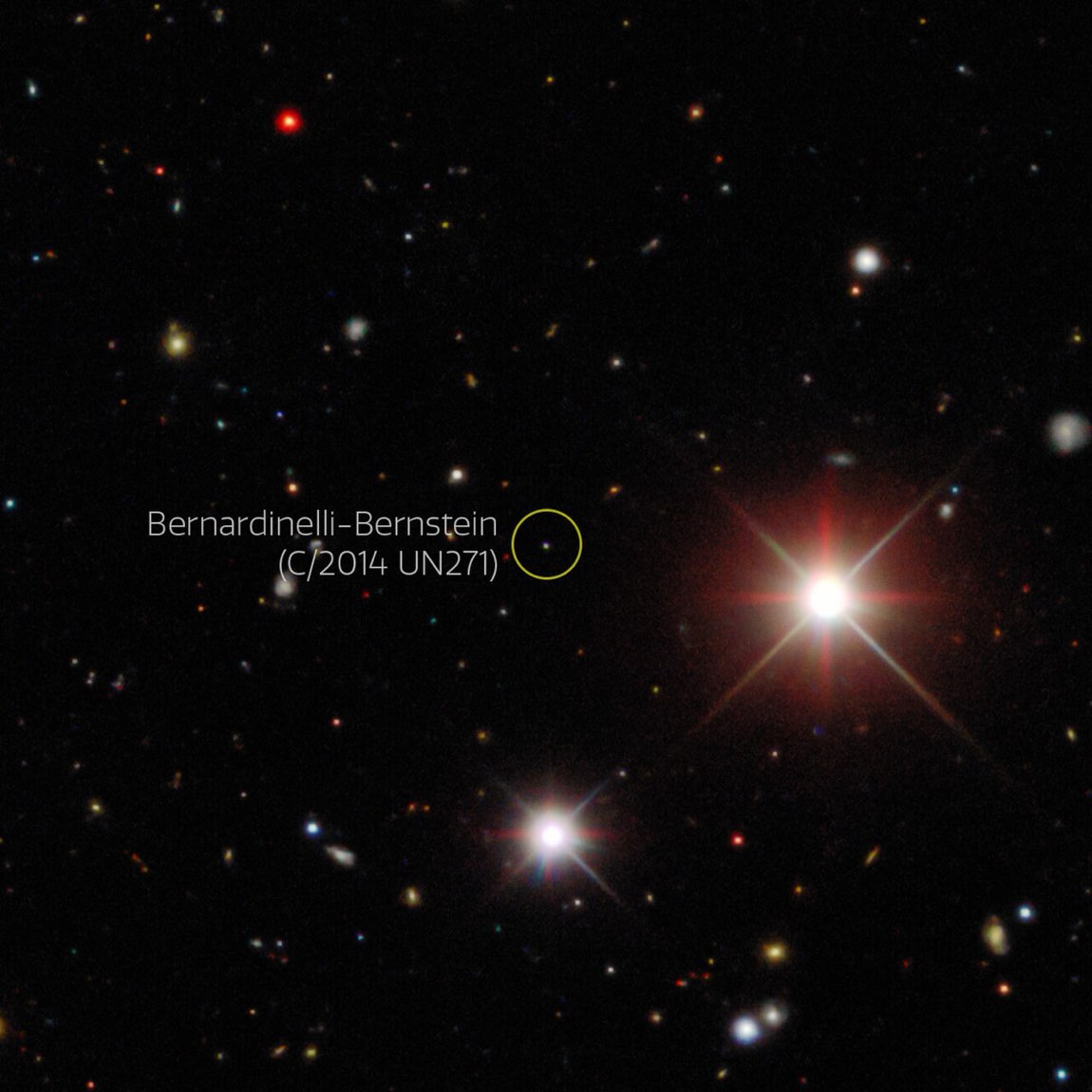
Gennadiy Borisov spotted his namesake comet on 30 August 2019 (29 August UTC) using a 0.65-meter telescope he had designed and built himself at his private MARGO Observatory in Nauchnij, Crimea. The discovery has been compared to Clyde Tombaugh's finding of Pluto — Tombaugh was also an amateur who had built his own telescopes, though he ultimately used Lowell Observatory's 13-inch astrograph for that particular discovery. When Borisov first measured the object's orbital parameters, the automated near-Earth object rating came back at 100 percent, flagging it as potentially dangerous. He immediately posted the data to the global confirmation webpage, noting that the object appeared diffuse — comet-like, not asteroidal. At that moment it was 3 AU from the Sun and 3.7 AU from Earth, with a solar elongation of only 38 degrees, which made precise orbital determination difficult. It took about two weeks and 151 observations spread across 12 days before NASA JPL's Scout software converged on an eccentricity range of 2.9 to 4.5, firmly pointing to an interstellar origin that no amount of outgassing force could explain away.
02 What Makes Its Orbit So Extreme
2I/Borisov carries an orbital eccentricity of 3.36, a figure that dwarfs even ʻOumuamua's eccentricity of 1.2 and towers over the 300-plus known weakly hyperbolic comets whose eccentricities are only just above 1.0. Eccentricity alone tells part of the story; the comet's hyperbolic excess velocity — the speed it retains even at infinite distance from the Sun — is 32 km/s. For comparison, Voyager 1, humanity's most distant spacecraft, is leaving the Solar System at 16.9 km/s (3.57 AU per year), so 2I/Borisov was moving through interstellar space at nearly twice that pace. Gravitational perturbations within our Solar System can nudge a comet's velocity by only a few km/s at most, nowhere near enough to account for 32 km/s. The comet's unusually high perihelion distance of just over 2 AU also played a role: at that distance the Sun's gravity is weaker and less able to bend the comet's path, resulting in a trajectory that remained dramatically curved rather than being substantially redirected. These two parameters together — high eccentricity and high excess velocity — are the clearest possible signatures of a true interstellar traveler.
03 A Tail Fourteen Earths Wide
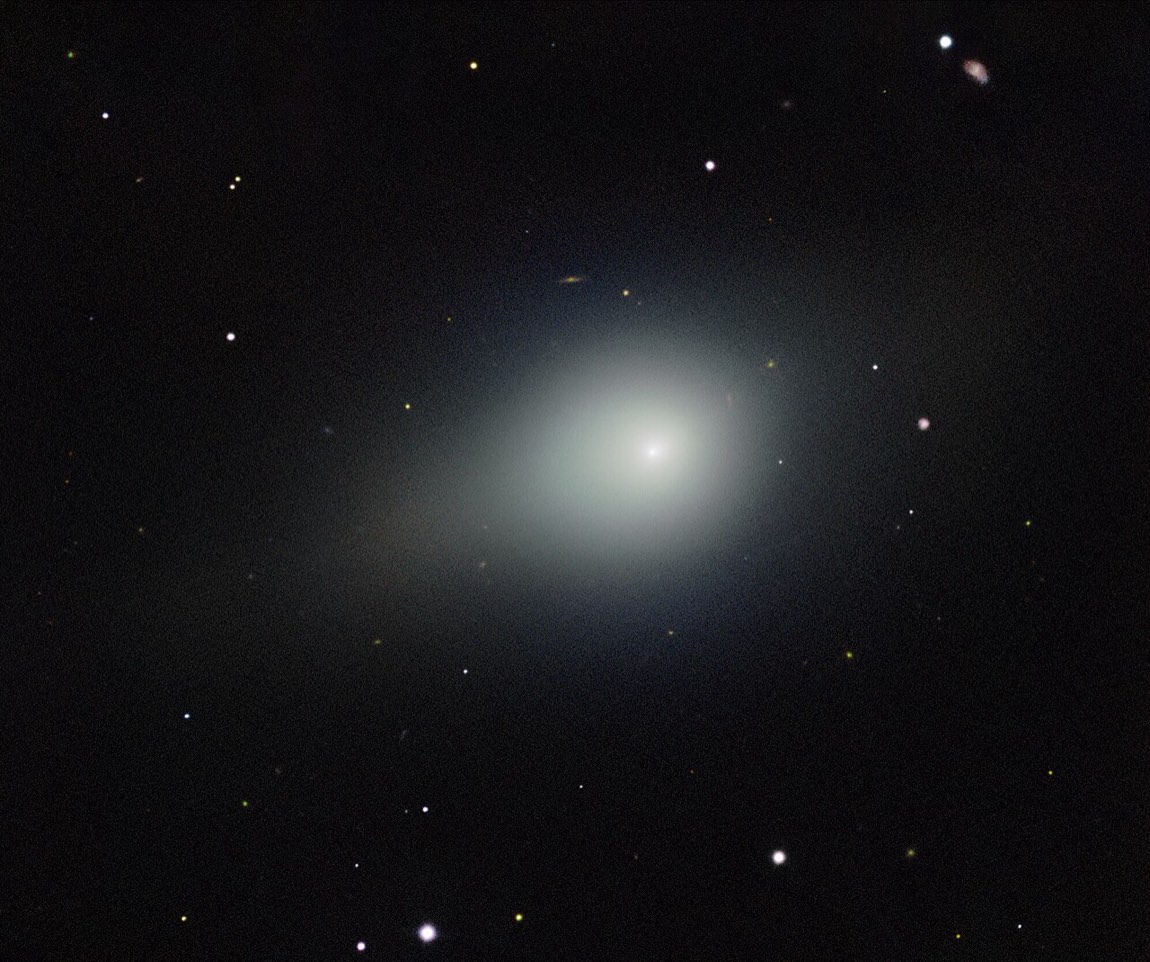
In November 2019, astronomers from Yale University reported that 2I/Borisov's tail had grown to 14 times the diameter of Earth. That comparison captures something genuinely humbling: a comet whose solid nucleus is probably smaller than a mid-sized city was trailing a structure wider than a column of 14 Earths stacked side by side. The coma — the cloud of dust and gas enveloping the nucleus — was itself visible in ground-based telescopes, distinguishing 2I/Borisov immediately from the featureless, asteroidal appearance of ʻOumuamua. David Jewitt and Jane Luu estimated from coma measurements that the comet was shedding 2 kilograms of dust per second and losing 60 kilograms of water per second. Archive searches traced its activity back to between 13 December 2018 and 21 November 2018 — the comet was not seen on the November date but was detected on the December one, so it must have switched on in that window, when it was still far from our Sun. By their extrapolation it had already become active by June 2019 when it was between 4 and 5 AU away.
04 Chemistry Unlike Most Solar System Comets Deeper
Early spectroscopy showed that 2I/Borisov's visible spectrum resembled typical Oort Cloud comets, and the first detected molecule was cyanide (CN), emitting at 388 nanometers — historically the first molecule identified in Solar System comets too. But the resemblance to familiar comets ended there in several important ways. The comet is notably depleted in water and in diatomic carbon (C2), yet strikingly enriched in carbon monoxide and amines (compounds of the form R-NH2). The molar ratio of carbon monoxide to water in its tail reaches 35 to 105 percent; in an average Solar System comet that ratio is only 4 percent. This made 2I/Borisov resemble the unusual blue-tailed comet C/2016 R2 (PanSTARRS) far more than it resembled a typical comet. By late November 2019, C2 production had dramatically increased and bright amine bands appeared together, suggesting coupled chemistry. The comet also produced a minor amount of neutral nickel emission, attributed to an unknown volatile nickel compound, though the nickel-to-iron abundance ratio turned out to be similar to Solar System comets. Its composition is described as uncommon yet not entirely unseen — a visitor shaped by a different solar system but not from an utterly alien chemistry.
 ⤢
05 How the Nucleus Was Crumbling in Real Time Deeper
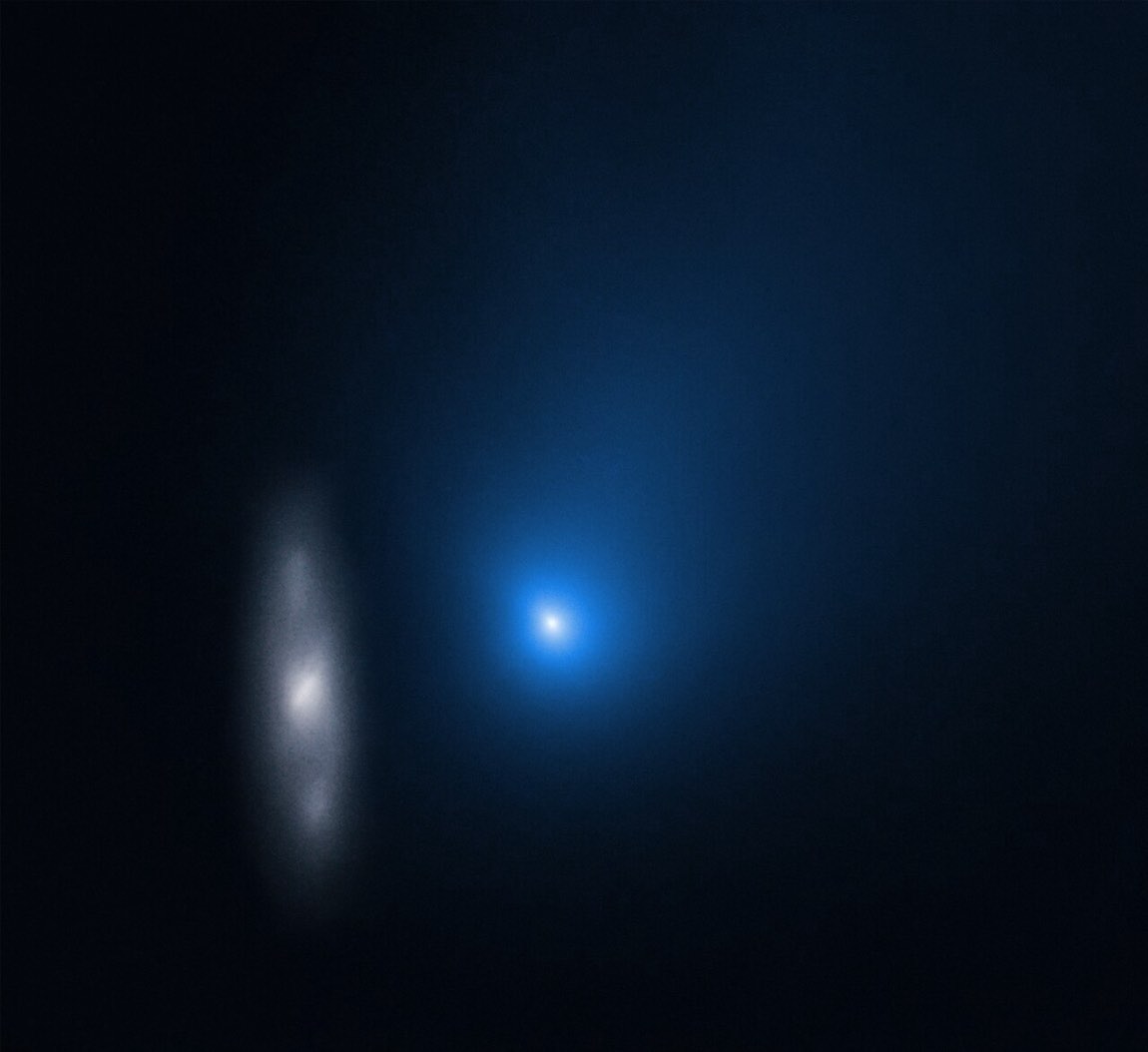
2I/Borisov passed within about 2 AU of the Sun, a distance at which many small comets have been observed to disintegrate. Guzik and colleagues estimated a 10 percent probability that this comet would not survive intact, and Jewitt and Luu drew a pointed comparison to C/2019 J2 (Palomar), a similarly sized comet that did disintegrate in May 2019 at 1.9 AU. In February and March 2020 a severe outburst hit, and by 12 March astronomers suspected ongoing nucleus fragmentation was underway. Hubble Space Telescope images taken on 30 March 2020 showed a non-stellar core and what appeared to be a large fragment ejected sunward, with the ejection estimated to have begun around 7 March. A follow-up study reported on 6 April found only a single object — the fragment had vanished. Later analysis clarified that the ejected dust and fragments together amounted to only about 0.1 percent of the total nucleus mass, reclassifying the event as a large outburst rather than a true fragmentation. The nucleus had lost at least 0.4 percent of its total mass before even reaching perihelion, a degree of mass loss noticeably larger than typically seen in Solar System comets during a comparable flyby.
06 Pinning Down the Nucleus Size Deeper
Measuring the actual size of 2I/Borisov's nucleus proved remarkably difficult. Early estimates ranged widely, from 1.4 to 16 kilometers in diameter. Two independent lines of evidence eventually pushed those estimates far downward. First, the amplitude of non-gravitational accelerations — the rocket-like push caused by outgassing jets — placed a firm upper limit of 0.4 kilometers on the nucleus size. Second, Hubble Space Telescope observations independently set an upper limit of 0.5 kilometers. These two constraints are consistent with each other and suggest a nucleus smaller than many city blocks. The comet never approached Earth closer than about 300 million kilometers, or roughly 2.0 AU, which ruled out radar ranging as a direct measurement technique. An occultation — catching the comet as it passed in front of a background star and measuring how long the star's light blinked out — could in principle give a precise size, but that would have required predicting the exact path of a fast-moving interstellar object to pinpoint which star it would occult, and then deploying a network of small telescopes along a narrow ground track. No such campaign succeeded during the comet's visit.
07 Rotation: Two Conflicting Answers Deeper
Measuring how fast 2I/Borisov spins revealed a puzzling disagreement between studies. A Hubble Space Telescope analysis found no detectable variation in the light curve and concluded that the rotational period of the nucleus must be longer than 10 hours. The Canadian Space Agency's NEOSSat satellite, however, found a period of 13.2 plus or minus 0.2 days — but researchers noted this long period is unlikely to represent the nuclear spin itself and may instead reflect something else, such as precession or the motion of a larger structure. Meanwhile, motion in jet-like features within the coma, observed by Hubble, indicated a 4.3-hour rotation period for the nucleus — a measurement that conflicts sharply with the 10-hour lower limit from the same telescope's light curve analysis. Monte Carlo simulations based on orbit determinations suggest that the equatorial obliquity — the tilt of the rotation axis — could be about 59 degrees or 90 degrees, with 90 degrees being favored by the most recent orbital data. A 90-degree obliquity would mean the comet spins essentially on its side relative to its orbit, an extreme configuration that would produce unusual seasonal patterns in outgassing.
08 Its Journey: Where It Came From and Where It's Going
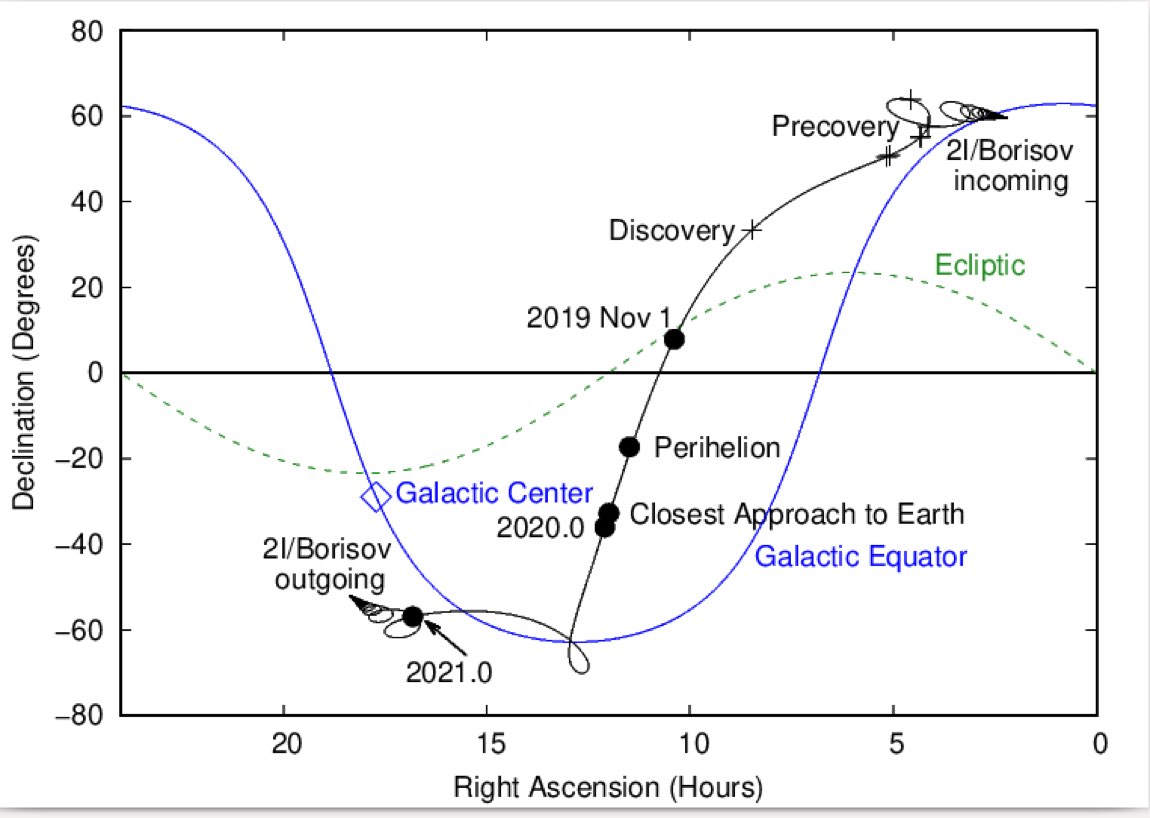
2I/Borisov entered the Solar System from the direction of the constellation Cassiopeia, near its border with Perseus. Astronomers interpret this incoming direction as evidence that the comet originates from the galactic plane rather than the galactic halo — suggesting it comes from a region populated with ordinary stellar systems rather than the sparse outer reaches of the Milky Way. It crossed the ecliptic plane on 26 October 2019 near the star Regulus, then crossed the celestial equator on 13 November, moving from the northern sky into the southern. Perihelion came on 8 December 2019 at just over 2 AU from the Sun, placing it near the inner edge of the asteroid belt. Its closest Earth approach, 1.9 AU, occurred in late December. The comet's 44-degree orbital inclination meant it made no notable close passes by any of the planets. After its Solar System visit it will depart in the direction of the southern constellation Telescopium. In interstellar space it covers roughly one light-year every 9,000 years relative to the Sun — a pace that makes even the vast distances between stars feel like a slow drift when measured against a human lifetime.
 ⤢
09 Why We Could Watch It Far Longer Than ʻOumuamua
The observational window for 2I/Borisov was dramatically larger than for the first interstellar visitor. ʻOumuamua was discovered while already leaving the Solar System, leaving astronomers only 80 days to gather data before it faded beyond reach. 2I/Borisov was caught while still inbound, 3 AU from the Sun, giving scientists months of observation before perihelion and months more afterward. The final observations were made in September 2020, nine months after perihelion — a total arc far more useful for orbital determination and chemical monitoring. Hubble Space Telescope observations began on 12 October 2019, once the comet had moved far enough from the Sun to be safely viewed by the telescope; above Earth's atmosphere, Hubble's angular resolution allowed astronomers to separate the signal of the nucleus from the surrounding coma in a way ground telescopes could not. Because the closest approach fell around traditional year-end holidays, some astronomers affectionately referred to 2I/Borisov as a "Christmas comet." The extended baseline also gave researchers the rare opportunity to watch the comet's chemistry evolve, tracking how molecules like C2 and OH ramped up as the comet warmed near the Sun and then faded as it receded.
10 The Near-Impossible Mission to Chase It Deeper
Sending a spacecraft to intercept 2I/Borisov was theoretically possible but practically devastating in its timing requirements. A team from the Initiative for Interstellar Studies calculated that a 202-kilogram spacecraft could have been dispatched in July 2018 using a Falcon Heavy-class launcher, or a 765-kilogram spacecraft using a Space Launch System-class booster — but only if the comet had been discovered years before it actually was. Because it was not found until August 2019, the optimal launch window had already closed. Any launch attempted after the actual discovery date would eliminate the Falcon Heavy option entirely and require Oberth maneuvers near both Jupiter and the Sun to squeeze out enough velocity, demanding a much larger rocket. Even then, the best an SLS-class vehicle could have delivered was a 3-kilogram payload — roughly the size of a CubeSat — on a trajectory that would intercept 2I/Borisov in 2045 at a relative speed of 34 km/s. Congressional testimony noted that NASA may need at least five years of preparation to launch any such interceptor mission for a future interstellar object. The comet's hyperbolic excess velocity of 32 km/s is the core obstacle: matching that speed with current rocket technology requires either enormous energy or an enormous head start.
11 How the Name and Designation Were Decided
The path from discovery to official name involved several provisional designations and a formal deliberation by an international body. When Borisov first posted the object it was listed on the Minor Planet Center's Near-Earth Object Confirmation Page as gb00234, reflecting the early suspicion that it might be a hazardous near-Earth asteroid. Thirteen days of refined observations revealed it as a hyperbolic comet, and on 11 September 2019 the Minor Planet Center assigned the designation C/2019 Q4 (Borisov). Independently, astronomers including Davide Farnocchia, Bill Gray, and David Tholen concluded the orbit was interstellar. On 24 September 2019 the International Astronomical Union announced that its Working Group for Small Bodies Nomenclature had assigned the interstellar designation 2I/Borisov — the "I" standing for interstellar and "2" marking it as the second confirmed interstellar object after 1I/ʻOumuamua. The name Borisov follows the long-standing tradition of naming comets after their discoverers. The popular press often drops the formal prefix and simply calls it Comet Borisov, though the IAU designation carries precise information about its category and sequence that the informal name does not.
 ⤢