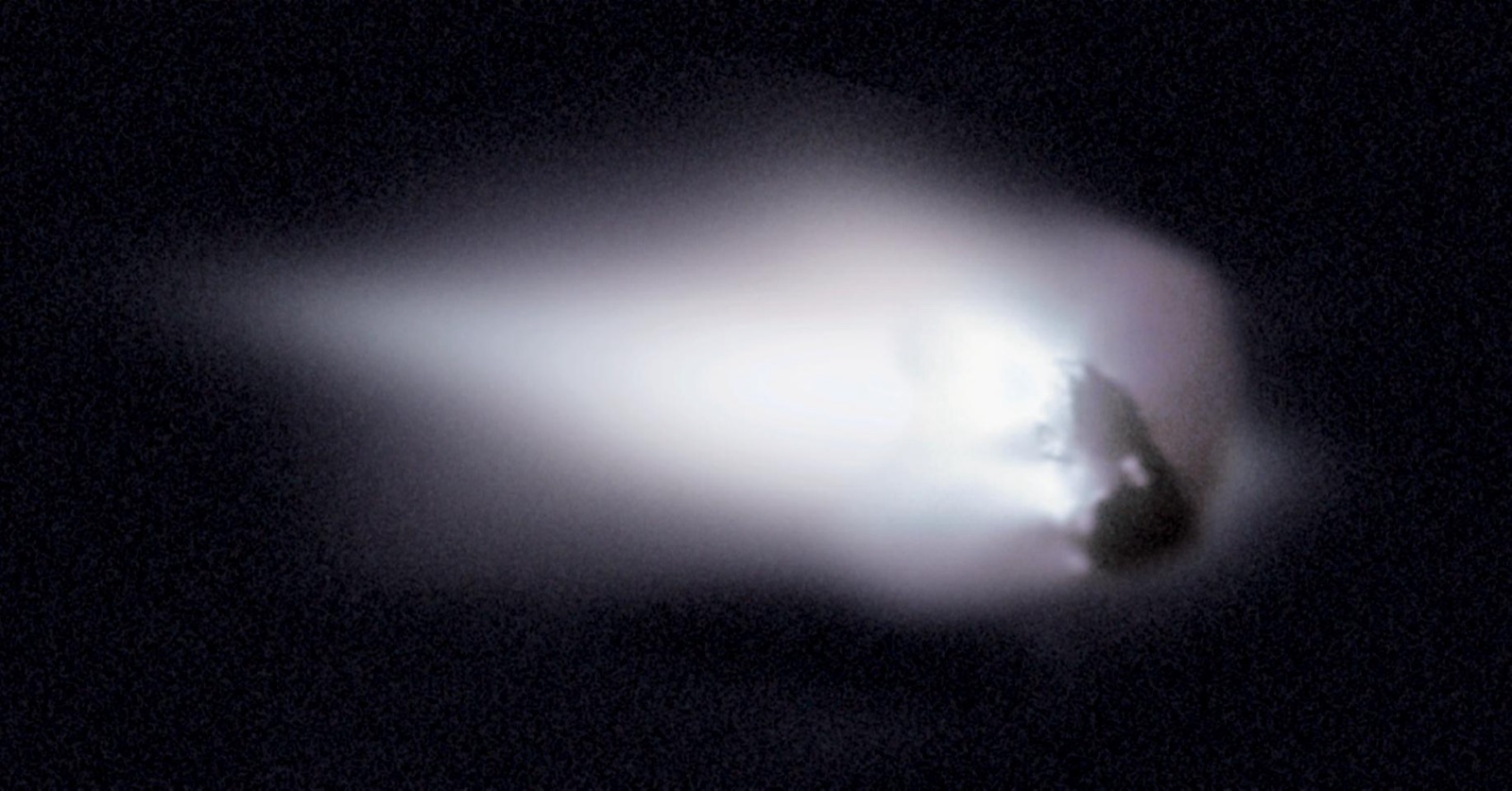
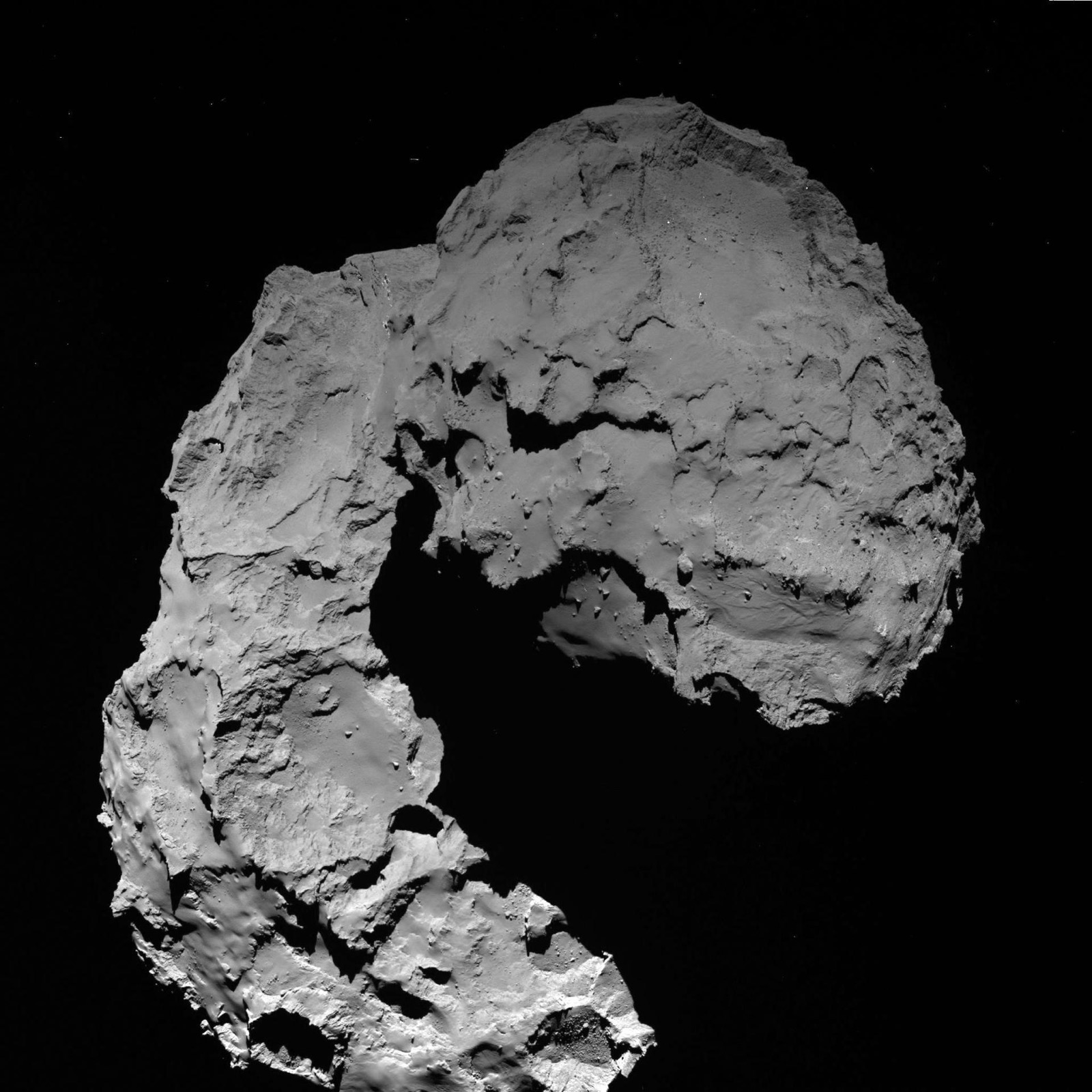
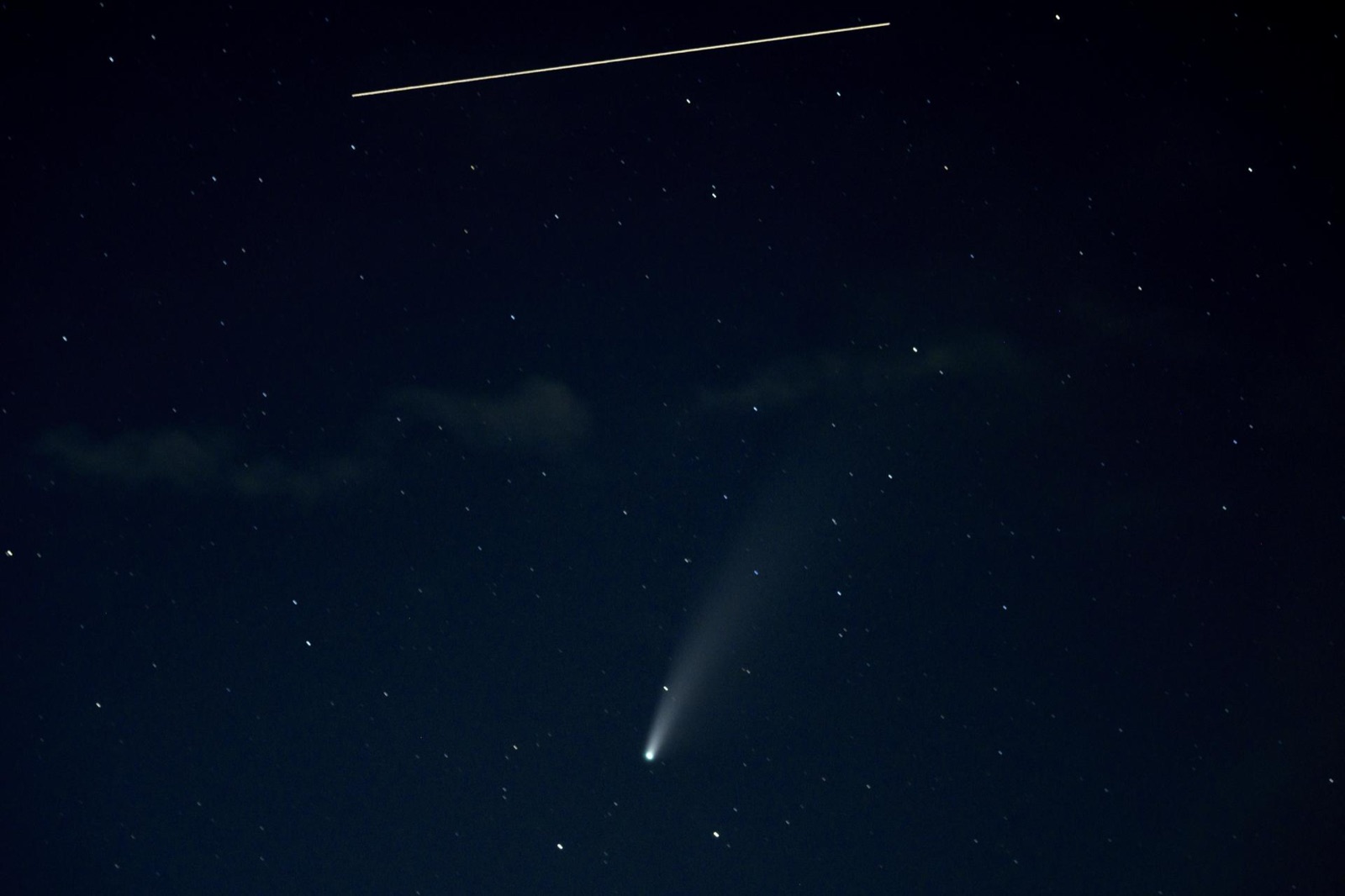
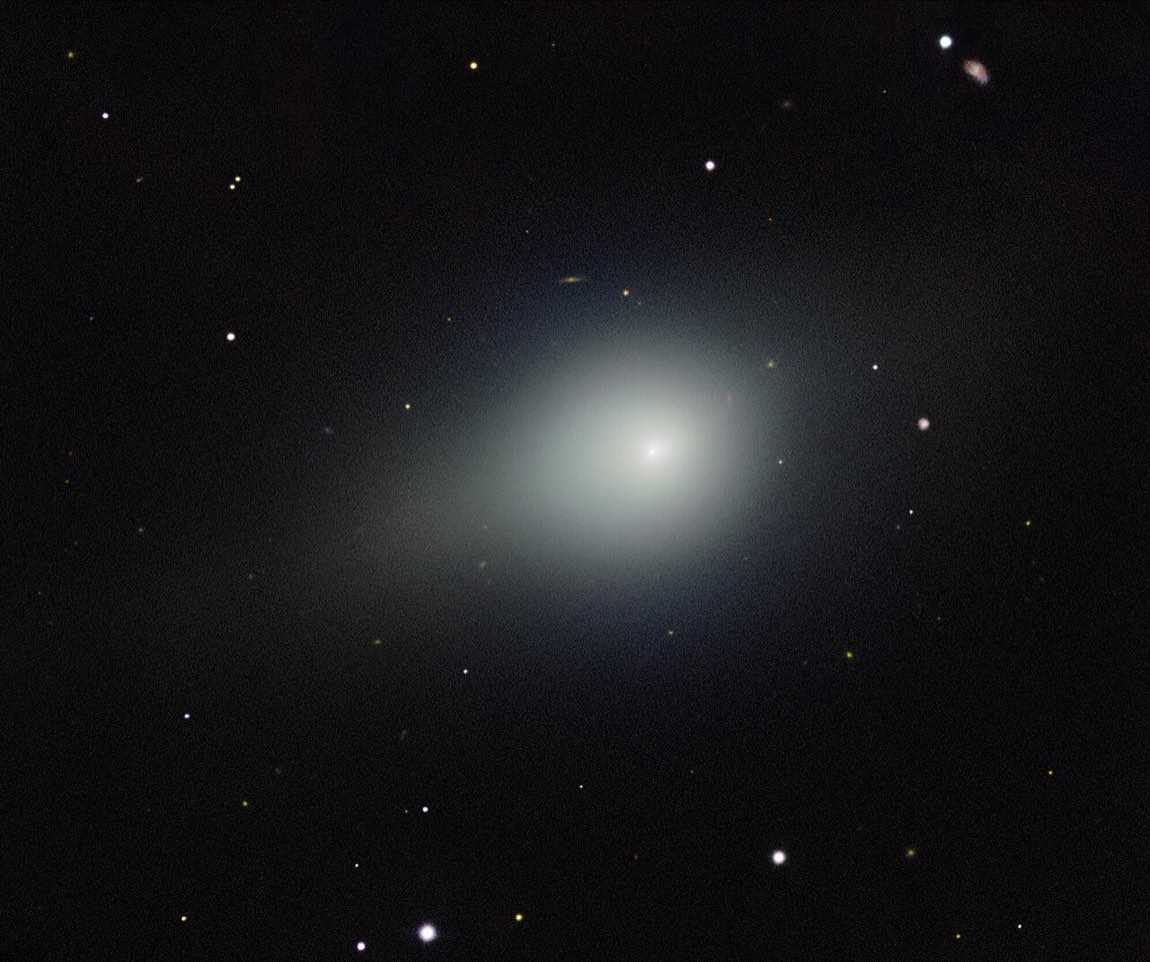
 Photograph · International Gemini Observatory/NOIRLab/NSF/AURA/B. Bolin Image Processing: J. · CC BY 4.0
Comet · Deep guide
3I/ATLAS
Also called: Interstellar comet 3I/ATLAS
A visitor from another star, and the third interstellar object ever caught crossing our Solar System.
What is it?
3I/ATLAS is a comet that does not belong to the Sun: discovered on July 1, 2025 by the ATLAS survey in Chile, its extreme hyperbolic trajectory proves it fell in from interstellar space — only the third such visitor ever detected, after 1I/'Oumuamua (2017) and 2I/Borisov (2019). It swung past the Sun in late October 2025 and is now outbound, never to return — a free sample of another planetary system, passing through.
Go deeper
Its orbital eccentricity (far above 1) and high inbound speed make solar-system origin impossible: 3I/ATLAS is debris ejected long ago from some other star's comet cloud. Unlike the puzzlingly inert 'Oumuamua, it showed clear comet activity (coma and tail), allowing spectroscopy of genuinely alien ices; early results reported an unusually CO₂-rich composition. Pre-perihelion estimates suggested it may be the largest interstellar object yet seen. Surveys like Vera Rubin Observatory are expected to turn such interstellar visitors from once-a-decade shocks into routine catches — check the News tab for the latest findings.
01 How do we know it's from another star?
Speed. Anything bound to the Sun follows a closed loop — an ellipse. 3I/ATLAS came in so fast that the Sun's gravity can only bend its path, not capture it: an open curve in, an open curve out. Rewind that trajectory and it points out of the Solar System entirely, back toward deep interstellar space. It spent perhaps millions or billions of years between the stars before briefly crossing our sky.
02 Three visitors, three personalities Deeper
'Oumuamua (2017): small, elongated, no visible tail, and accelerating oddly — still argued about. Borisov (2019): a reassuringly normal comet, alien only in address. 3I/ATLAS (2025): active, apparently large, chemically distinctive. Sample size three is the frontier of a brand-new field — comparative study of other stars' construction debris, delivered free of charge.
The deep dive
Researched for the Atlas from Wikipedia — 3I/ATLAS (42,293 characters read) · updated Sep 20, 2026
03 Caught before anyone knew what it was
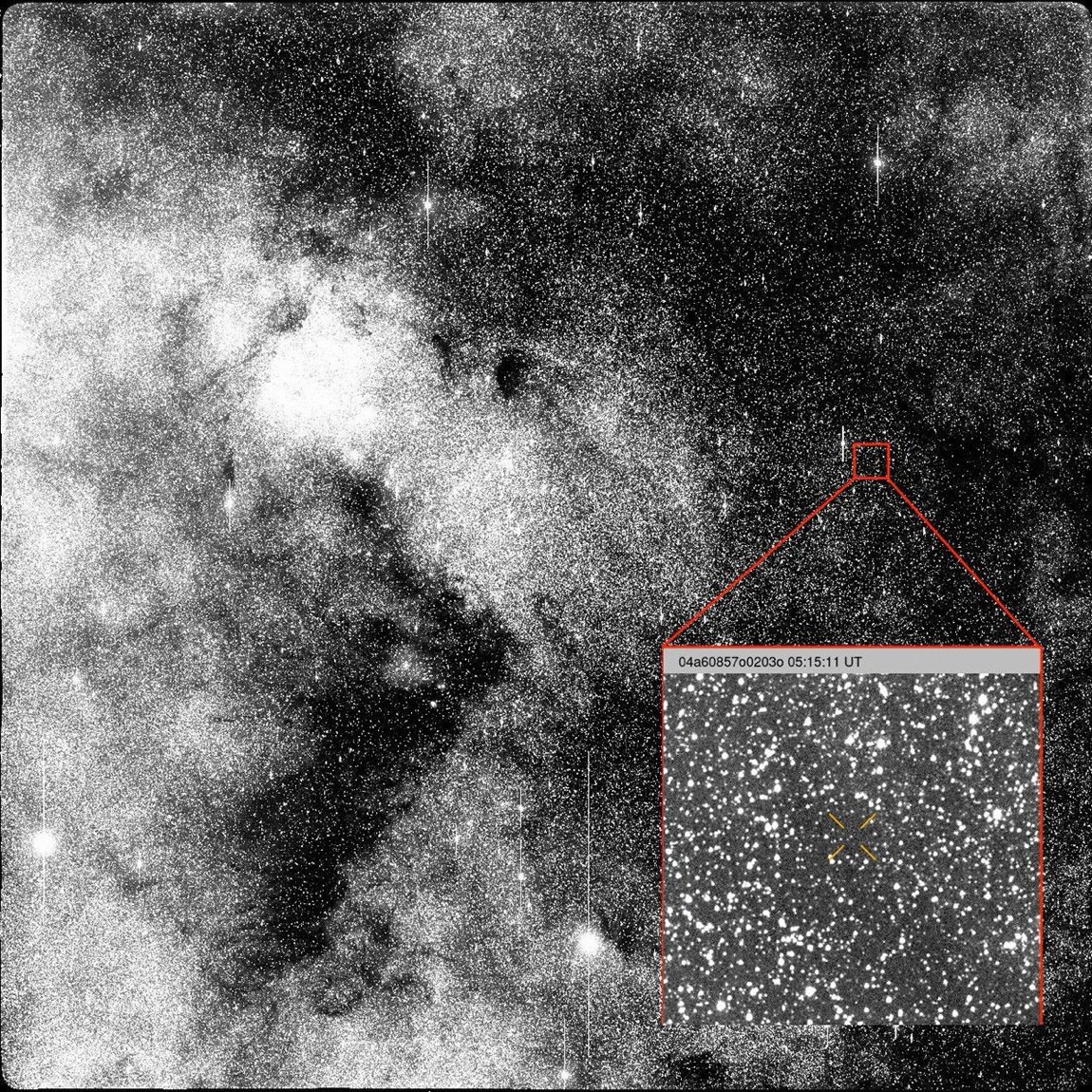
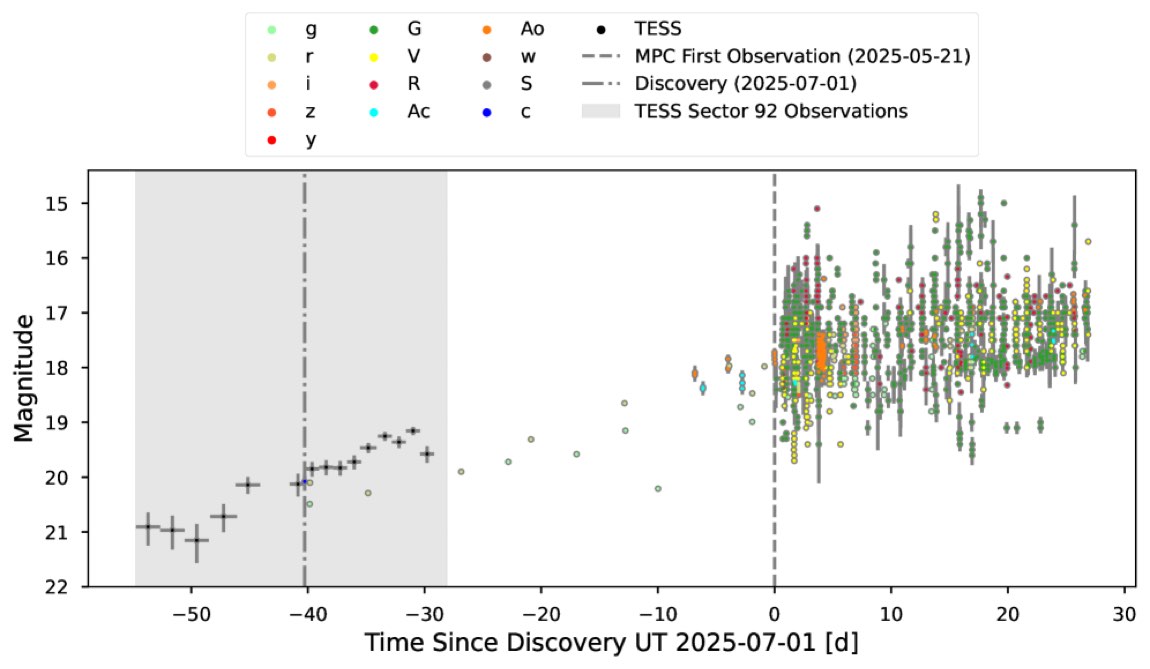
The formal discovery date of 1 July 2025 is only part of the story. Pre-discovery images stitched together afterward reveal that 3I/ATLAS had already been quietly crossing the sky for weeks. The Zwicky Transient Facility recorded it as early as 22 May 2025, and NASA's TESS space telescope had been watching it since 7 May 2025 — nearly two months before anyone recognised it. The very earliest confirmed sighting is a precovery image from the Weizmann Astrophysical Observatory dated 21 May 2025, published on 18 July. Amateur astronomer Sam Deen suspects the comet went unnoticed even longer because it was passing in front of the dense star fields near the Galactic Center, where any faint fuzzy interloper can hide among millions of background points of light. The Vera C. Rubin Observatory — the newest major survey telescope — had serendipitously imaged it during science validation runs and would have beaten ATLAS to the announcement by roughly two weeks had its formal survey begun that much sooner. By the time the Minor Planet Center made the official announcement on 2 July 2025, it had already collected 122 observations from 31 different observatories.
04 Why it was active so far from the Sun Deeper
Most Solar System comets only spring to life within roughly 3 AU of the Sun, when solar heat becomes strong enough to vaporise water ice. What makes 3I/ATLAS striking is that TESS data show it was already bright and active in early May 2025 when it sat roughly 6.4 AU from the Sun — farther out than Jupiter. At that distance, water ice barely sublimates at all. This strongly implies that the comet's early activity was driven by more volatile ices with lower sublimation temperatures, such as carbon monoxide (CO) or carbon dioxide (CO2). JWST later confirmed that CO2 is indeed the dominant outgassing species, emitting at a rate of 129 ± 1 kg per second during August 2025 observations when the comet was at 3.32 AU. CO was also detected at 14.0 ± 0.9 kg per second. Because CO2 sublimes at temperatures reached much farther from a star than water does, a CO2-rich nucleus would naturally explain why 3I/ATLAS was already shedding material when most comets would still be frozen solid. This early activity was one of the first clues that 3I/ATLAS had an unusually volatile-rich composition compared to typical inner Solar System visitors.
05 A coma twice the width of Earth
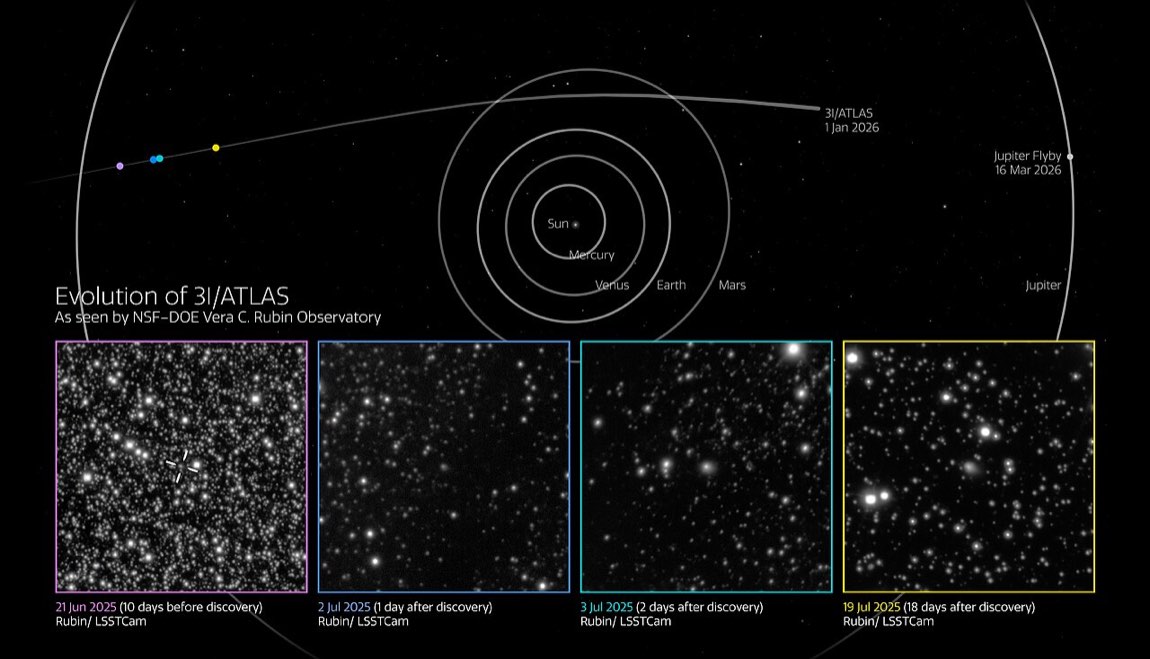
Although the solid nucleus of 3I/ATLAS is almost certainly less than 1 km across, the comet wraps itself in a vast cloud of gas and dust called a coma that dwarfs our entire planet. High-resolution images from the 10.4-meter Gran Telescopio Canarias taken on 2 July 2025 show the inner coma spanning up to 26,400 by 24,700 km — roughly twice Earth's diameter of about 12,700 km. But that is only the dense, visible core. SPHEREx observations from mid-August 2025 revealed a far larger CO2 gas coma extending at least 348,000 km in radius — nearly as wide as the distance from Earth to the Moon — though this outer halo is only detectable in near-infrared light. The coma grew steadily as the comet drew closer to the Sun: Vera Rubin Observatory data show it expanded from 13,040 km across on 21 June 2025 to 18,760 km by 2 July. The coma has a reddish tint caused by irradiated organic compounds called tholins, similar in colour to D-type asteroids and the previous interstellar visitor 2I/Borisov. A study led by Toni Santana-Ros found the coma grew progressively redder throughout July 2025, suggesting the surface or coma composition was evolving as activity intensified.
 ⤢
⤢
06 The sun-facing plume that fooled observers Deeper
Early telescope images of 3I/ATLAS showed its coma stretched out in a direction that seemed puzzling: toward the Sun and toward the comet's direction of motion, rather than away. Many initial reports called this a tail, but it is not. It is a dust plume ejected directly from the sunlit face of the nucleus, where solar heating drives ice sublimation at its fastest rate and flings the most dust into space. This sunward elongation persisted throughout July and August 2025 and resembles features seen in other distant comets such as C/2014 UN271 (Bernardinelli–Bernstein). By late August 2025, the overall coma no longer appeared elongated toward the Sun as a conventional anti-solar dust tail had grown more prominent, but images from 26 August still showed the inner coma — within 5 arcseconds of the nucleus — retaining a fan-shaped brightness excess on the Sun-facing side. Meanwhile the growing anti-solar tail had reached 30 arcseconds in angular length, corresponding to roughly 56,000 km, by end of August as recorded by the 8.2-meter Gemini South telescope. By 15 September 2025 the dust tail had extended further to 50 arcseconds, equivalent to approximately 100,000 km — about a quarter of the distance from Earth to the Moon.
07 Minerals that point to a cold, distant birthplace Deeper
One of the most remarkable findings from JWST's mid-infrared observations concerns not what 3I/ATLAS contains but what it lacks. Every comet studied in the Solar System shows signatures of crystalline silicates — minerals that form when material from a cold outer disk gets churned inward by turbulent mixing and heated enough to recrystallise. 3I/ATLAS shows none of this. Its silicate emission spectrum is matched entirely by amorphous silicates of pyroxene- and olivine-like chemistry, the kind found in the interstellar medium or in evolved protoplanetary disks where radial mixing was weak or absent. This absence of crystalline silicates is independent evidence that 3I/ATLAS formed far from its parent star in a cold, quiet region, inheriting material directly from the interstellar medium without significant thermal processing. JWST also detected hints of carbonate minerals including magnesite and siderite, as well as abundant amorphous carbon. These findings complement the CO2-richness story: together they paint a picture of a comet that condensed beyond the CO2 frost line of its parent system and was never substantially heated or stirred inward before being ejected into interstellar space.
08 What its spin tells us about the nucleus Deeper
Pinning down the rotation period of 3I/ATLAS has proved genuinely difficult because the dusty coma muffles the brightness flicker that an irregularly shaped, bare nucleus would otherwise produce. Nonetheless three independent analyses have converged on a period near 15 to 17 hours. Raul de la Fuente Marcos and colleagues used Gran Telescopio Canarias observations from 2 to 5 July to find 16.79 ± 0.23 hours. Toni Santana-Ros and colleagues, drawing on observations spanning 2 to 29 July from multiple telescopes, found 16.16 ± 0.01 hours and also noted that brightness variations shrank from 0.3 to 0.2 magnitudes across that month — a sign the nucleus was becoming more shrouded as activity increased. A third measurement by Miquel Serra-Ricart and colleagues took a different approach: they tracked a wobbling jet of gas and dust visible in August 2025 images and tied its wobble period directly to nuclear rotation, finding 15.48 ± 0.70 hours. In August 2025, Virginio Oldani and Italian colleagues suggested from coma-shape modelling in Hubble images that the nucleus's north pole points toward either right ascension 154°, declination +25°, or the antipodal direction. All results are consistent, but uncertainties remain large.
09 The nickel mystery and missing iron Deeper
Among 3I/ATLAS's chemical surprises is the detection of atomic nickel vapor in its coma, first confirmed by the Very Large Telescope on 20 July 2025. Nickel vapor has been seen in Solar System comets, including 2I/Borisov, so its presence alone is not shocking. What is unusual is the absence of iron vapor. In Solar System comets, nickel and iron are generally detected together in roughly equal amounts. In 3I/ATLAS, no iron was found at all despite a sensitive search. Rohan Rahatgaonkar and colleagues who analysed the VLT data proposed that nickel might be released through the chemical decomposition of nickel-bearing organic molecules — nickel tetracarbonyl was suggested as one candidate — via space weathering, and that whatever process operates in 3I/ATLAS selectively liberates nickel without iron. By the time VLT observations concluded on 21 August 2025, the comet was emitting an estimated 4.6 ± 0.7 grams of nickel per second and 17.6 ± 2.0 grams of cyanide per second. The nickel and cyanide concentrations are broadly similar to those in Solar System comets at comparable solar distances, and the nickel abundance is consistent with the prediction that a thick-disk origin star would have given 3I/ATLAS a metal-poor composition.
10 An orbit that barely curves at all
Comets in the Solar System travel on ellipses — stretched ovals that curve back to return to the Sun. The shape of any orbit is captured by a single number called eccentricity: an ellipse has eccentricity below 1, a parabola exactly 1, and a hyperbola above 1. 3I/ATLAS has an eccentricity of 6.141 ± 0.00002 — more than six times the threshold for escape and the highest of any of the three confirmed interstellar objects. For comparison, 1I/ʻOumuamua had e = 1.2 and 2I/Borisov had e = 3.4. At such extreme eccentricity, the comet's path through the Solar System looks almost perfectly straight to the eye rather than curved. It entered moving at 61 km/s relative to the Sun, accelerated to a peak of 68 km/s at perihelion on 29 October 2025, then began slowing as it climbed back out of the Sun's gravity well — though it will never slow enough to be captured. It will reach the inner boundary of the Oort cloud, some 2,000 AU away, around the year 2189, and will not clear the outer Oort cloud until roughly 8,000 years from now. At that point it will once again be a true interstellar traveller.
 ⤢
⤢
11 How spacecraft at Mars, Venus, and beyond watched
Because 3I/ATLAS's orbit aligned closely with the ecliptic plane, it swept past several planets in a way that put existing spacecraft in advantageous positions. On 3 October 2025, the comet passed within 0.194 AU (29.0 million km) of Mars. ESA's Trace Gas Orbiter captured images of 3I/ATLAS during this close approach using its Colour and Stereo Surface Imaging System (CaSSIS), recording the coma with 5-second exposures even though the comet was around 50,000 times fainter than the spacecraft typically images. Mars Express also attempted observations but could not detect the comet, likely due to its shorter exposure times. China's Tianwen-1 Mars orbiter also successfully imaged the comet, while data from NASA's Mars Reconnaissance Orbiter were not released due to a government shutdown. After perihelion, the comet passed 0.65 AU from Venus on 3 November 2025, and Europa Clipper was predicted to be immersed within the comet's ion tail from 30 October to 6 November 2025 — a rare opportunity to sample interstellar comet plasma directly. ESA's Juice spacecraft also passed within 0.428 AU of 3I/ATLAS on 4 November 2025 and observed it with cameras, spectrometers, and a particle sensor, later reporting in April 2026 that the comet's gas tail stretched at least 5 million km from the nucleus.
12 Why no probe could chase it in time
The moment 3I/ATLAS was confirmed on 2 July 2025, mission planners around the world ran the numbers on whether any spacecraft could reach it. The answer was deeply frustrating. A July 2025 study led by Atsuhiro Yaginuma and collaborators found that any probe launched from Earth after 1 July 2025 would need a delta-v — the change in velocity required to match the target's trajectory — of at least 24 km/s. That is far beyond what any currently operational propulsion system can deliver. Had the comet been spotted before 1 July, the picture would have been far better: a probe launched from Earth on that date would have needed only about 7 km/s, and one departing from Mars between July and September 2025 would have required as little as 5 km/s to achieve a fly-by in early October 2025. The Psyche spacecraft happened to pass within 0.302 AU of 3I/ATLAS on 4 September 2025, and Juno might have had a viewing opportunity near Jupiter in March 2026, but redirecting either spacecraft carried significant risk to their primary missions given fuel constraints. The 3I/ATLAS encounter has energised discussions about keeping a ready-to-launch interstellar intercept mission on standby for the next such visitor.
13 How old, and how unusual is that?
The question of 3I/ATLAS's age hinges on which stellar population it belongs to. Its high vertical velocity through the galactic plane — W = +18.5 km/s — indicates that it does not follow the neat, thin orbits of young disk stars but instead traces the more tilted path typical of the Milky Way's thick disk, which is composed mainly of older, metal-poor stars. A July 2025 study led by Matthew Hopkins estimated with 68 percent confidence that 3I/ATLAS is between 7.6 and 14 billion years old, based on the age distribution of thick-disk stars. For context, the Solar System itself is only 4.6 billion years old, so the comet could predate it by three billion years or more — making it potentially the oldest comet ever studied. An independent analysis by Aster Taylor and Darryl Seligman placed the age at 3 to 11 billion years, broadly consistent with Hopkins's figures. If confirmed, this means 3I/ATLAS condensed around a star that formed in the early universe, was ejected, and has been drifting through the Milky Way ever since, surviving interstellar space for a span of time longer than Earth has existed.
14 What a 25-star neighbourhood says about its journey Deeper
Although tracing 3I/ATLAS all the way back to its birth star is impossible — billions of years of galactic mixing have scrambled any clear thread — astronomers can still examine its recent neighbourhood. A September 2025 study by Yiyang Guo and collaborators calculated that 3I/ATLAS passed within 1 parsec (3.3 light-years) of 25 known stars during the past 10 million years alone. Each of those close passes could have delivered a gravitational nudge — a stellar gravity assist — that slightly altered the comet's speed and direction. These cumulative perturbations mean that even 3I/ATLAS's current velocity, 58 km/s relative to the Sun at solar system entry, may be the product of a long series of gravitational encounters rather than simply reflecting the velocity of its birth system. The parent star itself, wherever it formed, was probably a low-metallicity star with heavy element abundances at least 40 percent below the Sun's, if thick-disk membership is confirmed. Because 3I/ATLAS is CO2-rich and shows amorphous rather than crystalline silicates, it most likely condensed beyond the CO2 frost line of that ancient, metal-poor protoplanetary disk, then was hurled outward by a close encounter with either a giant planet or a passing star.
15 How to actually observe it from Earth
3I/ATLAS never became a naked-eye spectacle, and that is worth understanding concretely. Its predicted peak brightness was only around apparent magnitude 11.5 — still roughly 5 times too faint for unaided human eyes under a dark sky. Even at magnitude 14, detecting a point-like star requires at least a 200 mm (8 in) telescope aperture, and a diffuse comet at the same magnitude demands 300 mm (12 in) or more. In practice, smart telescopes with apertures of at least 76 to 114 mm could image it by plate-solving long exposures. During the Mars approach on 3 October 2025, the comet's total magnitude was 12 — roughly 120 times fainter than comet C/2025 A6 (Lemmon) and 190 times fainter than C/2025 R2 (SWAN) at that moment. By mid-November 2025, it hovered on the borderline of detection in tripod-mounted 20×80 binoculars. The perihelion passage on 29 October was completely unobservable from Earth because the comet went into solar conjunction on 21 October — passing behind the Sun — eight days before its closest solar approach. During that hidden window, the GOES-19 weather satellite, which can detect objects down to magnitude 12, tracked it from 18 to 24 October. Post-perihelion, the comet re-emerged before sunrise in November, drifting through Virgo and Leo while fading.
 ⤢
⤢
Could life exist here?
A comet is a comet, wherever it was born. No evidence suggests otherwise — and claims of alien technology about such visitors remain firmly in the Speculation column.
Our labels: Confirmed · Strong Evidence · Estimated · Hypothesis · Theoretical · Speculative (see Methodology).
How would we get there?
Nobody could catch it — it moves too fast and was seen too late. ESA's Comet Interceptor (launching later this decade) is designed to wait in space and ambush exactly this kind of once-ever target.
Weird & wonderful
- 3I/ATLAS is older than some stars — and just passed through our neighborhood forever.
- Its name is literally its passport: '3I' = third Interstellar.
- Every atom in it was assembled around another sun.