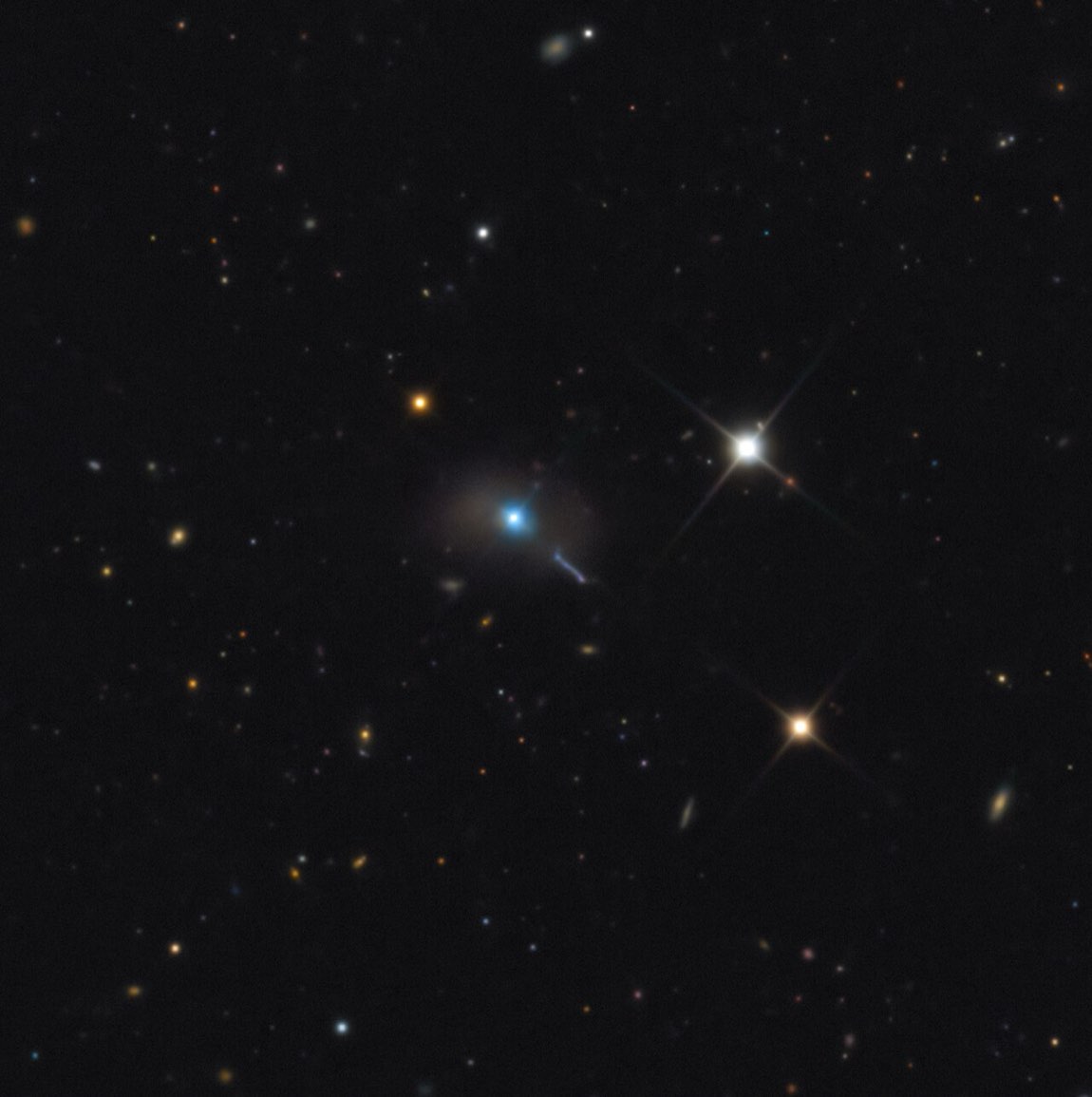
 Photograph · Hubble ESA · CC BY 2.0
Black Hole · Deep guide
3C 273
The first quasar. Its discovery revealed feeding black holes across the universe.
What is it?
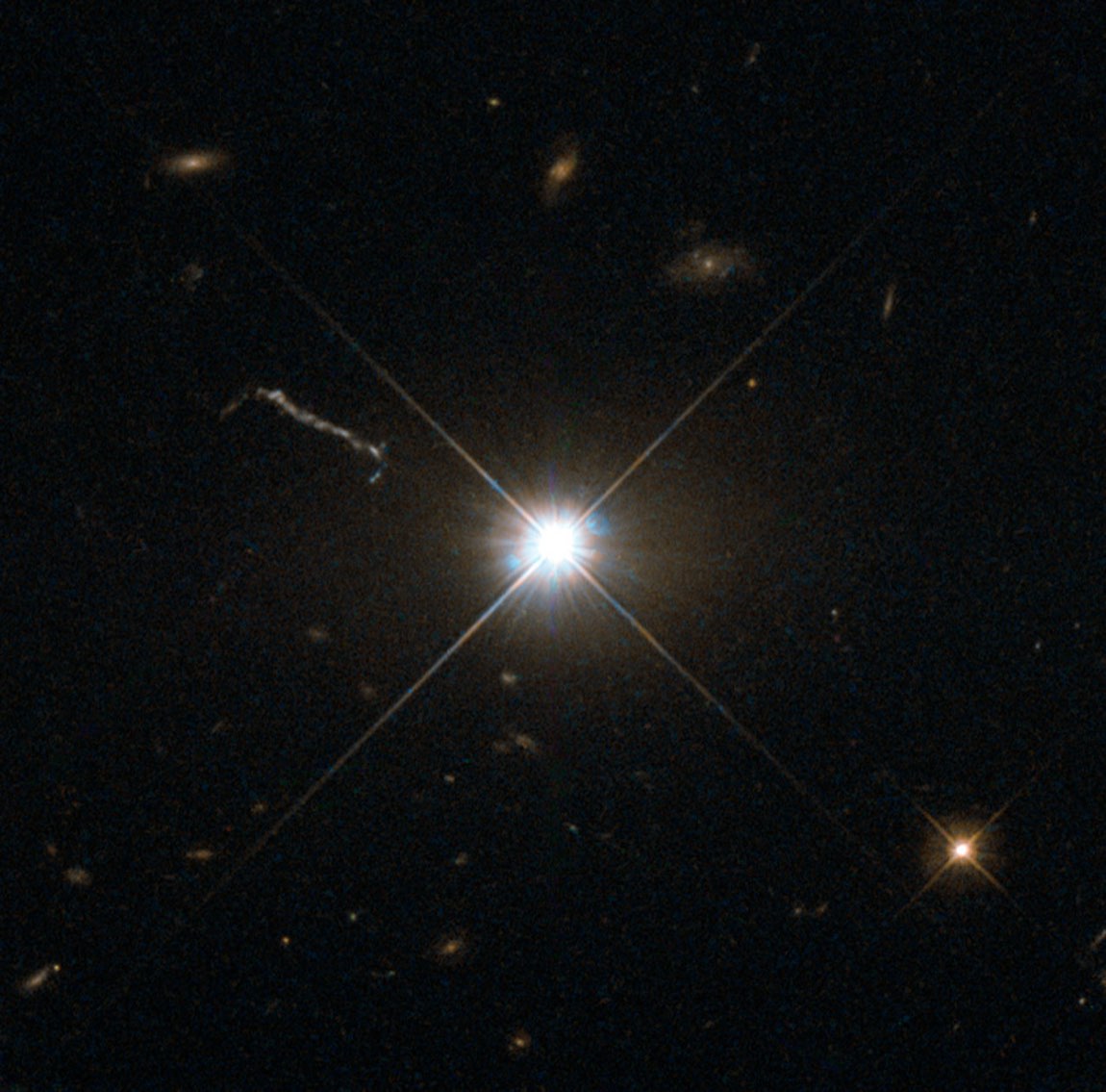
In 1963, astronomer Maarten Schmidt realized that the 'star' 3C 273 had a spectrum shifted by 16% — placing it billions of light-years away and making it thousands of times brighter than a galaxy. The quasar era had begun. 3C 273 remains the optically brightest quasar: a supermassive black hole in a distant galaxy, swallowing matter and firing a jet visible in modest amateur telescopes across 2.4 billion light-years.
The deep dive
Researched for the Atlas from Wikipedia — 3C 273 (5,778 characters read) · updated Sep 20, 2026
01 The Discovery That Changed Cosmology
Before 1963, astronomers were baffled by a handful of radio sources that appeared in optical telescopes as nothing more than faint, star-like pinpoints — yet their spectra matched no known element arrangement. The breakthrough came when Cyril Hazard used a clever trick at the Parkes Radio Telescope: he timed the Moon passing in front of 3C 273, a technique called lunar occultation, to nail down the radio source's precise position. That accurate location allowed Maarten Schmidt and Bev Oke to match it to an optical object and measure its spectrum. Schmidt recognized that the seemingly alien spectral lines were in fact familiar hydrogen lines — just stretched dramatically toward the red by a redshift of 0.158. Published in a pair of Nature papers in 1963, this meant 3C 273 sat several billion light-years away, far beyond any ordinary star. No star could shine that brightly across such a distance. The object was christened a quasi-stellar radio source, quickly shortened to quasar, and cosmology was permanently altered. 3C 273 was the first object ever to receive that classification.
02 Its Name Is a Catalog Entry, Not a Title
The designation 3C 273 is purely bureaucratic in origin, and knowing what it encodes helps decode the wider catalog system astronomers rely on. The '3C' stands for the Third Cambridge Catalogue of Radio Sources, published in 1959. Objects in that catalog were ordered simply by right ascension — their east-west position across the sky — so 3C 273 was literally the 273rd radio source listed in that sequence. The catalog predates the understanding of what quasars are; compilers had no idea they were tagging the most luminous class of objects in the observable universe. Today the catalog's historical importance runs deeper still: 3C 273's right ascension as recorded in the Fifth Fundamental Catalog (FK5) is used as an anchor point to standardize the positions of 23 extragalactic radio sources that together define the International Celestial Reference System, the coordinate grid modern astronomy uses to map the entire sky.
03 Brightness That Defies Comprehension
3C 273 carries an absolute magnitude of −26.7, a number that only becomes visceral with a comparison. If the quasar were placed just 10 parsecs away — roughly the distance of the nearby star Pollux — it would appear almost as bright in Earth's sky as the Sun does at its actual distance of one astronomical unit. Since the Sun's absolute magnitude is 4.83, working through the math reveals that 3C 273 is over 4 trillion times more luminous than the Sun at visible wavelengths alone. Spread that output across radio waves, infrared, X-rays, and gamma rays and the number climbs further still, because the quasar's luminosity varies at nearly every wavelength on timescales ranging from a few days to decades. Despite sitting 2.4 billion light-years away, it shines at an apparent visual magnitude of roughly 12.9 — outstripping the entire galaxy that hosts it by more than a factor of 16, and bright enough that a 150 mm amateur telescope can pick it up.
04 How a Jet 200,000 Light-Years Long Works Deeper
Stretching approximately 200,000 light-years (61 kiloparsecs) from the quasar's core, 3C 273's jet is one of the most studied structures in extragalactic astronomy. From Earth it subtends an apparent angle of 23 arcseconds, large enough that optical telescopes can resolve internal detail. Astronomers believe such jets form through the interaction between a supermassive black hole and its surrounding accretion disk, which channels energy into twin beams of charged particles accelerated to relativistic speeds. The radiation those particles emit — radio waves, infrared light, and visible light all sharing the same polarization orientation — is almost certainly synchrotron radiation, produced when fast electrons spiral around magnetic field lines. VLBI radio observations have detected apparent proper motion within the jet, a signature of relativistic bulk flow. In 1995 the Hubble Space Telescope revealed the jet's fine structure: repeated bright knots separated by dimmer regions, suggesting episodic energy injection or interaction with surrounding material. The jet is also inflating an expanding cocoon of heated gas that may be colliding with an inclined disk of gas within roughly the central 6 kiloparsecs of the host galaxy.
05 When the Jet Suddenly Changed Direction Deeper
Jets from active galactic nuclei are not always straight arrows. In 2003, observers watching 3C 273 documented an abrupt change in the jet's direction by an intrinsic angle of 2 degrees. That figure matters because the jet's own intrinsic opening angle is only 1.1 degrees, meaning the deflection was larger than the beam's full width — a genuinely sharp bend, not a gentle curve. The viewing angle of the jet as seen from Earth is approximately 6 degrees, which already indicates we are watching the beam nearly end-on; small intrinsic angles translate into amplified apparent motions and bending when the geometry is so oblique. What caused the directional shift is not stated definitively in the observational record, but candidates generally include interaction with dense clouds of gas in the host galaxy or instabilities in the flow itself. This event underscores that even the most famous and well-monitored jet in quasar astronomy can surprise researchers with dynamic structural changes on human timescales.
06 The Host Galaxy Hiding in Plain Sight
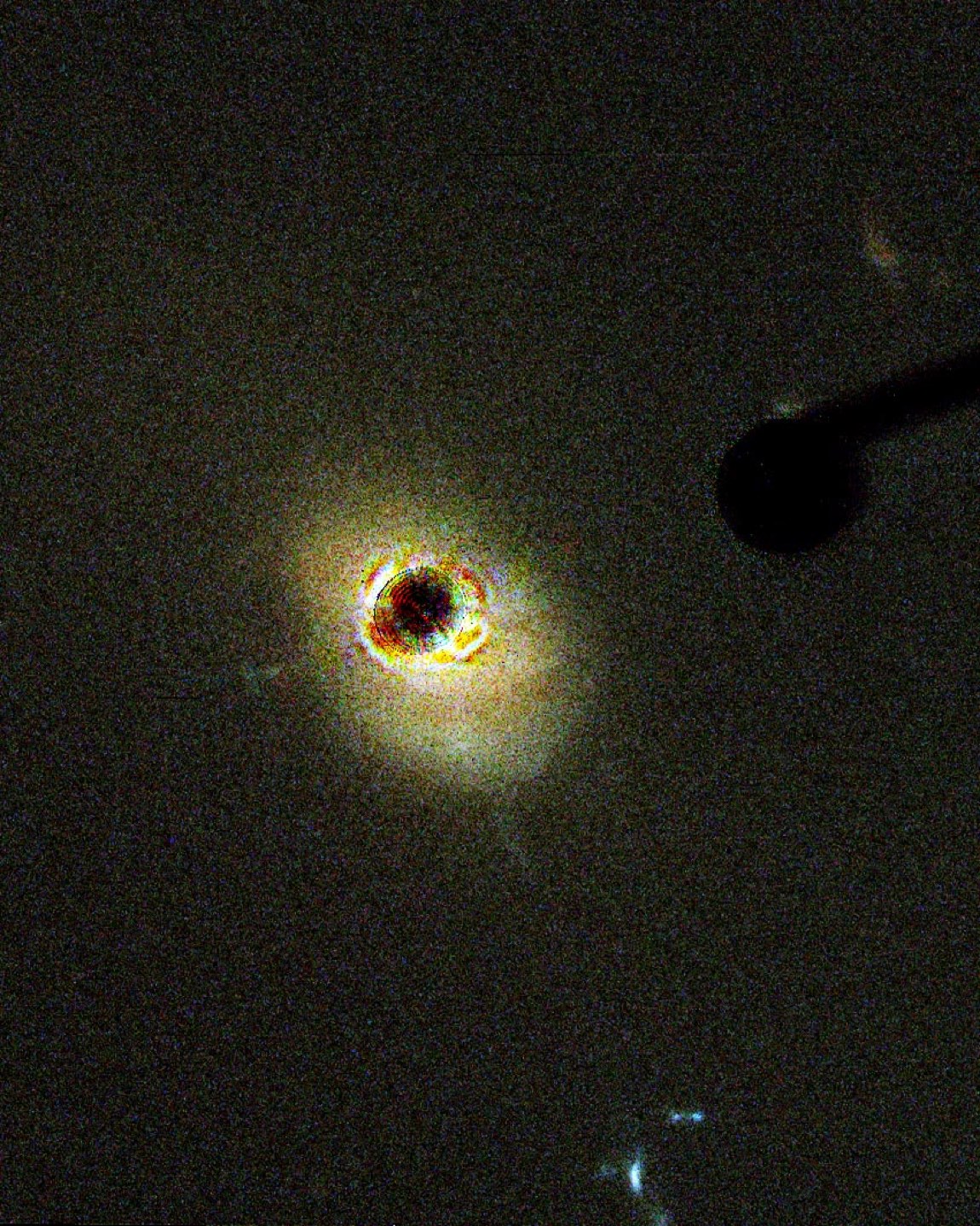
Most people who point a telescope at 3C 273 see only a brilliant point of light, because the quasar outshines its surrounding galaxy by more than a factor of 16. Yet that host galaxy is a substantial object in its own right. It is classified as an E4 elliptical, meaning it has a moderately flattened egg shape rather than the perfectly spherical appearance of some ellipticals. Its apparent size on the sky is 29 arcseconds and its apparent magnitude is 16 — faint but measurable when the quasar's glare is carefully subtracted. Astronomers estimate the galaxy's total mass at approximately 2×10¹¹ solar masses, roughly comparable to the Milky Way. Like most giant elliptical galaxies, it lacks the spiral arms and active star-forming regions typical of younger disk galaxies, instead containing older stellar populations. It sits in the constellation Virgo and is visible from both the northern and southern hemispheres between March and July each year.
 ⤢
⤢
07 Measuring the Black Hole at Its Heart Deeper
Pinning down the mass of a supermassive black hole 2.4 billion light-years away requires ingenuity. For 3C 273, astronomers used a technique called broad emission-line reverberation mapping. The method exploits the fact that the black hole's intense radiation illuminates surrounding gas clouds, which then glow in characteristic spectral lines. Because light travels at a finite speed, the gas clouds respond to brightness fluctuations in the central engine with a measurable time delay. The size of that delay reveals the physical distance between the black hole and the responding clouds, and the width of the emission lines encodes the orbital velocity of that gas. Combining distance and velocity through Kepler's laws yields the enclosed mass. For 3C 273, the result is 886 ± 187 million solar masses — just under a billion times the mass of the Sun, with an uncertainty of about plus or minus 187 million solar masses that reflects the real measurement challenges at cosmological distances. That mass is consistent with the overall description of approximately 900 million solar masses cited across the literature.
08 A Pioneer in X-Ray Astronomy Too Deeper
3C 273's contributions to astrophysics extend well beyond the optical and radio bands. In 1970 it became one of the first extragalactic objects ever detected as an X-ray source, placing it at the frontier of an entirely new observational window on the universe. X-ray astronomy was itself barely a decade old at that point, having only recently moved beyond solar observations. Identifying a quasar billions of light-years away as an X-ray emitter confirmed that the energy output from active galactic nuclei was extraordinarily broad in spectrum. However, the precise physical mechanism generating those X-ray emissions proved elusive. As late as 2006, when new observations were reported using the Spitzer Space Telescope, the process responsible for 3C 273's X-ray output was still considered controversial among researchers. This open question illustrates how a single object can simultaneously be a foundational reference point for one field of astronomy while remaining an unsolved puzzle in another.
09 Why It Anchors the Sky's Coordinate Grid Deeper
Astronomy depends on a shared coordinate system precise enough to allow telescopes on different continents — or in space — to point at the same source and compare data. The International Celestial Reference System fulfills that role, and its accuracy rests on a network of 23 extragalactic radio sources whose positions are known with extraordinary precision. 3C 273 is one of those anchors. Specifically, its right ascension as recorded in the Fifth Fundamental Catalog is used to standardize the positions of those 23 sources. The choice of extragalactic objects rather than nearby stars is deliberate: stars move perceptibly over years due to proper motion and parallax, while a quasar 2.4 billion light-years away shows no measurable shift across human timescales, making it a geometrically stable landmark. The fact that 3C 273 serves this role — simultaneously being the most visually accessible quasar for amateur astronomers and a cornerstone of professional astrometry — makes it one of the most practically important objects in the sky.
10 Distance: Two Ways to Measure It Deeper
The distance to 3C 273 is not a single clean number but rather a choice between conceptually distinct definitions, each useful for different purposes. The luminosity distance — calculated from the redshift of 0.158 — is 749 megaparsecs, or approximately 2.4 billion light-years; this is the distance you would infer if you assumed the quasar's dimness with distance follows the same inverse-square law as nearby objects, without cosmological corrections. But the universe has been expanding since that light left 3C 273, so a separate measure, the angular diameter distance, gives a smaller value: approximately 1.80 billion light-years (552 megaparsecs), with an uncertainty of roughly +97 to −79 megaparsecs. This angular distance was estimated using parallax methods with the Very Large Telescope interferometer and represents the geometric scale of the quasar as imprinted on the sky. The two distances are related by the cosmological formula that involves the factor (1+z) squared, where z is the redshift. Neither number is wrong; they answer different physical questions.
11 How to Actually Observe It Yourself
3C 273 holds a genuine observational distinction: it is considered the most distant object that average amateur astronomers are likely to see through their own telescopes. At an apparent visual magnitude of approximately 12.9, it sits well within reach of a 150 mm (6-inch) aperture instrument under reasonably dark skies — the kind of telescope found in many backyard observatories. The quasar is accessible from both the northern and southern hemispheres, appearing in the constellation Virgo and remaining visible in the evening sky from March through July. Through an eyepiece it looks indistinguishable from a faint star; no telescope available to amateurs can resolve the host galaxy around it or hint at the 200,000-light-year jet it drives. Yet the act of looking is still profound: the photons entering your eye left their source 2.4 billion years ago, before multicellular life had diversified on Earth, and they have been traveling through an expanding universe ever since.
12 What 3C 273 Reveals About All Quasars
Astronomers designate 3C 273 as a prototype of the Active Galactic Nucleus class, meaning lessons learned from it inform understanding of thousands of similar objects across the cosmos. The core principle is that no conventional astrophysical process — not nuclear fusion, not stellar collisions — can generate the energy output observed in a quasar. Accretion of matter onto a supermassive black hole is the only mechanism that fits: infalling gas releases gravitational potential energy with extraordinary efficiency as it spirals through an accretion disk, heating to millions of degrees and radiating across the electromagnetic spectrum. 3C 273 demonstrates this template clearly enough that it became the benchmark case. It is a radio-loud quasar, meaning its jet produces substantial emission detectable at radio wavelengths, which places it in a subclass representing perhaps ten percent of all known quasars. Its relative closeness — it has one of the lower redshifts among luminous quasars — and its brightness make it the best-studied example of this class, a kind of Rosetta Stone for decoding more distant and fainter active nuclei.
 ⤢
⤢