 Photograph · Yun Jiang, Jianghui Ji, Jiangchuan Huang, Simone Marchi, Yuan Li & Wing-Huen · CC BY 4.0
Asteroid · Deep guide
4179 Toutatis
Also called: 4179 Toutatis · (4179) Toutatis · 1989 AC
A tumbling, potato-shaped near-Earth asteroid that China's Chang'e 2 buzzed at just 3.2 km.
What is it?
Toutatis is an elongated stony asteroid about 4.3 km long that crosses Earth's orbit and is classed as potentially hazardous. It rotates very slowly, completing a rotation in about 176 hours. In December 2012 it passed Earth at roughly 18 times the Moon's distance, and China's Chang'e 2 probe shot past it at only 3.2 km. Its next notably close approach to Earth is not until 2069.
The deep dive
Researched for the Atlas from Wikipedia — 4179 Toutatis (7,709 characters read) · updated Nov 14, 2026
01 A Lost World Found Twice
Toutatis has a peculiar double history. It was first spotted on 10 February 1934 and given the provisional designation 1934 CT, but observations were too sparse to pin down its orbit, and the asteroid promptly vanished from records — a "lost asteroid" for more than half a century. It languished in obscurity until French astronomer Christian Pollas rediscovered it on 4 January 1989 at the Caussols observatory, earning it the fresh designation 1989 AC. Pollas chose the name Toutatis after the Celtic god of tribal protection — a deity best known in France through the comic series Asterix, whose Gaulish heroes swear "Par Toutatis!" at every opportunity. That pop-culture familiarity made the name an immediate hit. The gap between discovery and naming is a reminder of how routine astronomical surveys can resurrect bodies that slipped through the net decades earlier, and how orbital data, not just a single sighting, is what truly anchors an asteroid to our catalogues.
02 Two Worlds Stuck Together
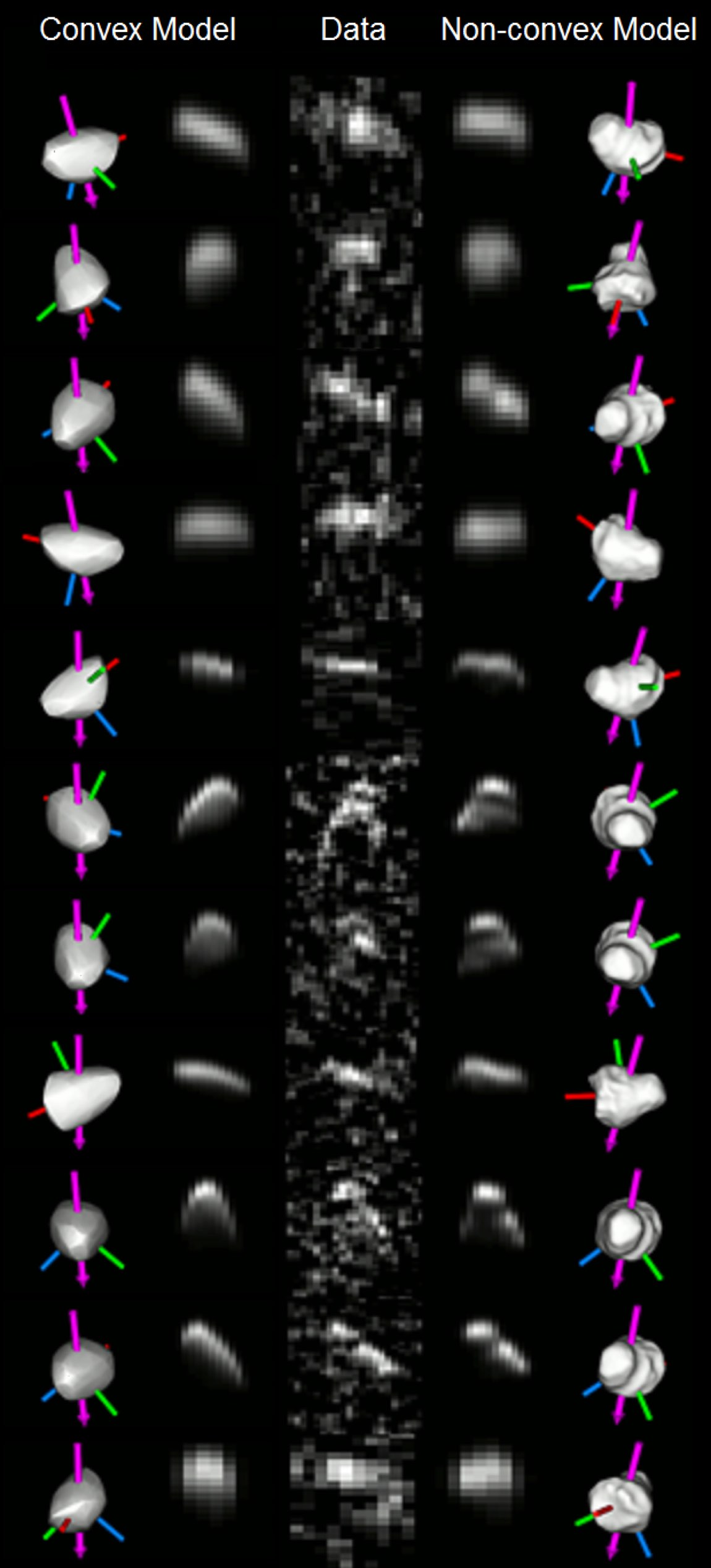
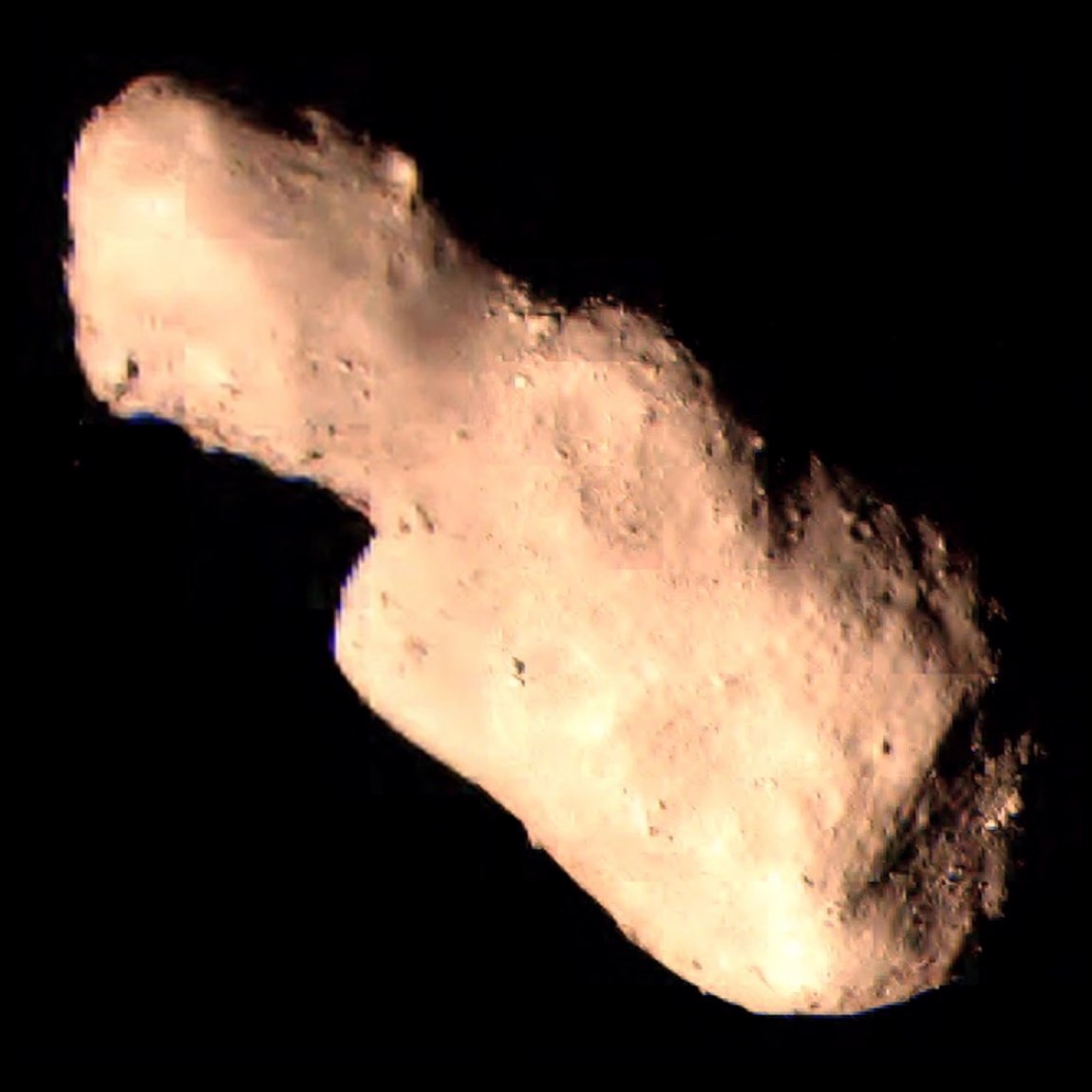
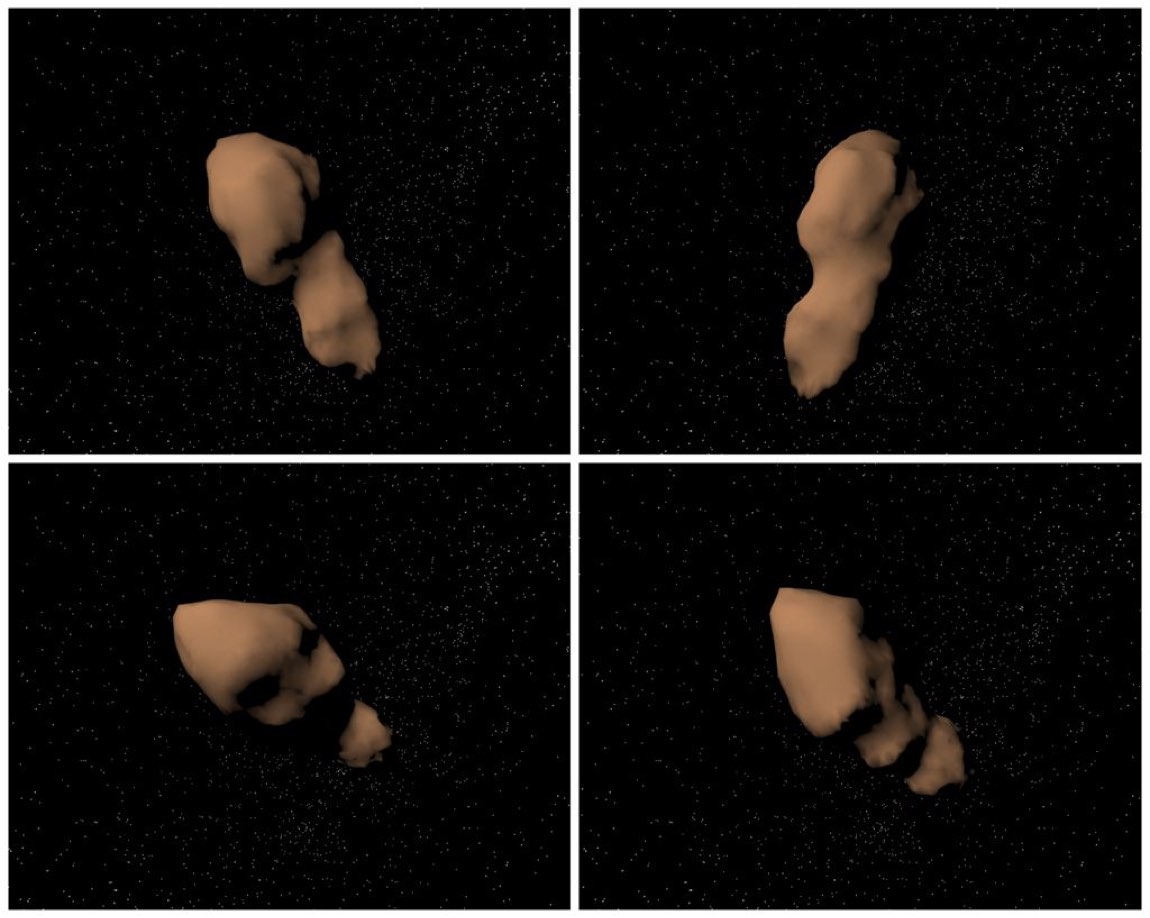
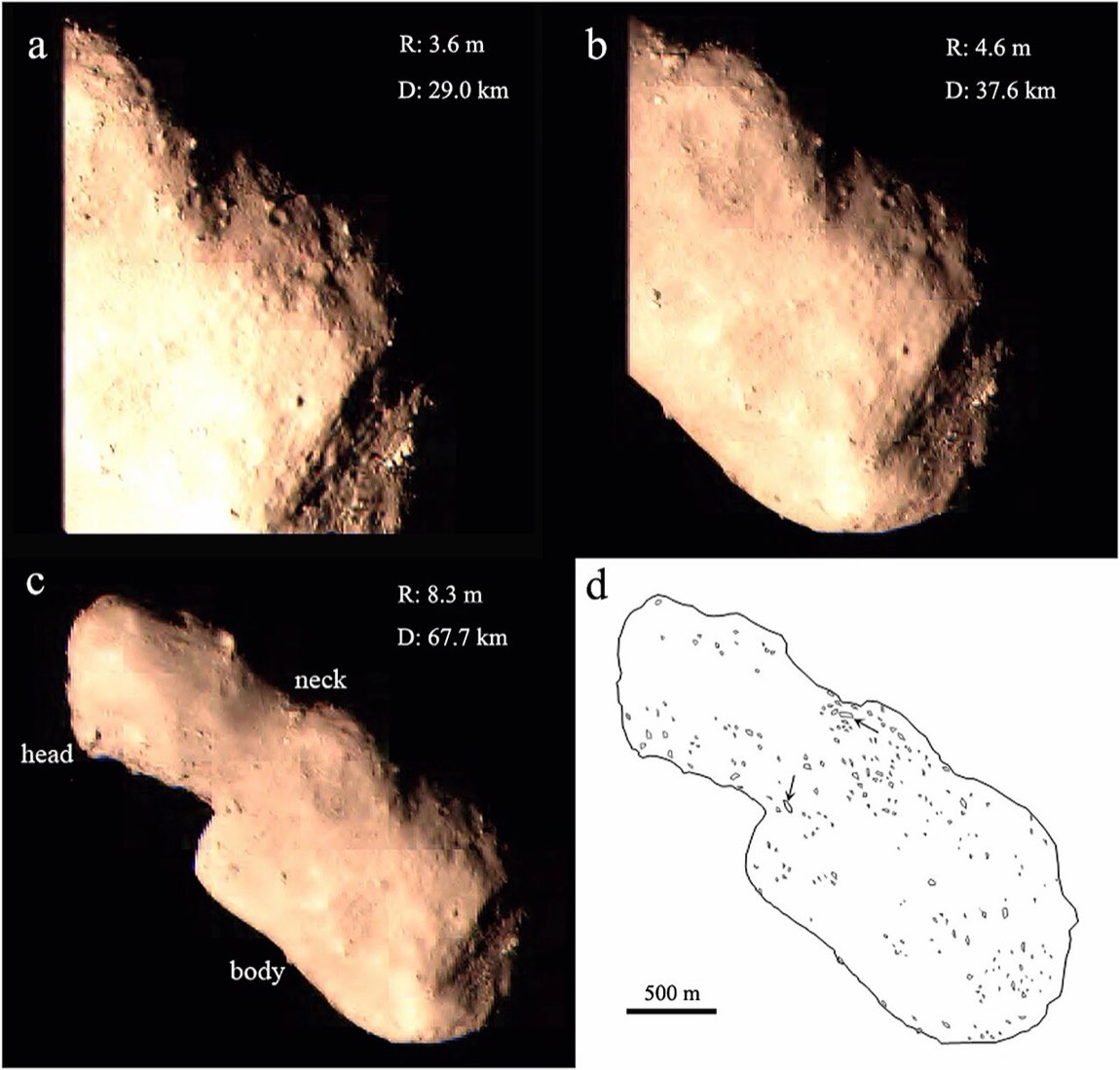
Radar imaging has revealed that Toutatis is not a simple, solid rock but a highly irregular body composed of two distinct lobes — one roughly 4.6 km wide and the other about 2.4 km wide — joined at a narrow neck region. Scientists classify it as a contact binary: two originally separate bodies that drifted together and coalesced, rather than a single object sculpted by erosion or cratering. The result is best described as a rubble pile, a loosely consolidated heap of shattered fragments rather than a monolith. The Chang'e 2 flyby confirmed this picture in detail, showing that the two major lobes are not round but covered in large flat facets, and that the neck connecting the "head" (small lobe) to the "body" (large lobe) has a sharply perpendicular silhouette that surprised researchers. Boulders of varying sizes are scattered across the surface, consistent with a body assembled from collisional debris rather than formed as one piece.
03 A Tumbling, Wandering Spin Deeper
Toutatis rotates in one of the strangest ways known for any solar system body. Instead of spinning steadily around a single axis like Earth does, it undergoes what physicists call non-principal-axis rotation, or tumbling: two separate periodic motions combine into a result that never repeats. Its long axis completes one rotation in 5.38 days (Pψ), while that same axis precesses — wobbles like a slowing top — with a period of 7.38 days (Pφ). Because these two periods are incommensurable, the motion never settles into a simple pattern. For a hypothetical observer standing on the surface, the Sun would appear to rise and set at seemingly random points on the horizon and at unpredictable intervals — a sky utterly unlike anything humans experience on Earth. The leading explanation for how Toutatis lost its original, orderly spin is the YORP effect: the subtle but cumulative torque that sunlight exerts on an irregularly shaped body, which over millions of years can drain angular momentum until the asteroid begins to tumble.
04 Orbital Chaos by Resonance Deeper
Toutatis orbits the Sun with a semimajor axis of 2.5294 AU, completing one circuit for every 4.02 orbits Earth makes — a near 1:4 resonance with our planet. Simultaneously it sits in a 3:1 resonance with Jupiter, the same gravitational trap responsible for the Kirkwood gap in the main asteroid belt. These overlapping resonances, combined with repeated close flybys of Mercury, Venus, Earth, and Mars, generate genuinely chaotic behavior: tiny uncertainties in Toutatis's position grow exponentially with time. The Lyapunov time — the horizon beyond which predictions become unreliable — was estimated in 1993 at roughly 50 years, far shorter than for most solar system objects. Without the perturbations from the terrestrial planets, that horizon would stretch to around 10,000 years. This chaotic character was first recognized observationally by Wiśniewski. The practical consequence is that while Toutatis's orbit is pinned down precisely for the next few hundred years (uncertainty parameter 0), confident long-term forecasts beyond that window are essentially impossible.
05 Planetary Transits Seen from an Asteroid
Because Toutatis's orbit is tilted only 0.47° from the plane of the solar system — almost perfectly flat — it enjoys a rare geometric privilege: frequent transits, where the inner planets Mercury, Venus, Earth, and Mars can appear to march across the face of the Sun as seen from the asteroid's surface. Earth itself made such a transit as viewed from Toutatis in January 2009, July 2012, July 2016, and again in 2020. These events are the mirror image of the Venus and Mercury transits that astronomers watch from Earth, but they underscore just how differently the solar system looks from a vantage point even a few AU away. The low orbital inclination is also the reason Toutatis qualifies as a Mars-crosser, threading close enough to the red planet's path to receive gravitational nudges that contribute to its chaotic trajectory.
06 The Giant Basin and Its Ridge Deeper
Among the most striking features revealed by the Chang'e 2 flyby is a giant basin at the large end of Toutatis measuring approximately 805 m in diameter — roughly the length of eight city blocks. Its size implies that one or more substantial impactors struck Toutatis there with enough energy to excavate the depression and stress the surrounding material. The most prominent element of this feature is not the basin floor but the ridge encircling it; the basin wall shows a relatively high density of lineaments, several of which appear concentric to the basin rim. Such ridge patterns are considered diagnostic of the internal structure of small bodies, and most of the ridges near the largest basin are interpreted as expressions of the enormous stress energy released during the impact event. Linear structures of a shorter kind are also scattered elsewhere on the surface, hinting at a complex deformation history for a body that is itself a coalescence of fragments.
 ⤢
07 Decades of Radar Portraits
Long before any spacecraft visited Toutatis, ground-based radar telescopes built up a surprisingly detailed picture of it. The Arecibo Observatory in Puerto Rico and the Goldstone Solar System Radar in California both trained their beams on the asteroid during its close Earth flybys in 1992, 1996, 2000, 2004, and 2008, and again during the December 2012 and December 2016 passes. The technique bounces a precisely timed radio pulse off the asteroid and analyses the returning echo to map surface features. At its finest, Goldstone and Arecibo imagery achieved a resolution of 3.75 meters per pixel — good enough to resolve individual boulders and topographic features across a body only 2.5 km across. That resolution is comparable to seeing a dinner table from across a large city using nothing but radio waves. These radar campaigns provided the shape models and spin-state data that guided mission planners for the Chang'e 2 flyby, demonstrating how powerful Earth-based radar astronomy can be as a precursor to spacecraft exploration.
08 Chang'e 2: A Lunar Probe Goes Asteroid Hunting
China's Chang'e 2 spacecraft was designed primarily as a lunar mission, but after completing its original objectives it was redirected toward an entirely different target. Departing from the Sun–Earth L2 Lagrange point in April 2012, the probe traveled for months before making its closest approach to Toutatis on 13 December 2012 — just one day after the asteroid reached its nearest point to Earth. Chang'e 2 passed within 3.2 kilometers of the asteroid's surface at a relative velocity of 10.73 km/s, capturing images that revealed the contact-binary structure, the giant basin, the neck region's perpendicular silhouette, and the boulder-strewn terrain in unprecedented detail. The flyby confirmed and extended the picture built up by decades of radar work, while also uncovering geological details — particularly the giant basin and the ridge system around it — that radar alone could not resolve. It marked China's first close encounter with a small solar system body and demonstrated the value of repurposing spacecraft already in deep space rather than launching dedicated missions.
09 How Close Has It Really Come?
Toutatis earns its "potentially hazardous" label through a series of genuine near-misses measured in lunar distances rather than millions of kilometers. Its minimum possible approach distance (Earth MOID) is just 0.006 AU, or about 2.3 times the Earth–Moon distance. The closest modern encounter on record occurred on 29 September 2004, when Toutatis passed within 0.0104 AU — roughly 4 lunar distances — and brightened to an apparent magnitude of 8.8, making it detectable with good binoculars. The December 2012 pass brought it to 0.046 AU (about 6,900,000 km), glowing at magnitude 10.7, which was just within reach of experienced observers with high-end binoculars but invisible to the naked eye. A 2004 chain email falsely claimed a 63% impact probability; in reality Toutatis sailed past at 1.5 million kilometres as predicted. With an uncertainty parameter of 0, its orbit is precisely known for centuries ahead, and the probability of collision is essentially zero for at least the next six hundred years.
10 Eventual Exile from the Inner Solar System Deeper
Despite its current status as a regular Earth visitor, Toutatis is not a permanent fixture of the inner solar system. Its chaotic, resonance-driven orbit means that each close planetary encounter subtly reshapes its trajectory, and over geological timescales the cumulative effect is dramatic. Astronomers consider it likely that Toutatis will be ejected from the inner solar system entirely within a few million years — a cosmically short timescale. The mechanism could be a particularly strong gravitational kick from Jupiter or one of the terrestrial planets, sending it onto a hyperbolic escape trajectory or crashing it into a planet. In 2006, Toutatis already approached within 2 AU of Jupiter, and in the 2100s it is expected to make many similar approaches. Each one is a roll of the dice. The asteroid's classification as an Alinda group member — defined by that 3:1 Jupiter and near-1:4 Earth resonance with a semimajor axis of 2.5294 AU — places it in exactly the category of objects most susceptible to this kind of long-term orbital instability.
11 Surface Texture: Boulders and Facets Deeper
The Chang'e 2 imagery documented a surface far more geologically varied than a smooth, featureless rock. Beyond the giant 805-m basin, the asteroid's terrain includes a large number of boulders of varying sizes scattered across both lobes, several short linear structures whose origin remains under investigation, and the large flat facets that give the lobes their angular, non-spherical appearance. The neck connecting the two lobes is particularly distinctive: in profile it presents a sharply perpendicular silhouette that was not anticipated from radar models alone and stands as one of the more novel findings of the flyby. These surface characteristics are consistent with the rubble-pile hypothesis — a body whose constituent pieces have been jostled, re-accreted, and partially re-shaped by impacts over billions of years, rather than one that solidified from melt or was sculpted purely by space weathering. The relatively high density of lineaments on the walls of the giant basin suggests that individual impact events can impose structural signatures detectable at the global scale.
12 Reflectivity, Composition, and Brightness
Spectral observations classify Toutatis as an S-type asteroid, the most common variety among near-Earth objects, composed primarily of silicate minerals — essentially the same rocky material that makes up much of Earth's mantle. Its moderate Bond albedo of 0.13 means it reflects about 13% of the sunlight that strikes it, making it somewhat darker than a concrete pavement but nowhere near as dark as the carbon-rich C-type asteroids. During its closest modern approach in September 2004 it reached an apparent magnitude of 8.8 — bright enough to be glimpsed with binoculars under dark skies, though never naked-eye. The 2012 close approach produced a peak magnitude of only 10.7, requiring high-end binoculars and experienced observers to spot. After 2016, Toutatis fades from practical backyard observing range until its next notable close approach in November 2069, when it will pass at 0.01985 AU (2,970,000 km).
 ⤢