 Photograph · CSNA/Siyu Zhang/ Kevin M. Gill · CC BY 2.0
Spacecraft · Deep guide
Chang'e Program
China's Moon program went first to the far side and came home with samples twice.
What is it?
China's Chang'e program, named for the Moon goddess, went from first orbiter (2007) to feats no one else has managed: Chang'e 4 made history's first far-side landing in 2019, its Yutu-2 rover trundling for years; Chang'e 5 returned fresh lunar samples in 2020 — the first since 1976; and Chang'e 6 brought back the first far-side samples ever in June 2024. Crewed Chinese lunar landings are planned around 2030.
The deep dive
Researched for the Atlas from Wikipedia — Chinese Lunar Exploration Program (15,470 characters read) · updated Sep 20, 2026
01 Four Phases That Built a Lunar Program
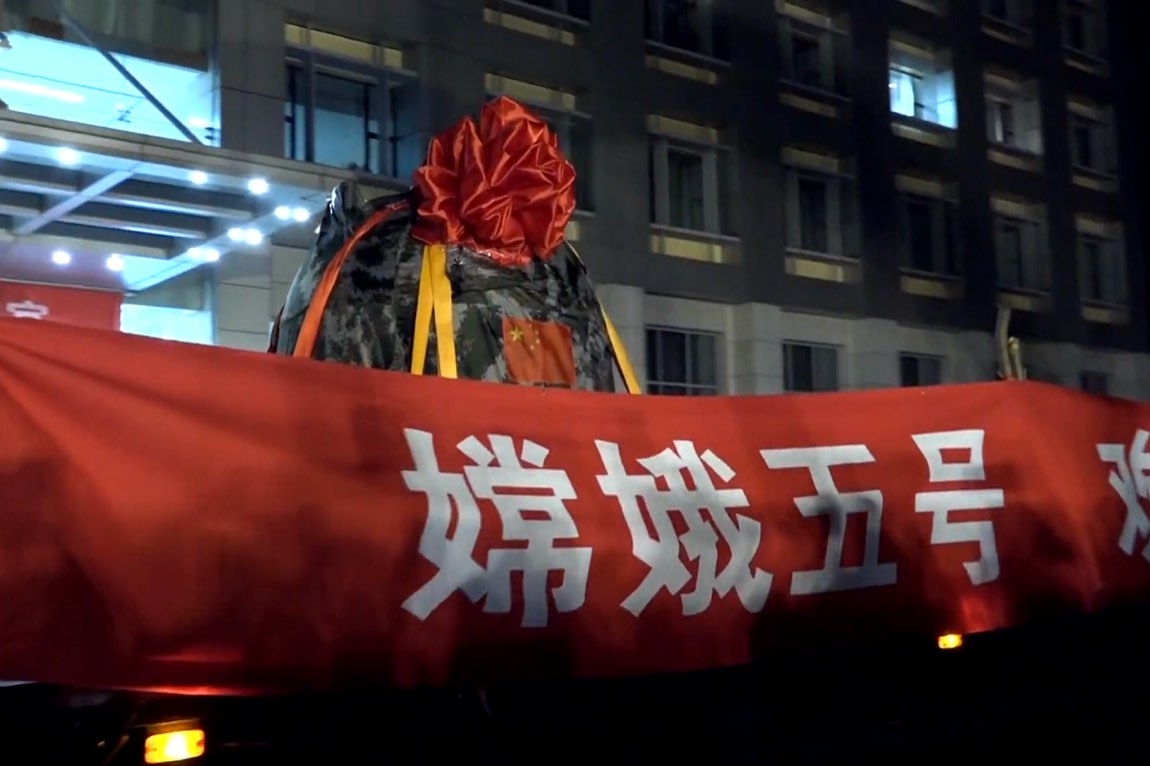
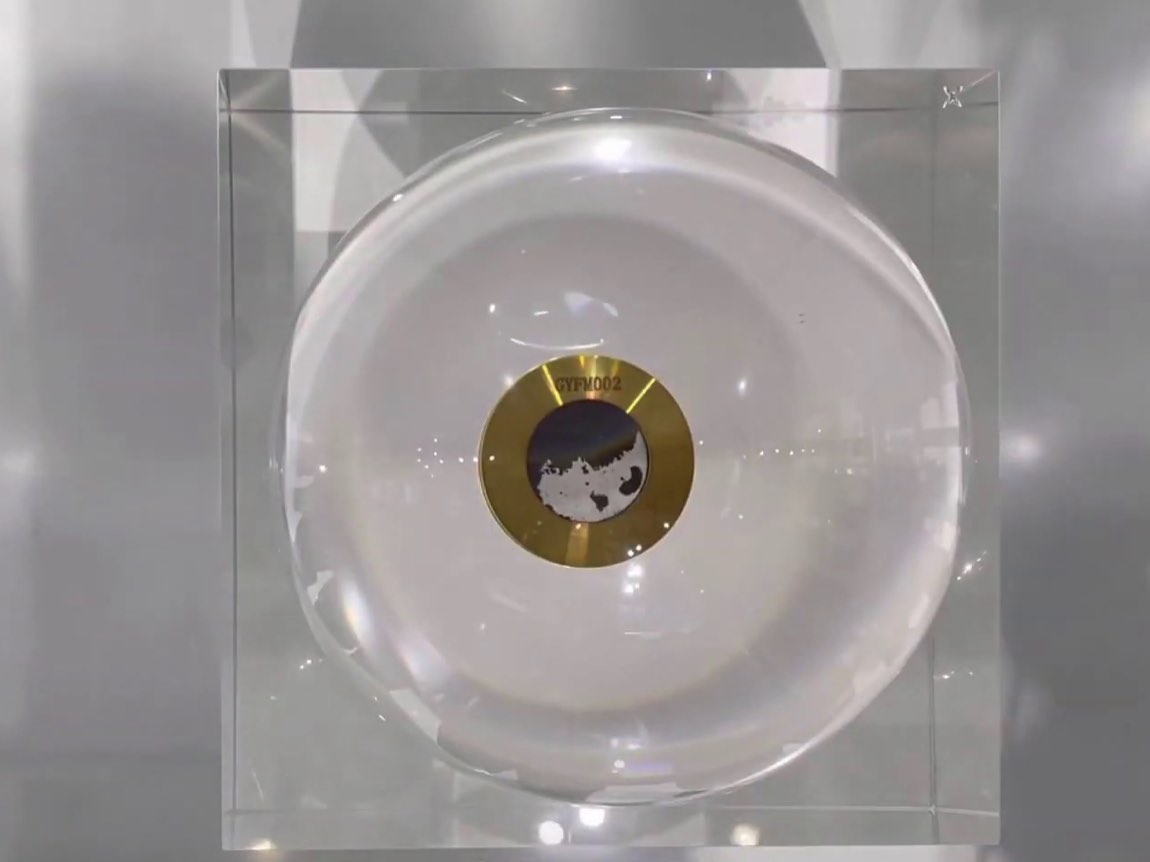
China's lunar effort was engineered in deliberate steps, each mission proving technology that the next one would depend on. Phase I sent two orbiters — Chang'e 1 in 2007 and Chang'e 2 in 2010 — to map the Moon and stress-test the tracking network before anything was asked to land. Phase II moved to soft landers and rovers, with Chang'e 3 in 2013 and the historic far-side Chang'e 4 in 2019. Phase III tackled sample return, culminating with Chang'e 5 bringing back 1,731 grams of lunar rock in 2020 — the first such delivery to Earth since the Soviet Luna 24 mission in 1974. Phase IV, which entered active development in 2023, is building toward a permanent robotic research station near the lunar south pole through Chang'e 6, 7, and 8. Rather than treating each mission as a standalone achievement, the program's designers explicitly described every spacecraft as a technology demonstrator preparing the ground for the one that followed. That philosophy of incremental validation is what allowed China to progress from its first orbital images to far-side sample collection in less than two decades.
02 Chang'e 2's Surprising Second Career
Most lunar orbiters retire into the history books, but Chang'e 2 kept going long after its primary job was done. Launched on 1 October 2010 aboard a Long March 3C rocket, it mapped the Moon in greater detail than its predecessor and reached lunar orbit in under five days, compared with twelve days for Chang'e 1. Once that work was finished, mission controllers pointed the spacecraft toward the Earth–Sun L2 Lagrangian point, roughly 1.5 million kilometers from Earth, to put China's deep-space tracking and command network through a demanding long-range test. Then, on 13 December 2012, Chang'e 2 flew past asteroid 4179 Toutatis, snapping close-up imagery of a body that periodically approaches Earth. Afterward it continued into deep space as a further test of the TT&C network's reach. The extended mission demonstrated that China's ground infrastructure could handle communication across distances far greater than the Moon — critical preparation for future missions that would push beyond Earth orbit entirely. Chang'e 2 also used the European Space Agency's deep space network for navigation and communication during its asteroid rendezvous phase.
03 Landing on the Moon's Hidden Side
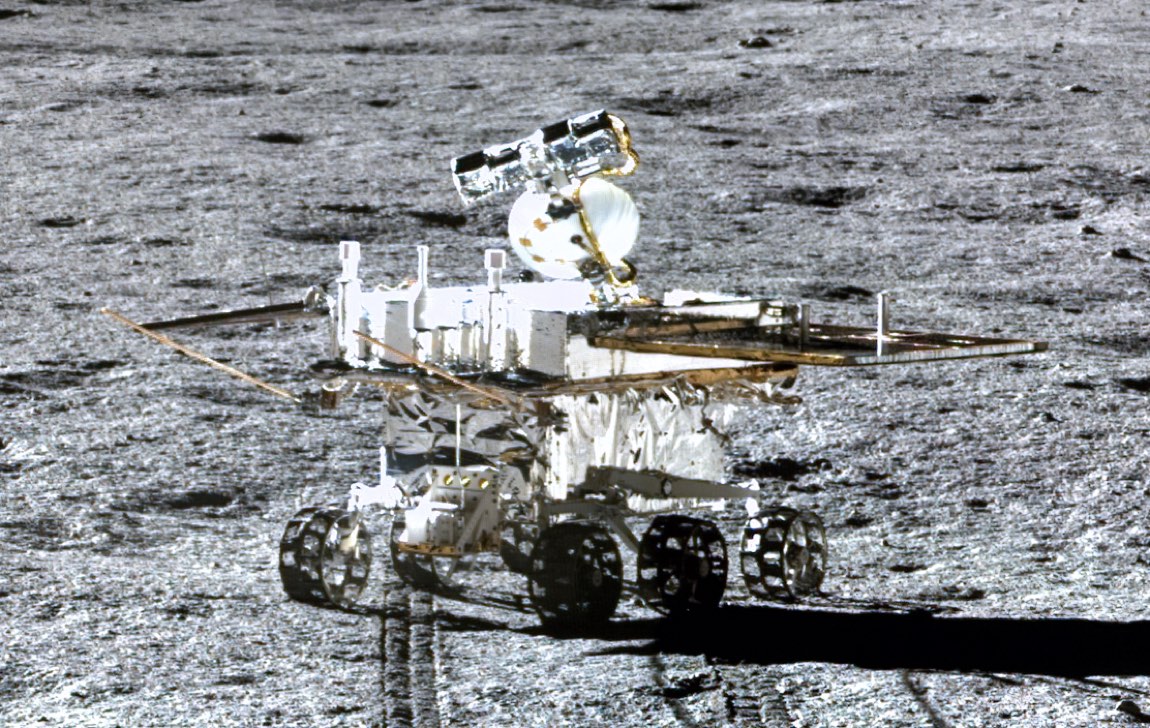
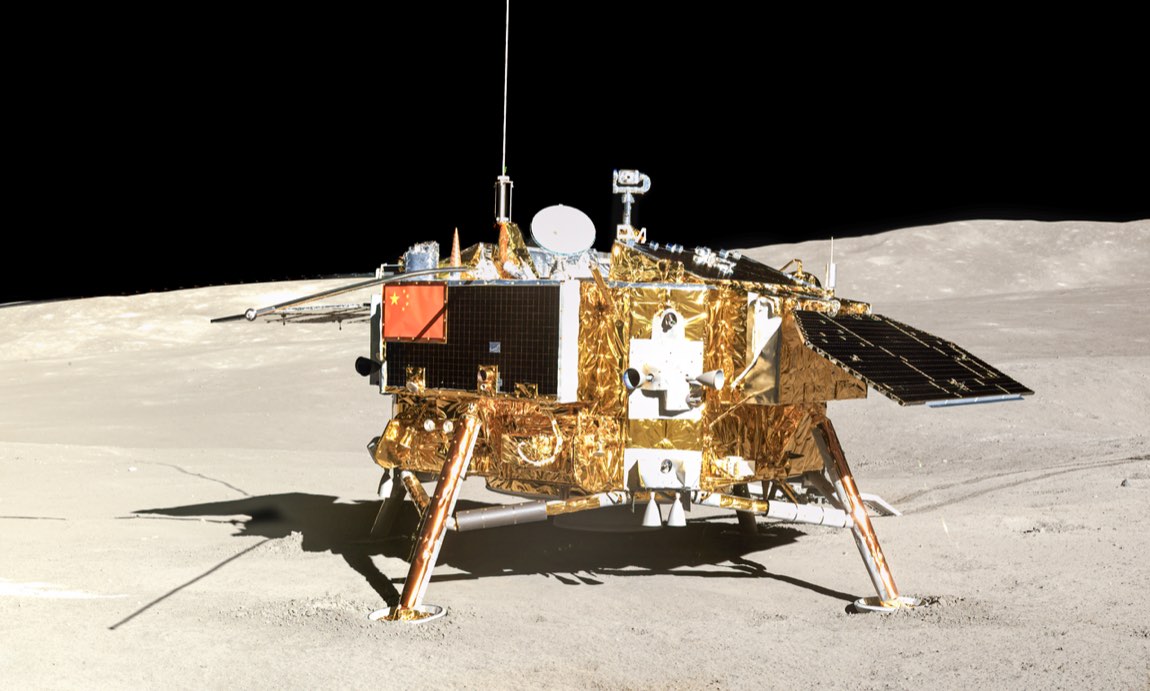
The far side of the Moon permanently faces away from Earth, which means radio signals cannot travel between it and any ground station in a straight line. No mission had ever landed there until Chang'e 4 touched down on 3 January 2019 in the South Pole-Aitken Basin — one of the largest and oldest impact craters in the solar system. To solve the communications blackout, China launched the Queqiao-1 relay satellite in 2018 and positioned it in a halo orbit, a gravitationally stable perch above the far side from which it could bridge signals between Earth and the lander. The Yutu-2 rover rolled out from the lander and eventually became the longest-lived lunar rover in history. Chang'e 4 also carried four international scientific payloads from the Netherlands, Germany, Sweden, and Saudi Arabia, and received support from Russia's radioisotope heat source as well as NASA's Lunar Reconnaissance Orbiter team. The mission demonstrated that the far side, long inaccessible, could be explored routinely — a capability China pressed into service again with Chang'e 6 in 2024.
04 Scooping Rocks From the Far Side
When Chang'e 6 launched on 3 May 2024, its goal was something no mission before it had ever accomplished: returning physical samples from the lunar far side. The spacecraft investigated the topography, composition, and subsurface structure of the South Pole–Aitken basin, and ultimately collected material from within Apollo Basin, a large impact crater nested inside that ancient giant structure. Scientists consider the South Pole–Aitken basin scientifically precious because the impact that created it may have excavated deep into the lunar interior, bringing up material that would otherwise be permanently buried. Chang'e 6 also carried a Chinese rover named Jinchan, which performed infrared spectroscopy of the surface and captured images of the lander itself sitting on the lunar ground. A French magnetic field detector was among the international instruments aboard. The samples it returned are the first far-side lunar specimens ever held in a laboratory on Earth, and researchers from multiple countries have already been given access to Chinese lunar material for scientific analysis.
 ⤢
⤢
05 Tracking Spacecraft Across 400,000 Kilometers Deeper
Keeping in contact with a probe at lunar distance turned out to be the most demanding engineering challenge of Phase I. China's standard satellite telemetry infrastructure had a reach of only 80,000 kilometers, but the Moon can be more than 400,000 kilometers away when it is near apogee — five times farther than the existing network could reliably handle. The solution was to combine a dedicated telemetry, tracking, and command system with China's astronomical observation network, using 50-meter radio antennas in Beijing alongside 40-meter antennas in Kunming, Shanghai, and Ürümqi. Together these dishes form a very-long-baseline interferometry array stretching 3,000 kilometers across the country. Even so, the breadth of China itself — 5,000 kilometers from east to west — created gaps in continuous coverage as probes arced across the sky. Program engineers acknowledged that the combined network met mission needs, but only by a small margin. Attitude maneuvers performed during cruise and orbital insertion phases added further strain, because a slewing spacecraft temporarily breaks its antenna lock with the ground. The European Space Agency's ground stations in Australia and Spain provided additional tracking support for early missions.
06 Surviving the Moon's Brutal Temperature Swings Deeper
The Moon offers no atmosphere to buffer its surface or the spacecraft sitting on it, which means hardware must endure one of the most punishing thermal environments in the inner solar system. On the sunlit face of a probe the temperature can climb to 130 degrees Celsius — hotter than boiling water — while the shadowed side simultaneously plunges to negative 170 degrees Celsius, a swing of 300 degrees across the width of a single spacecraft. Designers had to engineer thermal control systems capable of preventing electronics from cooking on one side and freezing on the other, often at the same moment. The high-radiation environment of Earth-Moon space added another requirement: all electronics had to be radiation-hardened to resist electromagnetic damage from charged particles. These constraints affected every subsystem, from power regulators and computer chips to camera optics and structural joints. Chang'e 3's hazard-avoidance computer, which had to process live camera and ranging data during the final 100-meter hover before touchdown, was among the components that had to function flawlessly inside this extreme environment without any possibility of repair from Earth.
07 How Rovers See and Avoid Danger
Setting a spacecraft down safely on an airless, rock-strewn surface requires the lander to think for itself, because the roughly 1.3-second one-way signal delay to the Moon makes real-time human steering impractical during the critical final moments. Chang'e 3 used a computer vision system fed by a downward-facing camera and two ranging devices, whose data were processed by specialized software to identify hazards and guide the spacecraft. The lander hovered first at 100 meters above the surface, then descended to a second hover at 30 meters while the software selected a safe patch of ground, adjusting engine throttle and spacecraft attitude as needed before committing to the final drop. The Yutu rover itself carried forward-facing stereo cameras and its own hazard-avoidance system for navigating boulders and craters once on the surface. Each new lander generation has refined these systems, building the autonomous-decision capability that will become even more critical when China attempts to land robotic hardware at the rugged lunar south pole terrain targeted by Chang'e 7 and Chang'e 8.
08 The Relay Satellites Behind Far-Side Access Deeper
Queqiao-1, launched in 2018, made Chang'e 4's far-side landing possible by positioning itself in a halo orbit above the Moon's far side, acting as a radio bridge between Earth and the lander below. A halo orbit is a gravitationally choreographed path near a Lagrange point that keeps a satellite roughly in place relative to two larger bodies — in this case Earth and Moon — without requiring continuous thrust. China followed this with Queqiao-2, launched in 2024, which occupies a different type of path: a frozen orbit designed to provide communications coverage of the lunar south pole, the region targeted by Chang'e 7 and Chang'e 8. A frozen orbit is one in which the orbital parameters remain stable over long periods without constant correction, which reduces the fuel needed to maintain the satellite's position. The two Queqiao satellites together form a dedicated communications infrastructure for the lunar far side and south pole, independent of any international relay network. Their existence reflects how seriously China treats communications architecture as a foundational requirement rather than an afterthought.
 ⤢
⤢
09 Testing Reentry Before the Real Thing
Bringing a capsule back from the Moon is fundamentally harder than returning from low Earth orbit. A spacecraft arriving from lunar distance hits Earth's atmosphere at roughly eleven kilometers per second — nearly twice the speed of a typical orbital reentry — and the heat generated is correspondingly more severe. Rather than attempt this for the first time with an irreplaceable cargo of lunar rocks, China flew Chang'e 5-T1 on 23 October 2014 specifically to rehearse the return. The mission tested both the reentry capsule's heat shield and its trajectory guidance, and also validated the robotic docking technology that would later allow Chang'e 5's ascent stage to rendezvous with an orbiting module in lunar orbit before heading home. That orbital docking was a world first for a robotic spacecraft operating at the Moon. The test-before-you-fly approach mirrors the logic of the whole program: each mission handles a slice of the overall challenge so that when the pieces come together, the critical unknowns have already been answered by hardware that already flew.
10 International Science Riding Chinese Rockets
Despite being a national program, the Chang'e missions have carried instruments from a notably wide range of international partners. Chang'e 1 flew a European Space Agency instrument called D-CIXS, which measured the elemental composition of the lunar surface. Chang'e 2 carried a laser altimeter from the German Aerospace Center to map lunar topography. Chang'e 4 hosted four payloads from the Netherlands, Germany, Sweden, and Saudi Arabia, and received a radioisotope heat source from Russia. Chang'e 5 flew a French magnetic field detector and benefited from telemetry support from ESA, Argentina, Namibia, Pakistan, and others. Scientists from Australia, Russia, France, the United States, the United Kingdom, and Sweden have been given access to samples returned by Chang'e 5 for their own research. The ESA also provided tracking support to Chang'e 1 through ground stations in Australia and Spain. This pattern of cooperation, even while the broader geopolitical context has made some forms of collaboration with China contentious, shows that the scientific community has found pragmatic ways to participate in missions it could not fund or fly independently.
11 A Future Station at the Lunar South Pole
China's long-term ambition reaches well beyond individual robotic missions. Phase IV of the program is aimed at constructing the International Lunar Research Station near the Moon's south pole, beginning in 2031, in collaboration with Russia and eleven other countries. The polar location is strategic: permanently shadowed craters there are thought to contain water ice, a resource that could support both life and rocket propellant production. Chang'e 7 and Chang'e 8 will scout and test the territory first. Chang'e 7, expected to launch in August 2026, will search for resources using an orbiter, a lander, and a mini flying probe capable of reaching areas a wheeled rover cannot. Chang'e 8, expected in 2028, goes further, planning a 3D-printing experiment that would use locally gathered material to build a physical structure — the first test of genuine in-situ resource utilization on the Moon. The heavy construction phase of the station itself is slated for the Long March 9, a super heavy-lift rocket analogous in ambition to SpaceX's Starship.
12 Named for a Goddess, Led by a Geologist
The program takes its popular name from Chang'e, the goddess of the Moon in Chinese mythology, lending each mission a resonance with a tradition of lunar storytelling stretching back millennia. The rovers carry equally evocative names: Yutu, the jade rabbit who is Chang'e's companion in legend, and Jinchan, meaning golden toad, which appears in related lunar folklore. On the engineering and science side, the program's chief scientist is Ouyang Ziyuan, a geologist and chemical cosmologist whose career has focused on the origin and evolution of the Moon and its resources. The program's chief commander and chief designer is Ye Peijian, while Sun Jiadong — an aerospace engineer — serves as general designer. Sun Zezhou is deputy general designer, and Luan Enjie is the leading program manager. This combination of deep planetary science expertise at the top with experienced aerospace engineers running operations has given the program both scientific ambition and the operational discipline to execute difficult missions reliably across nearly two decades of continuous activity.
 ⤢
⤢