Asteroid · Deep guide
1620 Geographos
Also called: 1620 Geographos · (1620) Geographos · 1951 RA
One of the most elongated objects in the Solar System, named after the National Geographic Society.
What is it?
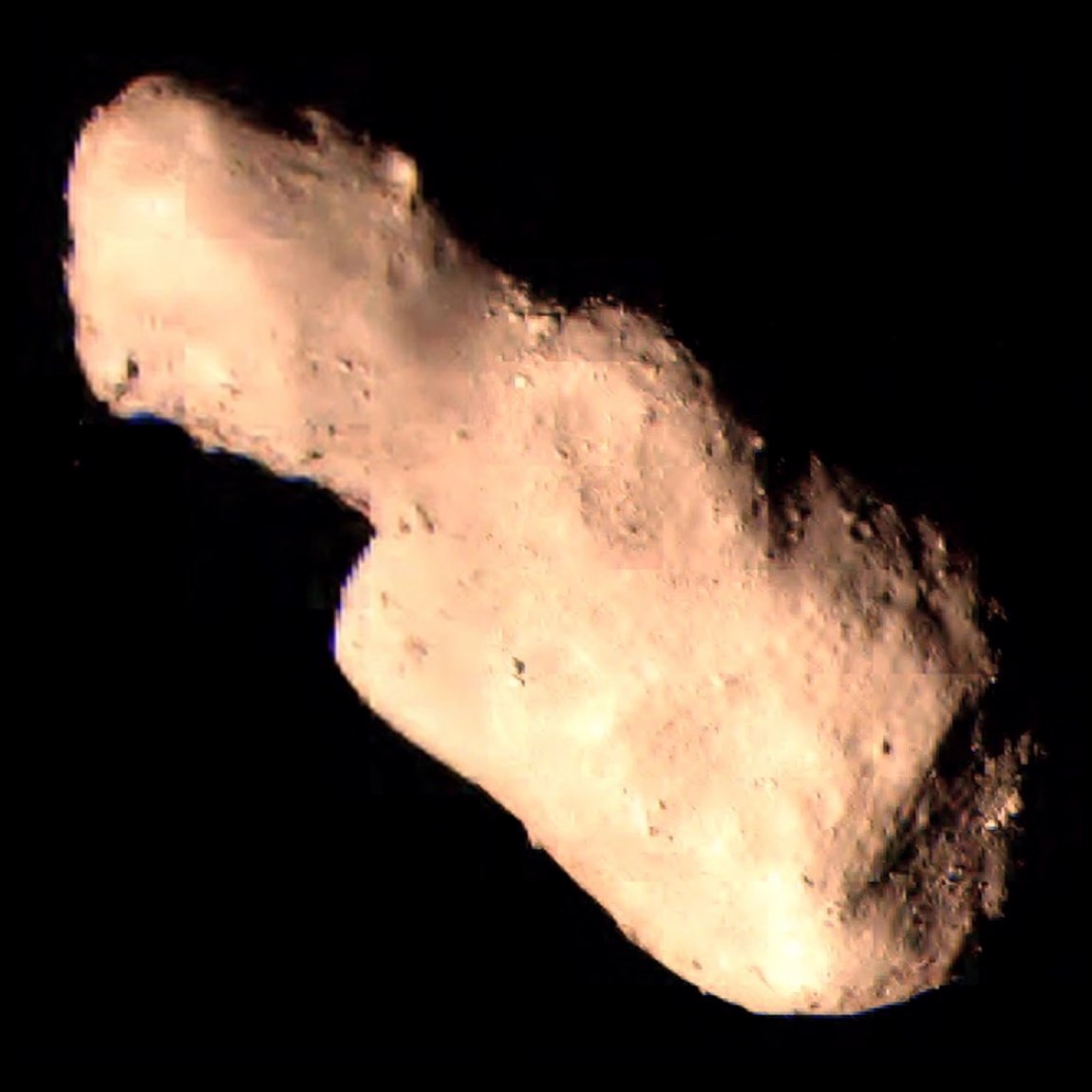
Geographos is a stony near-Earth asteroid about 5 km long but only about 2 km wide — shaped a bit like a cigar. Radar observations revealed just how stretched it is. It was discovered in 1951 at Palomar Observatory by Albert Wilson and Rudolph Minkowski, and was named in honour of the National Geographic Society. It is classed as potentially hazardous because of its size and orbit, though it poses no known threat.
The deep dive
Researched for the Atlas from Wikipedia — 1620 Geographos (4,513 characters read) · updated Nov 14, 2026
01 The Most Elongated Object in the Solar System
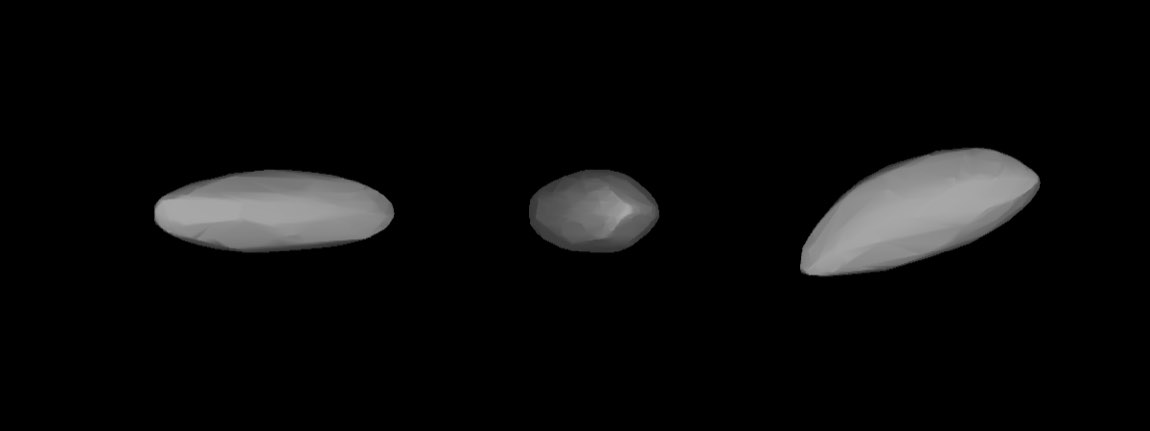
Geographos holds a remarkable distinction: radar images taken during its 1994 close approach revealed it to be the most elongated object in the Solar System at that time. Its dimensions, measured at 5.0 × 2.0 × 2.1 kilometers, mean that the asteroid is roughly two and a half times longer than it is wide — imagine a sweet potato the length of Central Park stretched end to end, tumbling through space. This extreme shape produces a dramatic signature in its lightcurve, where the brightness swings by as much as 2.03 magnitudes across a single rotation cycle. That is an enormous variation; most asteroids show changes of a fraction of a magnitude. The elongation likely reflects the violent collisional history of the early Solar System, though whether Geographos was always this shape or was gradually sculpted by impacts and tidal forces remains an open question. Its cigar-like proportions make it one of the most visually striking small bodies we have yet studied.
02 A Rubble Pile Wrapped in Boulders Deeper
Despite its dramatic silhouette, Geographos is probably not a solid chunk of rock. Scientists believe its interior has a rubble-pile structure — essentially a gravitationally bound collection of fragments and voids, more like a loosely packed gravel heap than a coherent monolith. This interpretation is consistent with what we know about many similar-sized near-Earth asteroids. Adding another layer of complexity, Geographos displays a high thermal inertia, which tells researchers that its surface is most likely a mixture of fine grains and large rocks and boulders rather than a uniform blanket of fine regolith dust. Thermal inertia measures how quickly a surface heats up and cools down as sunlight hits it; a very fine powder cools quickly, while coarser material retains heat longer. The blend of grain sizes on Geographos suggests a geologically active surface history, possibly shaped by impacts churning up material and re-depositing it across the body's unusual elongated form.
03 Radar Portrait from Goldstone
The clearest look humanity has ever gotten at Geographos came not from a spacecraft but from a dish on the ground. During the asteroid's closest approach to Earth in two centuries in August 1994, the Deep Space Network's Goldstone Observatory in California trained its powerful radar on the passing body. The resulting images were detailed enough to confirm the asteroid's extraordinary elongated shape and settle debates about its dimensions. Radar astronomy works by bouncing radio waves off a target and analyzing the returning echoes — a technique that can resolve surface features and shapes even across millions of kilometers of space. The Goldstone study was a landmark moment for planetary science, demonstrating that ground-based radar could characterize a potentially hazardous asteroid in remarkable detail without ever leaving Earth. That 1994 flyby, at just 5.0 million km from Earth — roughly 13 times the distance to the Moon — created a narrow observational window that researchers used to maximum effect.
04 How the Yarkovsky Effect Steers Its Path Deeper
Geographos is slowly drifting inward through the Solar System due to a subtle but measurable force called the Yarkovsky effect. Sunlight warms one side of the rotating asteroid; that heat is then re-radiated as infrared photons, which carry a tiny momentum. Over centuries this creates a persistent gentle push. For Geographos, measurements show the orbital semimajor axis is decreasing at a rate of 27.4 ± 5.7 meters per year — a drift so small it would take millennia to become dramatic, yet precise enough to be detected and quantified. A related phenomenon, the YORP effect, is simultaneously spinning the asteroid faster, increasing its rotation rate at (1.14 ± 0.03) × 10⁻³ radians per year squared. Both effects arise from the same basic physics of uneven heat radiation but operate on different aspects of the orbit. Understanding these forces is critical for long-range hazard assessment because even tiny annual drifts compound into significant orbital shifts over the timescales relevant to impact prediction.
05 A Spin Axis Pinned with Remarkable Precision Deeper
Few small asteroids have had their rotation state pinned down as precisely as Geographos. Multiple independent research teams, using photometric and radiometric observations gathered across different epochs, converged on a rotation period of approximately 5.223327 hours — agreement at the sixth decimal place, which is extraordinary for an object this size. The spin axis has been determined through several studies and clusters around ecliptic coordinates of roughly 55° longitude and −46° to −47° latitude, with Polish astronomers in 1994 and 1995 contributing an influential early solution of (54.0°, −52.0°). The retrograde sense of rotation — meaning Geographos spins in the opposite direction to its orbital motion around the Sun — is consistent across all analyses. The high quality ratings assigned to these solutions (Q=3 in multiple studies) indicate the results are considered reliable and well-constrained. This level of spin-state knowledge is an important foundation for modeling both the Yarkovsky drift and the long-term stability of the asteroid's orientation.
06 Clementine's Missed Rendezvous
Geographos came tantalizingly close to becoming the first asteroid ever visited by an American spacecraft. The U.S. Clementine mission, launched in January 1994, had Geographos written into its itinerary as a secondary target after completing its primary work mapping the Moon. The plan was to fly past the asteroid and return the first close-up images of a near-Earth asteroid from an American probe. It was not to be. A malfunction aboard the spacecraft ended the mission before Clementine could make its approach, leaving scientists empty-handed just as Geographos was making its closest pass to Earth in two centuries. The failure was a significant disappointment, partly because the 1994 close approach offered a rare geometric opportunity. Ground-based radar at Goldstone ultimately filled part of the scientific gap, but the detailed surface imagery that a spacecraft flyby would have delivered remains uncollected to this day.
07 An Apollo Asteroid That Also Crosses Mars
Geographos belongs to the Apollo group, the population of near-Earth asteroids whose orbits cross Earth's path around the Sun. It circles the Sun once every 508 days — about 1 year and 5 months — traveling between 0.8 and 1.7 AU from the Sun. That outer edge carries it well beyond Earth's orbit at 1.0 AU, reaching into the territory of Mars, which orbits at roughly 1.5 AU. This makes Geographos a Mars-crosser as well, an asteroid that intersects the orbital path of two planets. Its orbital eccentricity of 0.34 is what creates this wide range of distances: a nearly circular orbit would keep it at a constant distance, but Geographos swings in toward Venus-like territory and out toward the main asteroid belt zone on every trip around the Sun. The orbit's inclination of 13° to the ecliptic is moderate, meaning it stays relatively close to the plane in which the planets orbit, increasing the frequency of planetary encounters over geological time.
08 A Stony Composition Rich in Silicates
Geographos is classified as an S-type asteroid under both the Tholen and SMASS taxonomic systems, the most common spectral class among near-Earth asteroids. This classification tells scientists a great deal about what the body is made of: S-type asteroids are composed of nickel-iron metal mixed with iron- and magnesium-silicates. These are essentially the same minerals found in stony-iron meteorites that fall to Earth, which are believed to be fragments of S-type parent bodies shattered by ancient collisions. The surface of Geographos reflects between 26 and 32.58 percent of incoming sunlight — a relatively high albedo compared with the dark carbonaceous asteroids of the outer belt, which often reflect less than 10 percent. This higher reflectivity is characteristic of silicate-rich rocks and helps distinguish S-types from their darker cousins when viewed through a telescope.
09 Naming It After the Map-Makers of the Sky
The name Geographos honors the National Geographic Society, an organization better known for its yellow-bordered magazine than for astronomy. The connection is direct and meaningful: the Society co-funded the National Geographic Society – Palomar Observatory Sky Survey, known as NGS-POSS, which in the 1950s produced a comprehensive photographic atlas of the entire northern sky. That survey became a foundational reference tool for astronomers worldwide. Rudolph Minkowski, one of Geographos's two discoverers, headed the NGS-POSS project, linking the naming neatly to the discovery itself. The Greek roots of the word geographos are elegantly appropriate: geo meaning Earth and graphos meaning drawer or writer, so a geographer is literally one who draws the Earth. The official naming citation was published by the Minor Planet Center in August 1956, about five years after discovery, in Minor Planet Circular 1468.
10 Its Close Approach Record and What Comes Next
The 1994 flyby of Geographos was not just scientifically productive — it was historically exceptional. At 5.0 million km from Earth, it was the closest the asteroid had come in two centuries, and according to orbital calculations, that record will stand for a very long time. The next comparably close encounter is not expected until 2586, more than five centuries from now. The current minimum orbital intersection distance, the closest the two orbits can theoretically bring the bodies together, is 0.0301 AU, equivalent to about 4,500,000 km or 11.7 lunar distances. This figure keeps Geographos on the potentially hazardous asteroid list — a designation that requires a MOID of less than 0.05 AU combined with a diameter exceeding 150 meters. Geographos comfortably clears both thresholds, warranting continued monitoring. Fortunately, its orbit is described as well-determined for the next several hundred years, giving scientists confidence in long-range encounter forecasts.
11 Observing Geographos: What the Light Curves Reveal Deeper
Astronomers have been building up a picture of Geographos through photometric observations since the 1970s, making it one of the more extensively light-curve-studied near-Earth asteroids. The brightness variation recorded across those decades spans a wide range — from 1.02 to 2.03 magnitudes — reflecting how dramatically the visible cross-section changes as the elongated body rotates. When the long axis points toward Earth the asteroid appears brightest; when the short axis faces us it dims significantly. This range of variation is a direct geometric fingerprint of the shape. Multiple independent lightcurve campaigns, assigned the highest quality rating of U=3, have confirmed the period and established the retrograde spin. The abundance of high-quality photometric data is what allowed researchers to construct shape models and determine the spin axis orientation so precisely. For amateur and professional observers alike, Geographos brightens enough during close approaches to become accessible to moderate-aperture telescopes, though its usual faintness means it is primarily a target for professional facilities.
 ⤢