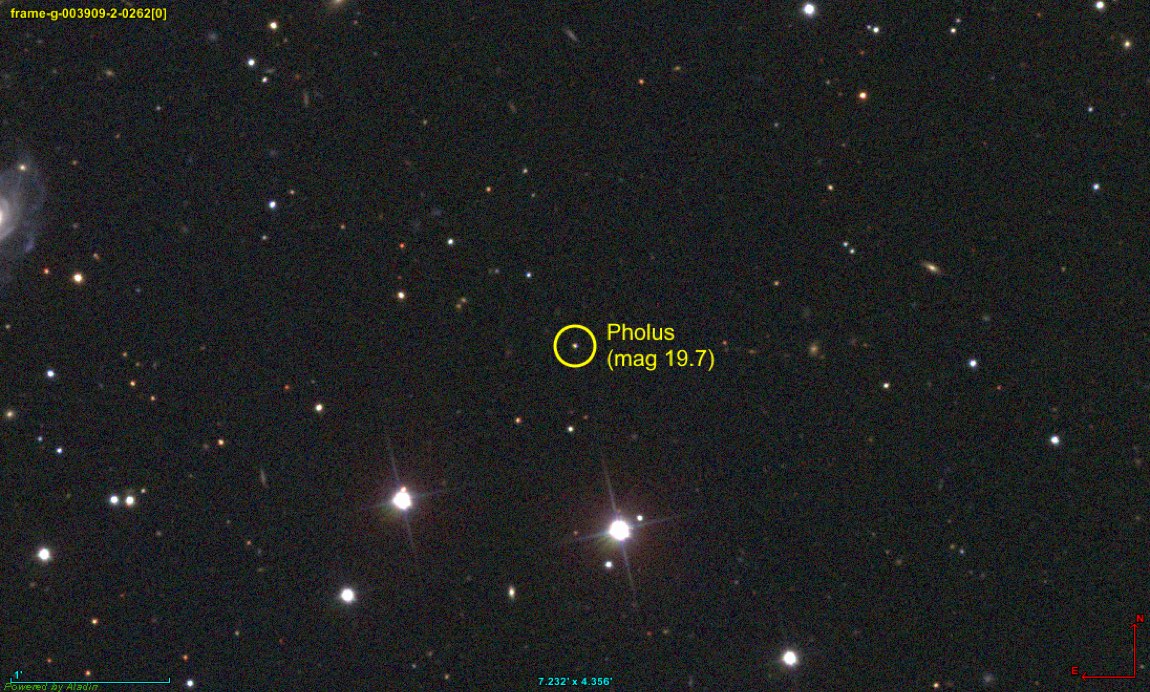
 Photograph · Processing and color compositing by Nrco0e ; original images by Sloan Digital Sk · CC BY 4.0
Asteroid · Deep guide
5145 Pholus
Also called: 5145 Pholus · (5145) Pholus · 1992 AD
One of the reddest objects in the Solar System, on an orbit that crosses Saturn and Neptune.
What is it?
Pholus is a centaur on a long, eccentric orbit that reaches from inside Saturn's orbit out to Neptune's, taking about 92 years per circuit. Its surface is strikingly red, a sign of complex organic compounds produced by radiation on ice. It was found in 1992 by David Rabinowitz of the Spacewatch survey and named after a centaur from Greek myth.
The deep dive
Researched for the Atlas from Wikipedia — 5145 Pholus (5,133 characters read) · updated Nov 14, 2026
01 The Second Centaur Ever Found
When David Rabinowitz spotted Pholus on 9 January 1992 through the Spacewatch survey at Kitt Peak National Observatory in Arizona, he was bagging only the second centaur ever identified. The first, 2060 Chiron, had been found by Charles Kowal back in 1977 — a full fifteen years earlier. What makes the discovery story richer is that Eugene and Carolyn Shoemaker independently confirmed the object by finding it on images they had already taken on 1 January 1992, before the official announcement. The discovery was formally announced by James Scotti on 23 January 1992 in IAU Circular 5434, issued by the Central Bureau for Astronomical Telegrams. Rabinowitz himself went uncredited officially, yet just one year later, in 1993, he discovered a third centaur, 7066 Nessus, while still working with the Spacewatch program. A precovery image from Australia's Siding Spring Observatory, taken as far back as 1977, stretched the known observation arc of Pholus to 15 years before its formal discovery date — giving scientists a much longer baseline of orbital data than the discovery date alone would suggest.
02 An Orbit That Crosses Three Giants
Pholus follows one of the more dramatic orbits in the mid-Solar System. It swings between 8.8 AU and 31.9 AU from the Sun — closer in than Saturn at its nearest, farther out than Neptune at its farthest — completing one full lap every 91 years and 9 months, or 33,526 days. Its semi-major axis sits at 20.35 AU, and the orbit is strikingly stretched, with an eccentricity of 0.57. That elongation is why Pholus crosses the orbital paths of not one but three giant planets: Saturn at a mean distance of 9.6 AU, Uranus at 19.1 AU, and Neptune at 30.1 AU. The orbit is also tilted 25 degrees relative to the ecliptic plane. Despite all this planet-crossing, gravitational close calls are rare: Pholus has not come within one astronomical unit of any planet since 764 BC, and calculations show it will not do so again until the year 5290. Astronomers believe it most likely originated in the Kuiper belt before being scattered inward into its current unstable path.
03 Why Pholus Is Extraordinarily Red
Even among outer Solar System objects, Pholus stands out for its color. After its discovery it was quickly found to be very red — so red that astronomers classify it as a Z-class object under the Tholen taxonomic scheme, and as RR and RR-U type under other classification systems. The leading hypothesis for the color is the presence of organic compounds on its surface. Detailed reflectance spectrum analysis supports a surface made up of two spatially separated components: dark amorphous carbon mixed with an intimate combination of water ice, methanol ice, olivine grains, and complex organic compounds called tholins. The dark carbon component was specifically invoked to match the object's low albedo. Polarimetric observations made with ESO's Very Large Telescope in 2007 and 2008 added another layer of detail, revealing noticeable negative polarization at certain phase angles that is distinctly different from what is seen on trans-Neptunian objects. The surface also appears relatively uniform, with just a small amount of water frost concentrated in its darker regions — a subtly varied landscape painted almost entirely in deep red.
04 Tholins: The Chemistry Behind the Color Deeper
The organic compounds called tholins detected in Pholus's surface mixture deserve special attention. Tholins are complex, reddish-brown macromolecular solids produced when simple molecules like methane, ethane, nitrogen, or water are irradiated by ultraviolet light or energetic particles over long timescales. They are not found naturally on Earth but appear in laboratory simulations of outer Solar System chemistry and have been inferred on several icy bodies beyond the asteroid belt. On Pholus, the reflectance spectrum points to tholins mixed together with water ice, methanol ice, and olivine grains — olivine being a silicate mineral common in rocky and primitive bodies. This intimate mixture, combined with the dark amorphous carbon component, produces the strikingly low albedo and extreme red color. Methanol ice is a particularly significant ingredient, as it hints at a chemically rich, primitive surface that has not been heavily processed since the early Solar System. Unlike its centaur cousin 2060 Chiron, Pholus has shown no signs of cometary activity — no outgassing, no coma — suggesting its surface ices remain locked in place rather than sublimating as it moves through the inner portions of its orbit.
05 A Body With a Stretched and Lumpy Shape
Pinning down Pholus's true size has proven surprisingly difficult. Estimates of its diameter range from 99 to 190 kilometers depending on the method and assumptions used. The Herschel Space Observatory, using its PACS instrument, measured a diameter of 99 kilometers paired with a relatively bright albedo of 0.155. A 1996 study pushed that figure much higher, to 185 kilometers. The most dramatic picture came from observations made between 2003 and 2004 with the 1.8-meter Vatican Advanced Technology Telescope on Mount Graham in Arizona, which resolved an elongated, irregular shape described as 310 km × 160 km × 150 km and yielding a mean diameter of 190 kilometers — though that result relied on an outdated, low albedo of 0.04. Johnston's archive offers a middle-ground estimate of 107 kilometers with an albedo of 0.126. What all these estimates agree on is that Pholus is not a tidy sphere. Its elongated shape, combined with its measurable brightness variations as it rotates, points to a body that is noticeably lumpy — more like a stretched potato than a ball — which is consistent with many small, primitive outer Solar System objects.
06 Measuring the Spin: 9.98 Hours Deeper
In March 2005, astronomer Tegler used the Vatican Advanced Technology Telescope at Mount Graham Observatory to record a rotational lightcurve of Pholus through careful photometric observations. The lightcurve — a graph of the object's brightness over time as it rotates and different parts of its surface face the observer — revealed a rotation period of 9.980 hours with a brightness amplitude of 0.60 magnitude. That amplitude is substantial: a variation of 0.60 magnitudes means the object's apparent brightness changes by a factor of roughly 1.7 as it spins, which is a strong indicator of an elongated or irregularly shaped body rather than a smooth sphere. Importantly, three independent teams arrived at nearly identical results: Hoffmann measured 9.977 hours, Franham found 9.982 hours, and Buie derived 9.983 hours. All four measurements carry a quality code of U=3, the highest reliability rating for lightcurve-derived rotation periods. The tight agreement across separate observers and instruments makes the roughly 9.98-hour spin one of the most confidently established physical facts about Pholus.
07 Naming a Centaur After a Centaur
The name Pholus follows a tradition established with the very first centaur asteroid, 2060 Chiron. Because centaur asteroids occupy a strange middle ground between the asteroid belt and trans-Neptunian space — crossing multiple planetary orbits and behaving partly like asteroids and partly like comets — astronomers decided to name them after the half-human, half-horse centaurs of Greek mythology. In that mythology, Pholus was a figure who died from a self-inflicted wound caused by one of the poisoned arrows belonging to the hero Heracles, who then buried Pholus on the mountain Pholoe. The asteroid 5143 Heracles is separately named after that same hero. The naming was handled by the Minor Planet Names Committee, and the official citation was published by the Minor Planet Center on 14 July 1992, in M.P.C. 20523. The name was proposed relatively quickly after discovery — within about six months — reflecting the community's interest in cementing the new centaur naming convention while the class was still fresh.
08 Pholus in Astrology: A Symbol Created in the 1990s
While Pholus is firmly a subject of astronomical science, it also attracted attention from astrologers who incorporate newly discovered Solar System bodies into their symbolic systems. In the late 1990s, German astrologer Robert von Heeren devised a symbol for Pholus derived directly from the symbol already in use for 2060 Chiron. The Chiron symbol uses the letter K at its center; von Heeren simply replaced the K with a P to represent Pholus, producing the Unicode character U+2BDB, encoded as the symbol ⯛ with the official Unicode name PHOLUS. A common variant of the symbol substitutes the Latin letter P with the Greek letter phi (φ), giving the glyph a more distinctly Greek flavor that nods to the mythological origin of the name. The creation of a dedicated Unicode symbol is unusual for minor planets and reflects how certain centaurs, particularly the earliest discovered ones, captured imagination well beyond the professional astronomy community.
09 How Pholus Compares to Chiron Deeper
Pholus and 2060 Chiron are the two founding members of the centaur class, and comparing them highlights both what centaurs share and how varied they can be. Both are named after mythological centaurs — brothers, in fact, in the Greek tradition — and both orbit in the region between Jupiter and Neptune. But there the similarities become complicated. Chiron is known for displaying cometary activity, producing a detectable coma and outgassing as it approaches the inner Solar System. Pholus, despite its similarly eccentric orbit and deep inward plunges toward Saturn, has shown no signs of cometary activity whatsoever. Surface chemistry also sets them apart: Pholus is dramatically redder, dominated by tholins and dark carbon, while Chiron shows a different spectral character. Polarimetric observations of Pholus at ESO's Very Large Telescope in 2007 and 2008 showed negative polarization behavior distinctly different from trans-Neptunian objects, suggesting its surface optical properties are not simply intermediate between asteroid and TNO populations. Together, the two objects suggest that centaurs are not a uniform class but a diverse population with widely varying surface chemistries and activity levels.
10 The Discovery That Opened a New Population
When Pholus was confirmed in January 1992, only one centaur was known: Chiron, found 15 years earlier in 1977. The discovery of a second centaur transformed Chiron from an oddity into the founding member of a recognized class of Solar System objects. Centaurs are now understood as bodies that have escaped from the Kuiper belt and are on dynamically unstable, planet-crossing orbits — Pholus itself is believed to be a Kuiper belt refugee. Because Pholus crosses the orbits of Saturn, Uranus, and Neptune, gravitational encounters with those planets will eventually eject it from its current path, either sending it inward toward the inner Solar System or outward into interstellar space, though that fate lies far in the future given that the next close planetary approach is not expected until the year 5290. The Spacewatch program that enabled Rabinowitz's discovery was specifically designed to find faint, slow-moving objects — exactly the kind of survey technology needed to uncover a population of bodies that move too slowly and are too far away to show up easily in surveys designed with near-Earth asteroids in mind.
11 Open Questions About Pholus Deeper
Despite more than three decades of observation, Pholus leaves significant questions unanswered. Its diameter is uncertain by nearly a factor of two depending on which measurement is trusted, with estimates ranging from 99 to 190 kilometers and albedo estimates spanning from 0.04 to 0.155. The elongated shape suggested by Vatican Advanced Technology Telescope observations — 310 km × 160 km × 150 km — has not been confirmed by independent high-resolution means. The origin of its extreme red color is attributed to tholins and organic compounds, but the precise formation conditions and irradiation history that produced this surface remain speculative. It is also unclear why Pholus shows no cometary activity when other centaurs, including Chiron, clearly do — whether this reflects differences in composition, internal structure, or thermal history is not established. The polarimetric behavior observed by the Very Large Telescope in 2007 and 2008, which differs from trans-Neptunian objects, is not yet fully explained. The surface being described as relatively homogeneous with small amounts of water frost in darker regions raises further questions about how ice and carbon are distributed across a body whose shape we cannot yet fully resolve.