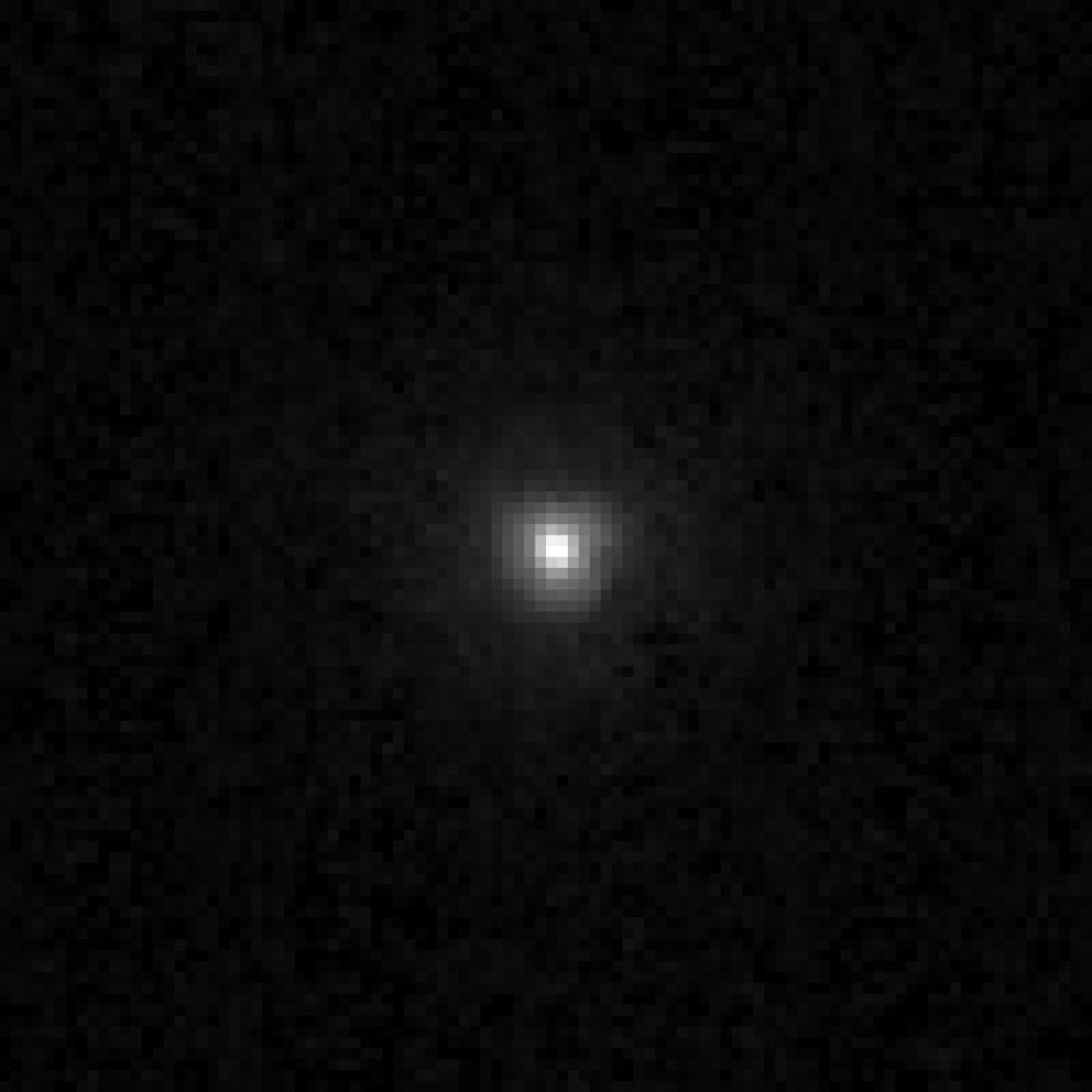
 Photograph · Hubble Space Telescope/Karen Meech · Public domain
Asteroid · Deep guide
2060 Chiron
Also called: 2060 Chiron · 95P/Chiron · 1977 UB · Object Kowal
Half asteroid, half comet — the first centaur ever found, and one with rings.
What is it?
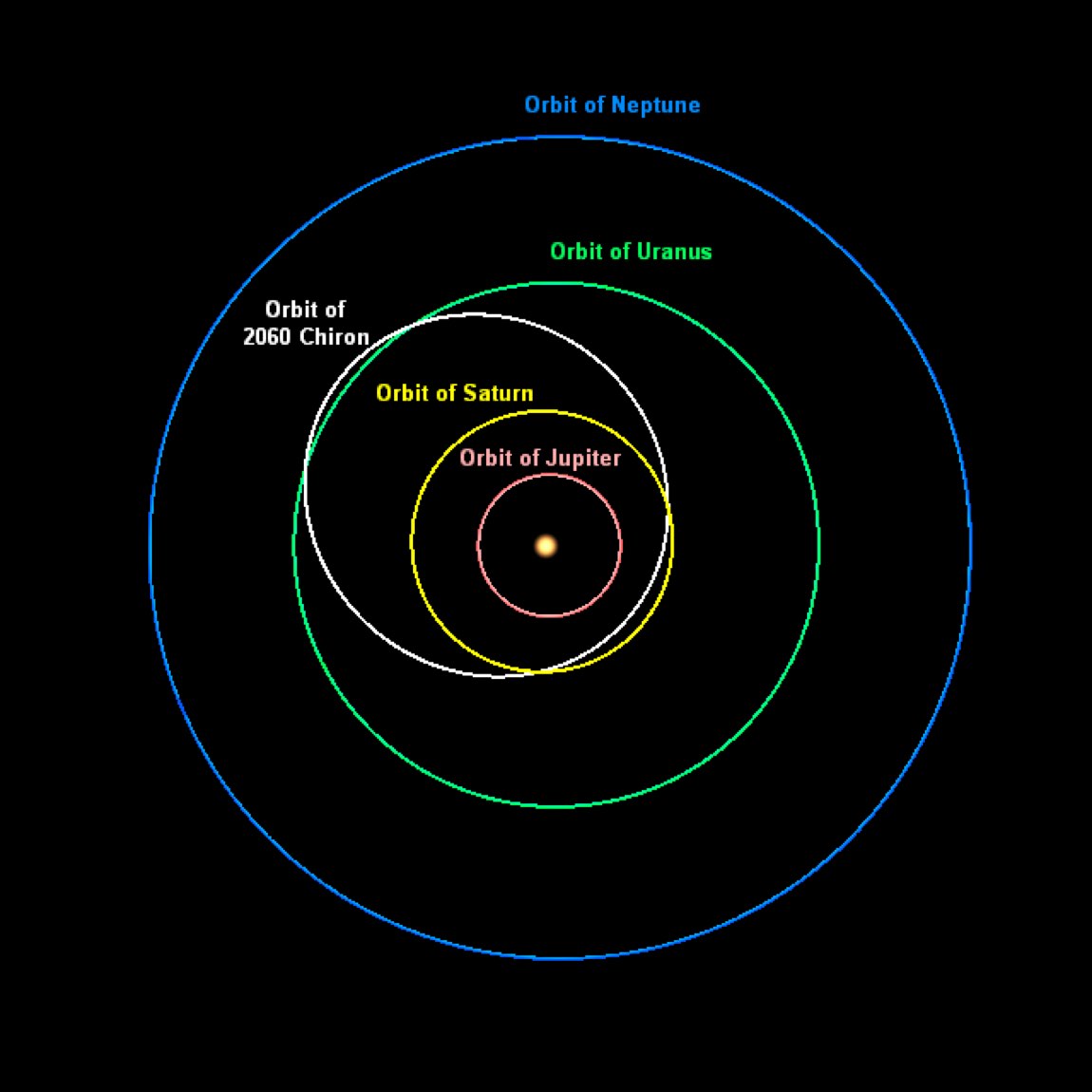
Chiron orbits the Sun between Saturn and Uranus, taking about 51 years per lap. When Charles Kowal found it in 1977 it was thought to be an ordinary asteroid, but in 1989 it began showing a comet-like haze, so it now carries both an asteroid number and a comet name, 95P/Chiron. It was the first known centaur, a class of icy bodies between the asteroid belt and the Kuiper belt, and star-occultation observations have since revealed rings around it.
The deep dive
Researched for the Atlas from Wikipedia — 2060 Chiron (11,924 characters read) · updated Nov 14, 2026
01 How Chiron was hiding in plain sight
Chiron was discovered on 1 November 1977 by Charles Kowal using images taken on 18 October at Palomar Observatory, and it immediately stood out as the most distant-known minor planet at the time — the press even breathlessly claimed it as a tenth planet. Yet Chiron had been photographed many times before anyone noticed. Precovery searches traced it back to April 1895, just one month after a perihelion passage that March. That deep archive of old photographic plates allowed astronomers to pin down its orbit with unusual precision. Chiron had also reached perihelion in 1945, but no one caught it then: surveys of that era were not sensitive enough to detect slow-moving, faint objects, and the Lowell Observatory's hunt for distant planets had not covered the right patch of sky in the right decade. The irony is that Chiron was orbiting quietly between Saturn and Uranus for the entire history of telescopic astronomy before Kowal finally pulled it out of the data.
02 An orbit that cannot last forever
Chiron follows a highly eccentric orbit with an eccentricity of 0.37, swinging from just inside Saturn's orbit at perihelion — which it last reached in 1996 — to just outside Uranus's perihelion distance at aphelion, which it reached in May 2021. It never actually reaches Uranus's average distance, and its orbit does not cross Uranus's orbit at all. This in-between territory makes Chiron a Saturn–Uranus centaur. The giant planets do not leave such orbits alone: gravitational perturbations are constantly nudging centaurs, and over millions of years they are either ejected from the Solar System or reshuffled into new paths. Chiron itself almost certainly migrated inward from the Kuiper belt, and simulations suggest it will likely become a short-period comet in roughly a million years. A close encounter with Saturn around May of the year 720 CE already reshaped its path significantly, shrinking its semi-major axis from 14.55 ± 0.12 AU to 13.7 AU when Chiron passed within 30.5 ± 2.0 million km of the planet.
03 When an asteroid started acting like a comet
For over a decade after its discovery Chiron looked perfectly unremarkable — a distant, inert rock. Then in February 1988, still 12 AU from the Sun, it abruptly brightened by 75 percent, behavior that asteroids simply do not show but comets do. Follow-up observations in April 1989 confirmed that a genuine cometary coma had developed around it. By 1993 a tail had been detected as well. This dual identity prompted astronomers to give Chiron two official designations simultaneously: it is minor planet 2060 Chiron and comet 95P/Chiron, a formal acknowledgment that the boundary between asteroid and comet can be blurry. The coma works differently from typical comets, however, because Chiron is so far from the Sun that water cannot sublimate to drive it. Instead, carbon monoxide — detected in 1995 — appears to be the main engine, and its production rate was calculated to be sufficient to account for the observed coma. Cyanide was also detected in Chiron's spectrum in 1991, adding another unusual ingredient to the mix.
04 A coma chemistry unlike any other comet Deeper
The James Webb Space Telescope gave astronomers their sharpest look yet at what floats around Chiron, covering the infrared spectrum from 0.97 to 5.27 μm. The results were remarkably rich: absorption bands of carbon dioxide, carbon monoxide, ethane, propane, and acetylene were all detected, along with water ice in its amorphous state. Irradiation byproducts of methane, carbon dioxide, and carbon monoxide were found under both reducing conditions — ethane being one example — and oxidizing conditions, such as CO₃. Interestingly, complex carbon-bearing molecules that would result from the combined irradiation of –CH– and –CO– groups, things like formaldehyde, acetaldehyde, or acetic acid, were not observed, which the researchers interpreted as evidence of a physical or temporal separation between the methane and carbon dioxide reservoirs inside Chiron. The headline finding was fluorescent methane emission — the first proof that Chiron hosts a gas coma rich in methane — alongside gaseous carbon dioxide emission at 4.27 μm. The authors argued that the methane is being released by a density phase transition of amorphous water ice at a temperature of approximately 61 K, a process previously studied only in laboratory settings.
05 Size, shape, and why it is so hard to measure
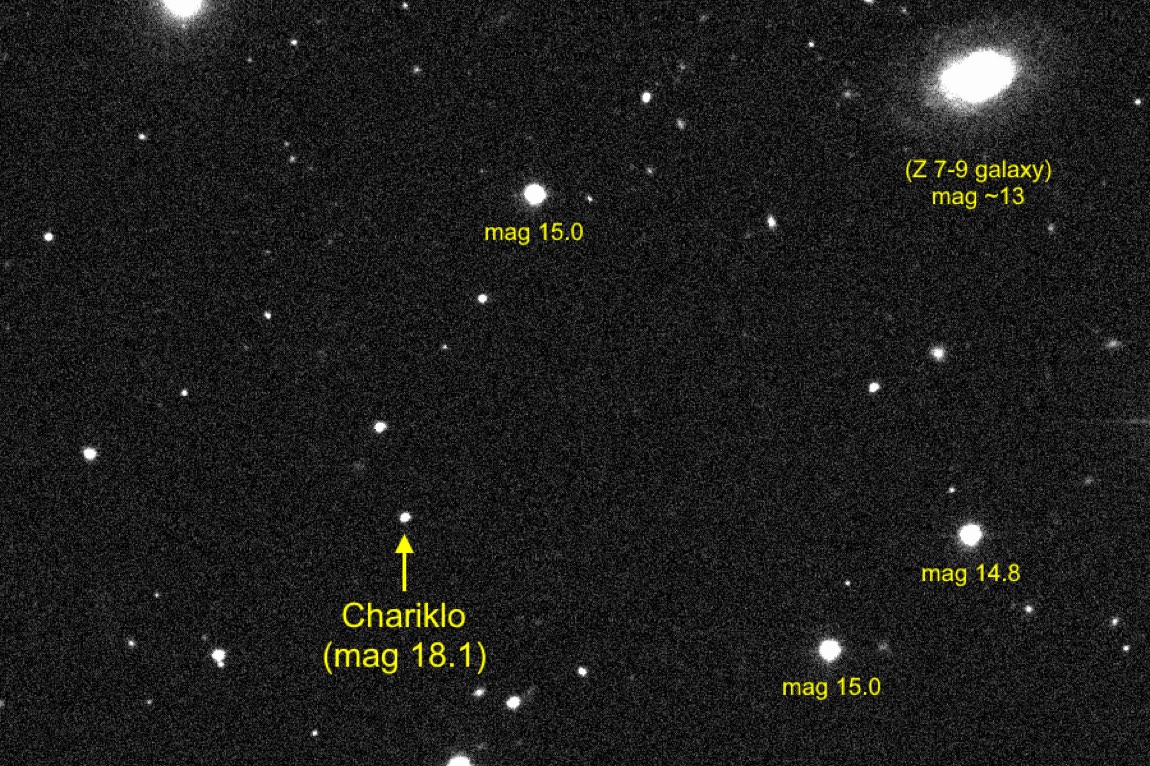
Estimating Chiron's size has been a moving target for decades, and the culprit is its own cometary activity. Because the coma adds extra light, the true brightness of the bare nucleus is uncertain, which makes albedo-based size estimates unreliable. Early work in 1984 by Lebofsky put the diameter at roughly 180 km. Through the 1990s estimates drifted closer to 150 km, while occultation data from 1993 suggested a return to about 180 km. Combined analysis of data from the Spitzer Space Telescope in 2007 and the Herschel Space Observatory in 2011 gave 218 ± 20 km. That would make Chiron comparable in size to fellow centaur 10199 Chariklo. At 5.918 hours the rotation period is well constrained from lightcurves taken between 1989 and 1997, and the small brightness variation of only 0.05 to 0.09 magnitude tells astronomers that Chiron's shape is fairly spheroidal rather than elongated or lumpy. To complicate size estimates further, the rings themselves contribute light and have a geometric albedo that affects long-term brightness measurements.
06 Rings discovered decades after the data were taken
Chiron's rings were not found by a dedicated spacecraft or even a purpose-built observation run — they were pieced together from stellar occultation events years and even decades after the fact. Observations from 7 November 1993 and 9 March 1994 showed unexpected dips in starlight that had originally been attributed to jets from Chiron's comet-like activity. When a 2011 occultation on 29 November was analysed alongside those older events, researchers proposed that Chiron hosts rings at a radius of 324 ± 10 km, sharply defined. The reinterpretation also resolved a long-standing puzzle: the rings' changing orientation as seen from Earth could largely explain the decades-long variation in Chiron's overall brightness, and by assuming that water ice resides in the rings, the fluctuating intensity of water-ice absorption features — including their complete disappearance in 2001 when the rings were viewed edge-on — made sense at last.
07 A ring system that keeps reinventing itself Deeper
What makes Chiron's rings scientifically extraordinary is that they appear to be actively evolving on human timescales. By the 2018 occultation on 28 November, there was noticeably less material in the rings than in 2011, but a partial third ring was developing. By 15 December 2022 total ring material had grown beyond either earlier observation, and that third ring was fully formed. Researcher J.L. Ortiz linked the extra material to an outburst seen in 2021, suggesting that periodic outbursts cyclically replenish the rings. The 10 September 2023 occultation sharpened the picture further, revealing two broad regions: an inner zone spanning 220 to 750 km with named peaks Chi1R at 273 km, Chi2R at 325 km, and Chi3R at 438 km, plus a sparse outer disk of material at 1,380 km and roughly 100 km wide. Chi2R was found to be splitting in two and had shed two-thirds of its optical depth between 2011 and 2023. Chi1R sits almost precisely at the 1:2 spin-orbit resonance given Chiron's density of 1.119 ± 0.004 g/cm³ and rotation period of 5.918 hours, while Chi2R lies near the 1:3 resonance.
08 Why some rings are inside Roche limits and some are not Deeper
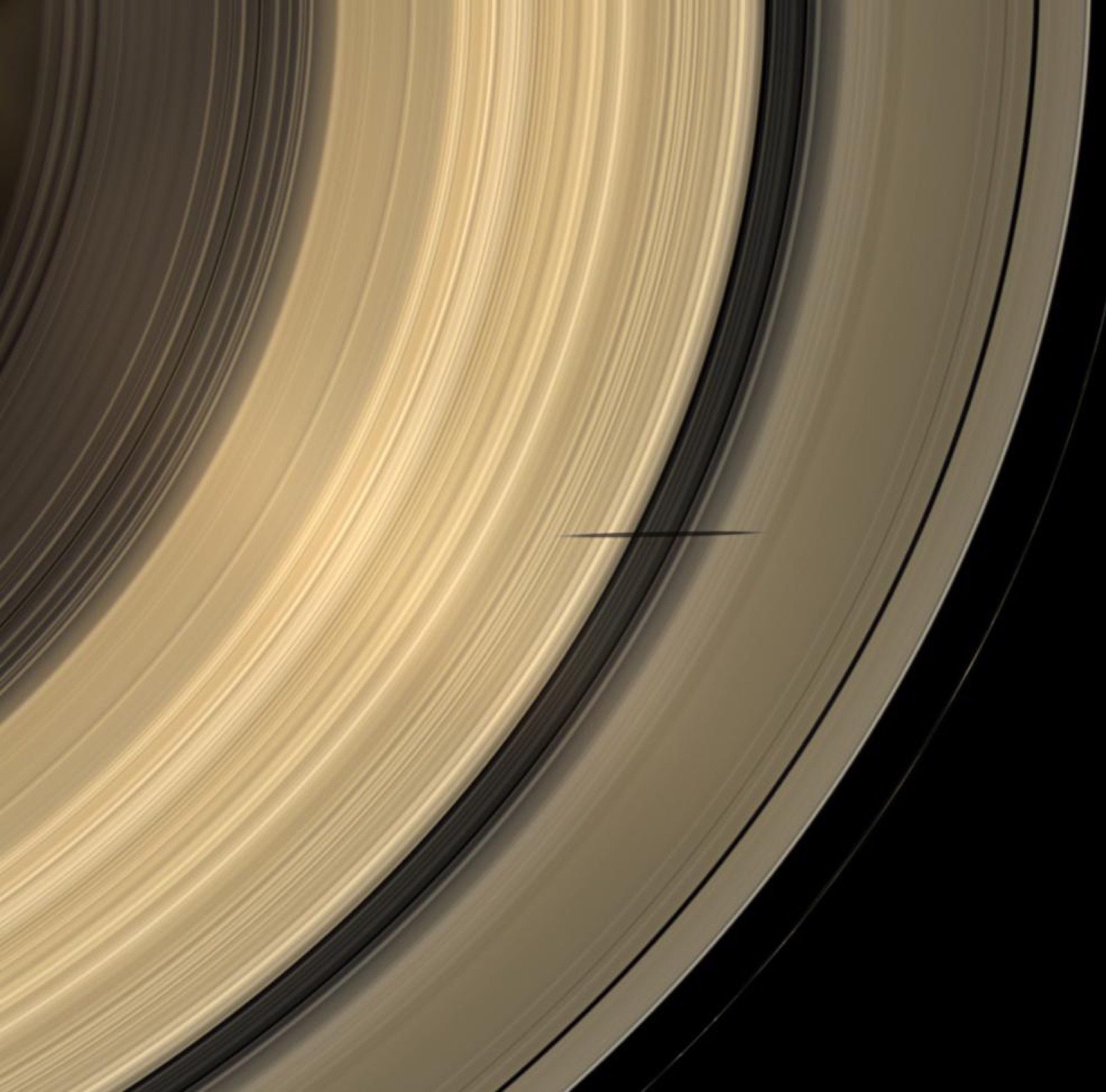
The Roche limit is the distance from a body within which tidal forces prevent loose material from clumping together into a larger object — it is why planetary rings exist at all rather than coalescing into moons. For Chiron, Chi1R and Chi2R sit within their respective Roche limits, mirroring the situation for the rings of centaur Chariklo and suggesting a common physical mechanism. The 2023 analysis noted that Chiron's inner rings are remarkably similar in width, separation, and optical depth to Chariklo's rings, hinting at a shared origin story for ring systems around centaurs. The complication comes with Chi3R and Chi4R: they fall outside the Roche limit, where tidal forces no longer prevent aggregation, meaning the standard explanation for ring confinement does not apply. What holds those outer rings in place remains an open question, and astronomers acknowledge that alternative mechanisms will be needed to explain their existence.
09 Founding member of the centaur family
When Chiron was discovered in 1977 it fit no known category neatly, sitting in a region of the solar system that astronomers had not expected to contain sizeable bodies. Its discovery effectively created a new class: centaurs, objects orbiting between the outer planets, beyond the asteroid belt but short of the Kuiper belt. Chiron is the prototype, and when its naming was proposed, the suggestion was made that future objects of the same orbital type should also carry the names of centaurs from Greek mythology. That convention stuck. Since then dozens of centaurs have been catalogued, and nearly all are classified primarily as minor planets while being watched for signs of cometary activity — a direct echo of what happened with Chiron itself. Fellow centaur 60558 Echeclus later developed a coma and earned its own cometary designation, 174P/Echeclus, while 52872 Okyrhoe brightened significantly after its 2008 perihelion passage. Chiron also founded a formal comet subclass, Chiron-type comets, defined by a Jovian Tisserand parameter greater than 3 and a semi-major axis larger than Jupiter's.
10 The mythology behind the name
Chiron takes its name from one of the most revered figures in Greek mythology: a centaur who was half-human and half-horse, son of the Titan Cronus and the nymph Philyra. Unlike most centaurs, who were depicted as wild and violent, Chiron was celebrated as the wisest and most just of his kind, serving as tutor and mentor to Greek heroes. The fit with the newly discovered object was apt — something that crossed category boundaries just as the mythological Chiron straddled the human and animal worlds. The official naming citation was published by the Minor Planet Center on 1 April 1978 in M.P.C. 4359. Chiron also acquired an informal symbol, designed by astrologer Al H. Morrison, which resembles a key and doubles as a visual monogram for "Object Kowal" — a nod to discoverer Charles Kowal. This symbol sees little use in professional astronomy but is widely recognized in astrological circles.
11 Proposed missions that could visit Chiron
No spacecraft has yet visited Chiron, but it has attracted serious mission planning. The Chiron Orbiter Mission was formally proposed for NASA's New Frontiers or Flagship programs and published in May 2010. As an orbiter — not just a flyby — it would have been among the most ambitious outer Solar System missions ever attempted, with launch dates ranging from as early as 2023 to as late as 2025 depending on budget and the propulsion system selected. A second concept, called Centaurus and developed under NASA's Discovery Program, envisioned a launch between 2026 and 2029 that would make a flyby of Chiron and at least one other centaur sometime in the 2030s. Neither mission has been approved, leaving Chiron — with its active coma, evolving ring system, and uncertain internal structure — as one of the most scientifically compelling unvisited targets in the outer Solar System. Given that its ring structure is visibly changing on timescales of years, an orbiter would arrive to a system markedly different from what any ground-based observation has captured.
12 Open questions Chiron still refuses to answer Deeper
Decades of observation have deepened the mystery of Chiron as much as they have resolved it. The true diameter of the nucleus remains uncertain because cometary activity inflates brightness measurements and the rings add their own contribution. The mechanism sustaining Chi3R and Chi4R beyond the Roche limit has no agreed explanation. It is unclear whether the ring material is primarily derived from outbursts, from impact ejecta, or from some internal structural process. The James Webb observations demonstrated a physical or temporal segregation between methane and carbon dioxide reservoirs within Chiron, but what that architecture looks like — whether distinct icy layers, geographically separate surface regions, or something else — is unknown. More fundamentally, Chiron's exact density of 1.119 ± 0.004 g/cm³, inferred from ring resonance arguments, implies a composition that sits between rocky and icy end-members, but whether the interior is homogeneous or differentiated is an open question. And given that Chiron is still actively outgassing, the question of how long it has occupied its current orbit — and what triggered the activity — remains unresolved.
 ⤢