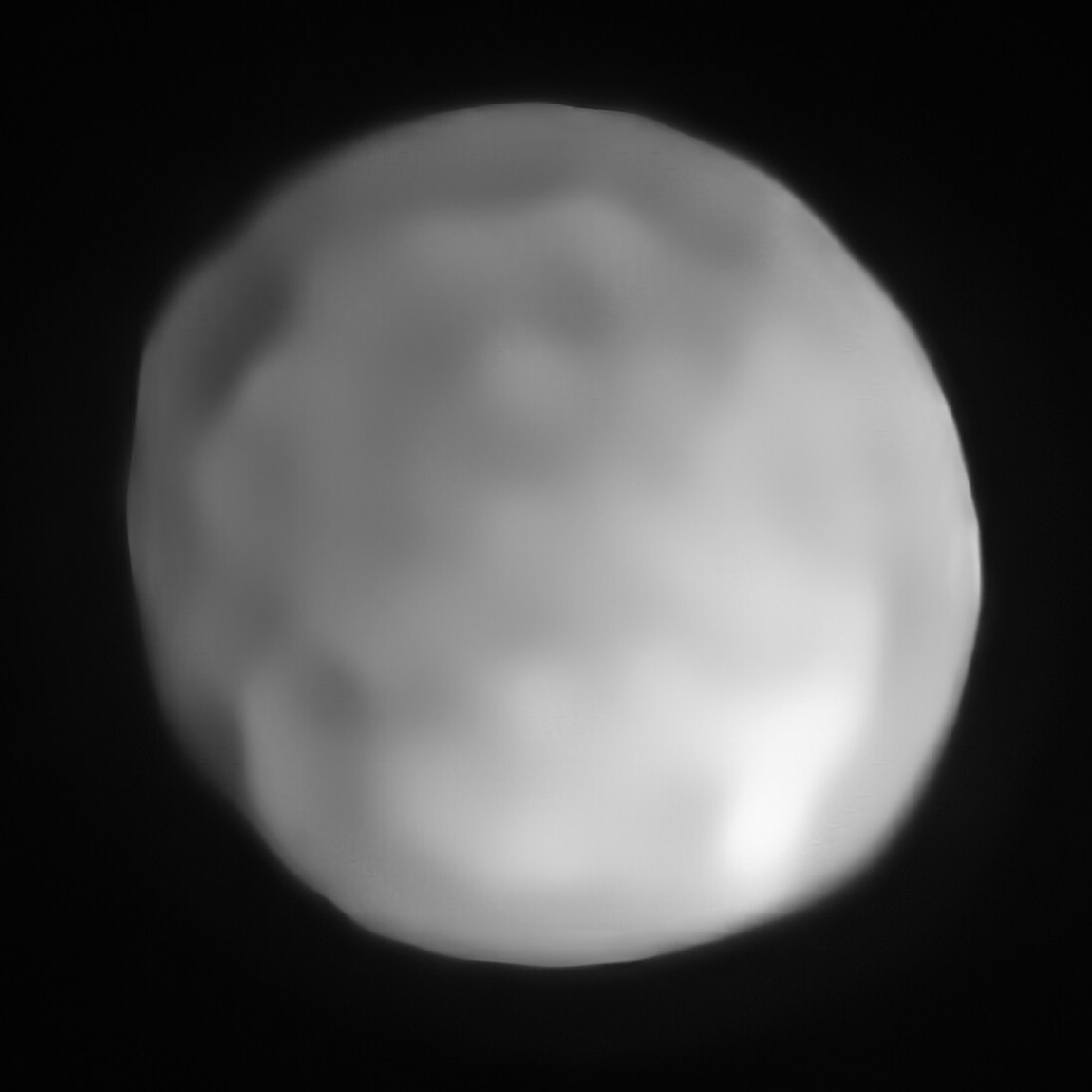
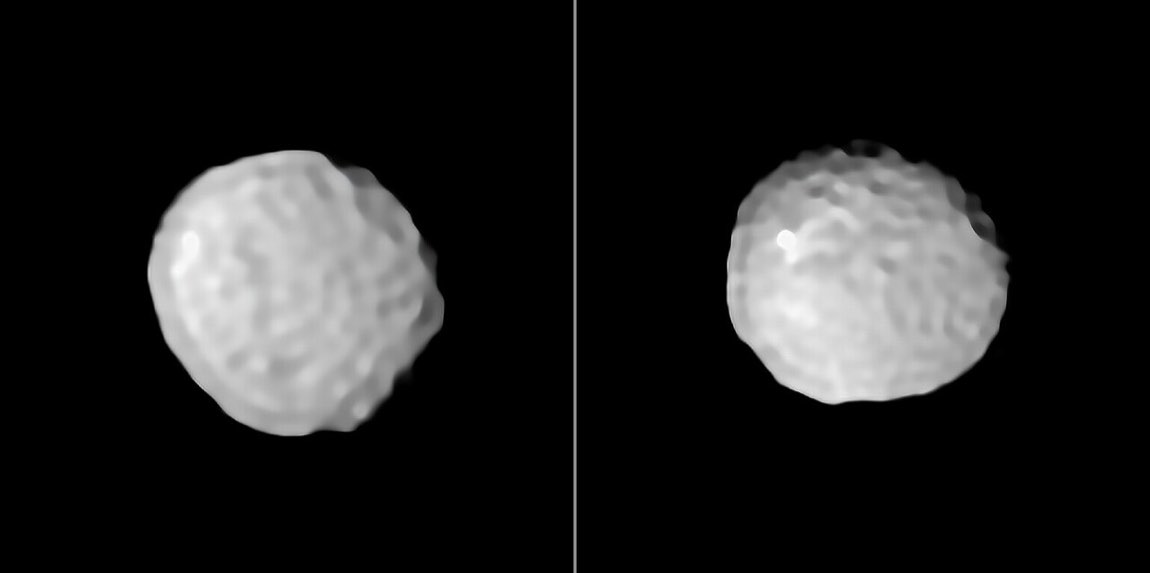
 Photograph · Credit: ESO/M. Marsset et al./MISTRAL algorithm (ONERA/CNRS) · CC BY-SA 4.0
Asteroid · Deep guide
2 Pallas
Also called: 2 Pallas · (2) Pallas · A802 FA
The second asteroid ever discovered — a tilted, battered protoplanet left over from the Solar System's birth.
What is it?
Pallas is the third-largest asteroid, about 510 km across, and was the second one found, in 1802. It is probably a surviving protoplanet: one of the few intact building blocks from the era when planets were forming. Its orbit is unusually tilted, about 35° to the plane of the planets. It holds roughly 7% of the asteroid belt's mass and is thought to resemble carbonaceous chondrite meteorites.
The deep dive
Researched for the Atlas from Wikipedia — 2 Pallas (13,255 characters read) · updated Nov 14, 2026
01 Discovered while hunting for another world
Heinrich Wilhelm Matthias Olbers found Pallas on 28 March 1802 almost by accident. He was simply trying to re-locate Ceres — the first asteroid, found just the year before — when he noticed a second moving object drifting nearby. The coincidence was remarkable: Pallas happened to be passing close to Ceres in the sky at that precise moment. The find electrified astronomers because theorists had already predicted a missing planet in the gap between Mars and Jupiter, and here was a second small body in roughly the right place. What nobody foresaw was how many more would follow. Early size estimates for Pallas were wildly wrong — some guesses ran as high as 3,380 km in diameter. Even as recently as 1979 it was still being listed at 673 km, fully 26% larger than the value accepted today. Carl Friedrich Gauss worked out the orbit and established that Pallas's period of 4.6 years was similar to that of Ceres, hinting that the two bodies shared the same region of space. Pallas was classed as a planet at the time of discovery, a status it held for decades before the flood of new asteroid finds after 1845 forced a reclassification.
02 A shadow on the sky: the 1983 occultation
The most precisely watched asteroid occultation in history took place on 29 May 1983, when Pallas slid in front of a background star and 140 observers across a wide swath of ground recorded the moment its shadow snuffed out the starlight. The event lasted only seconds from any single location, but by combining the chord timings from all 140 sites, astronomers were able to reconstruct the cross-sectional shape of Pallas with far better accuracy than any telescope image of the era could provide. That dataset yielded the first reliable calculation of Pallas's diameter. The technique also turned up a tantalizing hint of a moon: an occultation on 29 May 1979 — four years before the landmark 1983 event — suggested a tiny satellite perhaps 1 km across, though that detection was never confirmed. A 1980 attempt using speckle interferometry pointed to a much larger companion, but subsequent occultation data ruled that out. As of the article's writing, Pallas is considered moonless, though the question of a very small companion has never been definitively closed.
03 An orbit unlike any other large asteroid
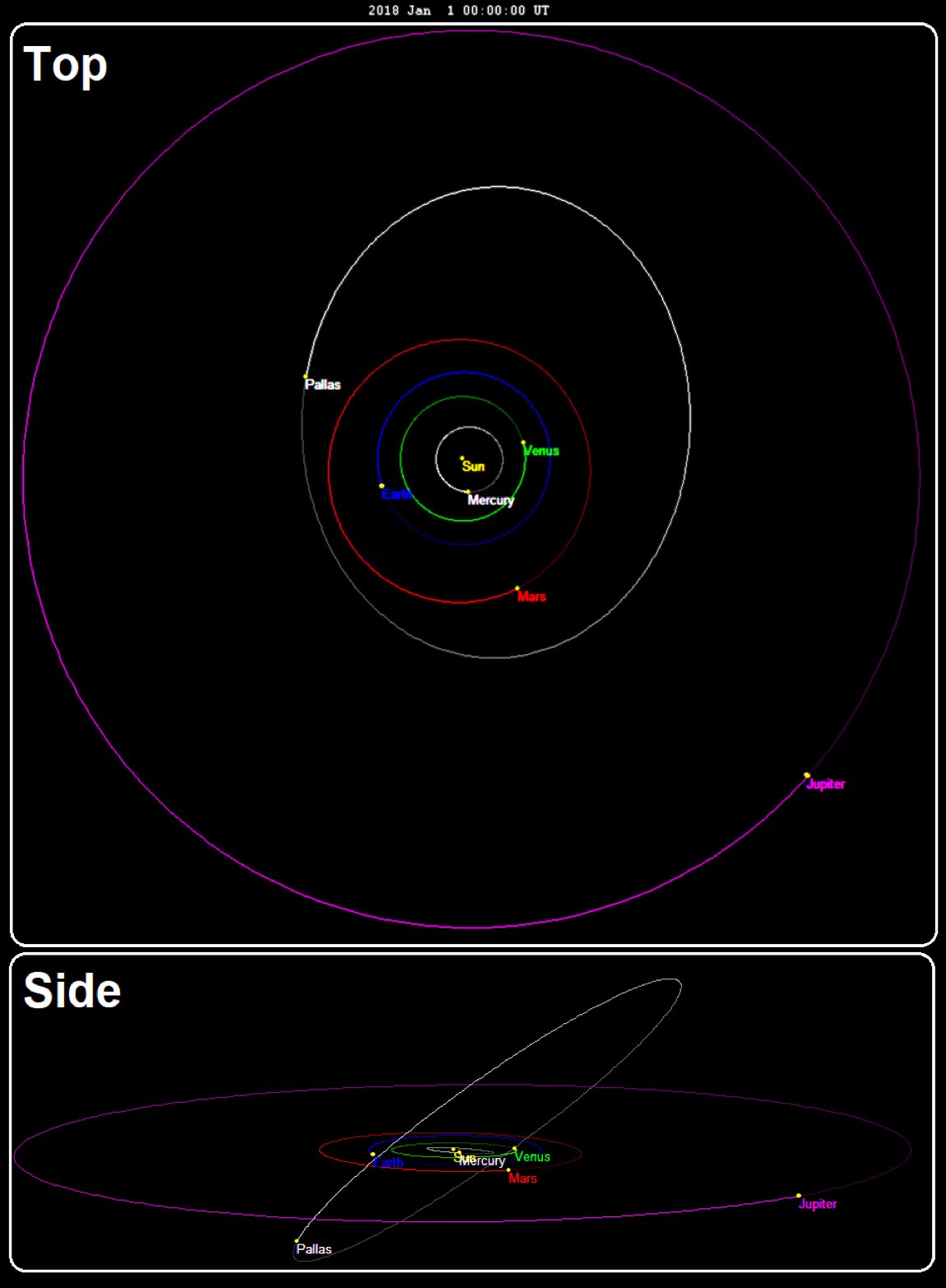
Pallas moves through the asteroid belt on a path that sets it apart from almost every other substantial body in the region. Its orbital inclination of 34.8° tilts it sharply out of the flat disk where most belt asteroids travel, and its eccentricity rivals that of Pluto. Together those two factors make Pallas a kind of outlier — sitting at the same average distance from the Sun as the heart of the main belt, yet following a path that carries it high above and below the belt plane. One concrete consequence is that impacts onto Pallas are far more violent than on Vesta or Ceres: because Pallas's inclined, eccentric orbit means it crosses the paths of other asteroids at steeper angles, the average collision velocity is roughly twice as high. That extra energy means even smaller, more common impactors can gouge out the same size crater that only large bodies could produce on its neighbors. The orbit also brings Pallas unusually close to certain bright stars. On 9 October 2022, it passed just 8.5 arcminutes south of Sirius — no planet can approach Sirius to within 30 degrees.
04 Extreme seasons on a tilted world Deeper
Pallas's axial tilt of 78° is nearly as extreme as Uranus's, and the consequences for any surface would be dramatic. Its north pole points toward ecliptic coordinates of roughly (42°, −15°), with an uncertainty of about 3°. At that tilt, regions near the poles experience continuous sunlight for periods on the order of an Earth year during summer and unbroken darkness for comparable spans in winter. Near the poles, the article notes, continuous sunlight can persist for as long as two years. Areas in mid-latitudes would endure wildly swinging illumination cycles rather than the mild seasonal changes familiar from Earth. The same high inclination and eccentricity that make the orbit unusual also amplify the intensity differences between perihelion and aphelion passages, piling temperature extremes on top of the already severe axial-tilt effect. This tilt may not always have been so extreme: researchers suspect that a large impact at the south pole ejected material equal to about 6%±1% of Pallas's total volume — twice the volume of the Rheasilvia basin on Vesta — and that this collision may have both slowed Pallas's rotation and increased its axial tilt to its current severe value.
05 Why Pallas is covered in giant craters
With 34 confirmed craters larger than 40 km in diameter out of 36 total identified features (as of 2020), Pallas appears saturated with large impacts to the limits of what current observations can resolve. That crater-heavy landscape is a direct consequence of its unusual orbit. Because Pallas moves at a steep angle relative to the rest of the belt and on an eccentric path, relative encounter velocities with other asteroids average about twice those experienced by Vesta or Ceres. Higher speed at impact releases far more energy, so a projectile that would leave only a modest dent on Vesta can blast out a crater tens of kilometers wide on Pallas. Craters larger than 40 km cover at least 9% of Pallas's surface — a remarkable fraction. The craters identified so far have been given provisional names drawn from ancient weapons, following the IAU naming theme. One smaller crater near the equator has been linked to the origin of the Palladian family of asteroids, suggesting that the collision that formed it launched fragments into independent orbits that persist as the family today.
06 The south pole basin and the family of fragments Deeper
A suspected large impact basin at the south pole of Pallas may be one of the most consequential single events in its history. Modelers estimate that the impact ejected material amounting to 6%±1% of Pallas's total volume — for comparison, that is twice the volume of the Rheasilvia basin on Vesta, itself one of the largest confirmed impact craters in the Solar System. The collision may have done two things simultaneously: increased Pallas's axial tilt to its present extreme of 78° and slowed its rotation from what models suggest was once a 6.2-hour spin. Without that basin, Pallas's shape would more closely resemble an equilibrium figure for a 6.2-hour period. A separate, smaller equatorial crater is associated with the Palladian asteroid family — a group of fragments sharing similar orbits. Kiyotsugu Hirayama first identified this family in work begun in 1917, and later papers confirmed that more than 10 members exist, with semi-major axes between 2.50 and 2.82 AU and inclinations of 33–38°. Spectral comparisons in 2002 confirmed the family's reality.
 ⤢
07 What Pallas is made of inside and out Deeper
Pallas is classified as a B-type asteroid, and its surface spectrum is nearly flat in visible light, being slightly brighter toward the blue. The one clear absorption feature sits in the 3-micron region, pointing to a mix of an anhydrous component with hydrated CM-like silicates. The surface composition closely matches the Renazzo carbonaceous chondrite meteorites — a CR-type that is even lower in hydrous minerals than CM chondrites — and the Renazzo meteorite itself, found in Italy in 1824, is considered one of the most primitive meteorites known. The measured bulk density of Pallas is 2.89±0.08 g/cm³, almost identical to CM chondrite laboratory values of 2.90±0.08 g/cm³. This tight match suggests Pallas never heated past the approximately 820 K needed to dehydrate silicates, meaning it never differentiated into a dry silicate core beneath a hydrated mantle. The interior is therefore probably quite homogeneous in composition. Some water migration toward the surface may have occurred, potentially depositing salts that could explain Pallas's relatively high albedo. One bright spot visible in imagery is reminiscent of the bright spots on Ceres.
08 A possible link to the Geminid meteor shower
Every December, Earth plows through a stream of debris called the Geminids, produced by the near-Earth object 3200 Phaethon. Some researchers have theorized that Phaethon itself is a fragment ejected from Pallas at some point in the past. If that idea is correct, then the composition of Pallas's surface would have direct implications for what we see burning up in the Geminid meteors. Specifically, if Pallas's surface is enriched in salts — a reasonable hypothesis given the possible upward migration of water described above — then those salts could explain the notable sodium abundance detected in the Geminid meteor shower. The connection is speculative, but it links a question about the internal evolution of a main-belt protoplanet to a meteor shower visible every year from Earth's surface. The article notes that other explanations for Pallas's bright spot are possible, such as a recent ejecta blanket, so the Phaethon link remains an open and debated question rather than an established fact.
09 How bright Pallas gets and how to find it
Pallas is dimmer than its size might suggest because it lies farther from Earth than Vesta and has a much lower albedo. Its mean opposition magnitude is +8.0, comfortably within reach of 10×50 binoculars — but that figure applies only at favorable oppositions near maximum elongation. When Pallas is at small elongations its magnitude can drop as low as +10.6, requiring more powerful optical aid. During the rare perihelic oppositions, when Pallas swings to its closest approach to the Sun and to Earth simultaneously, it can brighten to +6.4, right on the threshold of naked-eye visibility under dark skies. During late February 2014 it reached magnitude 6.96. For comparison, the much smaller asteroid 7 Iris marginally outshines Pallas in mean opposition magnitude, an illustration of how strongly albedo and distance shape apparent brightness. Pallas also offers a rare observational spectacle: its highly inclined orbit can carry it close to stars that no planet ever approaches. Its passage just 8.5 arcminutes south of Sirius on 9 October 2022 was visible to anyone with binoculars.
10 The name, the symbol, and what they inspired
Pallas takes its name from an epithet of the Greek goddess Athena — in some versions of the myth, Athena accidentally killed her friend Pallas, daughter of Triton, and adopted the name in mourning. The word's oblique Greek stem, Pallad-, shows up in Italian (Pallade) and Russian (Паллада). The asteroid's old astronomical symbol is a spear or lance, reflecting Athena's martial role; variants of the blade shape included a lozenge, a leaf, and a triangle, the last doubling as the alchemical symbol for sulfur. A generic discovery-number symbol was introduced in 1852, but the lozenge was revived for astrological use in 1973. Two famous things were named after Pallas in the early 19th century: the chemical element palladium, named just after the asteroid's discovery, and — confusingly — the pallasite class of stony-iron meteorites is not Palladian at all, being named instead after the German naturalist Peter Simon Pallas. So the name appears in chemistry because of the asteroid, but in meteoritics because of the man.
11 The spacecraft that never came
No mission has ever visited Pallas, and the reasons are largely orbital. Its inclination of 34.8° makes reaching it enormously expensive in terms of the velocity change — delta-v — a spacecraft must perform. When the Dawn probe was being routed between Vesta and Ceres, engineers examined whether a Pallas flyby could be inserted into the itinerary, but the high orbital inclination made it impossible without a prohibitive fuel cost. A later concept called the Athena SmallSat mission was specifically designed to change that: it would have launched in 2022 as a secondary payload aboard the Psyche mission and flown an independent trajectory to a Pallas flyby. The proposal was not funded, losing out in competition with other concepts including the TransOrbital Trailblazer Lunar Orbiter. The authors of the Athena proposal explicitly described Pallas as the "largest unexplored" main-belt protoplanet. The Dawn team did secure Hubble Space Telescope time in September 2007, capturing images of Pallas during a closest-approach opportunity that occurs only once every twenty years, to compare with its data on Ceres and Vesta.
12 Pallas in the age of planets — and after Deeper
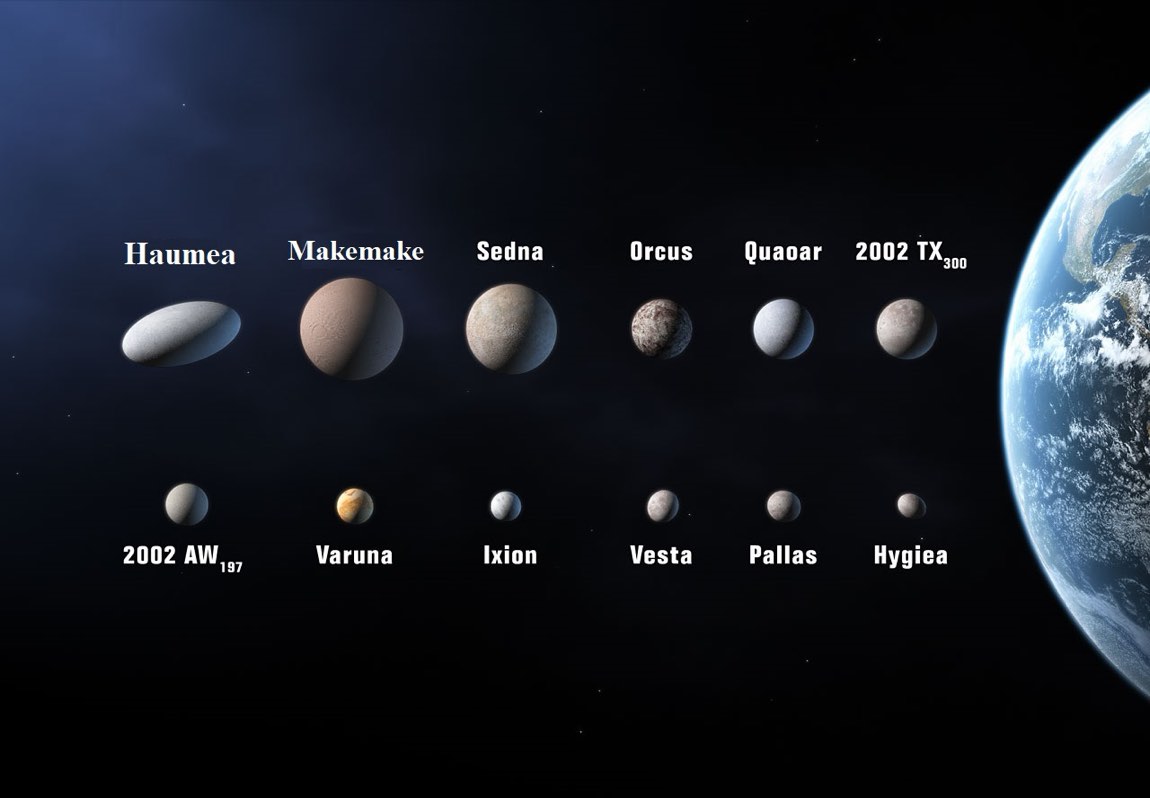
During the solar system's formation era, objects grew through accretion to roughly the size of Pallas before most were swept up into larger bodies or ejected by gravitational interactions with the growing planets. Pallas, Vesta, and Ceres appear to be the only survivors of that early stage that remain intact within the orbit of Neptune — genuine remnant protoplanets rather than collision fragments or captured bodies. When Pallas was discovered in 1802, it was counted as a planet, as was every asteroid found in the early 19th century. The cascade of new discoveries after 1845 forced the introduction of the "minor planet" category. Then in the 1950s, the realization that these small bodies did not form by the same processes as the classical planets led to the gradual adoption of "asteroid" and, for larger objects like Pallas, "planetoid" in place of "minor planet." Pallas does not qualify as a dwarf planet today because its shape departs significantly from that of a body in hydrostatic equilibrium at its current rotation rate — a consequence, researchers suspect, of that enormous south-polar impact that reshaped it long ago.
 ⤢