 Photograph · ESO/P. Vernazza et al./MISTRAL algorithm (ONERA/CNRS) · CC BY 4.0
Asteroid · Deep guide
10 Hygiea
Also called: 10 Hygiea · (10) Hygiea · A849 GA
A nearly round, dark giant of the outer belt that some researchers think could be a dwarf planet.
What is it?
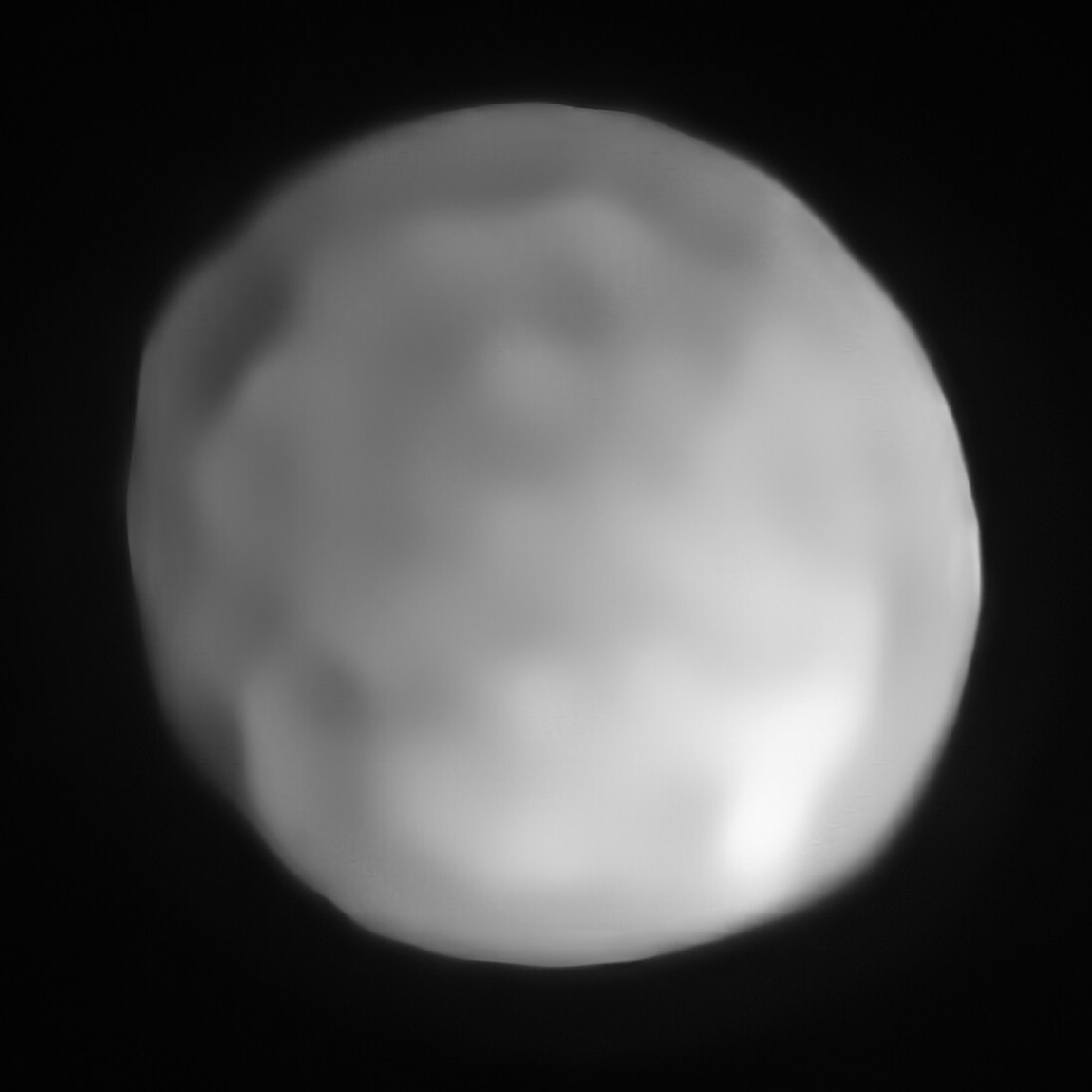
Hygiea is the fourth-largest asteroid, about 430 km across, in the outer part of the main belt. Telescope images show it is almost spherical, which is why some scientists suggest it might qualify as a dwarf planet. Its dark, carbon-rich surface contains water-altered minerals and carbonates, much like Ceres, hinting that the two formed in similar ways. Hygiea is the parent of a family of more than 7,000 smaller asteroids blasted off in an ancient collision.
The deep dive
Researched for the Atlas from Wikipedia — 10 Hygiea (26,372 characters read) · updated Nov 14, 2026
01 Annibale de Gasparis and the Discovery Night
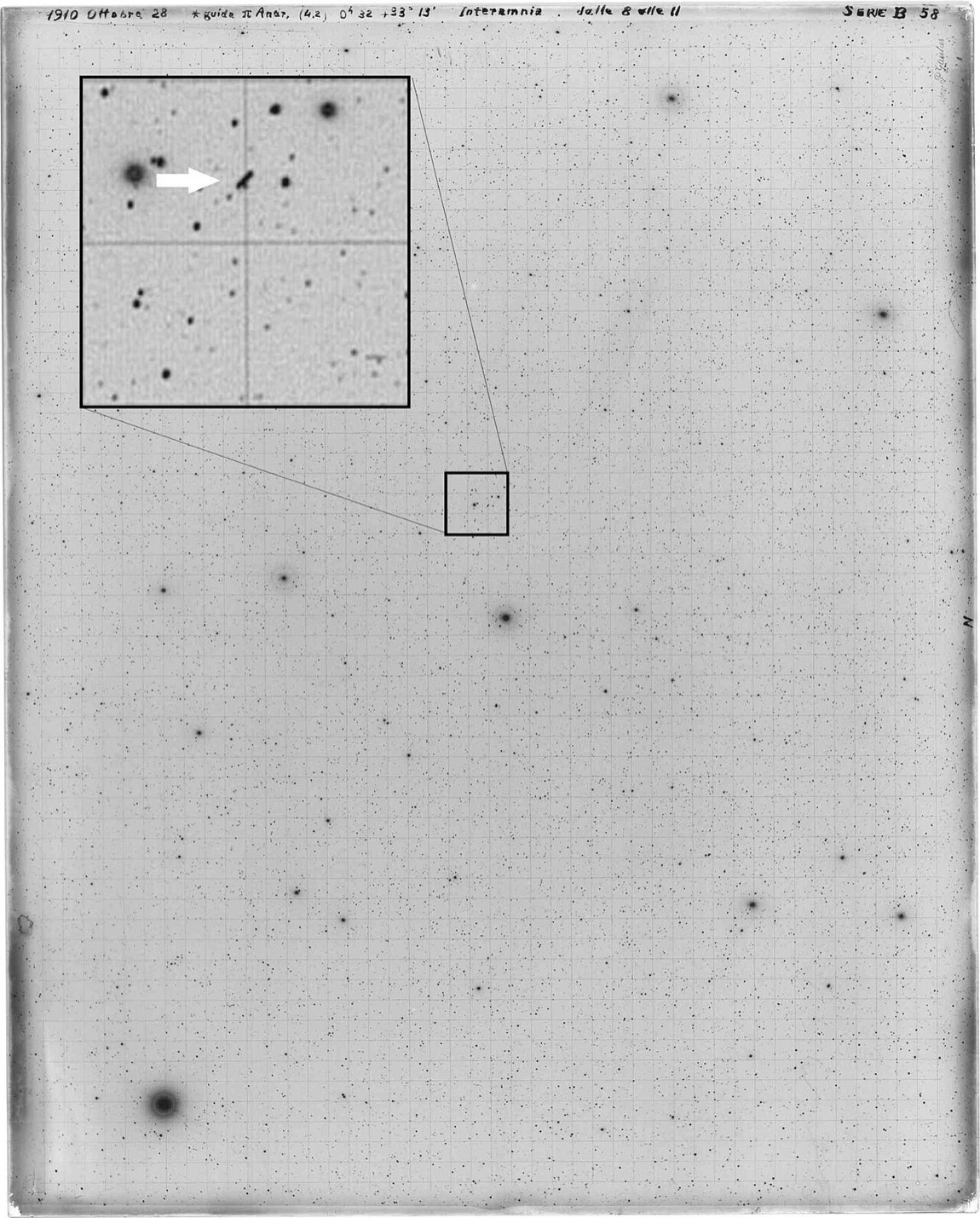
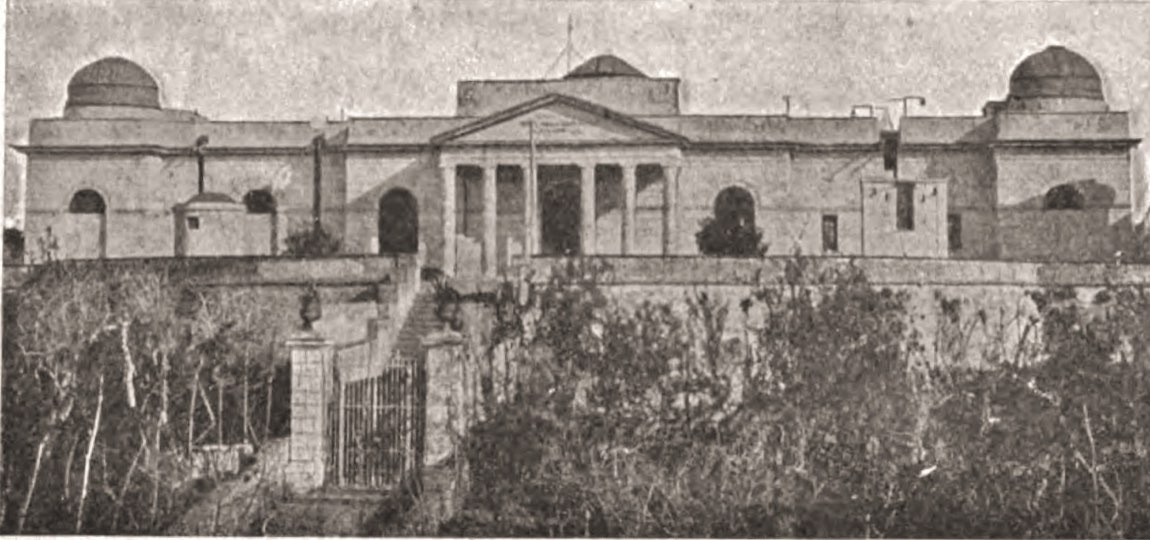
On the evening of 12 April 1849, Italian astronomer Annibale de Gasparis was methodically working through the sky at the Astronomical Observatory of Capodimonte in Naples, using a Reichenbach equatorial telescope to catalogue stars along the ecliptic down to the 14th apparent magnitude. While comparing his fresh observations against the Berlin Academy's star chart, he noticed a starlike object between magnitude 9 and 10 that simply wasn't recorded. Poor weather denied him follow-up observations for a couple of days, but on 14 and 17 April he reobserved the same object and confirmed it had shifted position — the unmistakable signature of a body orbiting within the Solar System. Judging by how far it had moved, he concluded it was another new planet between Mars and Jupiter. He reported the discovery through Erasmo Fabri Scarpellini in Rome, who relayed it to Heinrich Christian Schumacher, and the announcement was published in Astronomische Nachrichten on 11 May 1849. It was de Gasparis's first asteroid find; he would go on to discover six more between 1850 and 1853 and two additional ones in the 1860s.
02 A Name Wrapped in Politics and Poetry
The naming of the tenth asteroid turned into a surprisingly layered affair. De Gasparis invited his friend Ernesto Capocci Belmonte, director of the Capodimonte Observatory, to suggest a name, and Capocci proposed Igea — the Italian form of Hygieia, the Greek goddess of health and daughter of Asclepius. De Gasparis then appended the adjective Borbonica to honor King Ferdinand II of the Bourbons of Naples, who funded the observatory's work, sending the combined proposal Igea Borbonica to Ferdinand II in a letter on 8 May 1849. Scholars note that this royal flattery may have helped both men avoid punishment for their involvement in the liberal movements of 1848. Meanwhile, the English astronomer John Herschel had independently suggested the name Parthenope — after the siren of Greek myth who was said to have founded Naples — not knowing the asteroid was already named. By the time Herschel reached de Gasparis, the matter was settled. De Gasparis graciously acknowledged Herschel by naming his very next discovery, found on 11 May 1850, the asteroid 11 Parthenope. The royal suffix Borbonica had been dropped from common use by 1852, according to English astronomer John Russell Hind.
03 Symbols, Numbers, and a Naming System Revolution Deeper
Like the asteroids before it, Hygiea was assigned an astronomical symbol. De Gasparis described it in a letter to John Russell Hind on 4 November 1850 as "a serpent (like a Greek ζ) crowned with a star," a form encoded in modern Unicode 17.0 as U+1F779. Because the symbol was announced late, some major almanacs — including the Berliner Astronomisches Jahrbuch in 1850 and the Nautical Almanac and Astronomical Ephemeris in 1852 — simply listed Hygiea without any symbol, the first time this had ever happened. American astronomer Benjamin Apthorp Gould separately interpreted the symbol as a rod of Asclepius, depicting a serpent coiled around a staff (U+2695), in a January 1852 publication of the Astronomical Journal. Both symbols quickly became impractical as the asteroid tally exploded. In 1851, Johann Franz Encke proposed replacing symbols with circled numbers corresponding to discovery order — Hygiea would be ⑩ — and astronomers gradually adopted this scheme before settling on the plain-number system still used today. Hygiea's history thus marks the moment asteroid nomenclature tipped from mythology-inspired artistry toward systematic cataloguing.
04 An Orbit Shaped by Jupiter and Saturn Together Deeper
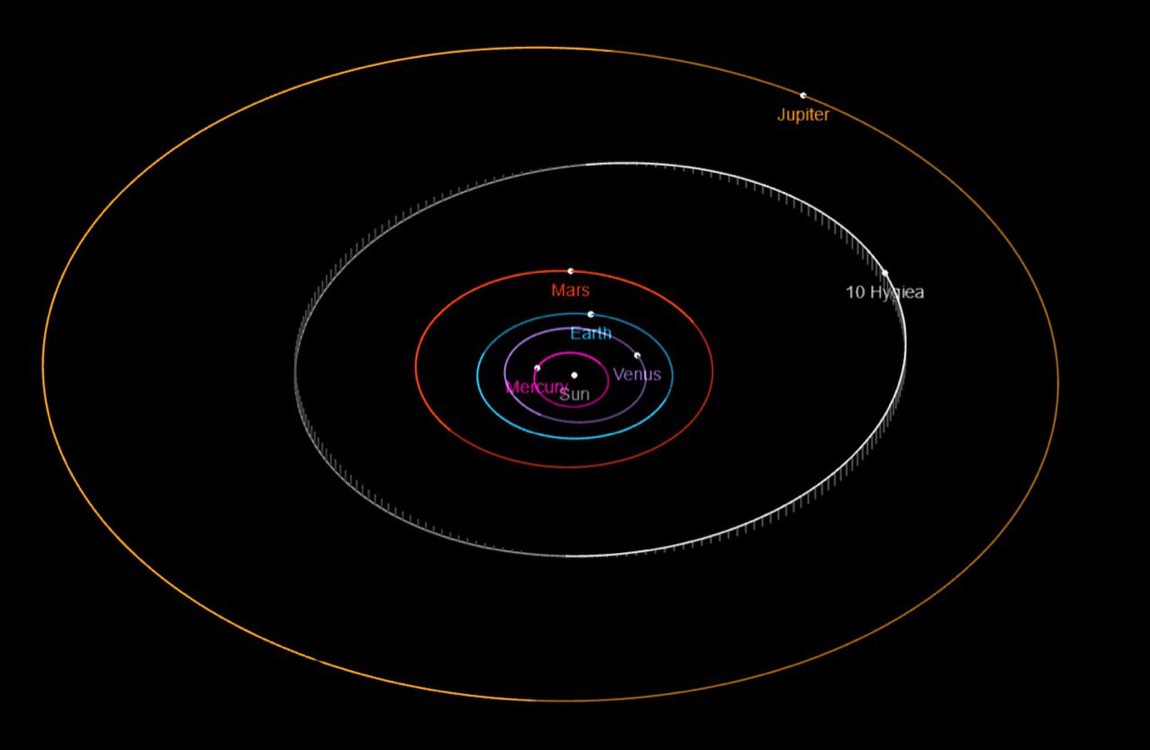
Hygiea travels the Sun at an average distance of 3.15 AU — roughly 470 million km — completing one orbit every 5.59 Earth years. Its path is elliptical, swinging from 2.81 AU at perihelion to 3.49 AU at aphelion, while staying at a relatively low orbital inclination of just 3.8° from the ecliptic. What makes Hygiea's orbital situation especially interesting is a three-body mean motion resonance it shares with both Jupiter and Saturn, expressed mathematically as 8nJupiter − 4nSaturn − 3nHygiea = 0. This linked gravitational drumbeat means Hygiea's orbit does not evolve smoothly over time. Simulations reveal the resonance produces chaotic orbital evolution with a Lyapunov time — the timescale over which predictions become exponentially unreliable — of only 14,000 to 16,000 years. In practical terms, astronomers cannot confidently trace Hygiea's precise path more than a geological eyeblink into the future. Despite this chaos, near-term predictions remain possible: an n-body calculation accounting for the planets and 16 largest asteroids places Hygiea's next perihelion on 15 February 2028.
05 The Giant Impact That Remade a World
About 2 to 3 billion years ago, something enormous — probably a body between 75 and 150 km (47 and 93 mi) across — slammed into Hygiea with enough violence to completely shatter it. Rather than carving out a single enormous basin the way a large impact did on Vesta, this collision broke Hygiea apart entirely, erasing all pre-existing surface features. Computer simulations of the event show that most of the debris reaccumulated under its own gravity into a fluid-like mass, which then relaxed into the near-spherical shape Hygiea has today. The modeling suggests Hygiea solidified roughly four hours after the impact. The wreckage that did not fall back became the Hygiea family — now comprising over 7,000 known asteroids sharing similar orbits and compositions — which is the most populous asteroid family in the outer main belt. Hygiea itself retained over 98% of the family's total mass. Other large asteroid family parents, including 8 Flora and 31 Euphrosyne, show similar roughly spherical shapes, suggesting collisional disruption and reaccumulation may be a common fate for large asteroids.
06 A Surface Dark as Charcoal and What It Holds
Hygiea's surface is strikingly dark, reflecting only 6.3% to 7.2% of the sunlight that strikes it — comparable to fresh asphalt. This low albedo arises from a composition dominated by carbonaceous, hydrated, and ammoniated silicate minerals called phyllosilicates, alongside carbonates and traces of water ice. Spectroscopic observations classify Hygiea firmly as a C-type asteroid and place it within the broader C spectral complex typical of the outer main belt. Its spectrum so closely resembles both carbonaceous chondrite meteorites and the dwarf planet Ceres that some astronomers have called Hygiea a "virtual spectral twin of Ceres." The James Webb Space Telescope has refined this picture further, finding that Hygiea's phyllosilicates are magnesium-rich and appear to match ammoniated saponite specifically. Despite the overall chemical similarity to Ceres, slight differences in near-infrared spectra suggest the two bodies have somewhat different concentrations of hydrated and ammoniated minerals — a subtle chemical distinction between two otherwise remarkably similar worlds.
07 A Surface That Changes As You Watch It Deeper
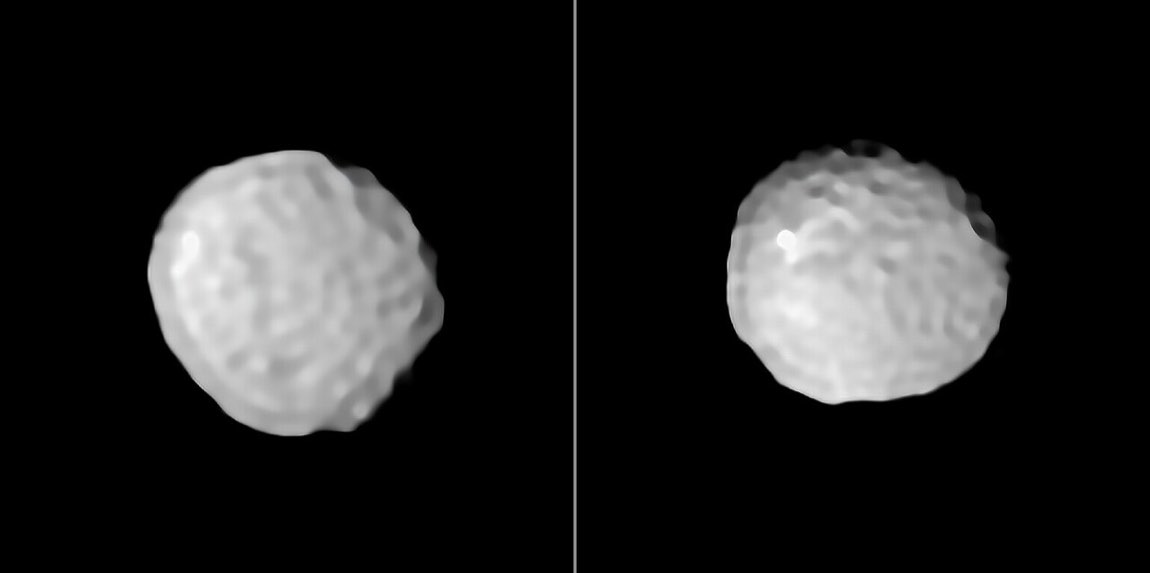
Hygiea's surface is not chemically uniform, and tracking it over time reveals unexpected variability. From Earth, Hygiea's brightness fluctuates by up to 15% from its average value as albedo features rotate in and out of view. VLT imaging has identified several bright spots, the most prominent of which sits in the southern hemisphere at longitude 290° and latitude −30° and is 10% brighter than the average surface reflectance. A large dark region appears along the equator near longitude 60°, though it is most likely a shadowed area rather than a true compositional difference. At the spectral level, a 2011 study by Vladimir Busarev recorded the spectral type shifting between C, B, and F types over a single rotation, which he interpreted as localized dehydration possibly caused by impact heating. Separately, a 2019 study by Andrew Rivkin and colleagues detected changes in the 3.1 μm absorption feature over years, an indicator that could correspond to ammoniated minerals, hydrated minerals, or even water ice frost — the team speculated these variations might reflect exposed subsurface material, though no correlation with a single surface location was found.
 ⤢
08 Craters Named for Serpents and Cups
Despite the violent ancient impact that remade Hygiea, its present surface is remarkably smooth. VLT imaging has confidently identified only two craters: a larger one measuring 180 ± 15 km (about 112 ± 9 mi) across, and a smaller one at 97 ± 10 km (about 60 ± 6 mi) across — both possessing central peaks. Pierre Vernazza and collaborators informally named these Serpens and Calix, from the Latin words for 'snake' and 'cup' respectively, echoing the symbolism traditionally associated with the goddess Hygieia. These names are not yet approved by the IAU. Beyond these two features, VLT images show no obvious craters larger than 30 km (19 mi) in diameter. By comparison, Ceres similarly lacks large bowl-shaped craters and instead hosts flat-floored complex craters that are hard to detect from Earth. If Hygiea follows the same pattern, its apparent crater scarcity may reflect crater relaxation driven by a water ice-rich subsurface rather than a true absence of impacts — an icy interior would allow surface topography to slowly flow and flatten over time.
09 Cold Dust and Ice Beneath the Surface Deeper
Hygiea's interior likely harbors a substantial fraction of water ice, an inference supported by multiple independent lines of evidence. Its bulk density has been measured at either 1.944 ± 0.250 g/cm³ or 2.06 ± 0.20 g/cm³ depending on the study, figures similar to Ceres's density of 2.16 g/cm³ — both are low enough to suggest water ice is diluting the rock. Spectroscopic detections of water ice at the surface and the apparent absence of deep bowl-shaped craters (which would be smoothed away by an icy interior) further support this picture. The surface itself is blanketed by a fine-grained regolith that astronomers describe as dustier than Earth's Moon, with a low thermal inertia that lets it shed heat readily. The regolith layer is estimated to be at least 8 cm (3.1 in) deep. Surface temperatures reach as high as 230 K (−43 °C) at the sunlit subsolar point but average between 150 and 180 K (−123 to −93 °C) across the orbit, dropping to roughly 163 K (−110 °C) at Hygiea's mean distance from the Sun. These frigid conditions are consistent with the preservation of subsurface ice over billions of years.
10 A Retrograde Spinner Pointing South Deeper
Hygiea rotates once every 13.83 hours — 13 hours and 49.5 minutes — with an uncertainty of just 0.2 seconds, determined through a combination of direct telescope imaging and light-curve analysis. This value replaced a long-standing misconception: early measurements from the 1950s suggested an 18-hour rotation period, while studies from 1991 onward reported 27.6 hours, errors that arose because those older observations lacked enough data points to construct reliable light curves. Hygiea's spin axis is tilted dramatically, pointing toward ecliptic longitude 306° ± 3° and ecliptic latitude −29° ± 3° — in other words, its north pole aims toward the ecliptic's southern side. This gives Hygiea an obliquity of 120° from the ecliptic plane, which is greater than 90° and therefore means Hygiea has a retrograde rotation: it spins in the opposite direction to its orbital motion around the Sun, the same counterintuitive behavior seen on Venus. The polar flattening and angular momentum of Hygiea closely match predictions for a Maclaurin spheroid, the shape a self-gravitating rotating fluid reaches in hydrostatic equilibrium — supporting the idea that Hygiea once behaved, briefly, like a liquid.
11 Weighing an Asteroid by Its Gravitational Wake Deeper
Measuring the mass of an asteroid with no visiting spacecraft requires patience and ingenuity. Because Hygiea has enough gravity to measurably deflect other asteroids that fly close by, astronomers can work backward from the deflection to calculate its mass. A 2002 study identified 40 known asteroids that had passed within 0.05 AU (about 7.5 million km) of Hygiea between 1970 and 2000. The technique requires precise positional measurements of the passing asteroid both before and after its closest approach. The first attempt at measuring Hygiea's mass this way came in 1986, using archival records of a close approach by asteroid 829 Academia, which had passed just 0.006 AU — roughly 900,000 km — from Hygiea on 19 May 1927. Successive refinements using more close approaches and improved astrometric observations eventually yielded the current best mass estimate of (8.237 ± 0.020) × 10¹⁹ kg. Over a 30-million-year span, Hygiea's gravitational tugs can shift the proper semi-major axes of close-passing asteroids by as much as 0.000908 AU (approximately 136,000 km) — a subtle but measurable imprint of Hygiea's presence.
12 Observing Hygiea: Binoculars vs. Telescopes
Despite being the largest asteroid in the outer main belt, Hygiea is frustratingly dim from Earth. Its dark surface and its position near 3.15 AU from the Sun conspire to make it the third dimmest of the first 23 asteroids discovered, brighter in mean opposition magnitude than only 13 Egeria and 17 Thetis. At most oppositions Hygiea hovers around magnitude +10.2 — up to four orders fainter than Vesta — meaning most observers need at least a 4-inch (100 mm) telescope to find it. At a favorable perihelic opposition, however, it can brighten to magnitude +9.1, making it just reachable with 10 × 50 binoculars — something the next two largest belt asteroids, 704 Interamnia and 511 Davida, never achieve. Earth-based astronomers have tracked 17 stellar occultations by Hygiea, including two in 2002 and 2014 observed by large numbers of observers simultaneously, using the brief dimming of background stars to refine Hygiea's size, shape, and spin axis. The Hubble Space Telescope has also resolved the asteroid directly and ruled out any orbiting companion larger than about 16 km (9.9 mi) in diameter.
13 Missions Proposed but Never Flown
No spacecraft has ever visited Hygiea, leaving it one of the largest unvisited major bodies in the Solar System. In 2006, Mark V. Sykes and colleagues at the Planetary Science Institute submitted the Exploring the Very Earliest Epoch (EVE) mission concept to NASA's Discovery Program, proposing to send a copy of the Dawn probe toward Hygiea with a launch in October 2011 and a rendezvous in 2021. The proposal was not approved. In 2013, Pierre Vernazza and Philippe Lamy proposed a medium-class mission called INSIDER to the European Space Agency, which would rendezvous with and orbit two or three large main-belt asteroids and deploy one or two landers; Hygiea and 24 Themis were among the named targets. That proposal was also rejected. Scientists advocate for a Hygiea mission on the grounds that primitive carbonaceous asteroids like Hygiea — with their hydrated minerals, possible water ice, and chemical similarity to Ceres — could preserve a record of the processes that shaped the early Solar System, making them compelling but as yet unvisited scientific destinations.
 ⤢