 Photograph · JAXA · CC BY 4.0
Asteroid · Deep guide
25143 Itokawa
Also called: 25143 Itokawa · (25143) Itokawa · 1998 SF36
A tiny peanut-shaped rubble pile — the first asteroid to have pieces brought back to Earth.
What is it?
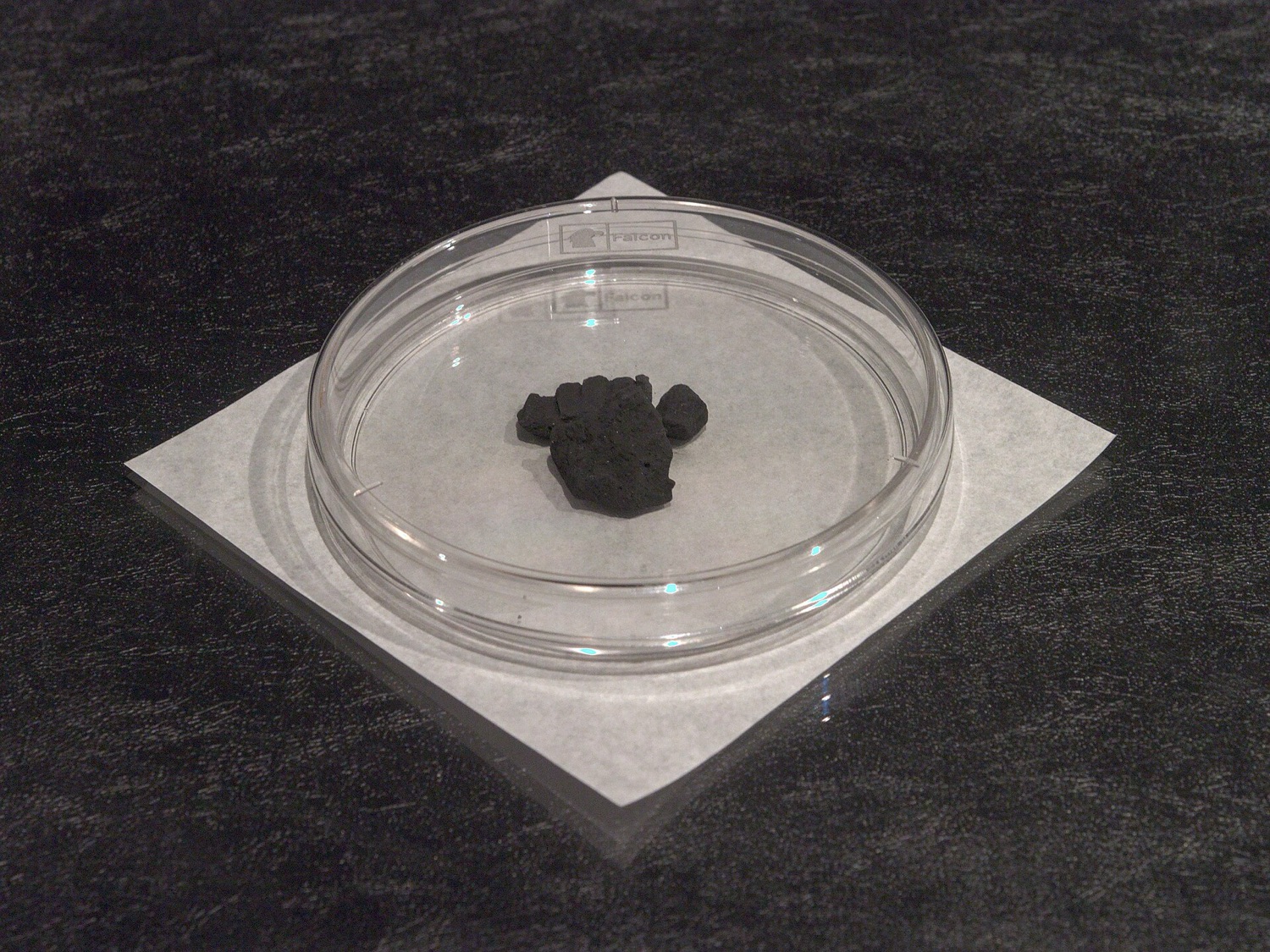
Itokawa is a small near-Earth asteroid only about 330 m across, shaped like a peanut and made of loosely packed boulders rather than solid rock. Japan's Hayabusa probe visited it in 2005 and collected more than 1,500 tiny dust grains from its surface. When those grains reached Earth in 2010, it was the first sample ever returned from an asteroid. Since then, scientists have studied their minerals, chemistry and isotopes in detail.
The deep dive
Researched for the Atlas from Wikipedia — 25143 Itokawa (8,265 characters read) · updated Nov 14, 2026
01 A Rubble Pile, Not a Single Rock
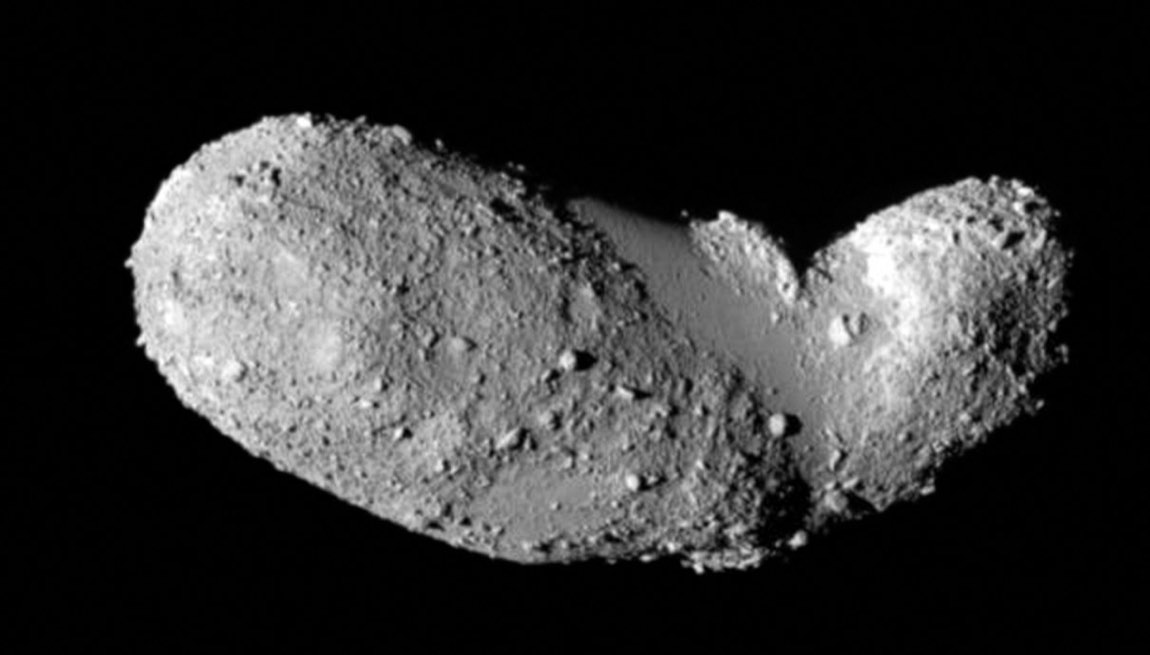
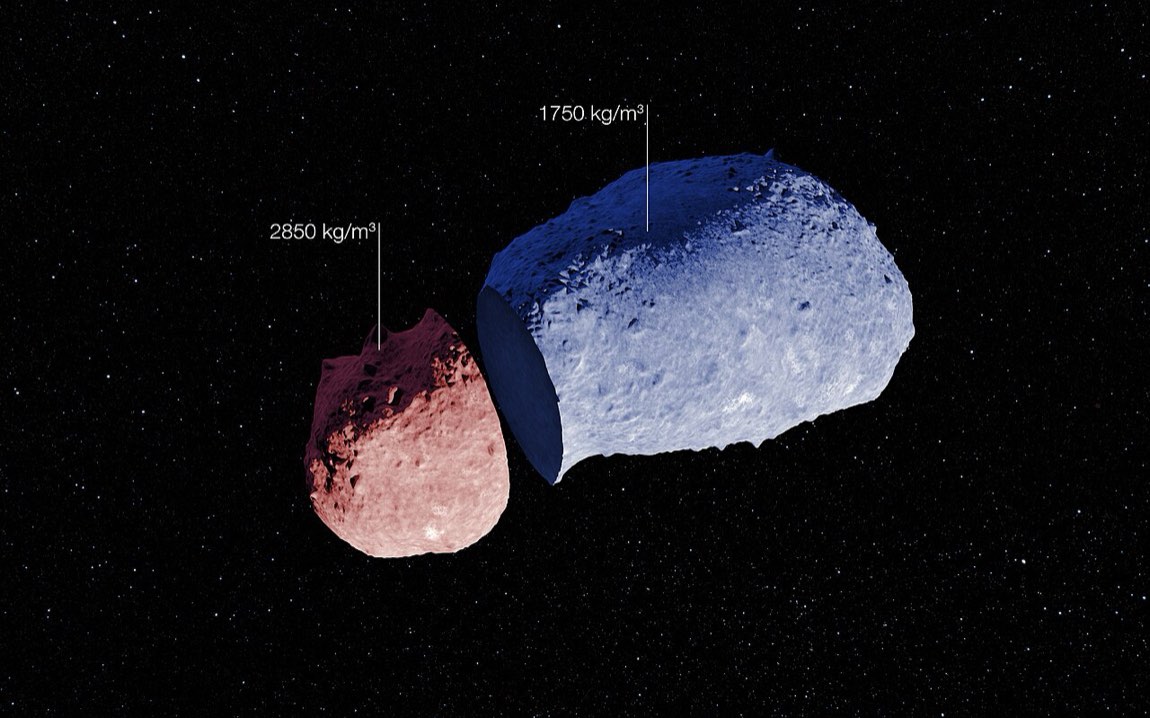
One of the most striking things Hayabusa revealed about Itokawa is that it is not a solid body at all. Its density is far too low for solid rock, and two distinct zones have been measured using the Yarkovsky–O'Keefe–Radzievskii–Paddack effect: a smaller section estimated at 2.9 g/cm³ and a larger section at only 1.8 g/cm³. That larger figure is roughly the density of soft coal — nowhere near what you would expect from a coherent stony asteroid. The leading explanation is that Itokawa is a rubble pile, a loose collection of boulders and debris held together mainly by their own weak mutual gravity. The Hayabusa images reinforced this: rather than a cratered, smooth surface like many rocky bodies, Itokawa is studded with boulders of varying sizes, and impact craters are conspicuously scarce. Scientists believe the whole structure may have assembled gradually as fragments coalesced over time following the break-up of a larger parent body.
02 A Contact Binary in Disguise Deeper
Itokawa's distinctive peanut shape is more than cosmetic. Hayabusa data suggest the asteroid may be a contact binary — meaning it formed when two or more smaller asteroids drifted close enough for gravity to draw them together and they gently merged. Each lobe would then preserve the internal structure and composition of a separate original body, which could help explain the two different density regions measured across the asteroid. Radar imaging by Goldstone in 2001, before any spacecraft visited, already hinted at this geometry: it observed an ellipsoid 630 ± 60 meters long and 250 ± 30 meters wide, far more elongated than a simple rounded asteroid. The lack of a clear impact-crater record on the surface further complicates the picture, since a loose rubble pile would absorb collisions differently than solid rock, making age estimates from crater counts unreliable. Whether Itokawa's two lobes originated as truly independent bodies or as fragments of the same disrupted parent remains an open question.
03 Dust Ponds: Calm Patches on a Chaotic World
Despite having no atmosphere and negligible gravity, Itokawa hosts a genuinely surprising surface feature: dust ponds. These are smooth deposits of fine material that have settled into depressions such as craters, forming visually calm patches against the surrounding rocky terrain. They were identified in two specific regions of the asteroid — Sagamihara and Muses-Sea — where the contrast between the silky dust and the boulder-strewn landscape is especially clear. The dust particles range in size from millimeters to less than a centimeter. On an airless body, the mechanism that moves and sorts this material is not wind but subtle forces such as electrostatic levitation and the gentle shaking caused by micro-impacts. Dust ponds have since been observed on other small airless bodies, so Itokawa helped establish them as a recognisable class of feature in planetary geology rather than an oddity unique to one asteroid.
04 Water Hidden Inside Asteroid Grains Deeper
Among the most consequential discoveries from the Hayabusa sample return were signs of water locked inside the returned dust. Two independent research groups reported their findings in 2018 using different particles and different techniques. Jin and colleagues found water in low-calcium pyroxene grains, with isotope ratios matching those of inner Solar System water and carbonaceous chondrites. Separately, Daly and colleagues detected OH and H₂O in the rims of olivine particles, with enrichment of up to approximately 1.2 atomic percent, apparently produced by solar wind hydrogen implanting itself into the mineral surface. When researchers scaled these concentrations up to estimate the bulk water content of the whole asteroid — a figure they called BSI, Bulk Silicate Itokawa — they found it comparable to Earth's bulk water content, suggesting Itokawa was once a water-rich asteroid. A third group, reporting at the 2020 Lunar and Planetary Science Conference, added organics to the picture using a single particle nicknamed "Amazon," finding water in olivine, pyroxene, and albite with isotopic compositions confirming an extraterrestrial origin.
05 Solar Wind Writing the Story of Earth's Oceans
A 2021 follow-up by Daly's research group pushed the water findings in an unexpected direction. Using atom probe tomography — a technique that maps individual atoms within a material — the team examined a single grain from the Hayabusa sample and found hydroxide and water molecules sitting right on the grain's surface. Their conclusion supported a broader theory: that a significant source of Earth's water arrived not from comets or icy planetesimals alone, but from hydrogen atoms carried on solar wind particles that struck oxygen-bearing minerals on asteroids like Itokawa. Over billions of years, those water-bearing grains could have rained down onto the early Earth as space dust. This chain of events — Sun to asteroid surface to Earth's oceans — transforms Itokawa from an interesting local curiosity into a possible piece of evidence for how our planet became a water world. The result remains part of an active scientific debate, but the Itokawa grains are among the most direct physical evidence yet gathered.
06 How Itokawa Got Its Color
The surface of Itokawa is notably dark and iron-tinted, but the reason is not what it first appears. The underlying iron minerals would naturally produce a whitish iron-oxide coloring, yet what Hayabusa's cameras and the returned samples showed was a much darker surface. Scientists determined that this darkening is a form of space weathering: a constant bombardment by high-speed particles from the Sun and by tiny micrometeoroids that abrade the mineral surface at the microscopic level. This abrasion converts the normally light-colored iron oxide into a dark iron compound, progressively staining the entire surface over geological time. The dust collected from Itokawa's surface is estimated to have been sitting exposed there for approximately eight million years — long enough for space weathering to leave a clear imprint. This finding helped confirm a long-standing hypothesis that the reddened or darkened surfaces of S-type asteroids like Itokawa are closely related to ordinary chondrite meteorites, which appear lighter simply because they fall through Earth's atmosphere and land far more recently than the timescales of space weathering.
07 Matching Itokawa to Meteorites in Our Collections Deeper
Before Hayabusa, one of the persistent puzzles in planetary science was why S-type asteroids, the most common class of near-Earth asteroid, did not seem to match well with the most common type of meteorite found on Earth: ordinary chondrites. The Hayabusa samples helped resolve this. Chemical and mineralogical analysis of the returned dust showed that Itokawa's composition matches the specific sub-category known as low-total-iron, low-metal ordinary chondrites. Six separate articles in the 26 August 2011 issue of the journal Science were devoted to these findings. Furthermore, the composition pattern of the samples pointed to their origin not in Itokawa's outer layers but in the interior of a larger predecessor asteroid. The current Itokawa is therefore thought to be made primarily from fragments that were once deep inside a bigger parent body — fragments that were excavated and scattered by a large collision long ago and subsequently reassembled under gravity into the rubble pile we observe today. This confirmed that the apparent spectral mismatch between S-type asteroids and ordinary chondrites was largely an effect of surface weathering rather than a fundamental compositional difference.
 ⤢
08 Named Features and What They Tell Us
Itokawa's surface features were formally named through the Working Group for Planetary System Nomenclature of the International Astronomical Union, with names proposed by the Hayabusa science team. Ten impact craters received official names on 18 February 2009. The asteroid also has named regiones — large areas distinguished from surrounding terrain by differences in reflectivity or color — including Sagamihara and Muses-Sea, the same two regions where the dust ponds were identified. For smaller surface features the Hayabusa team continued to use working names that have not been formally ratified, and notably no single naming convention was disclosed or enforced for features on Itokawa as a whole. This mix of formal and informal nomenclature reflects how rapidly the science was developing: researchers needed names to communicate efficiently in papers and meetings before the IAU process could keep up. The paucity of confirmed craters — only ten named on the entire asteroid — is itself scientifically significant, reinforcing the interpretation that a rubble-pile structure absorbs and erases impact signatures far more efficiently than a solid rocky body would.
09 Itokawa's Orbit and Its Proximity to Earth
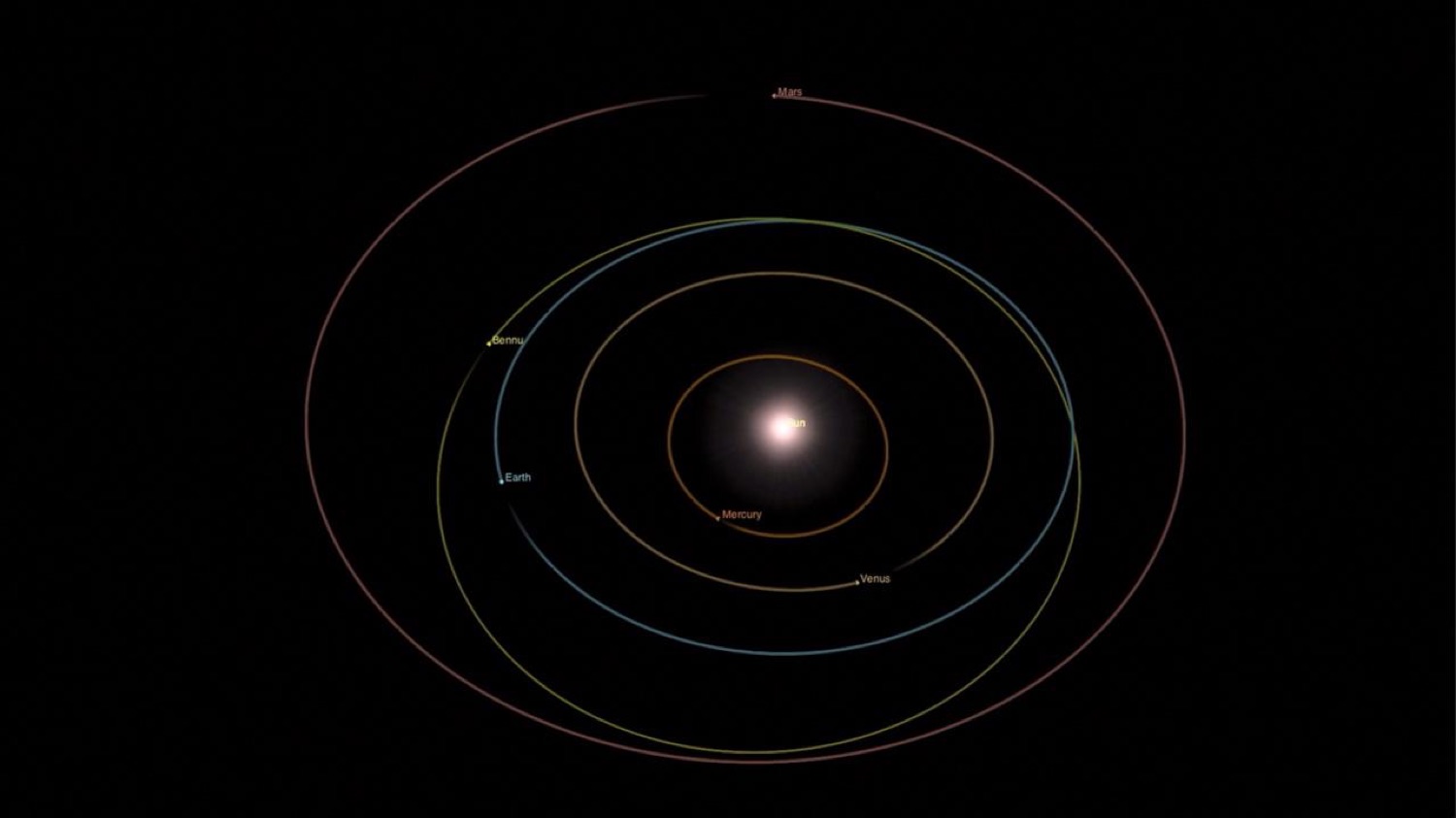
Itokawa follows an elliptical path around the Sun that carries it from 0.95 AU at its closest point to 1.70 AU at its farthest, completing one orbit every 557 days — just under 18 months. Its orbital eccentricity is 0.28 and its inclination to the ecliptic is a modest 2°, meaning it moves nearly in the same plane as Earth. As an Apollo asteroid, it regularly crosses Earth's orbital path, and its minimum orbital intersection distance — the closest its orbit can theoretically bring it to Earth's orbit — is 0.0131 AU, equal to about 1,960,000 kilometres or roughly 5.1 times the distance to the Moon. This qualifies it as a potentially hazardous asteroid. The semi-major axis of 1.32 AU places it among nearly 10,000 known Apollo group members, the largest dynamical class of near-Earth objects. Because of this Earth-approaching orbit, Itokawa was accessible to a space mission launched from Earth without requiring enormous fuel reserves, which made it a practical first target for a sample-return attempt.
10 The Hayabusa Mission Step by Step
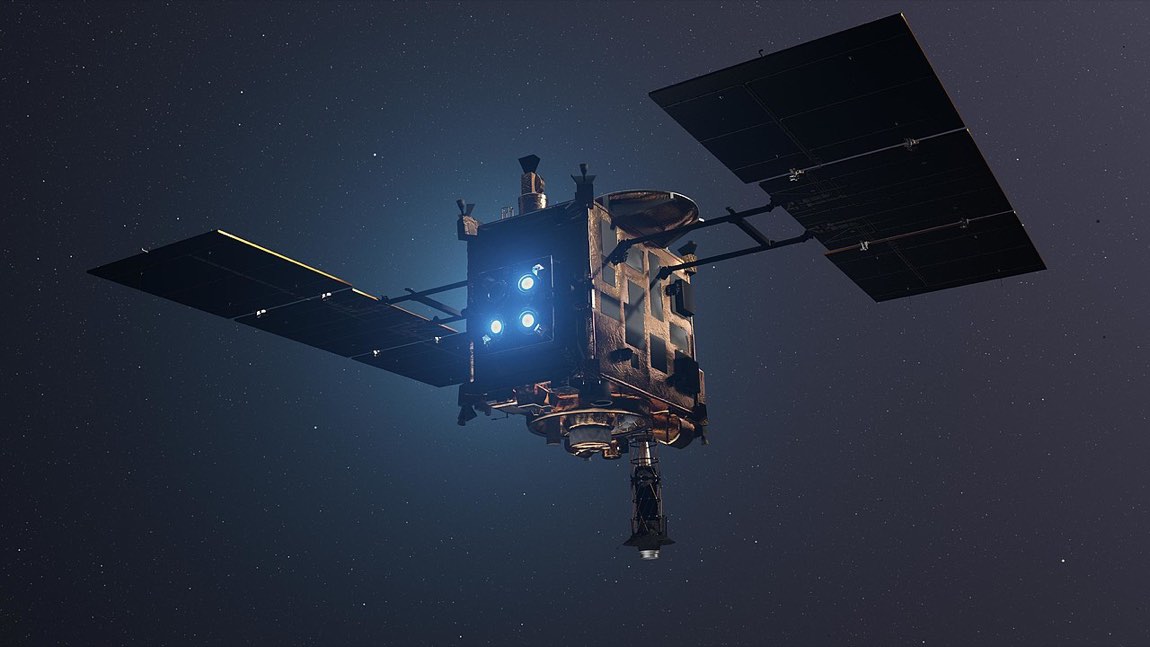
Itokawa was selected as the target for Japan's Hayabusa spacecraft in 2000. The probe arrived in the vicinity of the asteroid on 12 September 2005 and initially held position on the asteroid–Sun line at a distance of 20 kilometres, later closing to 7 kilometres. Because Itokawa's gravity was too feeble to sustain a true orbit, Hayabusa adjusted its own solar orbit until the two objects moved together. On 20 November 2005 the spacecraft landed for thirty minutes but a device intended to collect soil samples failed to operate. A second landing attempt was made on 25 November. The sample capsule then began its long journey home, landing near Woomera, South Australia on 13 June 2010 at around 13:51 UTC. On 16 November 2010, the Japan Aerospace Exploration Agency confirmed that dust recovered from the capsule had genuinely originated from the asteroid rather than from contamination during the flight. That confirmation opened a decade-long programme of laboratory analysis across multiple scientific disciplines — mineralogy, petrography, chemistry, and isotope measurement — that is still producing results.
11 Lightcurves and the Shape of a Tumbling World Deeper
Itokawa's rotation has been measured repeatedly since 2001 through photometric observations — tracking how its brightness varies as it spins and different cross-sections face the observer. The best-rated lightcurve analysis, carried out by Mikko Kaasalainen, yielded a sidereal rotation period of 12.132 hours and a brightness variation of 0.8 magnitudes, an unusually large swing that reflects the asteroid's dramatically non-spherical, peanut shape. Kaasalainen also derived two candidate spin-axis solutions: (355.0°, −84.0°) and (39°, −87.0°) in ecliptic coordinates. Independent measurements by multiple other researchers — including Lambert, Lowry, Ohba, Warner, Ďurech, and Nishihara — all converged on values between 12 and 12.1324 hours, giving high confidence in the period. The consistency across so many independent observers is notable for a sub-kilometre object that is genuinely difficult to track. The high brightness variation was an early indicator that whatever spacecraft eventually visited Itokawa would encounter something far from a simple sphere, a prediction that Hayabusa's images spectacularly confirmed.
12 Discovery, Naming, and a Pioneer of Rocketry
Itokawa was discovered on 26 September 1998 by the Lincoln Near-Earth Asteroid Research program, known as LINEAR, operating from Lincoln Laboratory's Experimental Test Site near Socorro, New Mexico. It received the provisional designation 1998 SF36. Interestingly, its observational record extends back one week earlier than the official discovery, to an image taken by the Sloan Digital Sky Survey that was later recognised as the same object. The asteroid was formally named in memory of Hideo Itokawa (1912–1999), a Japanese rocket scientist widely regarded as the father of Japanese rocketry. The Minor Planet Center published the official naming citation on 6 August 2003. Choosing Itokawa's name for the target of Japan's first interplanetary sample-return mission was a deliberate tribute: the mission itself was a direct descendant of the rocketry tradition that Hideo Itokawa had founded in Japan, so the asteroid and the mission became linked not just technically but historically and culturally.
13 Open Questions That Remain Unanswered Deeper
Even after two successful touchdowns and more than a decade of laboratory analysis, Itokawa leaves significant questions unresolved. The two distinct density regions — 2.9 g/cm³ and 1.8 g/cm³ — are well-established, but whether they correspond to truly separate original bodies or to different packing arrangements within one disrupted parent is still debated. The near-absence of impact craters continues to challenge models of rubble-pile surface evolution: it is not fully understood how efficiently loose aggregates erase or absorb impact signatures. The water results from 2018 through 2021 raise their own questions about how representative a few microscopic grains are of the whole asteroid, and whether the implanted solar-wind water survives the journey from asteroid surface to Earth's surface intact. Meanwhile, the dust ponds in the Sagamihara and Muses-Sea regions invite follow-up: the exact transport mechanisms that move millimeter-to-centimeter grains across an airless, low-gravity surface remain incompletely modelled. Itokawa demonstrated that even a 330-metre rock can be scientifically inexhaustible.
 ⤢