 Photograph · Cantiell · CC BY-SA 3.0
Asteroid · Deep guide
704 Interamnia
Also called: 704 Interamnia · (704) Interamnia · 1910 KU
The fifth-largest asteroid — big, dark, and surprisingly little-known.
What is it?
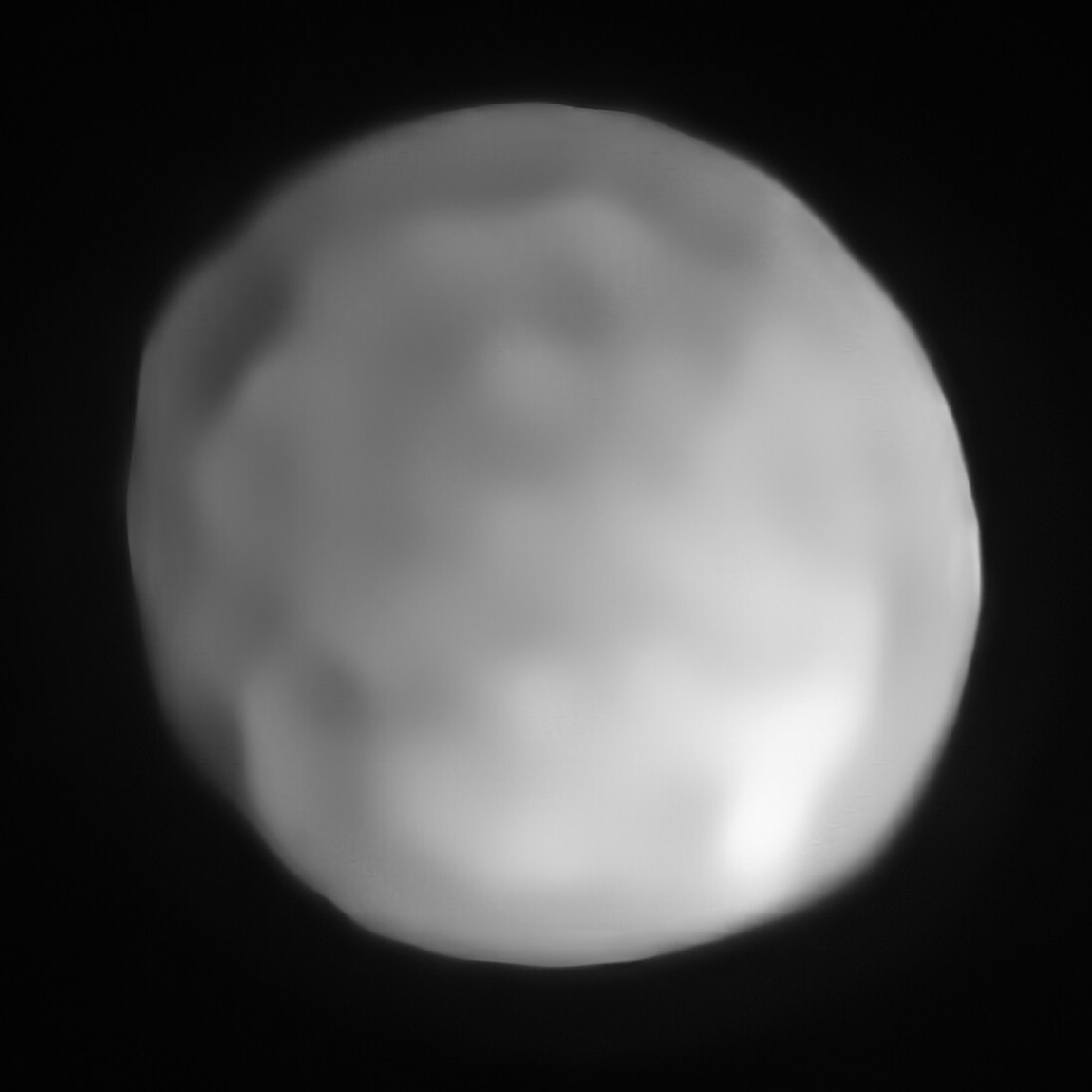
Interamnia is a large, dark asteroid about 330 km across in the outer main belt, the fifth largest after Ceres, Vesta, Pallas and Hygiea. It was found in 1910 by Vincenzo Cerulli and named after the Latin name of Teramo, his Italian home town. Images from the Very Large Telescope suggest its shape may once have matched a fluid body in balance, hinting that impacts later changed how fast it spins.
The deep dive
Researched for the Atlas from Wikipedia — 704 Interamnia (3,019 characters read) · updated Nov 14, 2026
01 The fifth-largest asteroid by size
Interamnia sits in a peculiar position in the solar system's hierarchy: it is definitively the fifth-largest asteroid, trailing only Ceres, Vesta, Pallas, and Hygiea, yet it remains one of the least studied of that elite group. Its mean diameter of around 330 kilometres — roughly the distance from London to Edinburgh — places it well above the threshold where gravity starts to pull a rocky body into a rounded shape. Studies by the Very Large Telescope give a more precise average diameter of about 332 km and reveal an ellipsoidal form similar to that of 4 Vesta. Despite this respectable size, Interamnia receives comparatively little scientific attention, and basic data such as the ecliptic coordinates of its poles and its axial tilt remain undetermined because no light curve analysis has yet been completed. It is, in short, a world of significant scale that science has barely begun to read.
02 An F-type giant: surface clues
Interamnia is not just the fifth-largest asteroid — it is easily the largest member of the F-type asteroid class, a dark, carbon-rich group whose spectral properties set them apart from the more common C-types and the rocky S-types. Its surface is very dark, absorbing most of the sunlight that falls on it. Crucially, observations detect hydrated materials at the surface, and Interamnia's overall spectral signature is similar to that of Ceres, the dwarf planet and largest body in the asteroid belt. That resemblance is scientifically significant: it suggests Interamnia is likely an icy body, one that may have incorporated substantial water ice or hydrated minerals during its formation in the outer belt. The density measurement of 1.98 ± 0.68 g·cm⁻³ is consistent with an icy composition but carries enough uncertainty that researchers cannot yet declare the case closed.
03 How precisely do we know its mass? Deeper
Pinning down the mass of an asteroid with no dedicated spacecraft visit is genuinely difficult, and Interamnia's mass history illustrates that challenge vividly. In 2001, Michalak estimated its mass at (7±2)×10¹⁹ kg — but that figure depended on assumed masses for three other asteroids, 19 Fortuna, 29 Amphitrite, and 16 Psyche, making it vulnerable to cascading errors. By 2011, Baer arrived at a substantially lower figure of (3.9±0.2)×10¹⁹ kg. Goffin's 2014 astrometric reanalysis pushed it lower still, to (2.7±0.1)×10¹⁹ kg. The most statistically careful treatment came in 2020, when Hanuš and colleagues combined 21 prior mass estimates spanning 1992 to 2017, producing a metastatistical result of (3.8±1.3)×10¹⁹ kg — a range of roughly 2.5 to 5.1×10¹⁹ kg within one sigma. The spread across all estimates spans nearly a factor of three, underscoring how uncertain our knowledge of this body's bulk properties remains.
04 A significant slice of the belt's total mass
Even with that mass uncertainty, Interamnia clearly punches well above its weight in the asteroid belt economy. Its mass is estimated at approximately 1.2% of the mass of the entire asteroid belt — a remarkable share for a single object in a region containing hundreds of thousands of numbered bodies. Its mass rank is probably between fifth and tenth highest in the entire asteroid belt, meaning it competes for gravitational influence with the acknowledged giants: Ceres, Vesta, Pallas, and Hygiea. This makes Interamnia a minor but real player in the long-term dynamical sculpting of the inner solar system, capable of measurably nudging the orbits of smaller asteroids that pass close to it — which is, in fact, how astronomers measure its mass in the first place, by watching the tiny gravitational deflections it induces on passing bodies.
05 A spin-down story written in ice Deeper
One of the most intriguing findings from the 2017–2019 Very Large Telescope observations concerns Interamnia's shape and what it implies about the asteroid's past. The VLT's SPHERE imager, combined with stellar occultation data, found that Interamnia's shape is consistent with hydrostatic equilibrium — the state where gravity and rotation together mold a body into a stable, rounded form — but only if its rotation period were 7.6 hours. Its actual current rotation period is 8.7 hours, which is slower. The most natural interpretation is that Interamnia originally formed as a fully equilibrated, plastic body spinning at 7.6 hours, and that subsequent impacts after it solidified slowed its spin to the present rate. This is a subtle but powerful argument: the shape preserves a fossil memory of the original spin, while the current period reflects billions of years of collisional history — a geological clock frozen into the asteroid's silhouette.
06 No family, no giant impacts for 3 billion years
Many large asteroids are surrounded by swarms of smaller fragments — their families — ejected by catastrophic collisions long ago. Vesta has a prominent family; so does Hygiea. Interamnia has none. The complete absence of an affiliated asteroid family is strong evidence that Interamnia has not suffered a giant impact within the past 3 billion years. That is a remarkable statement about its survival: for most of the solar system's history, this large and presumably ice-rich body has drifted through the asteroid belt relatively unscathed by the kind of violent collision that would shatter or heavily resurface it. This pristine status makes Interamnia potentially valuable as a time capsule of early solar system chemistry, its surface and interior less scrambled by impact gardening than those of more battered neighbors like Vesta.
07 Flat floors and hidden craters
The VLT images of Interamnia reveal no deep basins on its surface — a conspicuous absence for a body that has existed for billions of years in a collision-prone environment. The scientific interpretation is not that Interamnia has escaped all impacts, but that any large craters it has accumulated must have flat floors. This is exactly what you would expect from a body with an icy or volatile-rich composition: ice and weak, porous material flow and relax over geological time under the influence of gravity, causing steep crater walls to slump and deep floors to fill in. The same feature is seen on icy moons and dwarf planets elsewhere in the solar system. So while the surface may look smoother than a rocky asteroid's, that apparent smoothness is itself diagnostic — it is the calling card of a world where the interior has enough ice or weak material to let craters gradually heal themselves.
08 Discovery and the name from Teramo
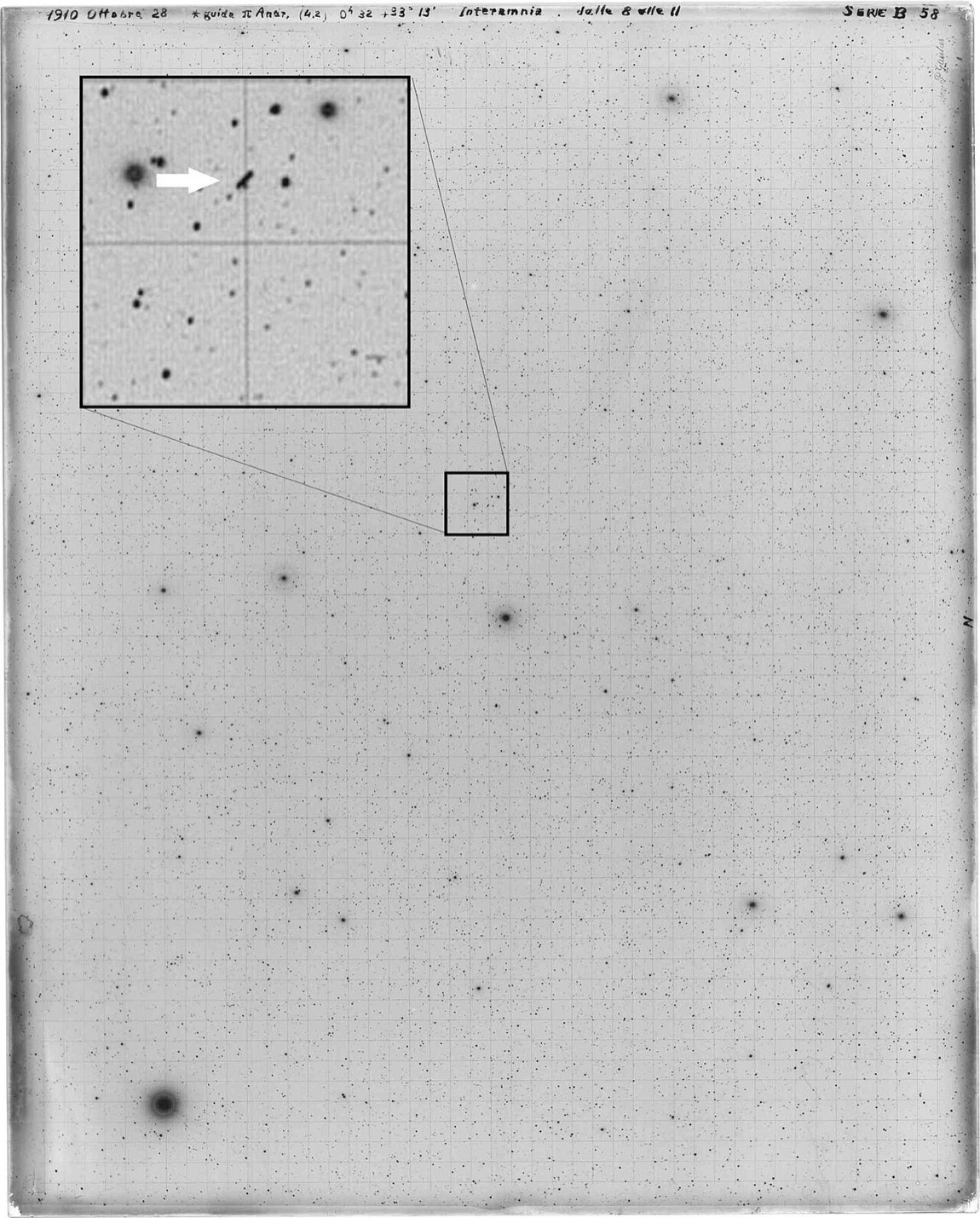
Interamnia was discovered on 2 October 1910 by Vincenzo Cerulli, an Italian astronomer who worked at an observatory in Teramo, a city in the Abruzzo region of central Italy. The asteroid's name honors that city directly: Interamnia is the ancient Latin name for Teramo, derived from the Latin words for "between the rivers," a reference to the city's geographic setting between two watercourses. Cerulli was a skilled observational astronomer, and his discovery of what turned out to be the fifth-largest asteroid in the belt — a distinction that would only become clear as the asteroid belt's population was catalogued over the following century — was one of the notable finds of early twentieth-century planetary science. The naming tradition of using classical Latin place names for asteroids was common in that era and gives Interamnia a geographic identity rooted in Italian cultural history.
09 Why Interamnia is so hard to observe
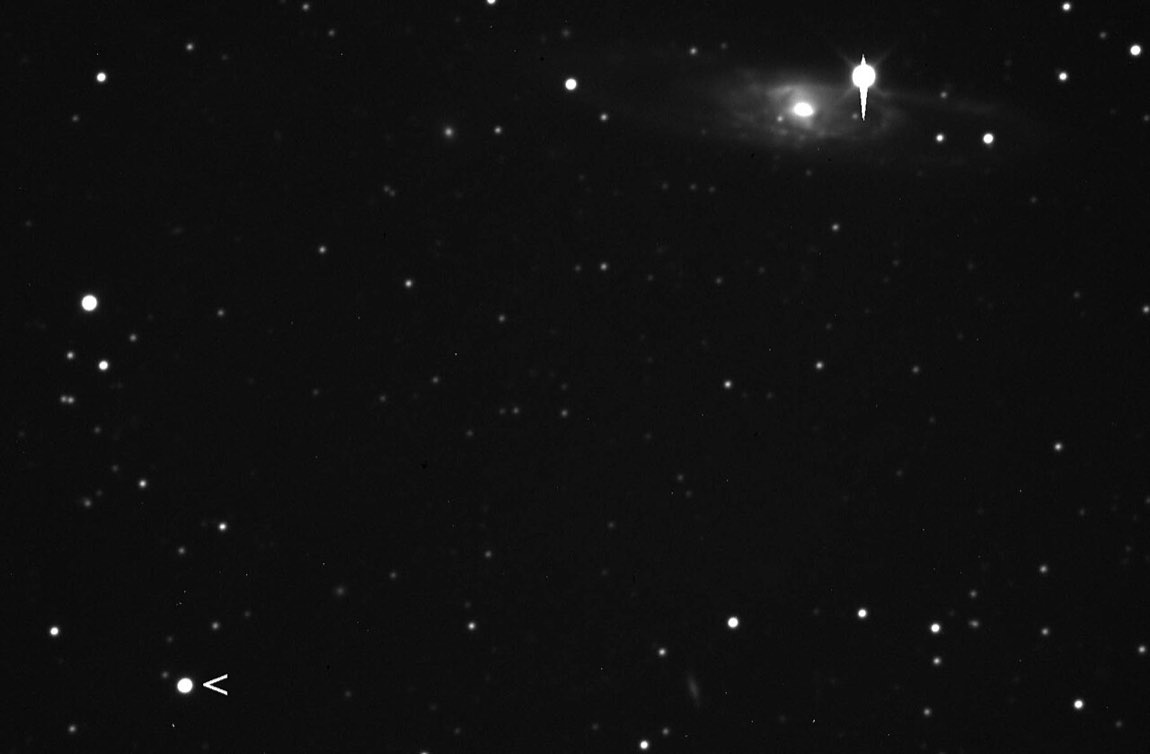
Despite being the fifth-largest asteroid, Interamnia is frustratingly faint for backyard observers. Its very dark surface reflects little light, and its mean distance from the Sun of 3.067 AU keeps it far from Earth even at opposition. At most oppositions its apparent magnitude hovers around +11.0, fainter than the minimum brightness Vesta, Ceres, or Pallas achieve. Even at a perihelic opposition — when it is as close to both the Sun and Earth as its orbit allows — it only reaches magnitude +9.9. That is more than four magnitudes fainter than Vesta at its best, meaning Vesta outshines it by a factor of over forty. The practical result is that Interamnia can never be seen with 10×50 binoculars, the standard instrument casual sky-watchers use to hunt asteroids. A telescope of at least modest aperture is required, and the lack of bright apparitions has contributed to how little observational data exists for this large but elusive world.
10 The VLT's SPHERE and what it revealed Deeper
The observational breakthrough for Interamnia came from the SPHERE instrument mounted on the European Southern Observatory's Very Large Telescope, used in a campaign spanning 2017 to 2019. SPHERE — Spectro-Polarimetric High-contrast Exoplanet REsearch — uses adaptive optics to achieve angular resolutions sharp enough to resolve the disks of large asteroids from Earth's surface, a capability that was previously confined to spacecraft rendezvous missions. Combined with stellar occultation measurements, in which the asteroid passes in front of a star and the shadow timing across multiple ground stations constrains the body's silhouette, the VLT data yielded an average diameter of about 332 km and confirmed an ellipsoidal shape. The resulting density of 1.98 ± 0.68 g·cm⁻³, while imprecise, anchored the inference that Interamnia is likely an icy body. These observations also produced the hydrostatic equilibrium argument about the original spin period, making the 2017–2019 campaign by far the most scientifically productive study of Interamnia to date.
11 Open questions and what comes next Deeper
For all its size, Interamnia leaves fundamental questions unanswered. The density measurement of 1.98 ± 0.68 g·cm⁻³ spans a range wide enough to be consistent with several different internal compositions, so its true makeup — how much ice, how much silicate rock, how much void space — remains undetermined. No light curve analysis has established the ecliptic coordinates of Interamnia's poles, meaning its axial tilt is unknown. The mass estimates from different research groups span nearly a factor of three, an unusually large spread for a body of this importance. No spacecraft has visited it, and none is currently planned. Its status as the largest unstudied body among the top five asteroids makes it a compelling target for a future mission, but for now astronomers must continue to work from the outside, refining occultation profiles, pushing adaptive optics to their limits, and debating what the numbers, fragmentary as they are, truly mean.