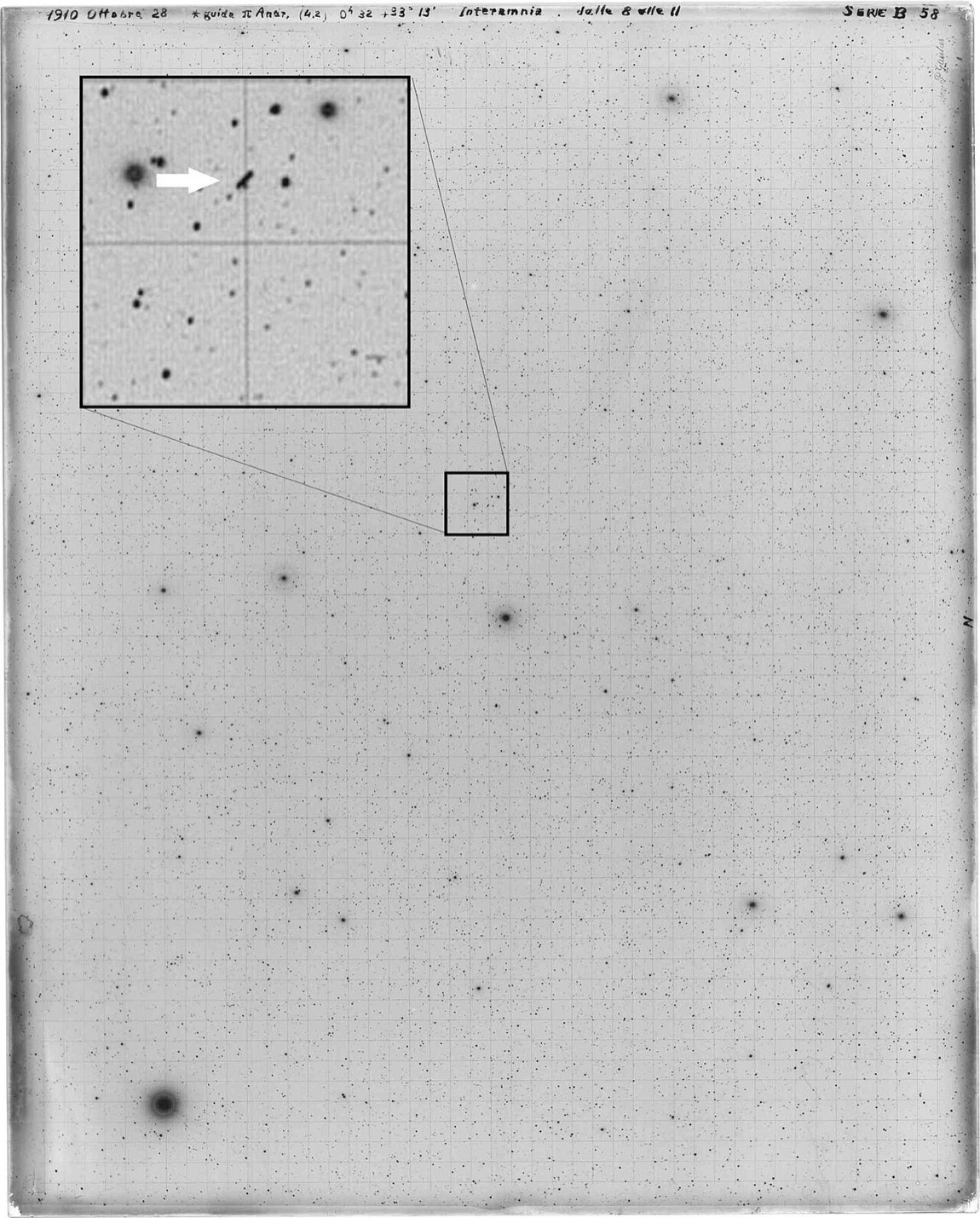
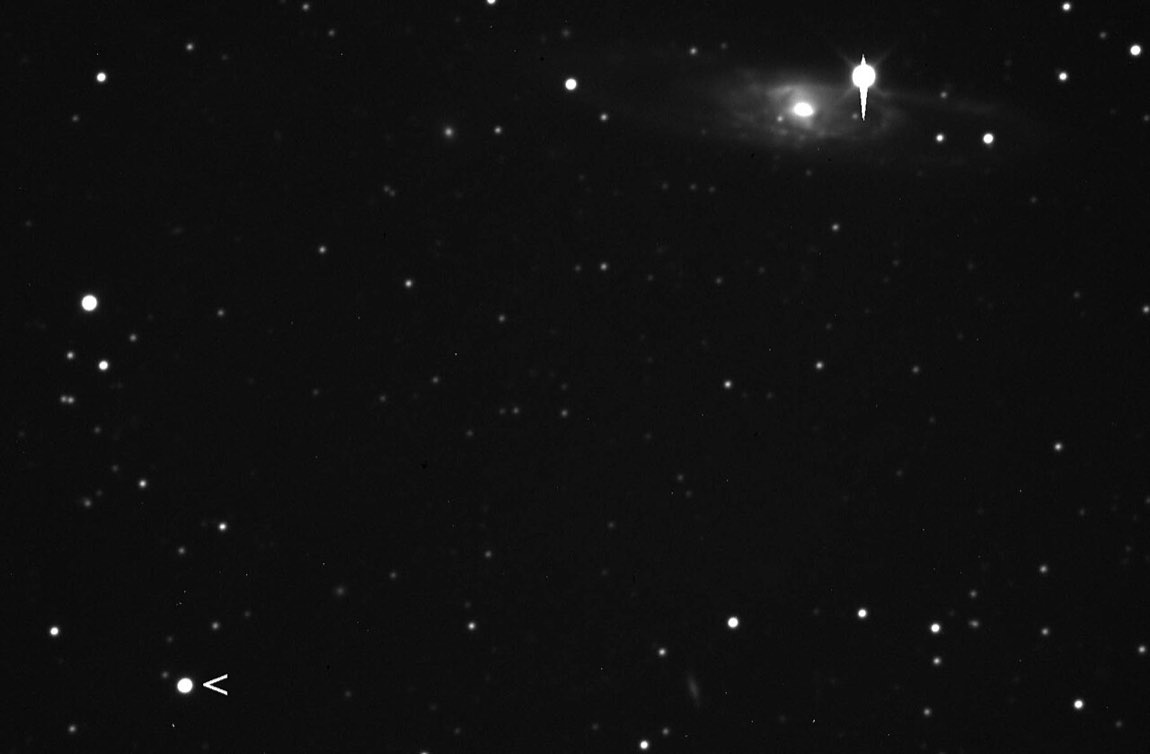
 Photograph · Kevin Heider @ LightBuckets · CC BY-SA 3.0
Asteroid · Deep guide
511 Davida
Also called: 511 Davida · (511) Davida · 1903 LU
One of the ten biggest asteroids, named after an astronomy professor.
What is it?
Davida is a large, dark carbonaceous asteroid in the outer main belt, roughly 290–300 km across. Within measurement uncertainties it ties for about seventh-largest asteroid and is among the five or six most massive. It was discovered in 1903 by Raymond Dugan at Heidelberg and named after David Peck Todd, an astronomy professor at Amherst College.
The deep dive
Researched for the Atlas from Wikipedia — 511 Davida (1,891 characters read) · updated Nov 14, 2026
01 A giant in the asteroid belt
Davida is not just large by asteroid standards — it is genuinely enormous. With a diameter of roughly 280 to 300 kilometers, it sits in the same size class as a small moon. To put that in perspective, you could drive across it at highway speed and it would take about two to three hours just to cross its face. It ranks approximately 7th among all asteroids by size, though measurement uncertainties mean that ranking is a rough tie with several neighbors. By mass, it fares slightly better: estimates place it 5th or 6th most massive in the entire asteroid belt. Perhaps most strikingly, Davida alone accounts for an estimated 1.5 percent of the total mass of the asteroid belt — a remarkable share for a single body in a region containing millions of objects.
02 Why Davida is dark and carbon-rich
Davida belongs to the C-type classification, the most common category among asteroids in the outer belt. The "C" stands for carbonaceous, and it tells us a great deal about the body's nature. C-type asteroids are dark — they reflect very little sunlight, giving them a sooty, charcoal-like appearance. Their composition is closely matched to carbonaceous chondrite meteorites, some of the most primitive rocks known to science. These materials have changed very little since the early solar system, making Davida essentially a preserved sample of the building blocks that formed the planets roughly 4.5 billion years ago. The dark surface is not simply a curiosity; it is a chemical signature pointing to carbon compounds, hydrated silicates, and other complex molecules locked into the asteroid's structure.
03 Weighing an asteroid across the decades Deeper
Measuring an asteroid's mass from Earth is genuinely difficult, and Davida's story illustrates how estimates can shift dramatically as methods improve. In 2001, Michalak put Davida's mass at (6.64 ± 0.56) × 10¹⁹ kilograms — roughly 66 billion billion kilograms. Just six years later, Baer and Chesley revised that down to (5.9 ± 0.6) × 10¹⁹ kilograms. By 2010, Baer's most recent analysis pushed the figure further still, to (3.84 ± 0.20) × 10¹⁹ kilograms — barely more than half the 2001 estimate. Each revision used gravitational perturbations on other asteroids as a measuring stick, but the small size of those deflections makes the technique sensitive to observational errors. The 2010 figure places Davida approximately tied with 704 Interamnia as the fifth-most-massive asteroid, though the article notes that Interamnia's own error bars remain large, leaving even that ranking unsettled.
 ⤢
04 Craters the size of countries
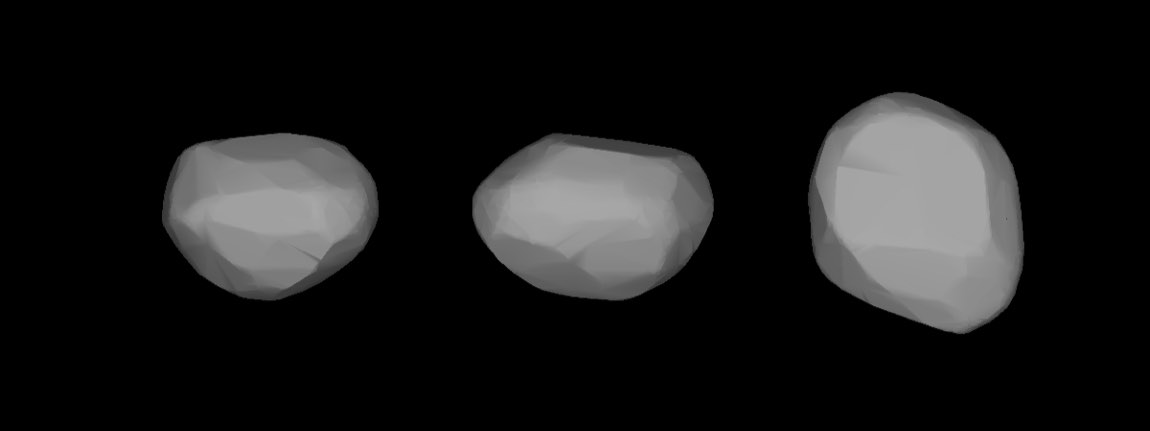
When astronomers at the Keck Observatory turned the Keck II telescope toward Davida between 2002 and 2007, they found a surface far from smooth. The images, sharpened by the telescope's adaptive optics system, revealed at least two prominent promontories and at least one striking flat facet. That facet deviates from a best-fit ellipsoid by as much as 15 kilometers — a staggering relief for a body of this size. The leading interpretation is that this flat region is the floor of a global-scale crater roughly 150 kilometers across, comparable to the giant impact scars seen on the asteroid 253 Mathilde. A crater spanning 150 km on a 280–300 km body would be nearly half the asteroid's own diameter, essentially reshaping the entire object. Conrad et al. (2007) concluded that such impacts can be expected from the known distribution of impactor sizes, without necessarily tearing Davida apart.
05 Why Davida is not a dwarf planet
With a diameter of 280 to 300 kilometers and an impressive share of the asteroid belt's total mass, one might wonder whether Davida crosses the threshold into dwarf planet territory. The key criterion for dwarf planet status is that a body must have pulled itself into a roughly spherical shape through its own gravity — a condition called hydrostatic equilibrium. Davida clearly has not. The Keck observations revealed at minimum two distinct promontories and at least one broad flat facet, with surface features deviating by as much as 15 kilometers from the smooth ellipsoid that a fully relaxed body would form. Those irregular humps and hollows demonstrate that Davida's interior is stiff enough to support topographic relief that gravity alone has not smoothed away, definitively placing it in the category of a small body rather than a dwarf planet.
06 Adaptive optics and imaging from Earth Deeper
Resolving the surface of an asteroid hundreds of millions of kilometers away from the ground was essentially impossible before adaptive optics technology matured. The Keck II telescope on Mauna Kea uses a deformable mirror that flexes hundreds of times per second to counteract the blurring caused by Earth's atmosphere, producing images that approach the theoretical sharpness of a space-based telescope. It was this technology that allowed the multi-year campaign from 2002 to 2007 to discern Davida's shape in enough detail to identify individual facets, promontories, and deviations from a smooth ellipsoid. The observations formed the observational backbone of Conrad et al. (2007), which remains the principal published analysis of Davida's global shape. Without adaptive optics, Davida would appear as an unresolved point of light, and the existence of its enormous surface features would remain unknown.
 ⤢
07 Tracking Davida through occultations Deeper
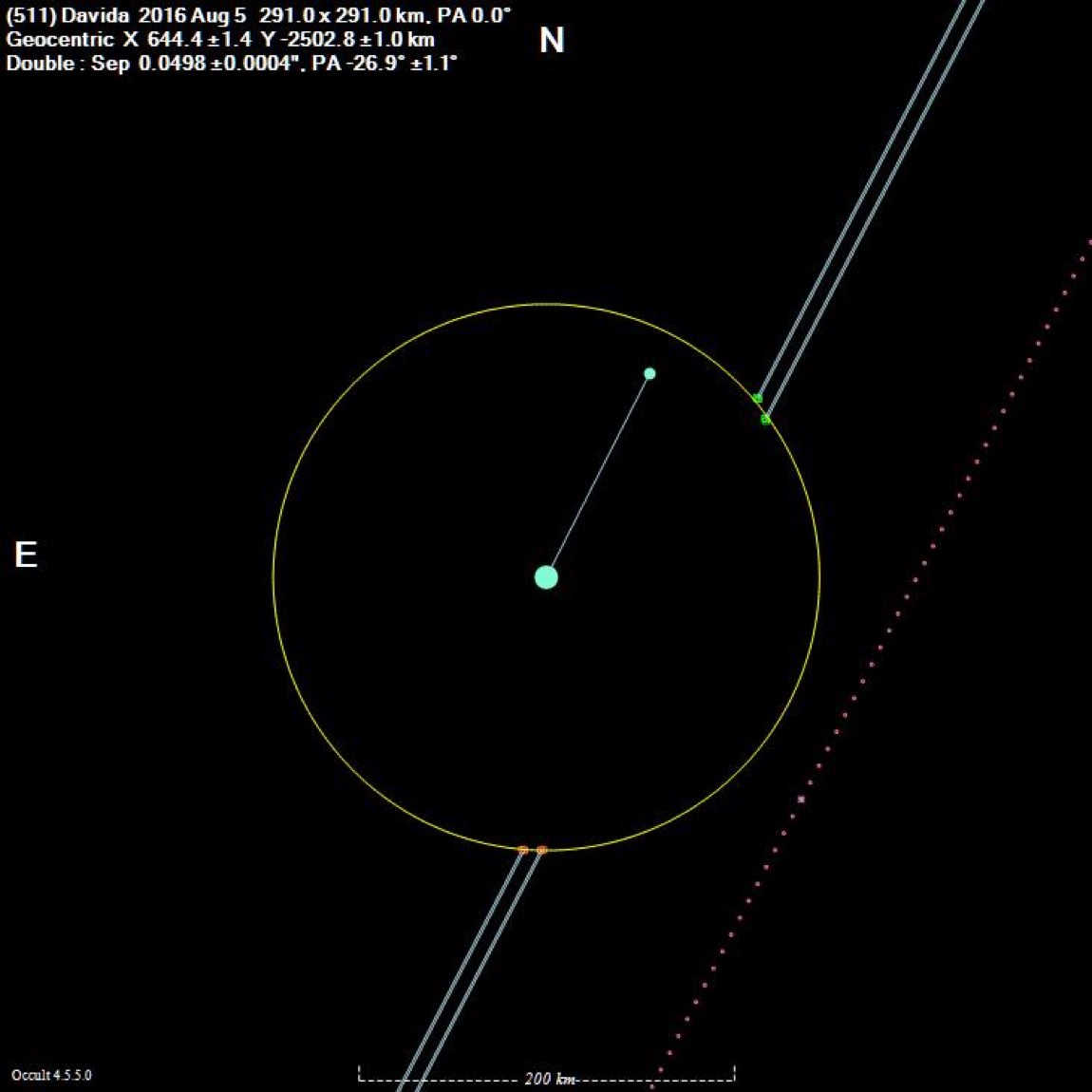
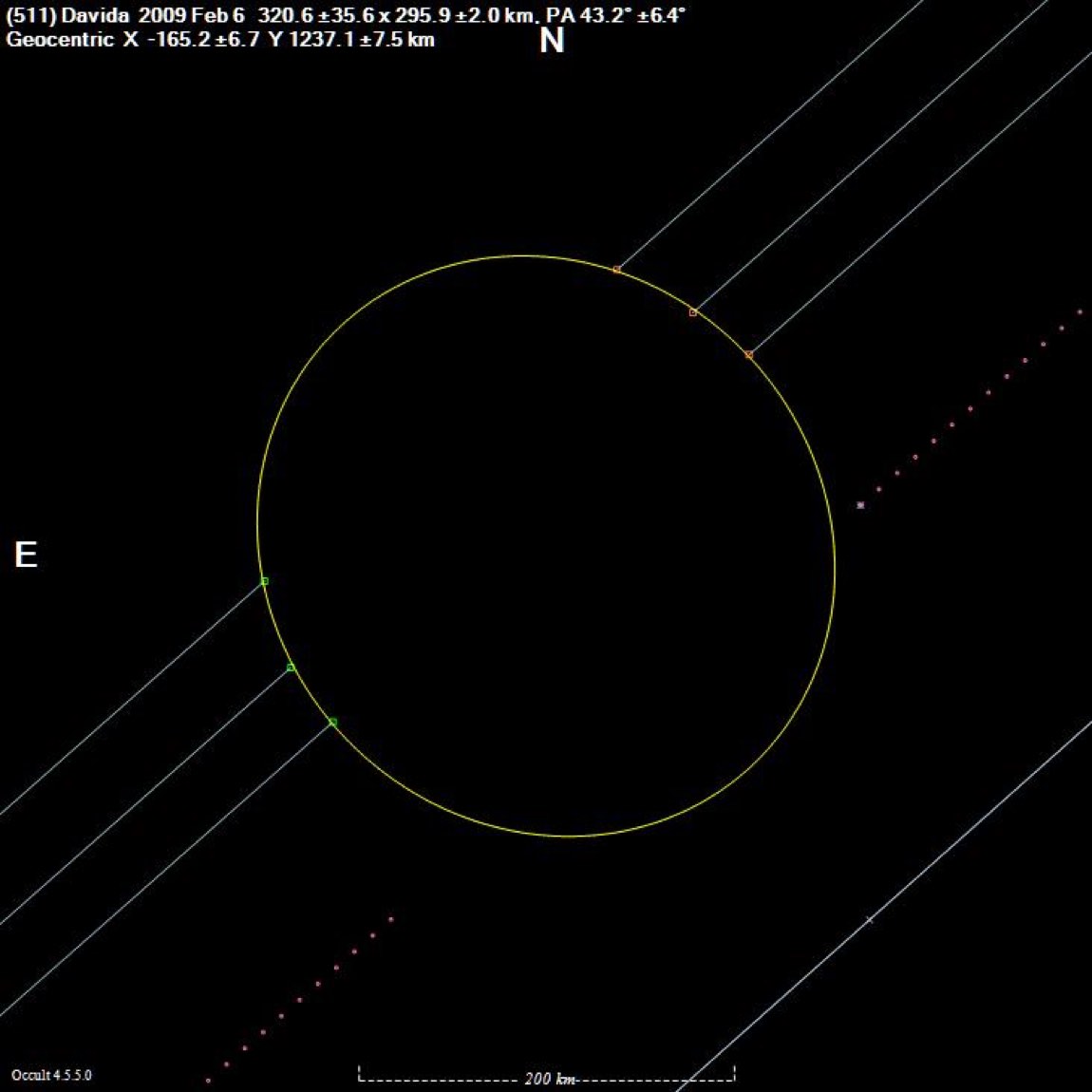
One of the oldest and most precise tools for measuring an asteroid's size and shape is the stellar occultation: watching Davida pass in front of a distant star and timing exactly how long the star's light disappears as seen from different locations on Earth. Each observer records a "chord" — a straight line across the asteroid's silhouette — and combining multiple chords from multiple sites builds up a cross-sectional outline. Since 1987, nine occultation events involving Davida have been successfully observed, with many individual events yielding two or three chords apiece. These events complement telescope imaging by providing high-precision edge measurements that do not depend on how much light the asteroid reflects. Together, occultation data and direct imaging form a powerful two-method check on Davida's true dimensions.
08 An asteroid with extraordinary mineral wealth
Beyond its scientific interest, Davida has attracted attention for a more economic reason: its calculated ore content is estimated to surpass that of every other known asteroid. The article places Davida first in hypothetical mineral worth, with 16 Psyche — often cited in popular coverage as the richest asteroid — ranking second and separated by a large margin. This ranking reflects both Davida's sheer size and its carbonaceous chondrite composition, which typically contains metals, silicates, and potentially water-bearing minerals. It is worth emphasizing that these figures are projections based on compositional models and remote observations, not direct surveys. Nonetheless, the calculation underscores why C-type asteroids of this scale draw interest from researchers thinking about the long-term resource potential of the asteroid belt.
09 Discovery and the man behind the name
Davida was discovered in 1903 by R. S. Dugan, adding it to the small but growing catalog of large asteroids known at the turn of the twentieth century. The name chosen for it looks toward the world of academic astronomy rather than mythology: Davida honors David Peck Todd, a professor of astronomy at Amherst College. Todd was a prominent figure in American astronomy during the late nineteenth and early twentieth centuries, known for solar and planetary observations. The convention of naming asteroids after mythological figures was already well established by 1903, making Davida's dedication to a living contemporary scholar somewhat unusual. The number 511 reflects the order in which it was catalogued among confirmed minor planets, situating it firmly in the era of early systematic asteroid discovery.
 ⤢
10 Open questions about shape and structure Deeper
Despite decades of observation, Davida's interior remains largely unknown. Its mass estimates have shifted by nearly a factor of two between 2001 and 2010, suggesting that the gravitational perturbations used to weigh it are still difficult to pin down precisely. The shape analysis from Keck identifies at minimum one probable giant impact crater and at least two promontories, but the full surface has not been mapped — only the portions visible during the 2002–2007 observation windows have been characterized. Whether additional large craters exist on the far or polar regions is unknown. Davida's internal density and porosity — which would reveal whether it is a solid rock, a fractured body, or a loosely bound rubble pile — cannot be determined from current data. A close flyby or orbital mission would transform understanding of this massive but still poorly characterized world.