 Photograph · 243_ida.jpg : NASA/JPL derivative work: Chzz ► · Public domain
Asteroid · Deep guide
243 Ida
Also called: 243 Ida · (243) Ida · A884 SB
The first asteroid found to have its own moon, spotted by the Galileo spacecraft in 1993.
What is it?
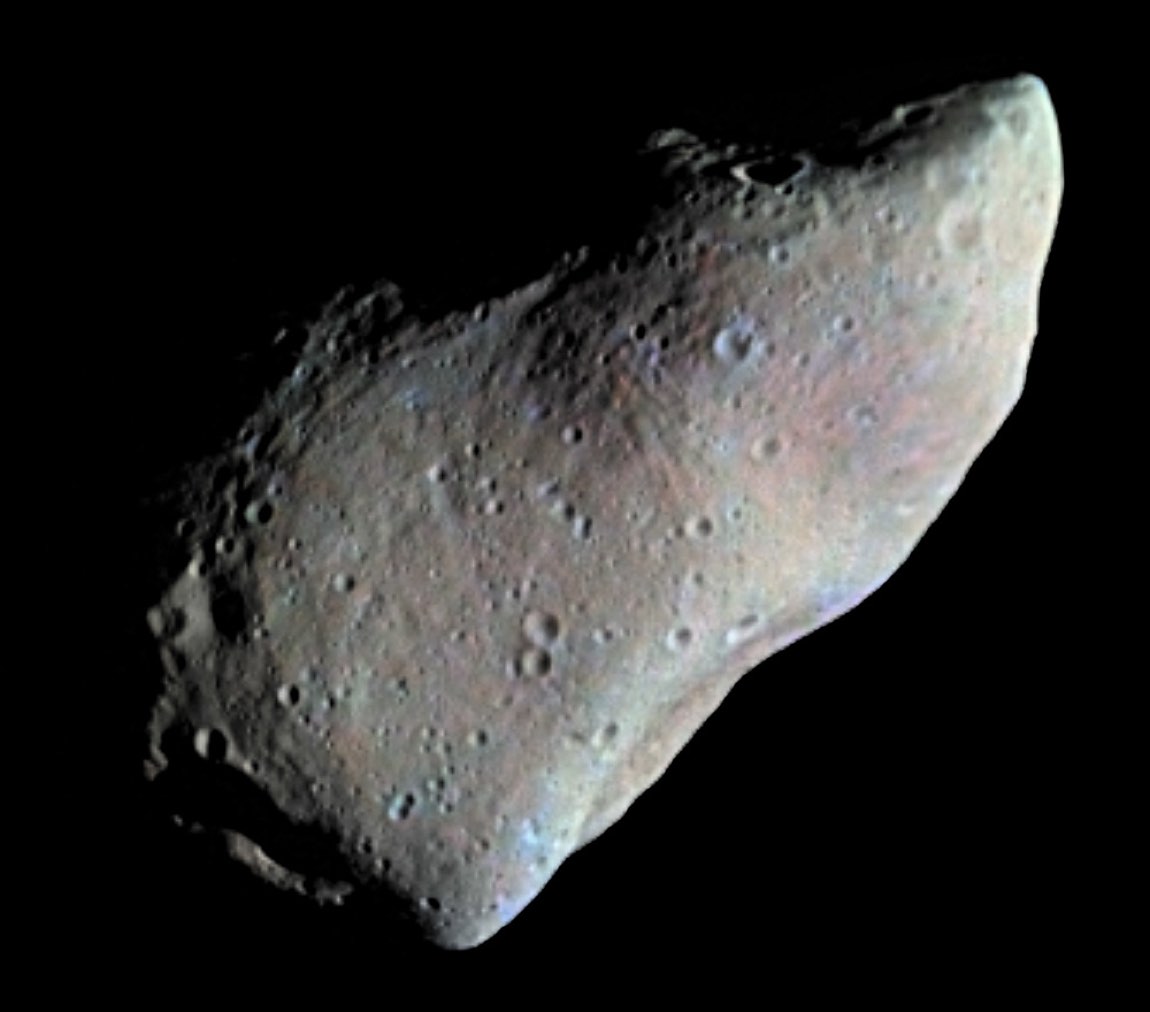
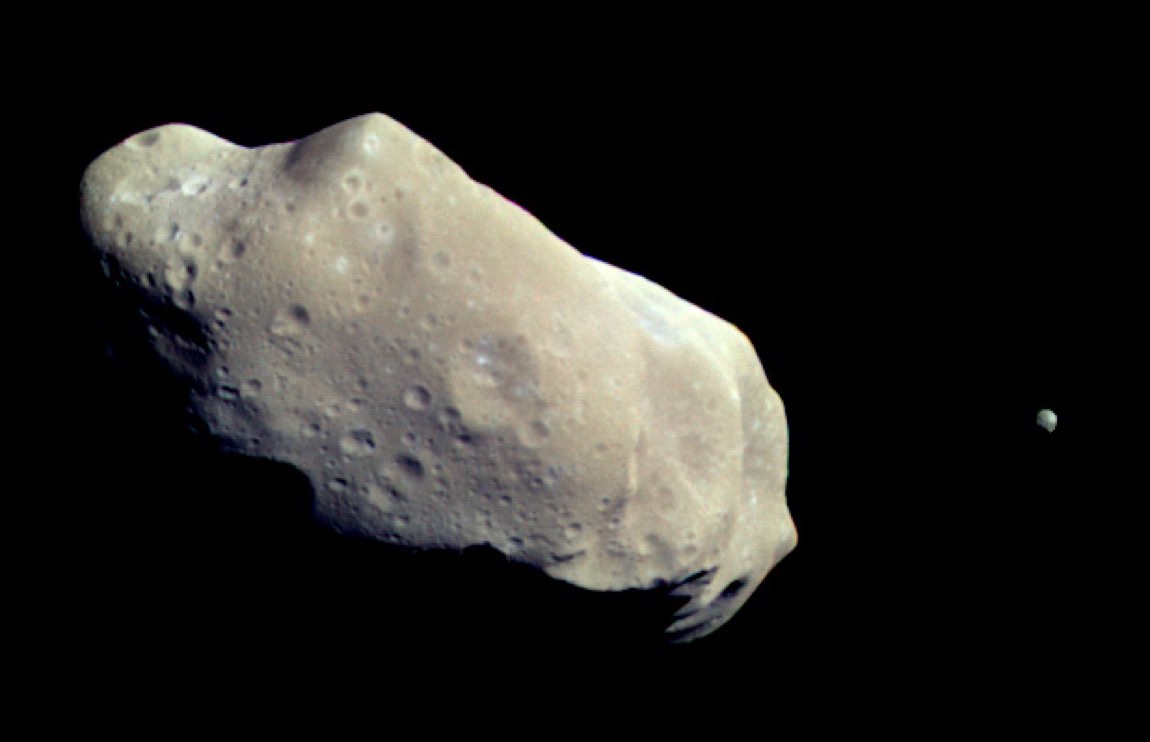
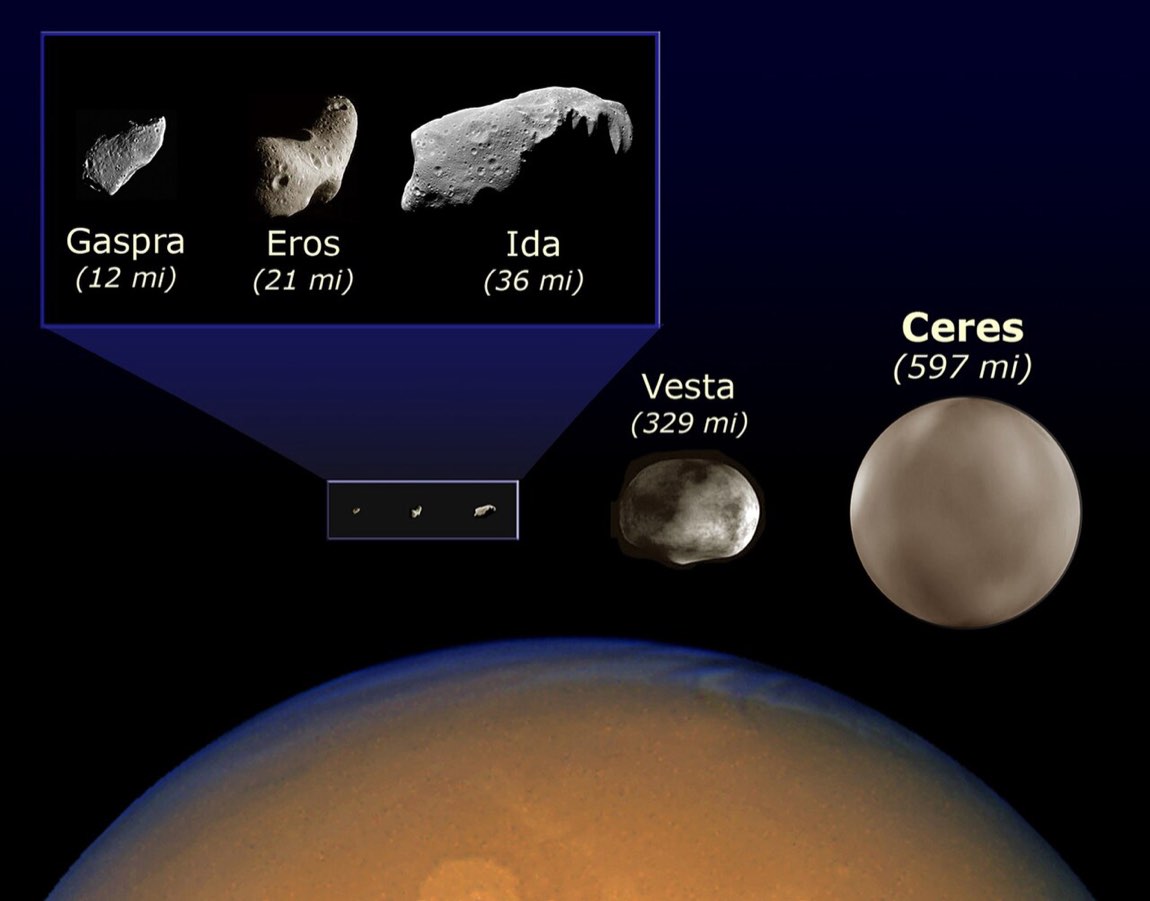
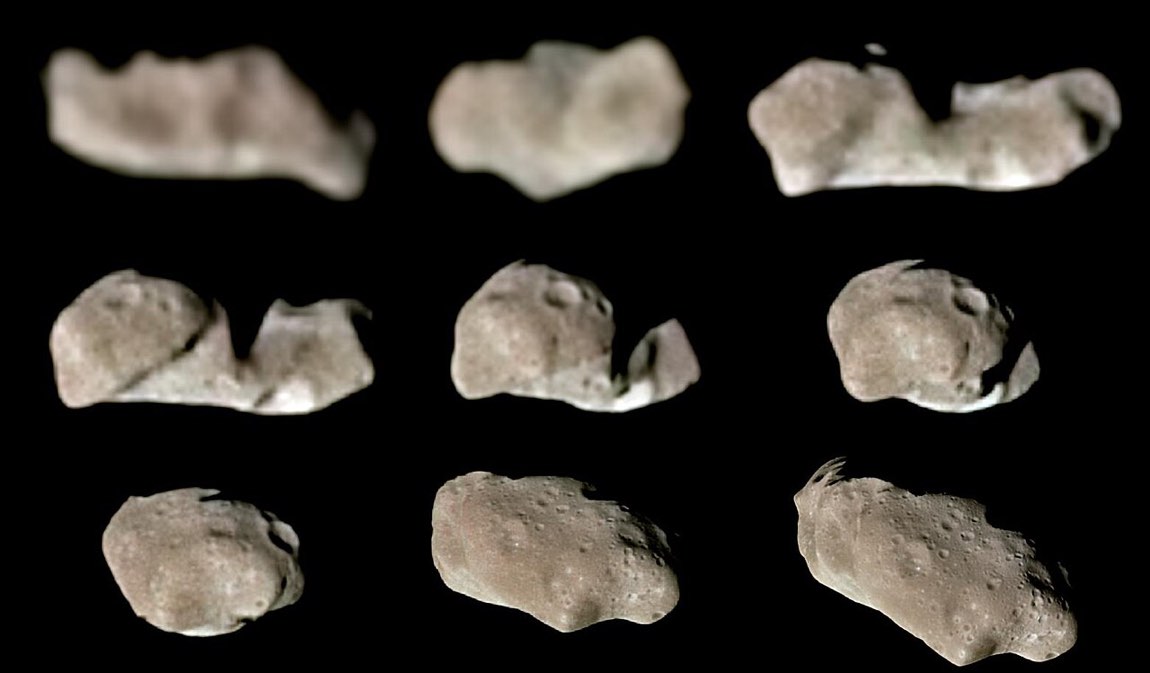
Ida is an elongated, heavily cratered asteroid about 60 km long in the main asteroid belt, between Mars and Jupiter. It belongs to the Koronis family, a group of fragments from an ancient collision. When NASA's Galileo probe flew past on its way to Jupiter in August 1993, its pictures revealed a tiny companion, Dactyl, only about 1.4 km across. That discovery proved asteroids can have moons, and Dactyl's orbit let scientists estimate Ida's density.
The deep dive
Researched for the Atlas from Wikipedia — 243 Ida (15,421 characters read) · updated Nov 14, 2026
01 Johann Palisa and the 45th Find
When Johann Palisa pointed his telescope toward the sky on 29 September 1884, he was already one of the most prolific asteroid hunters in history. Ida was his 45th asteroid discovery — a remarkable tally for an era entirely dependent on hand-drawn star charts and human eyesight. The Vienna Observatory, where he worked, was one of Europe's leading observatories at the time. Palisa himself had no say in naming the new rock. That honor went to Moriz von Kuffner, a Viennese brewer and amateur astronomer, who chose the name Ida after a nymph from Greek mythology — specifically the nymph of Crete who, according to legend, raised the god Zeus himself. Decades later, in 1918, the Japanese astronomer Kiyotsugu Hirayama recognized Ida as a member of the Koronis family and proposed that this entire group of asteroids represented the shattered remnants of a single, much larger predecessor body — a bold and largely correct insight that would only be confirmed by later missions.
02 The Galileo Flyby in Numbers
Galileo was launched aboard Space Shuttle Atlantis on 18 October 1989 during mission STS-34, and its path to Jupiter crossed the asteroid belt twice. The decision to fly past Ida was not automatic — mission planners had to confirm that the maneuver, which consumed 34 kg (75 lb) of propellant, would leave enough fuel to complete the primary Jupiter mission. On 28 August 1993, the probe swept past Ida at a blistering relative speed of 12,400 m/s — roughly 36 times faster than a commercial airliner. It observed Ida from as far as 240,350 km (149,350 mi) away, closing to a nearest approach of just 2,390 km (1,490 mi). That close pass was enough to bring about 95% of Ida's surface into view. The imaging resolution reached 31–38 m per pixel at its sharpest, fine enough to resolve features the size of a baseball diamond. A permanent failure of the spacecraft's high-gain antenna delayed much of the data: the first five images arrived in September 1993, while the rest waited until February 1994 when Earth's proximity allowed faster transmission.
03 How Ann Harch Found a Moon
Nobody sent Galileo to Ida specifically to find a moon — the discovery was entirely unplanned. Mission member Ann Harch was reviewing the returned images when she noticed a small, distinct object close to Ida. That object, later named Dactyl, was only 1.4 kilometres (0.87 mi) across — roughly the size of a small town — making it about one-twentieth the diameter of Ida itself. At the moment of observation it sat 90 kilometres (56 mi) from Ida, moving in a prograde orbit. The confirmation was historic: this was the first direct proof that an asteroid could have its own natural satellite. The name Dactyl was chosen to match Ida's mythological roots — the Dactyls were figures who, in Greek mythology, inhabited Mount Ida. Though the flyby geometry made it impossible to pin down Dactyl's orbit with high precision, the constraints that could be placed on possible orbits were still scientifically invaluable, allowing researchers to estimate Ida's density and probe its mineral makeup.
04 What Dactyl Revealed About Ida's Interior Deeper
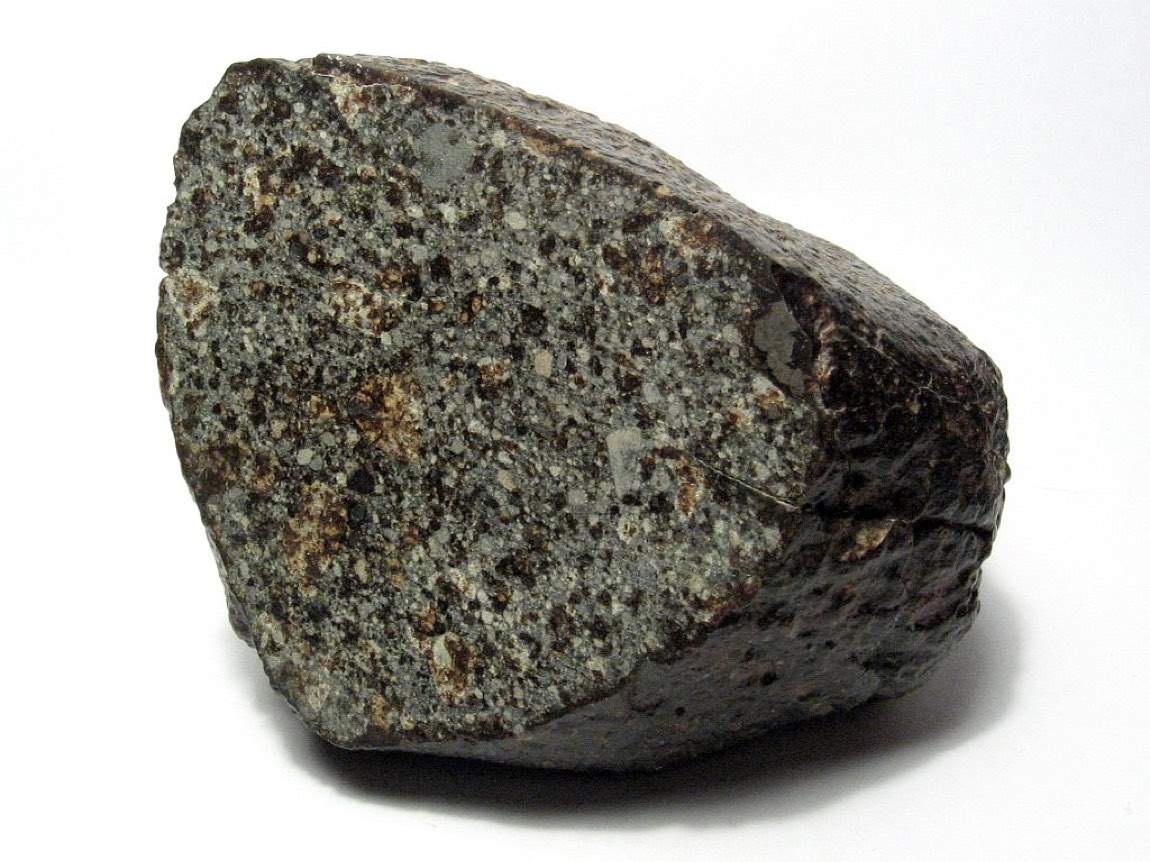
A moon's motion around its parent body is one of nature's own weighing scales, and even Dactyl's poorly constrained orbit yielded a crucial upper limit: Ida's density must be less than 3.2 g/cm3. That single number had outsized consequences. It effectively ruled out a stony-iron composition for Ida, because stony-iron material is dominated by iron and nickel at roughly 5 g/cm3. If Ida were made of such dense stuff, it would have to consist of more than 40% empty space to stay within the density limit — a physically implausible arrangement. The more likely scenario is that Ida's composition resembles ordinary chondrite (OC) meteorites, which have densities ranging from 3.48 to 3.64 g/cm3. Even so, matching the observed bulk density of 2.27–3.10 g/cm3 requires a porosity of 11–42%, suggesting that Ida's interior is significantly fractured. The article describes a probable layer of impact-shattered rock — megaregolith — extending from hundreds of meters below the surface to a few kilometers down, with additional fracturing beneath the large craters Mammoth, Lascaux, and Undara.
 ⤢
05 Space Weathering: Aging Written in Color
One of the most practically important findings from the Galileo flyby had nothing to do with craters or moons — it was about color. Galileo's images revealed that older regions of Ida's surface appear noticeably more red than freshly exposed material. This process, called space weathering, gradually alters the optical properties of a surface through prolonged exposure to solar radiation and micrometeorite bombardment. Crucially, the reflection spectrum of freshly uncovered surface material on Ida closely matched that of ordinary chondrite (OC) meteorites. The older, weathered regions, however, matched the spectra of S-type asteroids as measured from Earth-based telescopes. This was a breakthrough: for years, astronomers had been puzzled because S-type asteroids and OC meteorites had different-looking spectra, even though both were expected to share similar chemistry. The Galileo data showed the difference was largely an artifact of surface aging, not a true compositional mismatch. Space weathering affects Dactyl too, though to a lesser degree, hinting that both bodies have been exposed to the same environment for a long time.
06 A Surface Saturated With Craters
Ida's surface has been battered for so long and so thoroughly that it has reached what geologists call saturation — the point at which new impacts simply erase old ones, keeping the total crater count roughly constant rather than ever increasing it. This makes Ida one of the most densely cratered bodies explored anywhere in the Solar System. The craters span a full range of sizes and ages, from fresh young pits to ancient depressions thought to date back to the violent breakup of the Koronis parent body. The largest, Lascaux, stretches almost 12 km (7.5 mi) across. Interestingly, nearly all craters larger than 6 km (3.7 mi) in diameter are confined to one half of the asteroid — region 2 — while region 1 has none at all. All of Ida's named craters follow a thematic convention: they are named after caves and lava tubes on Earth. Azzurra, for instance, takes its name from the famous submerged cave on the island of Capri, also known as the Blue Grotto. The crater Afon serves a navigational role, marking Ida's prime meridian.
07 Ridges, Grooves, and a 150-Degree Spine Deeper
Craters are not the only story written on Ida's surface. Region 1 is dominated by a dramatic ridge called Townsend Dorsum — a 40 km (25 mi) spine that arcs a full 150 degrees around the asteroid's surface, making it one of the most prominent linear features on any small body yet explored. Region 1 also contains a large indentation named Vienna Regio. Region 2 has a different character: it is laced with sets of grooves, most of them 100 m (330 ft) wide or less and up to 4 km (2.5 mi) long, clustering near — but not directly connected to — the craters Mammoth, Lascaux, and Kartchner. Some of these grooves are linked to major impact events, including a set that lies directly opposite Vienna Regio. The "waist" separating the two regions is itself a subject of debate; it may represent a gap filled in by loose debris, or it may have been blasted out by impacts. Neither possibility was fully resolved by Galileo imagery alone, leaving the internal architecture of Ida an open question.
08 Gravity So Weak, You Could Jump Across It
Ida's gravitational field is almost too feeble to seem real. Its mass falls between 3.65 and 4.99 × 10^16 kg — for comparison, that is roughly a hundred million times less than the mass of Earth — and the surface acceleration ranges from just 0.3 to 1.1 cm/s2 depending on where you stand. Because Ida spins so quickly (once every 4.63 hours) and has such an irregular shape, its gravity varies considerably across the surface. The extremities, whipping around at high rotational speed, experience the lowest effective gravity. The "waist" region also feels weaker gravity because Ida's mass is concentrated in its two lobes, away from that central zone. The practical consequences are dramatic: an astronaut on the surface could leap from one end of the asteroid to the other in a single jump, and any object moving faster than 20 m/s (70 ft/s) would escape Ida's gravity entirely. This feebleness also means that ejecta thrown up by impacts behaves very differently than on a planet — fast-moving debris simply leaves and never comes back.
 ⤢
09 The Regolith Blanket and Its Boulders Deeper
Despite Ida's low gravity, it is blanketed in a layer of pulverized rock — regolith — estimated to be 50–100 m (160–330 ft) thick. This material accumulates from billions of years of impact events, with each collision grinding rock into finer and finer particles and redistributing them across the surface. Galileo captured direct evidence of recent downslope movement of this loose material, suggesting that even on such a small body, geological redistribution is ongoing. The regolith is composed primarily of the silicate minerals olivine and pyroxene. Embedded within it are roughly 20 large ejecta blocks, each measuring 40–150 m across — boulders in the most literal sense. Because impacts are expected to grind such blocks down relatively quickly, their presence means they must be geologically recent, either newly formed or recently excavated by an impact. Most of these blocks cluster around the craters Lascaux and Mammoth, drawn there by Ida's uneven gravitational field, though some may have been flung from the young crater Azzurra on the opposite side of the asteroid.
10 The Koronis Family and Ida's Ancient Origins Deeper
Ida did not form from scratch in its current location. It is a fragment of a much larger body — the Koronis parent asteroid — estimated to have been roughly 120 km (75 mi) in diameter before it was destroyed in a catastrophic collision. That progenitor body had lived long enough to begin differentiating, meaning heavier metals had started migrating toward its core. When it broke apart, the fragments that became the Koronis family, including Ida, carried away very little of that metal-rich core material. Precisely when this destruction occurred remains uncertain and is one of the genuinely open questions in the study of Ida. Surface cratering analysis suggests Ida's surface is more than a billion years old, yet the Ida-Dactyl system is estimated at less than 100 million years — an apparent contradiction, since tiny Dactyl would statistically be unlikely to survive major collisions for a billion years. One possible resolution is that the debris cloud left by the Koronis parent body's destruction temporarily increased the local cratering rate, compressing what looks like a billion years of impact history into a much shorter period.
11 Solving the Meteorite Mystery
For decades before Galileo flew past Ida, there was an embarrassing mismatch at the heart of asteroid science. S-type asteroids are the most common kind in the inner asteroid belt. Ordinary chondrite meteorites are the most common type landing on Earth. Logically, S-types should be the source of OC meteorites. But when astronomers compared the reflection spectra of S-type asteroids with those of OC meteorites measured in the laboratory, they did not match well enough to confirm the connection. The Galileo flyby of Ida, combined with its low-density estimate ruling out stony-iron compositions, helped resolve this long-standing puzzle. The key was space weathering: older S-type surfaces develop spectra that differ from fresh OC material, but freshly exposed surfaces on Ida look spectroscopically just like OC meteorites. Add in the density evidence pointing away from iron-rich compositions, and the data pointed strongly toward the Koronis family — and S-type asteroids more broadly — as a primary source of the OC meteorites that geologists routinely find and study on Earth.
12 Ida's Slow Wobble and What It Tells Us Deeper
Ida spins in the retrograde direction — opposite to the direction most planets orbit — completing one full rotation every 4.63 hours. But its spin axis is not perfectly fixed. Like a slightly tilted top being nudged by an external force, Ida's rotational axis precesses with a period of 77 thousand years, driven by the gravitational influence of the Sun acting on its non-spherical shape. This kind of torque-driven precession is well understood in mechanics and is the same basic process that causes Earth's own polar axis to trace a slow circle over roughly 26,000 years. The orientation of Ida's calculated maximum moment of inertia — the axis about which a uniform object of the same shape would most naturally spin — coincides with Ida's actual spin axis. That alignment is significant: it implies there are no large-scale density variations inside the asteroid. If one half were dramatically denser than the other, the natural spin axis would shift away from that geometric maximum, and Galileo's data show no such shift.
 ⤢
13 Observing Ida from Earth: Then and Now
Long before any spacecraft reached Ida, ground-based astronomers were steadily building a picture of it through telescopes. Its reflectance spectrum was first measured on 16 September 1980, when David J. Tholen and Edward F. Tedesco observed it as part of the eight-color asteroid survey — known as ECAS — and found that its spectrum matched the S-type classification. In early 1993, with the Galileo flyby approaching, the US Naval Observatory in Flagstaff and the Oak Ridge Observatory conducted intensive observations to refine Ida's orbital parameters. Those campaigns reduced the uncertainty in Ida's predicted position during the flyby from 78 km down to 60 km (48 to 37 mi) — a meaningful improvement that helped engineers plan the encounter geometry. Today Ida continues to be studied from Earth as a benchmark for understanding S-type asteroid spectroscopy and space weathering. It orbits the Sun at an average distance of 2.862 AU (428.1 Gm), taking 4.84 years to complete one loop, well within reach of telescopes used for asteroid characterization campaigns.