 Photograph · NASA · Public domain
Asteroid · Deep guide
951 Gaspra
Also called: 951 Gaspra · (951) Gaspra · A916 OJ · 1916 S45
The very first asteroid ever photographed up close by a spacecraft.
What is it?
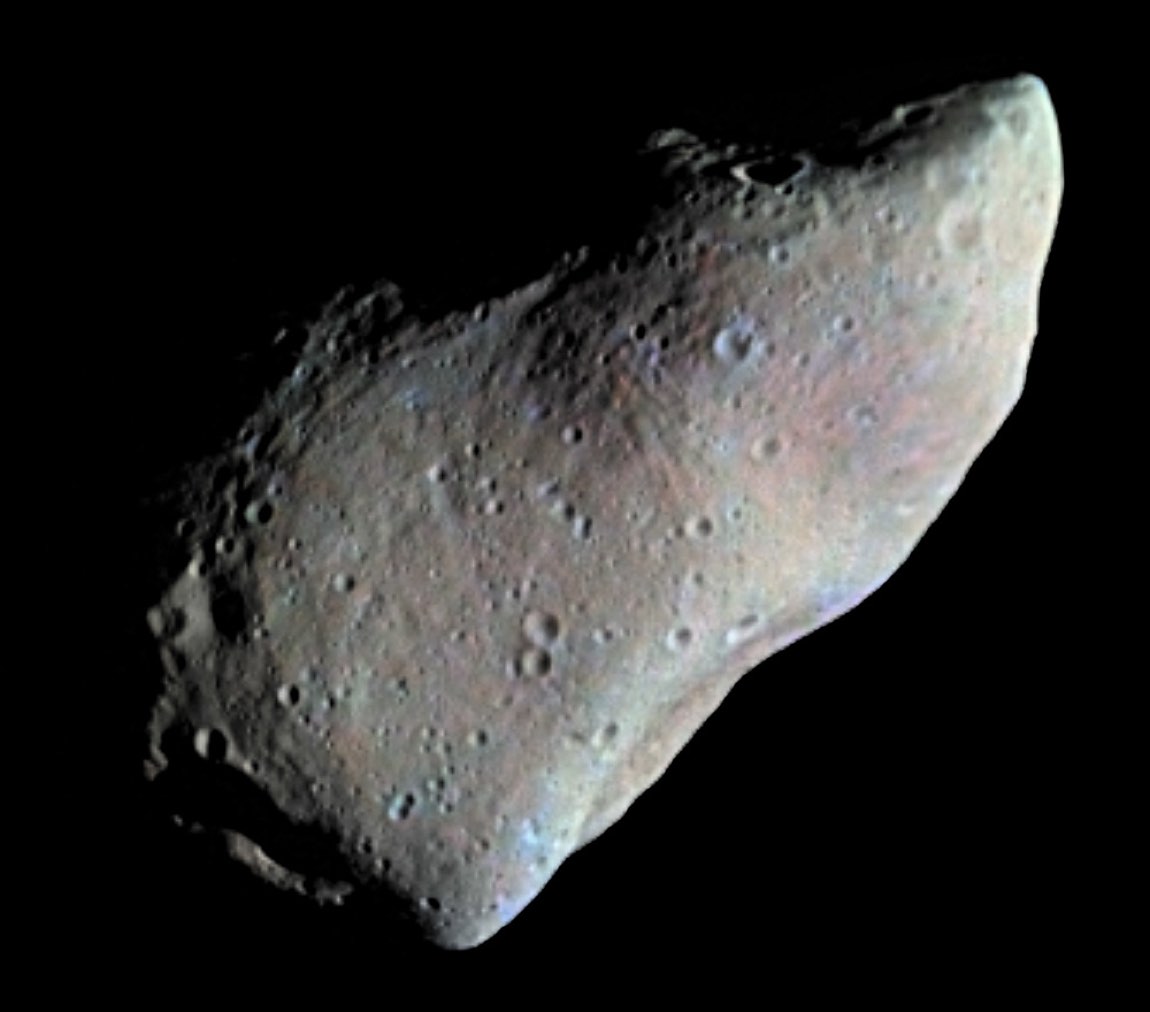
Gaspra is a lumpy, stony asteroid about 18 km long near the inner edge of the asteroid belt. On 29 October 1991 NASA's Galileo spacecraft, on its long route to Jupiter, flew past it and returned the first close-up images of any asteroid. They showed an irregular rock covered with small craters and grooves. Gaspra was discovered in 1916 by Grigory Neujmin and named after a Black Sea resort in Crimea.
The deep dive
Researched for the Atlas from Wikipedia — 951 Gaspra (5,712 characters read) · updated Nov 14, 2026
01 The Galileo Flyby: A Historic First
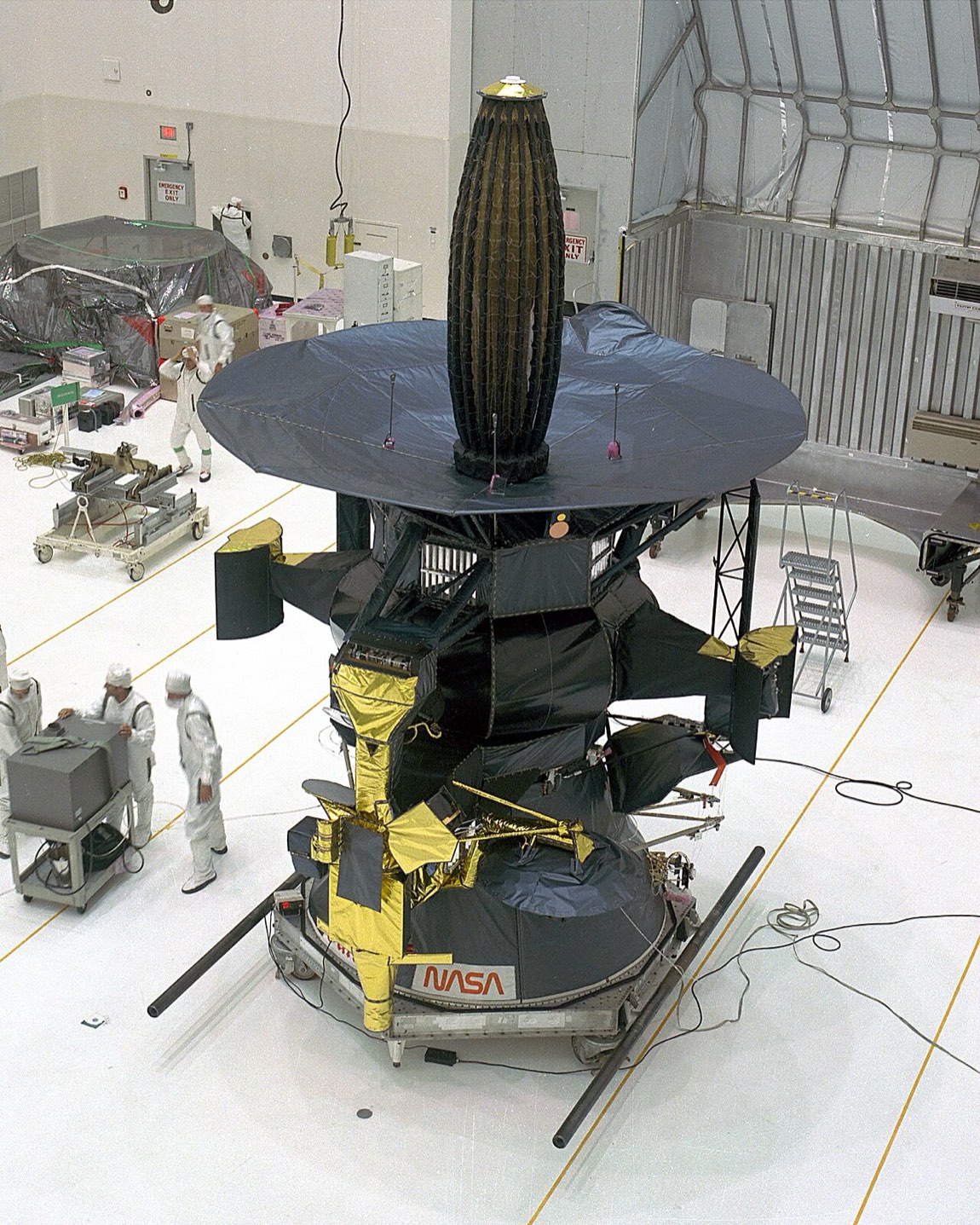
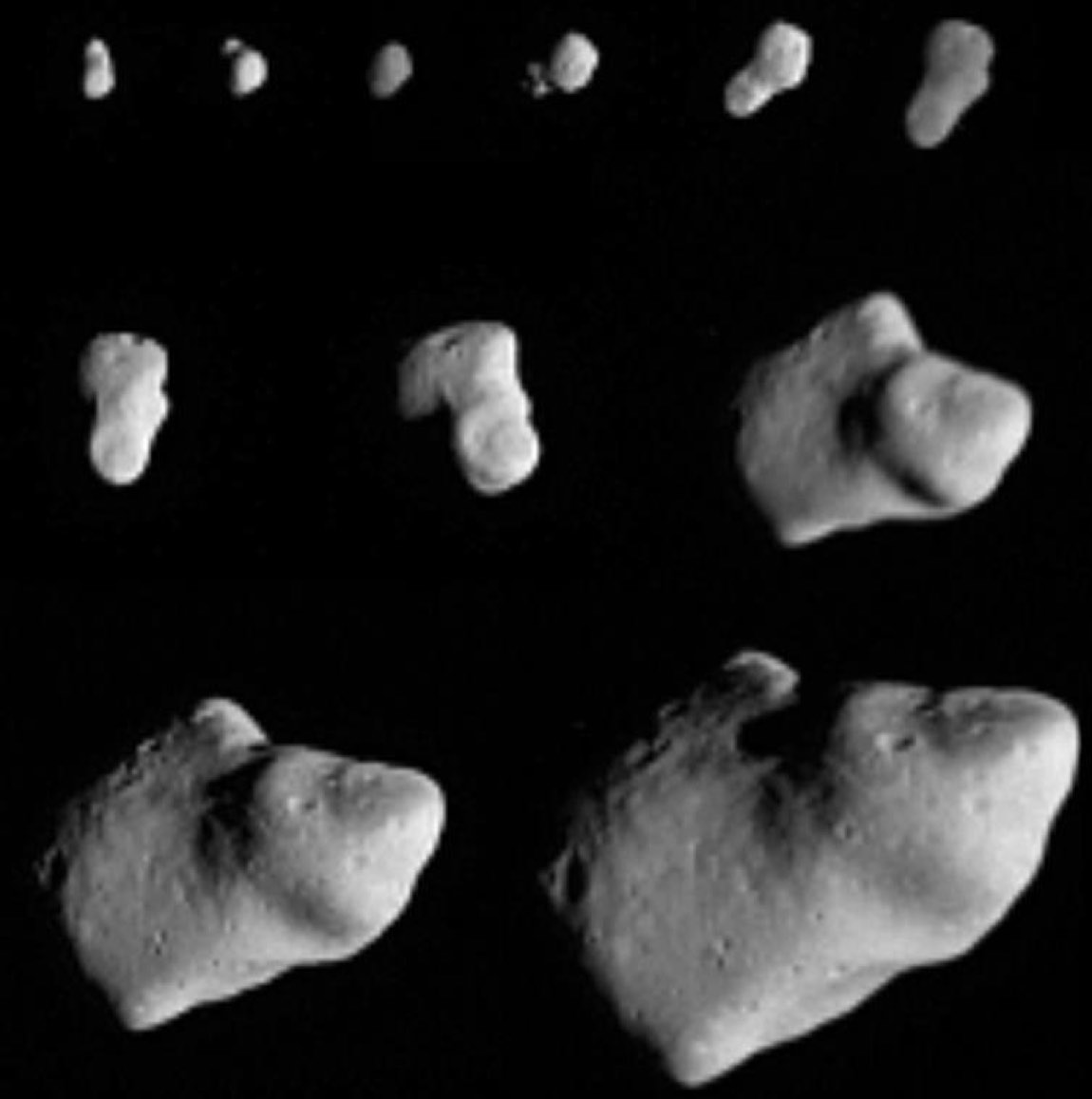
On 29 October 1991, the Galileo spacecraft made history by becoming the first ever to visit an asteroid, passing Gaspra at a closest approach of just 1,600 km — roughly the driving distance from New York to Miami — at a relative speed of about 8 km/s, or 18,000 mph. The encounter was brief, but Galileo managed to return 57 images to Earth, with the closest frame taken from 5,300 km away and achieving a resolution of about 54 meters per pixel. That level of detail was enough to reveal craters, grooves, and large flat regions that had never been seen on any asteroid before. Critically, 80 percent of Gaspra's surface was imaged during the flyby, though the region around the southern pole remained in shadow and was not captured. The mission was fundamentally exploratory — Galileo was really on its way to Jupiter — but it transformed our understanding of small rocky bodies in the solar system in one short pass.
02 A Navigation Problem Solved Mid-Mission Deeper
Getting sharp images of a small, dim asteroid from a fast-moving spacecraft turned out to be a significant engineering puzzle. Before the encounter, Gaspra's position in space was only known to within about 200 km — a large uncertainty when the spacecraft's camera had a field of view of only about 5 degrees across. At distances closer than 70,000 km, Galileo's pre-programmed pointing instructions would have been hopelessly off-target, making the scientific return of the flyby very poor. To solve this, the Galileo team implemented what the article describes as a pioneering optical navigation campaign: they used images taken during the approach to refine Gaspra's position in real time, dramatically tightening the uncertainty. Even so, at the closest range the pointing was still not perfectly known, so the camera captured a 51-image mosaic designed to ensure that Gaspra would appear in at least one frame. The technique worked, and the resulting close-up imagery set the standard for how future asteroid encounters would be planned and executed.
03 Flat Faces and Concavities: A Puzzle in Stone
What immediately strikes observers about Gaspra is its angular, almost faceted shape. Rather than the roughly rounded form one might expect, it sports about half a dozen large flat areas and concavities. One of these, a region called Dunne Regio, measures 5 km by 7 km and is flat to within just 200 m across its entire span — a remarkable regularity for a natural object in space. Scientists are genuinely uncertain what produced these features. One possibility is that they are the scars of large impacts; another is that they are facets — natural flat surfaces that were exposed when Gaspra itself broke away from a larger parent body during a collision. Complicating the matter, Gaspra's gravity is both very weak and unevenly distributed, which means that impact craters forming there would naturally take on flat, asymmetric shapes even without any special cause. This makes it difficult to distinguish impact-made flatness from fracture-made flatness, and the debate remains unresolved.
04 Grooves, Fractures, and What They Reveal Deeper
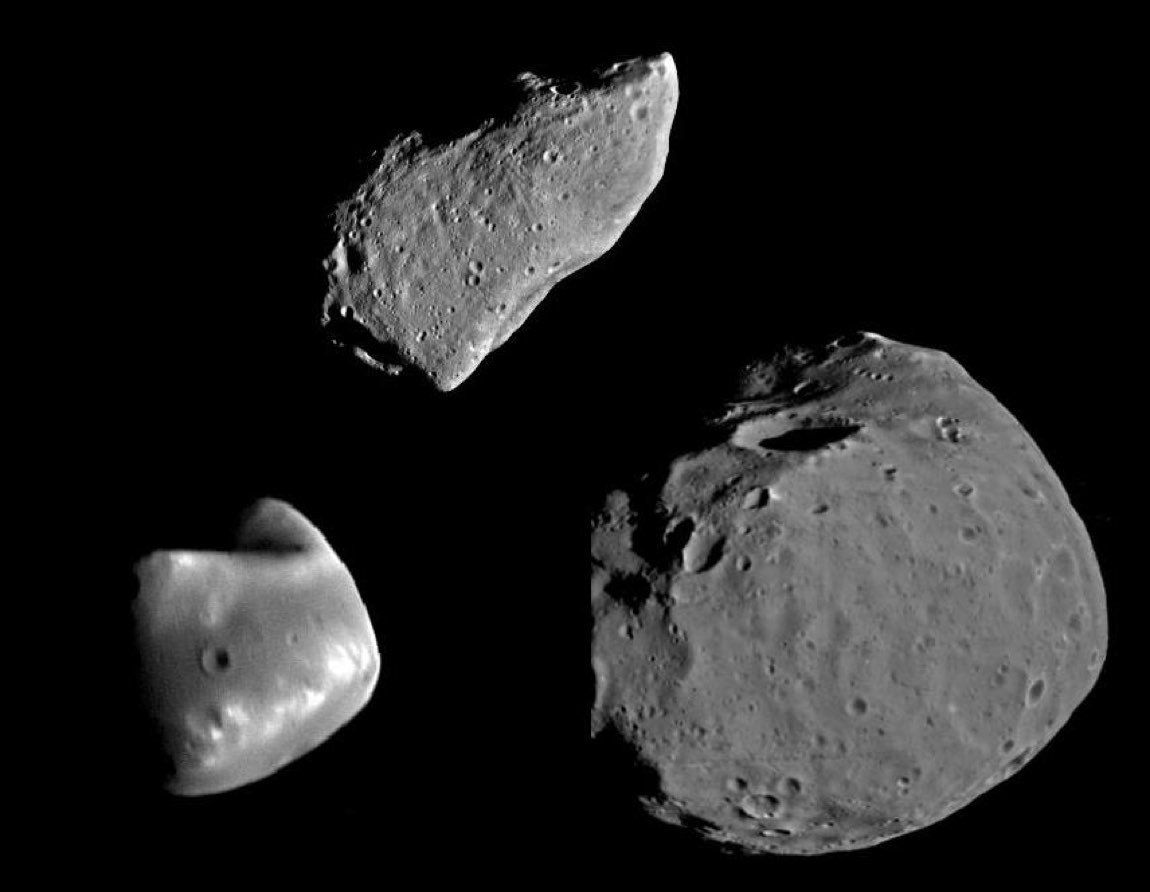
Running across Gaspra's surface is a set of linear grooves ranging from about 100 m to 300 m wide, up to 2.5 km long, and tens of meters deep. Their origin is thought to be linked to impacts powerful enough to shatter the rock beneath the surface, sending fractures propagating through the body. The fact that such grooves exist at all carries a significant scientific implication: they suggest Gaspra is a single coherent, solid rock rather than a loosely bound rubble pile of fragments held together only by gravity. A similar but far more prominent system of grooves is seen on Phobos, one of the moons of Mars. In Gaspra's case, some of the grooves display a pitted texture, hinting that the surface above them is draped in a layer of loose material called regolith. The grooves may also be a physical record of the violent collision event that created the entire Flora asteroid family — the same event that may have produced Gaspra itself.
 ⤢
05 The Regolith Mystery: Dust That Shouldn't Be There Deeper
Whether Gaspra is coated in a layer of loose, fragmented material — regolith — is one of the genuinely open questions the article identifies. Visually, the asteroid's surface looks somewhat muted and mantled, which is consistent with a regolith blanket. Color variations across the surface also appear to correlate with local topography in a way that suggests fine material slowly migrating downhill over geological time. But explaining how that regolith got there and stays there is difficult. Gaspra's escape velocity is so small that most debris ejected by impacts would fly off into space rather than settle back onto the surface. One possible workaround is that Gaspra is a porous body, which could affect how impacts interact with it. Another hypothesis is that Gaspra inherited a large initial regolith during the Flora-family-forming collision that created it. The numbers also create a secondary puzzle: estimates suggest all the craters combined ejected only enough material to cover Gaspra in about 10 m of regolith, yet some craters are themselves much deeper than 10 m without showing any sign of structural change in their walls.
06 Surface Age: Reading the Crater Clock
One way planetary scientists estimate how old a surface is involves counting how many craters have accumulated on it over time — the more craters, the older the surface. Applied to Gaspra, this method gives an estimated surface age of somewhere between about 20 million and 300 million years, a wide range that reflects genuine uncertainty in the cratering rate models. By cosmic standards, even 300 million years is relatively young — Earth's dinosaurs were alive more recently than the lower end of that range. The probable reason Gaspra's surface is so young is that the collision creating the Flora asteroid family, to which Gaspra belongs, happened relatively recently in astronomical time. Gaspra simply has not been orbiting long enough to accumulate the large craters that older asteroids display. A 2007 hypothesis went further, suggesting that the fresh, steep craters specifically visible on Gaspra were blasted out by the impact event that formed the Baptistina asteroid family, which occurred in Gaspra's neighborhood.
07 Gaspra's Mineralogy: Mostly Olivine Deeper
Gaspra belongs to the S-type asteroid class, which are generally stony bodies, but within that broad category it appears to be particularly rich in olivine — a silicate mineral familiar on Earth as the green gemstone peridot. Spectral analysis indicates the surface contains olivine and pyroxene in proportions ranging from 4:1 to 7:1 in favor of olivine, making it stand out among its S-type peers. Despite this compositional character, the surface shows no prominent patterns of albedo — that is, reflectivity — or color when viewed globally. Only a subtle color variation is detectable, and as noted in discussions of the regolith, that variation appears to be tied to local topography rather than to differences in underlying rock composition. The absence of dramatic color or brightness patchwork suggests that whatever surface processes are at work on Gaspra, they tend to homogenize the surface appearance even if the underlying mineralogy is not perfectly uniform.
08 An Unusual Axial Tilt
Like Earth and other bodies in the solar system, Gaspra has a rotational axis that points in a specific direction in space. Scientists have determined that Gaspra's rotational pole points toward a right ascension of 0 hours 40 minutes and a declination of 27 degrees, with an uncertainty of plus or minus 2 degrees. Translated into ecliptic coordinates, this corresponds to values of roughly 21 degrees latitude and 20 degrees longitude on the celestial sphere. The resulting axial tilt is 72 degrees — steeply tilted compared to Earth's 23.5 degrees, and closer in character to Uranus, which is effectively rolling on its side. Such a large tilt would have dramatic seasonal implications if Gaspra had an atmosphere, as the poles would alternately point almost directly toward and away from the Sun over the course of its 3.29-year orbit. It also means that the southern polar region, which remained unimaged during the Galileo flyby, was likely oriented away from the spacecraft during the encounter.
 ⤢
09 Flora Family Origins and Gaspra's Birth
Gaspra is a member of the Flora asteroid family, a large group of S-type asteroids that share similar orbital characteristics and are thought to descend from the same parent body. The leading explanation is that a major collision shattered a larger asteroid at some point in the past, sending fragments on related orbits that persist to this day as the Flora family. Gaspra is believed to be one of those fragments. This origin story shows up in Gaspra's physical features: the flat facets and concavities may be fracture surfaces exposed when it split from the parent body, and the grooves visible on its surface may be fractures caused by that same violent event. The relatively young surface age estimated from crater counts — between 20 and 300 million years — is consistent with a comparatively recent origin event rather than a primordial surface that has been collecting craters since the early solar system. Gaspra thus carries in its shape and geology a physical record of a catastrophic collision.
10 Why No Mass Measurement Was Possible
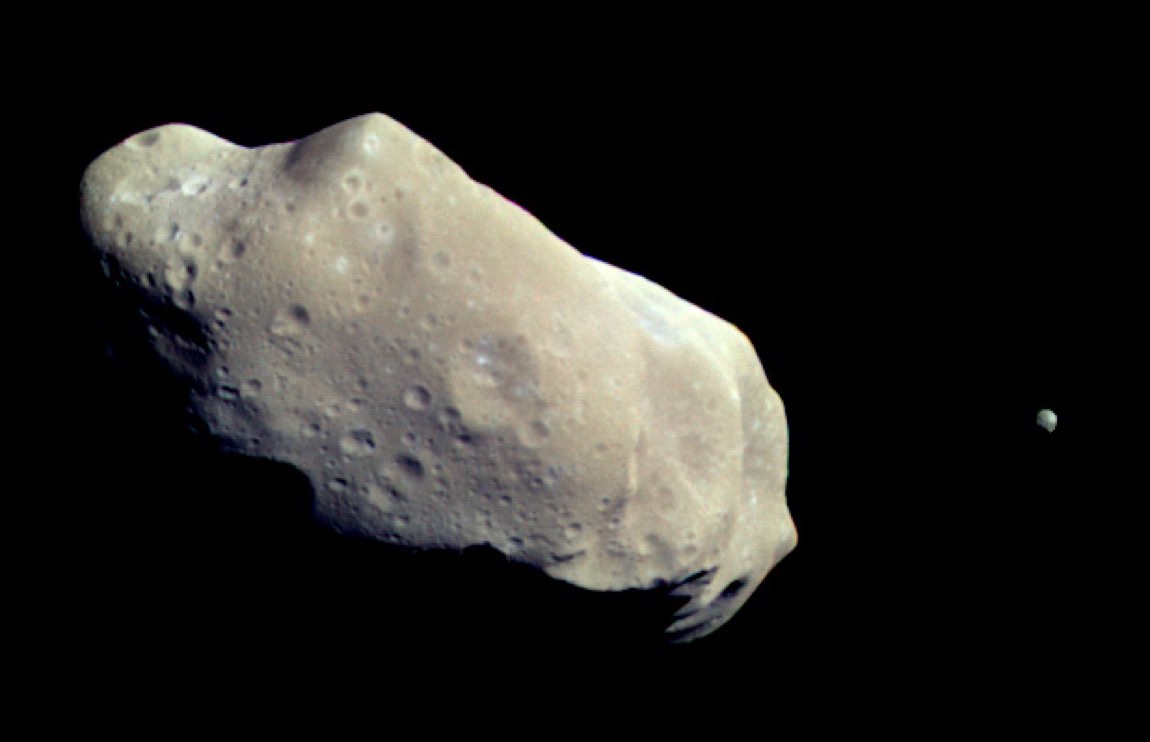
One piece of information scientists dearly want for any solar system body is its mass, because mass combined with volume gives density, which in turn reveals something about interior composition. For Gaspra, however, no mass measurement was obtainable during the Galileo flyby. The reason is straightforward: Gaspra is so small that its gravitational pull was far too weak to produce any measurable deflection in Galileo's trajectory as the spacecraft sailed past at 1,600 km. The article notes explicitly that the flyby was simply too distant for a body of Gaspra's small size to noticeably affect Galileo's path. This stands in contrast to Galileo's later encounter with the asteroid 243 Ida, where the spacecraft famously discovered a small moon orbiting Ida. By tracking that moon's orbit, scientists could calculate Ida's mass — a technique that was simply unavailable at Gaspra, which has no known companion.
11 How Gaspra Got Its Name
The asteroid was discovered in 1916 by Russian astronomer G. N. Neujmin and named after Gaspra, a town on the Black Sea coast of Crimea. The place was evidently a cultured retreat in Neujmin's era: the article notes that it was visited by some of the towering literary figures of the time, including Maxim Gorky and Leo Tolstoy. Naming an asteroid after such a culturally resonant location was not uncommon in the early twentieth century, when astronomical discoverers had wide latitude in choosing names before formal conventions tightened. Neujmin himself was a prolific discoverer of asteroids and comets; his choice of Gaspra as a name tied one of the solar system's small bodies to a specific corner of human intellectual and literary history. Today, more than a century after the discovery, the name has taken on additional fame as the site of the very first asteroid ever visited by a spacecraft.
12 Gaspra's Place in the Asteroid Belt
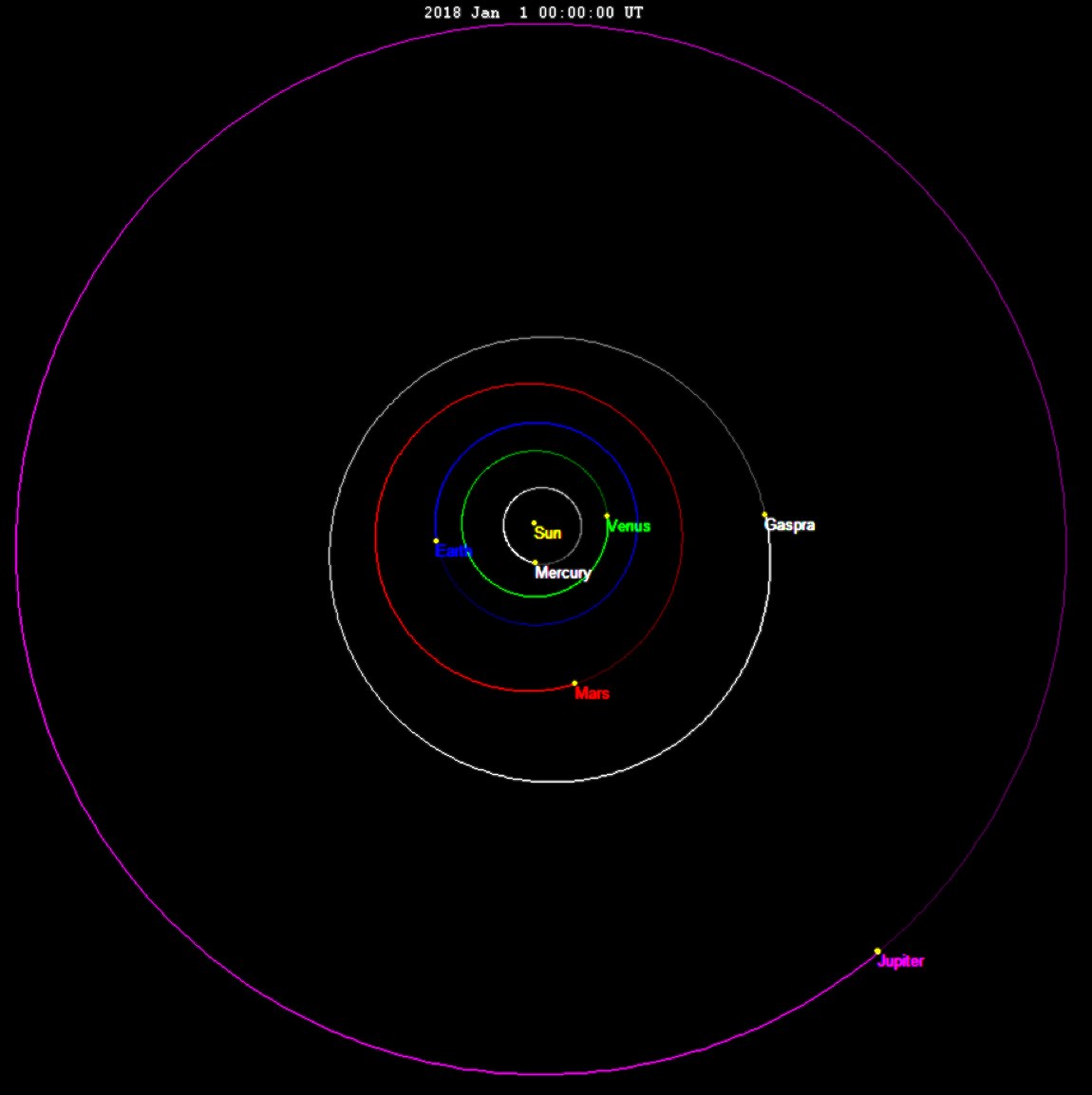
Gaspra travels around the Sun at an average distance of about 2.21 astronomical units, placing it very close to the inner edge of the main asteroid belt. For context, Earth orbits at 1 astronomical unit, and Mars at roughly 1.52 astronomical units, so Gaspra sits not far beyond Mars in the solar system's architecture. At that distance, it completes one full orbit in 3.29 years. Its position near the inner edge of the belt is significant for understanding its history: the Flora family, of which Gaspra is a member, is concentrated in this inner-belt region. The inner edge of the asteroid belt is also closer to Jupiter's gravitational influence through certain orbital resonances, which over long timescales can nudge asteroid orbits. Gaspra's surface area has been calculated at about 525 square kilometers, roughly the size of the island of Guam or about half the land area of Hong Kong — a vivid reminder of how small these bodies are by human standards.
 ⤢