Asteroid · Deep guide
1566 Icarus
Also called: 1566 Icarus · (1566) Icarus · 1949 MA
A sun-diving asteroid that flies closer to the Sun than Mercury — the first asteroid ever seen by radar.
What is it?
Icarus is a near-Earth asteroid about 1.4 km across on an extremely stretched orbit. At its closest it passes inside the orbit of Mercury, and at its farthest it travels beyond Mars, crossing the paths of four planets. Walter Baade discovered it in 1949 and named it after the mythical boy who flew too near the Sun. In 1968 it became the first asteroid ever detected by radar.
The deep dive
Researched for the Atlas from Wikipedia — 1566 Icarus (7,135 characters read) · updated Nov 14, 2026
01 An orbit wilder than almost any other
Icarus traces one of the most extreme paths in the inner solar system. Its orbit stretches from just 0.19 AU at perihelion — closer to the Sun than Mercury ever gets — all the way out to 1.97 AU, beyond the orbit of Mars. That gives it an eccentricity of 0.83, a number approaching the elongated shape of a comet's path rather than a planet's near-circular one. The semi-major axis of 1.08 AU means it completes one full lap around the Sun in only 409 days, roughly 13 months. Because it slices through the orbital planes of Mercury, Venus, Earth, and Mars in turn, it qualifies simultaneously as a Mercury-crosser, a Venus-crosser, an Earth-crosser, and a Mars-crosser — a rare distinction. The orbital inclination of 23 degrees to the ecliptic tilts its path noticeably out of the flat plane where most inner solar system bodies travel, adding further drama to an already restless trajectory.
02 The solar record it held for 34 years
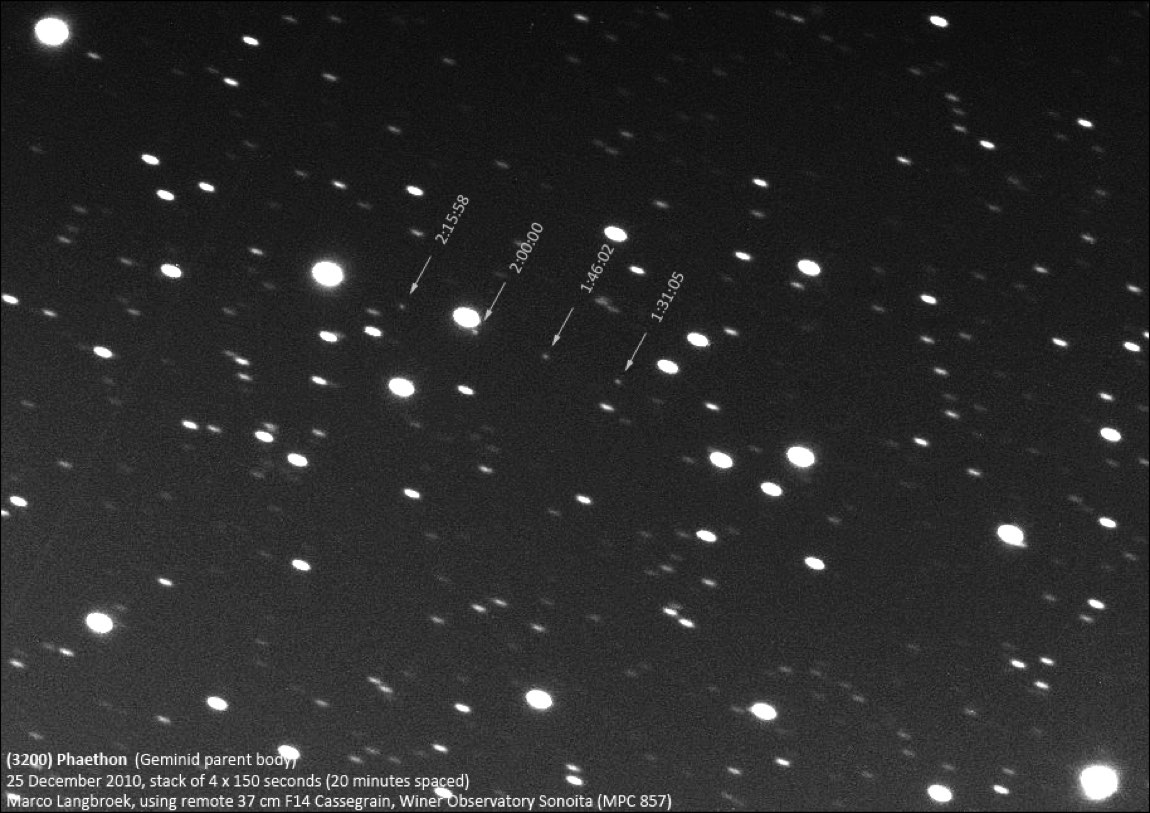
From the moment of its discovery in 1949 until 1983, Icarus held a remarkable title: the asteroid known to pass closest to the Sun. No other catalogued minor planet dove deeper into the solar furnace at perihelion. That record finally fell when 3200 Phaethon was discovered in 1983. Since then, the census of Mercury-crossing asteroids has swelled into the hundreds, and the current record-holders for solar proximity are 2005 HC4 and (394130) 2006 HY51. Still, Icarus's perihelion distance of 0.19 AU remains extraordinarily small. At that point in its orbit, Icarus receives sunlight roughly 28 times more intense than Earth does — enough to heat any surface to extreme temperatures. This solar intimacy is precisely what makes Icarus scientifically valuable: the forces that act on it at perihelion are powerful enough to produce measurable effects on its orbit.
03 First asteroid ever pinged by radar
On 14 June 1968, Icarus made a close pass of Earth at 0.042482 AU — roughly 6,355,200 km, or about 16.5 times the Earth-Moon distance. Scientists seized the opportunity and trained radar beams on the approaching rock, making Icarus the first minor planet in history to be observed by radar. The measurements came from two facilities working in tandem: the Haystack Observatory and the Goldstone Tracking Station. Radar astronomy offers something optical telescopes cannot — direct measurement of distance and, with enough precision, shape and surface texture. This 1968 milestone opened a new era for asteroid science. Decades later, during Icarus's close approach in June 2015, radar observations were again obtained at the Arecibo Observatory and the Goldstone Observatory, this time yielding detailed three-dimensional dimensions: 1.61 by 1.60 by 1.17 kilometers, revealing a body that is notably flattened along one axis.
04 A spinning rock near its own breaking point Deeper
Icarus rotates once every 2.2726 hours, making it a relatively fast rotator by asteroid standards. That speed places it near a critical threshold in planetary science: the spin rate at which a loosely bound 'rubble pile' — an asteroid held together by gravity alone rather than internal strength — would fly apart. Objects faster than roughly 2.2 hours tend to be monolithic rocks rather than gravitational aggregates, because centrifugal force at the equator would otherwise exceed the gravitational pull holding the pieces together. Whether Icarus is a solid rock or a consolidated rubble pile is therefore a question its spin rate helps probe. The 2015 lightcurve campaign involved observers across multiple continents and hemispheres, including Italian astronomers Virginio Oldani and Federico Manzini, Brian Warner at the Palmer Divide Station in California, and Australian teams at the Darling Range and Blue Mountains Observatories. Their combined data produced a brightness variation of 0.22 magnitudes, rated with a quality code of U=3, the highest confidence level.
05 What radar reveals about its shape Deeper
The 2015 radar campaign at Arecibo and Goldstone did more than confirm Icarus's existence — it produced actual three-dimensional dimensions of the body: 1.61 by 1.60 by 1.17 kilometers. The first two numbers are strikingly similar, suggesting that in its two longest axes Icarus is nearly circular in cross-section, something close to a rounded disk or oblate shape. The third dimension, 1.17 km, is noticeably shorter, meaning the body is somewhat flattened. The equivalent spherical diameter derived from these measurements is 1.44 kilometers, consistent with the upper bound of estimates ranging from 1.0 to 1.44 km produced by radiometric, photometric, and radar observations collectively. The albedo picture is similarly uncertain, spanning a wide range of 0.14 to 0.51 depending on the method used. The Collaborative Asteroid Lightcurve Link settles on an albedo of 0.14 for working purposes, combined with the radar-derived diameter and an absolute magnitude of 16.96.
06 Testing Einstein at perihelion Deeper
Icarus is not merely a curiosity — it is a precision instrument for testing fundamental physics. Because it swings so close to the Sun at perihelion, the curvature of spacetime in that region leaves a detectable fingerprint on its orbit. The specific phenomenon is perihelion precession: the slow rotation of the entire orbit around the Sun, caused by general relativity. For Icarus, this precession amounts to 10.05 arcseconds per Julian century. That figure is small but measurable, and comparing it to predictions from general relativity allows scientists to test Einstein's theory using a natural laboratory that no spacecraft has yet visited. Beyond general relativity, Icarus is also studied for what it reveals about solar oblateness — the slight equatorial bulge of the Sun — which independently shifts orbital paths. Researchers additionally use Icarus to study the Yarkovsky effect, a subtle force caused by the uneven re-radiation of solar heat from a rotating body, which slowly alters an asteroid's orbit over long timescales.
07 Its close approaches follow a clockwork pattern
Because of the geometry of its orbit, Icarus makes its closest Earth approaches in June, and those approaches repeat at intervals of 9, 19, or 28 years. The last close brush was on 16 June 2015, when it passed at 0.05383 AU — about 8,053,000 km, or just under 21 lunar distances. Before that, the 1996 approach on 11 June kept a respectful distance of 0.10119 AU, nearly 15 million kilometers, almost 40 times as far as the Moon. Looking forward, the next notably close approach is predicted for 13 June 2043, at 0.0586 AU. Icarus's minimum orbital intersection distance with Earth — the closest its orbit ever geometrically approaches ours — is 0.0352 AU, equal to about 5,270,000 km or 13.7 lunar distances. This figure is what earns it the classification of potentially hazardous asteroid, though no known impact is forecast. It holds the distinction of being the lowest-numbered asteroid in the potentially hazardous category.
08 Possibly the source of a daytime meteor shower
Icarus is a leading candidate for the origin of the Arietids, one of the strongest meteor showers of the year — but one almost no one watches, because it peaks during daylight hours. The Arietids radiate from the constellation Aries in mid-June each year, and their daytime nature means they are detected primarily by radar rather than visual observation. The timing and geometry of the shower's radiant point aligns with debris along a trajectory compatible with Icarus's orbit, making a physical connection plausible. However, the article is careful to note that another candidate exists: 96P/Machholz, a short-period Sun-grazing comet. The debate over which object — asteroid, comet, or perhaps both — seeded the Arietid stream with meteoroid debris remains open. Resolving it matters, because it touches on the deeper question of whether Icarus itself may have a cometary origin or history, something not yet settled.
09 Discovered by one of astronomy's greats
Walter Baade, the German astronomer who discovered Icarus on 27 June 1949 at the Palomar Observatory in California, was one of the most important observational astronomers of the twentieth century. Icarus received the provisional designation 1949 MA at discovery and was officially numbered 1566. Its naming citation, published by the Minor Planet Center in January 1950 as M.P.C. 347, credits R. C. Cameron and Dr. Folkman with suggesting the name. The choice was inspired by the Greek myth of Icarus, son of the craftsman Daedalus, who constructed wings of feathers and wax so the two could escape imprisonment. Icarus ignored his father's warning to fly neither too high nor too low, soared toward the Sun, melted the wax in his wings, and fell into the sea. The mythological resonance with an asteroid that rushes perilously close to the Sun was unmistakable. The companion asteroid 1864 Daedalus honors the father, and both figures are commemorated by named craters on the Moon.
10 When MIT students planned to nuke an asteroid
In the spring of 1967, a group of graduate students in systems engineering at the Massachusetts Institute of Technology tackled an unusual assignment from professor Paul Sandorff: devise a realistic plan to prevent Icarus from hitting Earth. The result, known as Project Icarus, became a landmark thought experiment in planetary defense. The students proposed launching six Saturn V rockets — the same vehicles then being readied for the Apollo Moon program — each carrying a single 100-megaton nuclear warhead based on a theoretical design. The warheads would be detonated 30 meters from the asteroid's surface. Launches would be staggered across intervals ranging from months to hours before predicted impact, with each subsequent mission adjusted depending on how the earlier detonations altered the asteroid's course. The last-resort sixth rocket would lift off just 18 hours before impact. The student report was later published as a book, and their study of the Kennedy Space Center's Vehicle Assembly Building left them so awestruck that they described it as erasing all doubt about the feasibility of the plan.
11 From student report to Hollywood blockbuster
The Project Icarus report, produced by MIT students in 1967 and published as a book the following year, did not fade quietly into academic archives. Its premise — a racing deadline, nuclear warheads, desperate rocket launches — proved irresistible to storytellers. The report served as the direct basis and inspiration for the 1979 science fiction film Meteor, which dramatized the threat of a large space rock on a collision course with Earth. Icarus also attracted the attention of Arthur C. Clarke, one of the most celebrated science fiction writers of the twentieth century, who wrote a short story titled 'Summertime on Icarus' imagining human experience on the asteroid's surface. These cultural echoes are not trivial: the MIT project is widely regarded as one of the earliest serious public discussions of asteroid deflection as an engineering problem, predating by decades the institutional planetary defense programs that now monitor near-Earth objects including Icarus itself.
12 Its spin axis measured from two continents Deeper
Among the precise measurements extracted from the 2015 close approach, one stands out for its technical subtlety: the determination of Icarus's spin axis orientation in space. By combining radar observations from the Arecibo Observatory in Puerto Rico and the Goldstone Observatory in California, researchers were able to pin down the pole direction to ecliptic coordinates of longitude 270.0 degrees and latitude minus 81.0 degrees. A latitude of nearly minus 90 degrees places the spin pole almost perpendicular to the ecliptic plane — meaning Icarus rotates in a nearly upright orientation relative to its orbital plane, somewhat like Earth does compared to some other planets. This measurement matters for modeling the Yarkovsky effect, because the direction of thermal re-radiation depends critically on how the spin pole is oriented relative to the direction of travel around the Sun. Getting the pole right is essential for predicting how Icarus's orbit will drift over the coming decades and centuries.