Asteroid · Deep guide
1862 Apollo
Also called: 1862 Apollo · (1862) Apollo · 1932 HA
The namesake of the Apollo asteroids — the Earth-crossing family that holds most near-Earth asteroids.
What is it?
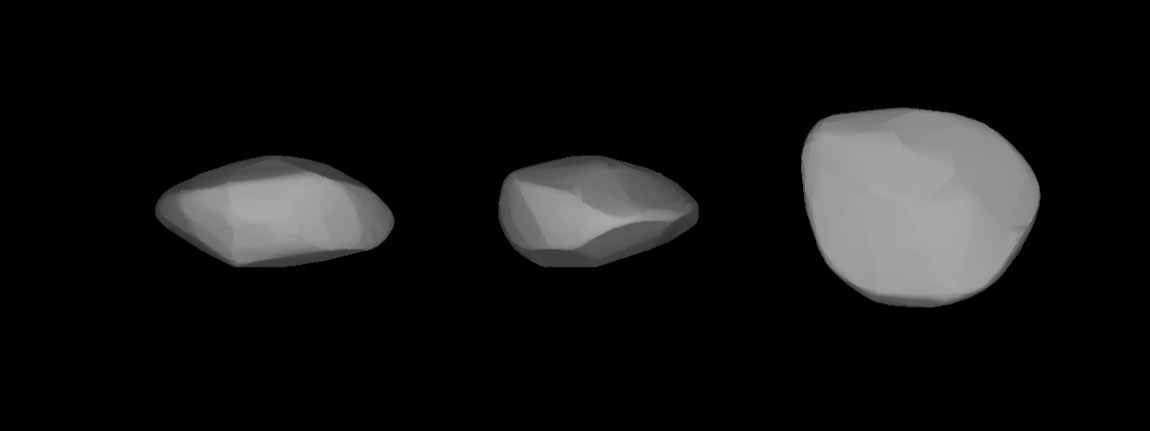
Apollo is a stony asteroid about 1.5 km across, discovered in 1932 by Karl Reinmuth and then lost for more than 40 years until it was recovered in 1973. It became the namesake of the Apollo asteroids, whose orbits cross Earth's. Its eccentric path also crosses the orbits of Venus and Mars. Careful measurements of its spin provided early evidence of the YORP effect, in which sunlight slowly changes an asteroid's rotation.
The deep dive
Researched for the Atlas from Wikipedia — 1862 Apollo (2,169 characters read) · updated Nov 14, 2026
01 The discovery that vanished for 41 years
Karl Reinmuth spotted Apollo on 24 April 1932 at Heidelberg Observatory, making it the first of its kind ever found. But the discovery was short-lived in a practical sense: before enough observations could be gathered to pin down its orbit precisely, Apollo simply slipped away. For more than four decades it was a "lost asteroid" — known to exist but impossible to locate. Only in 1973 was it recovered, giving astronomers the chance to properly characterize it. That long gap had an unexpected bureaucratic consequence: while Apollo was missing, the International Astronomical Union kept numbering newly confirmed bodies, so when Apollo was finally given its official IAU number it received 1862, a figure higher than several asteroids — like 1566 Icarus — that had been confirmed and numbered during Apollo's years of absence. The asteroid that defined an entire class thus carries a number that makes it look like a latecomer to its own family.
02 Founding member of the Apollo asteroid class
Apollo's greatest distinction is not its size or its orbit alone but its role as the namesake and first recognized member of the Apollo asteroid group, a subgroup of near-Earth objects defined by their ability to cross Earth's orbital path. The term "crossing" is carefully defined: it means the asteroid's orbit, when viewed perpendicularly to the ecliptic plane, overlaps Earth's orbit — a broader concept than actually intersecting Earth's path at the same point in space and time. Because Apollo's orbit is highly eccentric, it swings far enough inward and outward to also cross the orbits of Venus and Mars, earning it the additional labels of Venus-crosser and Mars-crosser. This range of orbital crossings makes Apollo a useful archetype for understanding how a single small body can be dynamically entangled with multiple planets simultaneously.
03 A tiny moon just 3 km away
Apollo does not travel alone. On 19 October through 2 November 2005, radar observations conducted at Arecibo Observatory in Puerto Rico revealed a small companion orbiting the asteroid. The discovery was announced on 4 November 2005 in International Astronomical Union Circular 8627. This satellite is remarkably small — only 80 meters (260 feet) across, roughly the length of a city block — and it orbits a mere 3 kilometers (1.9 miles) from Apollo's center. To put that proximity in perspective, 3 kilometers is about the distance of a short morning run. Standing on Apollo's surface and looking up, the moon would span an angular diameter of about 2.1 degrees — more than four times the apparent width of our full Moon as seen from Earth. Such close, tiny binary systems are increasingly recognized as common among near-Earth asteroids.
04 How Apollo fits the hazardous asteroid definition
Apollo qualifies as a potentially hazardous asteroid (PHA) under two criteria that must both be met. First, its diameter exceeds 150 meters — at approximately 1.5 kilometers across, it clears that threshold comfortably. Second, its minimum orbit intersection distance, or MOID, with Earth must be less than 0.05 AU. Apollo's Earth MOID is 0.0257 AU, equivalent to roughly 3,840,000 kilometers or 2,390,000 miles — about ten times the distance from Earth to the Moon. That gap sounds large but is considered uncomfortably close on astronomical scales. Crucially, astronomers can be reassured that Apollo's orbit is well-determined for the next several hundred years, meaning any genuinely threatening close approach would be identified far in advance. The PHA classification is a flag for continued monitoring, not an immediate alarm.
05 An upcoming close brush past Venus Deeper
Although Earth gets the most attention when Apollo's hazard potential is discussed, Venus also falls within the asteroid's gravitational neighborhood. On 17 May 2075, Apollo will pass just 0.0083 AU from Venus — that translates to approximately 1,240,000 kilometers or 770,000 miles. This is a notably close planetary encounter, and because Apollo is also classified as a Venus-crosser, such events are a recurring feature of its long-term orbital behavior. Close passes by Venus alter an asteroid's trajectory through gravitational perturbations, which means the 2075 flyby is scientifically interesting not only as an event in its own right but as a factor that could subtly reshape Apollo's future path. Planetary scientists tracking Apollo's orbit over centuries must account for these Venus encounters alongside the more-publicized interactions with Earth.
06 Catching the YORP effect in the act Deeper
One of Apollo's most significant scientific contributions is what it taught astronomers about a subtle but consequential force acting on small asteroids. Analysis of Apollo's rotation provided observational evidence for what is called the YORP effect — the Yarkovsky–O'Keefe–Radzievskii–Paddack effect. This phenomenon occurs when sunlight absorbed and then re-radiated as thermal energy by an irregularly shaped rotating body creates a tiny net torque. Over long timescales, that torque can measurably accelerate or decelerate an asteroid's spin rate. For a body the size of Apollo, the force involved is minuscule by everyday standards, but accumulated over thousands or millions of years it can dramatically change rotation and even alter orbital characteristics. Detecting the YORP effect requires precise, repeated measurements of an asteroid's spin — Apollo's well-studied rotation provided a data set good enough to see it happening in real time.
07 What kind of rock is Apollo made of?
Apollo is classified as a stony asteroid, which places it in the most common broad category of asteroid composition. Stony asteroids are silicate-rich bodies, in contrast to metallic or carbonaceous types. At approximately 1.5 kilometers in diameter, Apollo is large enough that it would likely have a complex interior history shaped by the early solar system — impacts, heating, and gravitational settling could all have played a role in its present structure. The article does not detail Apollo's specific mineralogical subtype or surface spectral class beyond calling it stony, so its precise mineral makeup remains an open point for future investigation. What is known is that its size, combined with its stony composition, is part of why it clears the 150-meter diameter threshold that contributes to its classification as a potentially hazardous asteroid.
08 The god behind the name
The asteroid's name reaches back to one of the most prominent figures in Greek mythology. Apollo was the god of prophecy, music, healing, and light, born to Zeus and Leto. The naming creates an interesting network of celestial connections, because the two divine parents are also honored in the solar system: minor planet 5731 Zeus is named for Apollo's father, and 68 Leto is named for his mother. This kind of mythological cross-referencing in asteroid nomenclature is not unique to Apollo but is particularly neat here because the family relationships in myth are mirrored by the catalogued relationships among named bodies. The asteroid Apollo was assigned its name by its discoverer Karl Reinmuth, following the tradition of naming significant small bodies after figures from classical antiquity.
09 Radar at Arecibo: the tool that found a moon Deeper
The discovery of Apollo's satellite relied on planetary radar astronomy — a technique in which a powerful radio signal is transmitted toward a solar system body and the returning echo is analyzed. Arecibo Observatory in Puerto Rico, home to what was at the time one of the largest radio telescopes on Earth, conducted the observations between 19 October and 2 November 2005. Radar is uniquely suited to detecting small moons around near-Earth asteroids because it can resolve structures far too dim and compact for optical telescopes to distinguish during a relatively brief close approach. The fact that Apollo's satellite is only 80 meters across and orbits just 3 kilometers away makes it virtually invisible to any other method when the system is tens of millions of kilometers from Earth. The result was formally communicated through International Astronomical Union Circular 8627, the standard mechanism for announcing such significant discoveries.
10 An orbit that touches three worlds Deeper
Apollo's orbital eccentricity is high enough that its elliptical path takes it across the designated orbital zones of not one but three planets: Earth, Venus, and Mars. This triple-crossing status is unusual and reflects how elongated Apollo's orbit must be. When an orbit is described as crossing another planet's orbit, it means the two paths share the same radial distance from the Sun at some point — not necessarily that the bodies are ever physically close simultaneously. Nevertheless, repeated orbital crossings over geological timescales create many opportunities for gravitational interactions with each of these planets. Those interactions, combined with radiation-driven forces like the YORP and Yarkovsky effects, make Apollo's long-term orbital evolution a genuinely complex dynamical problem. Despite this complexity, the orbit is described as well-determined for the next several hundred years, a testament to modern computational orbital mechanics.
 ⤢